




Solar activity & climate: is the sun causing global warming?
The skeptic argument...
It's the sun
"Over the past few hundred years, there has been a steady increase in the numbers of sunspots, at the time when the Earth has been getting warmer. The data suggests solar activity is influencing the global climate causing the world to get warmer." (BBC)
What the science says...
| Select a level... |
Basic
|
Intermediate
|
Advanced
| ||||
|
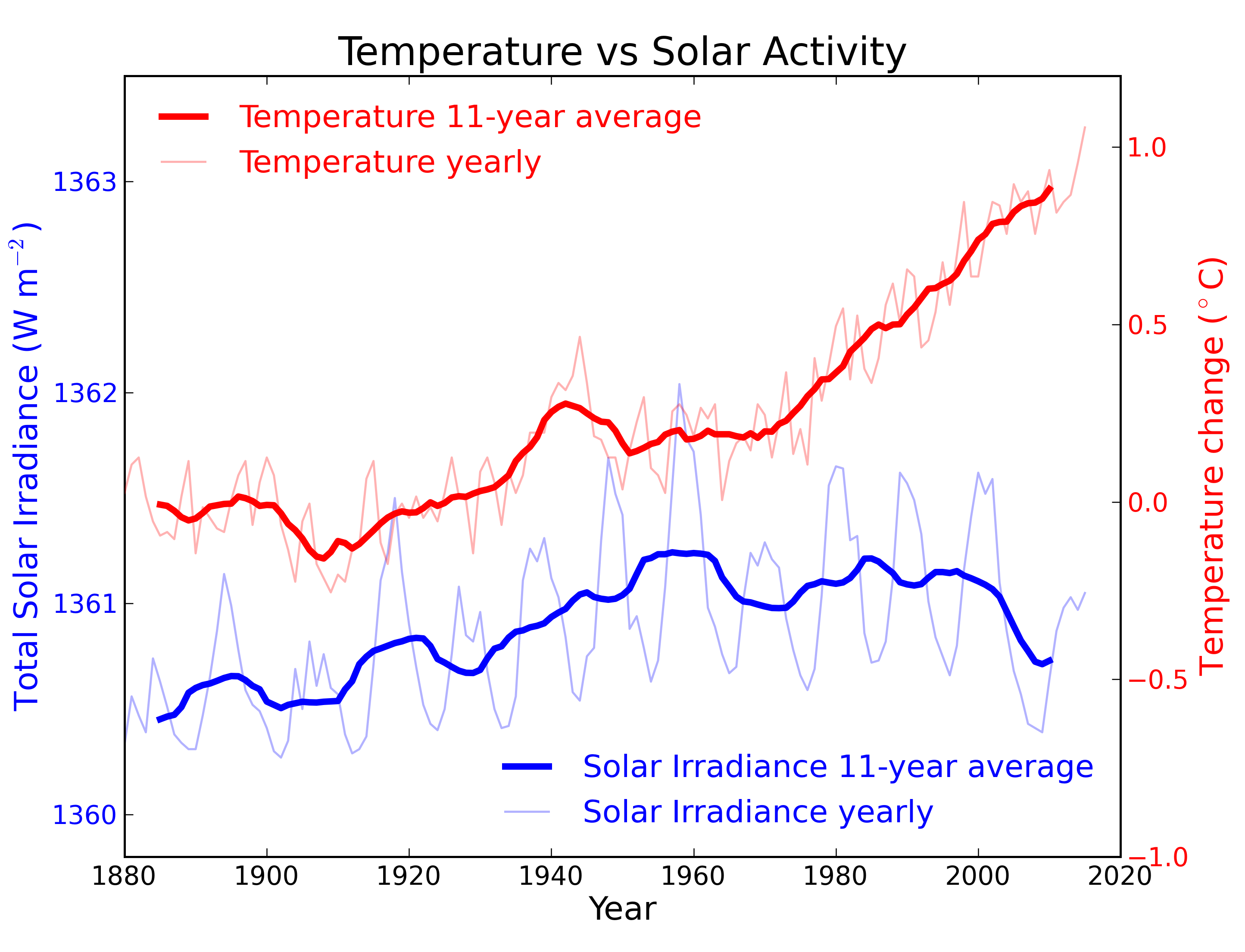
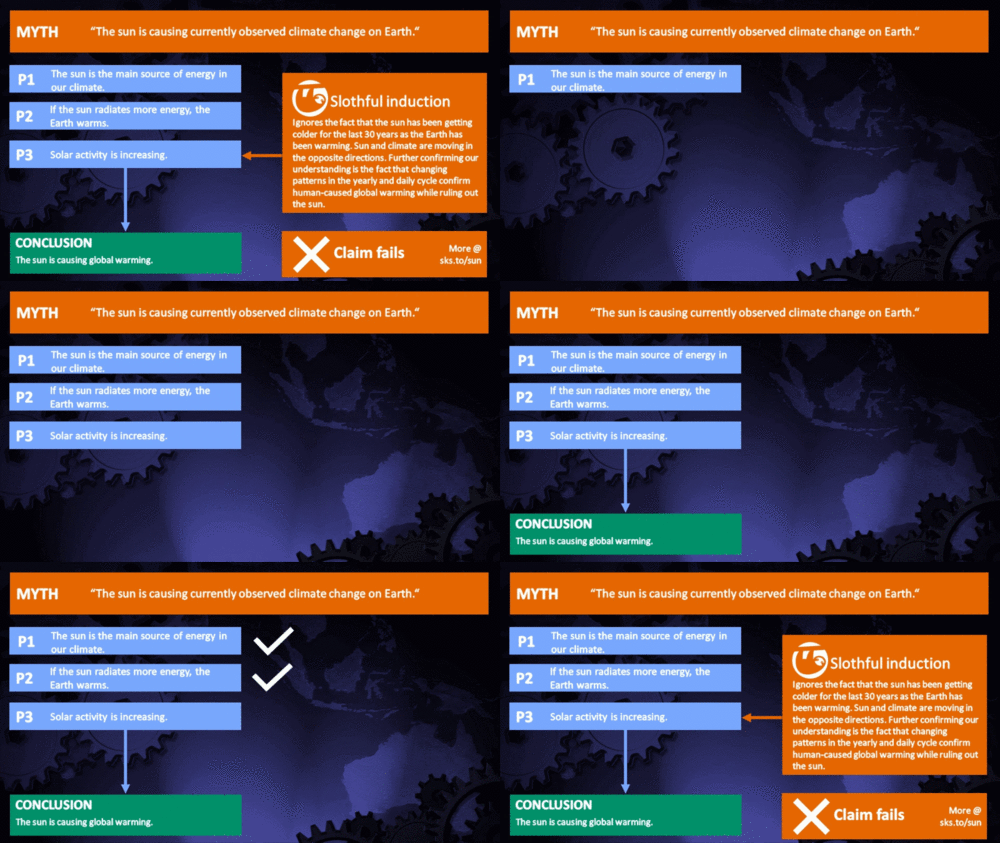
In the last 35 years of global warming, sun and climate have been going in opposite directions |
|||||||

Figure 1: Global temperature (red, NASA GISS) and Total solar irradiance (blue, 1880 to 1978 from Solanki, 1979 to 2009 from PMOD).
Last updated on 19 March 2013 by Stephen Leahy. View Archives

Arguments


Basic
Intermediate
Advanced


It also appears that you do not understand IPCC figure that KR posted. Noone expects (it would be utterly improbable) that temperatures follow the multimodel mean. You might want to look at this posting at RC for further explanation.
Finally, a close study of Hansen et al 2011 might be useful. Especially note the comments on model handling of aerosol forcings in light of Argo data.
Of course, because the IPCC didn't adopt it the right way from the original (Stott et al (2006b)).
In the original work it is as I told that it has to be: while the global dimming the only natural caused temperature is higher than the total (anthro+nat). So what did the IPCC do, or at least the authors that wrote the chapter?!
(Possibly this may be the reason why the link to the corresponding appendix is now broken in the IPCC documents. Who knows...)
Ok, I'm again off topic. Back to it.
The first paper you've linked is a good chance to get enhanced knowledge about another part of Sun's influence. But, if you are aware of it, this is in addition to the solar components that were used so far (TSI and SSN) and it is surely not the only parameter that may be of importance.
Perhaps it will come up to the IPCC documents in the future (I hope so).
As to Hansen, I will have a closer look at it. But obviously he didn't know about the global dimming because in Fig.1 (base of the whole work) the net forcing is steadily rising (except the volcanoes) what definitely would have disabled a cooling that was observed.
I'll come back to it (in the right topic, of course).
What do you mean by "global dimming"?
"it is surely not the only parameter that may be of importance"
Well when you have some other parameter that makes physical sense, let us know. Meanwhile I will continue to look at the well-established, measurable physics of GHGs. If you ignore them, you cant get planetary temperature right so why do think changing their forcing is so insignificant compared to same change in solar forcing?
This cannot be the correct method because Stott had a dependence between the models. If the anthropogenic forcings sum in a negative net forcing (what is necessary for a global cooling caused by the overwhealming of GHGs by aerosols, what commonly is called 'global dimming', occured mid century), then it is obvious that the natural forcings must show higher temperatures as far as they had no change in intensity (as to the time until '63, natural forcings had always caused a warming).
If you use independent models (at least 9 of the 'anthro+nat' were it definitely) there cannot be a correct result. Otherwise we would not speak about a 'primarily anthropogenic' driven cooling.
That was what made it curious to me.
Possible additional influences could be, as told before, for example number and intensities of flares. Each major flare destroyes an huge amount of high-stratospheric Ozone what reduces the absorption of high frequency radiation there.
This, of course, has only a small short term influence, but the long term effect that results in the lagrer absorption by oceans is currently not researched, but this is currently the only explanation for the sharp rise of the OHC in 2003. In this year we've seen the most and most intense flares, culminated in the biggest flare ever measured (X28..X40, not quite sure, because the direct measurements are only possible until X17.2).
That would be quite amazing, considering that the IPCC collected data and science from many contributors, but did not run any research itself. I suggest you check the various reports for links to the original works.
You appear to feel that 'solar flares' have a much larger effect - but unless you can point to some data, perhaps a paper or two, that supports your hypothesis, preferably with some suggestion as to mechanism, it's just an unsupported opinion, not science.
...
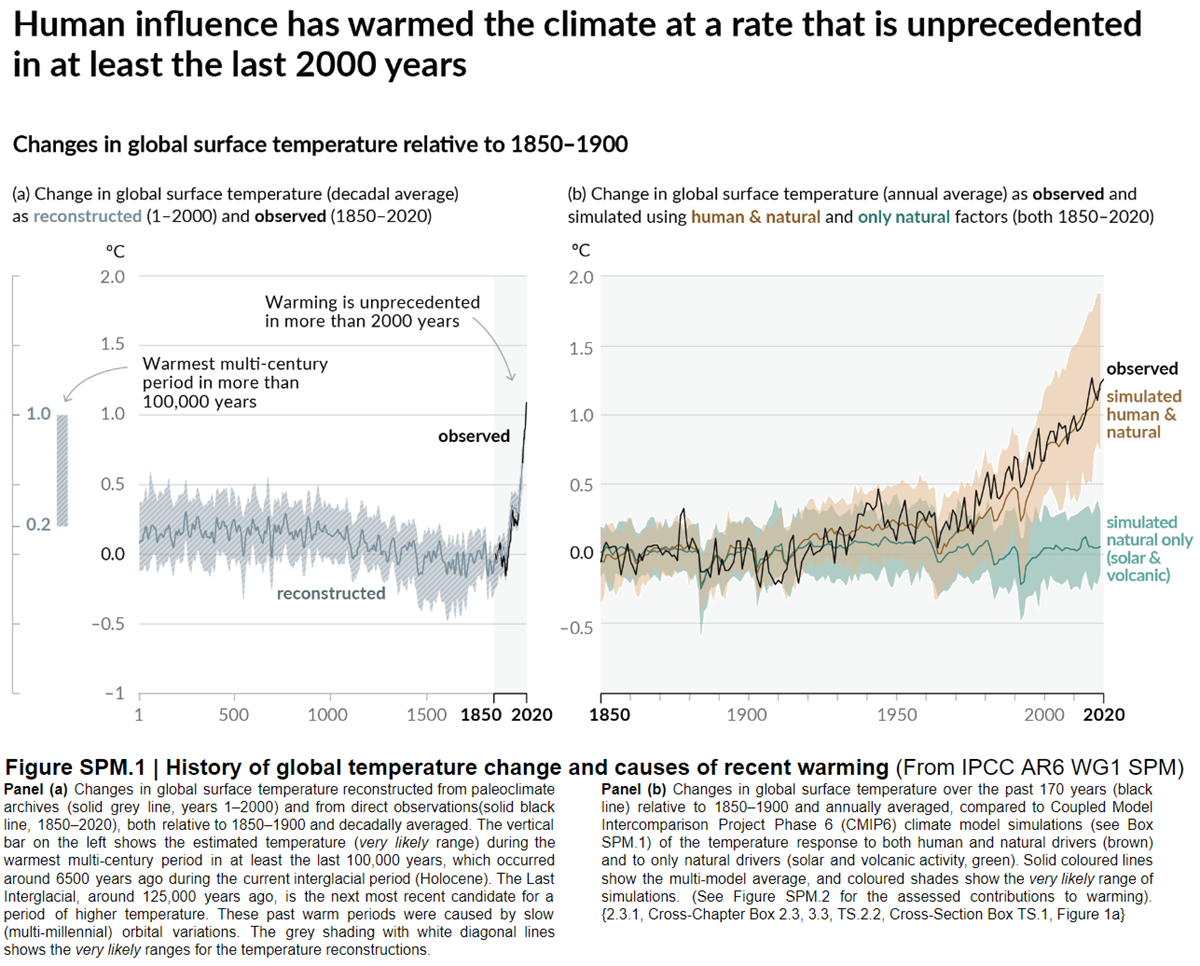
in (a) as obtained from 58 simulations produced by 14 models with both anthropogenic and natural forcings.
...
The simulated global mean temperature anomalies in (b) are from 19 simulations produced by five models with natural forcings only.
Well, this is taken from the caption of the figure (and I do not expect that all of the models were made by the autors).
So what would you expect from one who's reading this, unable to find any description (because of dead links, just a hint that leads to Stott) and finally realizing that the graphs did match neither the original model nor the physical behaviours that are to expect?
Should he say "hurray, it's from the IPCC, it's fine"?
Of course, very amazing.
I suggest you check the various reports for links to the original works.
I would, if you can give me the list of the used models. I can't get it from the IPCC page. Regrettably there is no 'Appendix 9C' -for whatever reasons- where the underlying papers/reports would have been listed.
Besides, you argued -using this figure- that the models are 'excellent'.
I showed -using the same figure as well- that they are not, at least if modified by the IPCC, because of mismatches to reality and, as shown by pointing out the difference to Stott, wrong adaptations.
(Of course, it's a completely different topic.)
Back to topic.
You are right, the flares are quite a hypothesis.
But, perhaps you can give another possible explanation (eventually a paper) for the needed ~3W/m² of positive radiative imbalance.
With the value of Trenberth 2006/2009 (0.8..0.9W/m²) it would need about 5 years to get the observed OHC-rise (by 6*10^22J) that obviously occured within a single year - given that the measurements are correct.
I believe the correct Stott reference is to Stott et al 2006, Transient Climate Simulations with the HadGEM1 Climate Model: Causes of Past Warming and Future Climate Change. A very similar work, although more focused on predicting than back-casting, that isn't pay-walled is Stott et al 2006, Observational constraints on past attributable warming and predictions of future global warming. Figure 1 of the second link shows a similar pattern, with current warming not explainable without anthropogenic influence.
"...you argued -using this figure- that the models are 'excellent'.
I showed -using the same figure as well- that they are not, at least if modified by the IPCC, because of mismatches to reality and, as shown by pointing out the difference to Stott, wrong adaptations."
The models, with anthropogenic forcings included, track observed temperatures quite well. They seem to include a fairly accurate internal representation of the physics and the effects - I don't think you have any basis for stating otherwise.
As to ocean warming (a completely different topic, mind you, and you should look at the appropriate links using the Search box), keep in mind that (a) our measurements of OHC are far from complete, especially at depth, and (b) circulation variances in the oceans are expected to show variations on a 5-10 year timespan.
Eric, this is so far off that it's close to being not even wrong. Changes in radiative forcing from TSI or from GHG's have slightly different distributions (particularly in the stratosphere), but all radiative forcings affect the oceans, the ice caps, and the weather.
Unless you have a reference or two to support this, I would have to consider your last post or two simply unsupportable.
It is interesting to note that the 2000s were even hotter than expected on a decadal scale, given the decadal increases from the 1970s, 1980s and 1990s. It's just that relatively speaking the earlier years of the 2000s were hotter and the later years were 'cooler'.
Weather pattern changes may also be GHG-driven (creates stratospheric cooling...), and sea ice reduction-driven (altering surface evaporation, temperature and pressure patterns).
Do you have any evidence for your assertions?
Here is a supportable statement: "the small but real change in solar forcing has lowered the energy of the earth system by a small amount. That loss of energy may or may not manifest in lowered atmospheric temperatures since other ocean-related factors such as ENSO are much larger than the ocean-related solar heating/cooling."
Now that I've corrected that tangent, please realize that my original point remains intact which is that the small TSI drop from the recent solar minimum can be easily outweighed by ENSO. That means the solar minimum does not necessarily translate to the atmosphere.
Yes, a solar minimum coincident with a strong El Nino will result in a warm year, but not as warm as a strong El Nino coincident with a solar maximum. More importantly, a solar minimum coincident with a La Nina, as occurred in 2008, will result in a cooler year than an equivalently strong La Nina by itself. If the solar minimum and La Nina also coincide with increasing sulphate concentrations, either due to a large tropical volcano or industrial emissions, it will be cooler still.
2008 happened to coincide with all three, yet was still the 12th warmest year on record, and warmer than any year prior to 1997 on the instrumental record going back to 1850 (hadcrut3 global). That also means there is a significant probability that it was warmer than any year in the MWP.
According to Mark Twain's famous definition, climate is what you expect, and based on our expectations (and denier descriptions), 2008 was a cold year a. When the 12th coldest year in (probably) over a thousand years is cold according to our expectations, our expectations have changed significantly. That is climate change, and GHG emissions is the only explanation that makes any sense.
Simply put, by measuring the atmosphere we can make no conclusions about the effects or lack thereof of the solar minimum, especially in such a short period of time.
To reiterate my basic point, the comment that the solar minimum since 2008 should have caused cooling but didn't (or words to that effect) is unsubstantiated. It shows up a lot on other threads.
The comment regarding thermal inertia of the oceans is also misguided. The thermal inertia of the oceans is a large part of the reason that there is unrealised warming to come due to the CO2 emissions made so far. However that doesn't mean there is not also an "instantaneous" response to a change in forcings. To demonstrate that is the case, the aerosols from volcanic eruptions cause an immediate drop in temperatures for a couple of years. If thermal inertia of the oceans buffers use from changes in solar forcing, you need to explain why it doesn't also buffer us from the negative forcing from volcanos.
If you think that the comment that the solar minimum should have an effect is unsubstantiated, then again you are incorrect. Tamino has shown that solar activity has a small, but non-zero effect on temperature, see this post for details, the plot of the effect of solar activity on temperatures is below
The peak-to-trough difference is about 0.1-0.2 degrees C, depending on which dataset you look at.
1) While the change in UV radiation absorbed in the stratosphere may change weather patterns because of its effect on jet streams and the Hadley circulation. It will not result in a different level of energy absorbed than that predicted by Line By Line models for that change. It certainly does not result in no effective change in the energy balance at either the top of the troposphere or the surface as you are implying.
2) The change in TSI associated with the solar cycle has been shown to have small effect on the solar cycle. The best prediction of the lag involved is 2 months (see discussion for Dikran's link). For large changes in solar output, as for example between 1910 and 1950, the lag is ten years. The reason for the difference is that the rate of change in surface temperature depends on the difference between the current temperature and the equilibrium temperature. For small changes as with the solar cycle, a small change in surface temperature will bring the surface close to equilibrium and slow further changes beneath the level of statistical detectability. For large continuous changes the disequilibrium is long lasting and hence the change in temperature detectable for a long time.
3) There is a difference between a change that induces a change in equilibrium, and a change that counters a previous change that effects equilibrium. If there is a forcing of +1 W/m^2 at the top of the atmosphere, the surface needs to warm to bring OLR and solar radiation back into balance. The heat required to bring the temperature back to balance is large compared to the additional heat gained each year due to the imbalance, hence thermal lag. But if there is a temporary reduction in TOA forcing by 1 W/m^2, the surface is already at the right temperature for the new, but temporary TOA balance. As no change of temperature is required, not lag will be present.
This is the circumstance when a solar minimum is superimposed on a background of rising temperatures due to a rising GHG concentration. The rising GHG concentration requires a higher surface temperature to re-establish equilibrium. But the solar minimum reduces the surface temperature required for the temporary equilibrium, thereby immediately reducing rates of warming.
The same is certainly true for the solar cycle, and probably true for changes in TSI over the 20th century in general, which first fell, than rose to about 1950, then fell again, then rose almost as far, and then fell gradually. Consequently thermal lag for insolation probably measures the period to peak measurable response rather than the period to a certain percentage of equilibrium response as with CO2. The difference is not because of the different source of forcing, but because the CO2 forcing is increasing monotonically (note: CO2 forcing, not total or total anthropogenic forcing).
Second, the level of the forcing for changes in TSI and especially for the solar cycle are not large, and certainly not nearly the same size as the CO2 forcing. Remember that the greatest change in TSI in the twentieth century (from 1910 to 1950) accounted for approximately a third of a slower warming than that at the end of the twentieth century which can be attributed exclusively to CO2 (but only in that the other factors canceled out). Consequently the peak solar forcing is at most a third of the peak CO2 forcing in the twentieth century, which means the resulting decadal temperature change from solar alone is not greatly different from the annual variation in mean global temperature.
If the temperature is rising then falling due to an oscillating forcing, it will approximate to a sine wave. It will first rise slowly, then quite rapidly, and then slow down again. For a weak forcing, it is probable that only the change in temperature during the rapid rise will be statistically detectable, particularly if the forcing is very weak (solar cycle) or there are only one or two examples to test against (major TSI changes). Consequently the end of the peak measurable change of temperature will coincide with the end of that rapid rise rather than the actual peak which will be obscured by year to year temperature variations.
Third, and particularly for the the solar cycle, because annual temperature fluctuations are large compared to those induced by the solar cycle, it is probable that after a short period of time a random fluctuation will bring the temperature up to the peak response point. From that point the higher (or lower) insolation will be acting to dampen departures from that temperature rather than lifting (or lowering) the temperature to that point. And as we have established, there is no thermal lag for that. Consequently the two month lag (which I and, more importantly as he has reasonable claim to expertise in this area, Tamino find surprising) may just be the average period until a random fluctuation shifts the temperature towards the effective equilibrium temperature.
My point is not that any of these factors is shortening the "thermal lag" period for TSI variations including the solar cycle. It is that there are good reasons to expect weak, and fluctuating forcings to exhibit a reduced lag response both because their full response is never exhibited due to lack of time, and because noise can swamp out the more subtle parts of the signal. I do not suppose these are the only ways that can happen, and nor can I claim to know how much each factor is relevant in particular cases. But I do know that the difference between the thermal lag duration for CO2 and solar forcings is a function of characteristics of those forcings, not special pleading.
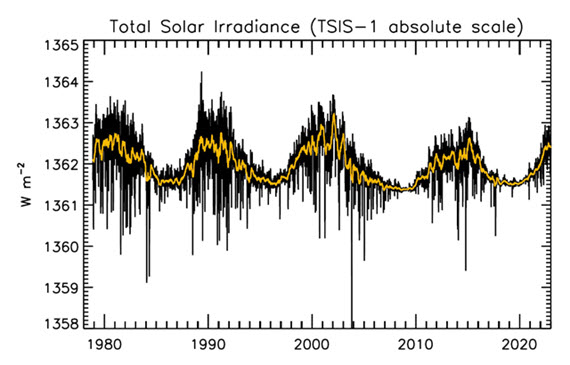
Please double check these numbers, but 11 year TSI amplitude is 0.1% or 1366/1000/4 or 0.34 W/m2. For CO2 over 11 years it is 22 ppm or (22/280)*3.7 or 0.29 W/m2. That means they are roughly the same amplitude over that phase of the solar cycle. Dikran, perhaps you can check those numbers too, I don't see how the damping on the CO2 rise can be any different than the damping on the TSI oscillation. Aren't they exactly the same?
If TSI gradually increased (rather than oscillated) it too would have an equilibrium response that would only be fully realised after several decades, but temperatures would start to rise immediately.
I don't know if you have an engineering background, but it is the difference between the equilibrium response and transient response of a system described by differential equations. They are not the same thing.
First, as to the cycle, while the change in amplitude could be 0.34 W/m2, it's not really fair to treat the minima as the baseline, so you're really talking about +/- 0.17 W/m2. It's also not a square cycle, jumping from minimum to maximum in one leap, so the duration of time spent at that full increase or decrease is low, with the majority of the cycle spent within 0.09 W/m2 or even less.
Also, every positive swing has the negative swing, so any lag at all is going to be very muddled (with the counter/braking action starting before the original action is able to take effect).
Second, for changes between cycles, the difference is even less than 0.34 W/m2, much less. In the past three cycles, the variation from the first to the third maximum (eyeballing it) looks to be less than one one hundredth of one percent, while the minima have no apparent change.
Just to make it a little clearer, no net change in minima, and a net change in maxima of about 0.03 W/m2 i the past 33 years, would net out (since most of the time is spent in the basically unchanged ups and downs of the cycle) to probably an addtional 0.03 W/m2 for maybe 6 or 9 of those 33 years, or at best 1/4 of the time, meaning a net of 0.0075 W/m2... a completely inconsequential number.
Whoa! Lastly, I just noticed that you bumped the CO2 forcing down to only consider the change in forcing, i.e. in the increase during an 11 year period. But the CO2 forcings are cumulative, where the TSI changes are not.
It's hardly a fair argument to compare 11 years of TSI changes (which net to zero!) to 11 years of CO2 changes which pile on top of decades of previous change in the value. Those are not the two values under discussion (11 year change in CO2 versus 11 year change in TSI, which itself is probably less than 0.0025 W/m2 anyway -- you have to measure the areas under the two curves to get a true number).
Dikran, you are suggsting that the earth has a different thermal intertia to TSI changes than to CO2 changes. I don't see how that can be true.
Tom, regarding your statement "Second, the level of the forcing for changes in TSI and especially for the solar cycle are not large certainly not nearly the same size as the CO2 forcing" would make sense if it was simply appended with "in total" or "since preindustrial" or "ongoing long term". Then we would all be able to violently agree.
Second, I think the best way to state it is that the unrealized instantaneous forcing is very much larger for CO2 than for TSI changes associated with the solar cycle, and significantly larger than for TSI changes at any time in the twentieth century. By "unrealized instantaneous changes" I mean the change in total forcing due to a given factor at anytime minus the change in OLR due to changes in surface temperature at the same time.
I take it that is what you mean by "ongoing long term forcing", and also what Sphaerica was describing in his 882. That being the case, we can all now agree furiously together on this point.
No, I am not suggesting any such thing. The thermal inertia of the earth has the same effect on warming due to TSI changes as it does on CO2 changes. The point is that you are comparing the equilibrium response to CO2 forcing with the transient response for TSI, so you are not comparing like with like.
If TSI forcing was steadily rising just as CO2 radiative forcing is, then there would be a transient response (the Earth would start warming essentially immediately), but the full warming would not be realised for some decades (the equilibrium response).
However, TSI is not steadily rising, it is oscillating, which is why the delay being discussed in relation to the 11-year solar cycle is not the delay before equilibrium is reached, it is a phase shift caused by the thermal inertia of the oceans.
Until you understand the difference between a transient and an equilibrium response in a dynamical system, you are unlikely to resolve your confusion.
The solar cycle has nothing to do with the Southern (especially Texan) drought. The main culpret has been the strong La Nina. Areas to the north experienced above normal precipitation (rain and snow), whereas southern areas were rain-starved. Similar occurrances accompanied past strong La Ninas, many of which were more severe than the current situation, particularly the mid 1950s.
http://www.cpc.ncep.noaa.gov/products/expert_assessment/seasonal_drought.html
Do you have a page dedicated to the Denialist claim that the IPCC itself admits it doesn't know what's happening with solar forcings at the following 2007 report page.
IPCC 2.9.1 Uncertainties in Radiative Forcing
If you are measuring values on 22DEC2009 that are within 1 W/m^2 of values on 22JUN2010, then you have some issues with your data. That difference should be pushing 90 W/m^2. The difference in r value for the intensity calculations is about 5 million km. So, maybe the sources for this article should be revised.
One query regarding the forum software: every thought of switching to Wordpress? Wordpress is great software and has BBpress forums as a plug-in now. Commenting could have all the power of BBpress (or SMF or Phpbb3 or whatever other open source forum software you want).
New Willie Soon paper
Does anyone know any peer-review work on this yet? Is the journal it is in actually an authentic climate journal? Is it legitimate science about a LOCAL Chinese phenomenon or a hyped up local phenomenon that fraudster Denialists are using to try and confuse people about GLOBAL climate change?
EtR's sunspot graph clearly shows the 1950s solar maximum; since then solar activity has in fact declined (hence the descriptive term maximum). A simple straight lines fit doesn't capture that important detail and is therefore irrelevant.
Yes, solar cycle 19 was definitely the highest of the 20th century. However, cycles 21 and 22, in the 1980s and 1990s, were the next two highest, significantly surpassing anything during the early 20th century. The point is that sunspot activity was still high during the last portion of the 20th century. To expect temperatures to decrease based on the drop from a very high to just a high value would be comparable to expecting temperatures to drop because we added less CO2 to the atmosphere this year than last.
A straight line fit does not capture the temperature profile of the 20th century, but does that negate the fact that an increase has occurred?