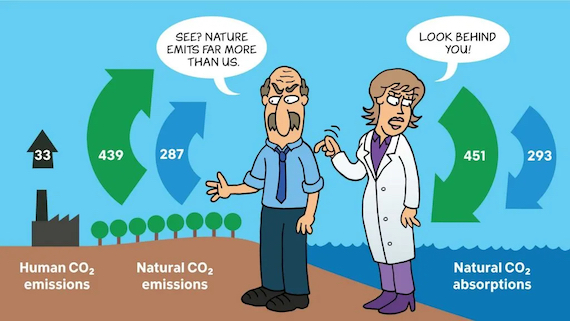
How do human CO2 emissions compare to natural CO2 emissions?
The skeptic argument...
Human CO2 is a tiny % of CO2 emissions
“The oceans contain 37,400 billion tons (GT) of suspended carbon, land biomass has 2000-3000 GT. The atpmosphere contains 720 billion tons of CO2 and humans contribute only 6 GT additional load on this balance. The oceans, land and atpmosphere exchange CO2 continuously so the additional load by humans is incredibly small. A small shift in the balance between oceans and air would cause a CO2 much more severe rise than anything we could produce.” (Jeff Id)
What the science says...
| Select a level... |
Basic
|
Intermediate
| |||
| The natural cycle adds and removes CO2 to keep a balance; humans add extra CO2 without removing any. | |||||
Before the industrial revolution, the CO2 content in the air remained quite steady for thousands of years. Natural CO2 is not static, however. It is generated by natural processes, and absorbed by others.
As you can see in Figure 1, natural land and ocean carbon remains roughly in balance and have done so for a long time – and we know this because we can measure historic levels of CO2 in the atmosphere both directly (in ice cores) and indirectly (through proxies).

Figure 1: Global carbon cycle. Numbers represent flux of carbon dioxide in gigatons (Source: Figure 7.3, IPCC AR4).
But consider what happens when more CO2 is released from outside of the natural carbon cycle – by burning fossil fuels. Although our output of 29 gigatons of CO2 is tiny compared to the 750 gigatons moving through the carbon cycle each year, it adds up because the land and ocean cannot absorb all of the extra CO2. About 40% of this additional CO2 is absorbed. The rest remains in the atmosphere, and as a consequence, atmospheric CO2 is at its highest level in 15 to 20 million years (Tripati 2009). (A natural change of 100ppm normally takes 5,000 to 20,000 years. The recent increase of 100ppm has taken just 120 years).
Human CO2 emissions upset the natural balance of the carbon cycle. Man-made CO2 in the atmosphere has increased by a third since the pre-industrial era, creating an artificial forcing of global temperatures which is warming the planet. While fossil-fuel derived CO2 is a very small component of the global carbon cycle, the extra CO2 is cumulative because the natural carbon exchange cannot absorb all the additional CO2.
The level of atmospheric CO2 is building up, the additional CO2 is being produced by burning fossil fuels, and that build up is accelerating.
Last updated on 29 August 2010 by gpwayne.

Arguments


Basic
Intermediate


But the mechanisms that deposited oil and coal beneath us are *not* going on today. There wouldn't be a problem if oil and coal were being deposited at the same time and the same rate as we use them. That's why they're called fossil fuels - as against renewable or replenishable fuels like burning wood or animal dung or anything else that will grow or return within a short time or at most, a human lifetime.
"But the mechanisms that deposited oil and coal beneath us are *not* going on today."
Not in any way at all meaningful to the human lifespan. On the other hand, I seem to recall that the ABC docco Crude suggested that maybe the processes that deposited all that oil might be beginning again, due to the action of anthropogenic CO2 entering the atmosphere (specifically in the Back to the Future episode I think).
The oldest known oil may be about 540 million years in age. That's a ballpark formation rate of about 3500 Bbl/year -- against an average consumption rate of 5+ billion Bbl/year from the late 1800s on.
(same source: 761 GBbl cumulative production in 130 years, starting around 1865 thru 1995). So we are indeed taking it out MUCH faster than it gets put in.
My question is this; why is there a balance in the first place? In other words, why is the equilibrium stable without human activity but unstable with human activity?
And in writing that, I think I might have figured out the answer to my own question, though I have never seen this written down. Is it that for *any* CO2 concentration, there is an equilibrium temperature, which the Earth will reach eventually. Human emissions have shifted that equilibrium position higher. We wiould eventually get to a stable point at current CO2 levels, but it will be much higher than today’s temperature.
Is that it?
John
The other, more subtle, part of the answer is that there is no one special equilibrium temperature for the Earth. The temperature and climate stability of the last few thousand years has allowed human civilization to flourish, but in previous eras the climate was quite different due to different degrees of the various forcings and feedbacks. Except for sudden events such as meteor and comet impacts, changes in the past mostly have been gradual in terms of human lifetime and even human civilizations. So the climate never really reaches an equilibrium, because some forcing or feedback always is changing. But for humans' practical purposes, slow changes are close enough to equilibrium for coping. The human release of massive amounts of CO2 is so fast that the resulting climate changes will be too fast that coping will be tremendously difficult, expensive, and painful.
Something to keep in mind is that if natural sources and sinks weren't approximately in balance, Earth would quickly become inhospitable for life as we know it. Thus, the fact that our species and our civilization exist (and we are able to ask questions about these things) necessarily implies that we must live on a planet where natural sinks and sources are more or less balanced.
Over the long term, however, sources and sinks do fluctuate slowly, as Tom Dayton points out. Thus, there are time periods when CO2 is higher or lower. Note, e.g., the Pleistocene glacial/interglacial cycle, when CO2 naturally fluctuated by around 100 ppm:
Figure 1: CO2 concentration over the past 800,000 years from ice cores at Dome C, Vostok, Taylor Dome, and Law Dome.
However, as seen on the far right side of that figure, we're currently raising CO2 much more rapidly, and to much higher levels, than anything seen during those glacial/interglacial cycles.
So, it's the RATE of addition of CO2 that is the problem. A 3% increase over thousands of years would be largely taken up by the various sinks and could indeed be called "tiny", but 3% in a few decades is unprecedented and too much for the system to bear.
Getting there?
Mostly. Consider, though, that we now have CO2 levels approximately 40% higher than "normal" interglacial highs...
Something to chew on.
The Yooper
People continue to breathe and fart. What goes in, must come out.
How about carbonated sodas, beer, and paintball guns? What effect do those have on the atmosphere?
"Iceland volcano causes fall in carbon emissions as eruption grounds aircraftCooling effect from volcano ash cloud will be 'very insignificant', but flight ban stops emission of estimated 2.8m tonnes of CO2"
but from the same article,
"Worldwide, the US Geological Survey says volcanoes produce about 200m tonnes of carbon dioxide every year."
I better stop now, turn off my computer and put a gun to my head, so as to not upset the balance of CO2.
Oh wait a second, firing a bullet produces CO2!, I better hang myself.
How do you know that? Please cite such a claim with a reputable source. If you can find any to back it up.
Consider the flip side: We've done plenty to increase atmospheric CO2 that is not negligible and can easily be observed. So your argument makes no sense.
Please look more carefully at the plentiful information on this subject: Fossil fuel burning now emits CO2 on the order of 30 Gigatonnes each year, whereas the number you quote for volcanoes is in Megatonnes. Fossil fuel burning produces about twice the annual rate of atmospheric increase (after converting metric tons to ppm by volume). The remainder is stored in the oceans and/or biosphere.
As far as "low" concentrations necessarily not having an effect, try hanging around an environment of 380 ppm H2S for a while.
The real question is, Is CO2 really causing global warming? Or is it the scapegoat for earth's natural cycle of weather change?
muoncounter's argument is that if 380ppm seems too small to have any effect consider what would happen if you replaced each molecule of CO2 with a molecule of say H2S or HCN. (To save you looking it up, it would annihilate mammalian life on earth at least with a couple of hours). 380ppm does not mean insignificant.
The earth has naturaly cycled through significant temperature changes throughout it's creation. Does our data from the last 200 years really tell us that our incremental affect of CO2 is causing the global warming, or like I said previously, this is a natural cycle of the planet?
Ah, the natural cycles game ... its all happened before. Dealt with extensively here and here and here.
Its necessary to substantiate your claims. Please find a reputable source that documents a prior natural cycle with all of the following: increasing global temperatures, accelerating Arctic ice melt, etc (full list here); in the face of decreasing solar output, lower concentrations of atmospheric aerosols, etc (full list here); AND increased CO2, all over a very short period of time.
And stop throwing around things like 'global birth control'. Once you come to understand that we have indeed made significant impacts on the environment, look for some practical ideas for creating change.
Care to try again?
Yes, CO2 has been higher in the past; yes, global temps have been higher in the past; yes, there are natural cycles that modify the Earth's climate. Modern humans, however, have never had to deal with a relatively very rapid global temperature increase. Our tripled population rests on an infrastructure and political/economic framework that has enjoyed a relatively stable climate.
Worse yet, as this incredibly energetic economic mode has developed over the past 150-200 years, absolutely no responsibility was built into the system. Externalizing waste costs has been a matter of course for most of industrialized history, to the extent that when such externalization is pointed out, industrialists like, I assume, yourself are shocked by the gall of someone questioning the integrity of the system ("it's just CO2 -- we've been pumping it out for decades. So what?").
You can't seriously expect a rapid doubling of a gas that re-radiates long-wave radiation to have no effect, can you? You do understand how the process works, yes? Maybe that's the first question skeptics should be asked: how does global warming work, according to climatologists? Well, ESG?
Thank you all for your input, it gives me stuff to think about.
Having just asked the question myself - about population and CO2 emmissions - I would direct you to the 'does breathing contribute to CO2 buildup in the atmosphere' argument.
Yes, the atmospheric level is rising. To say it is "building up" could be an emotive way of saying the same thing. It's certainly a slow rise, at an average over 51 years of about 1.43 ppmv per year.
It's incorrect to assert that the whole increase comes from fossil fuel use. For there are other sources, too, such as outgassing from warming oceans and variable (unknown) outputs from various sources, such as wetlands.
It's also incorrect to assert that the increase in atmospheric concentration is accelerating. The Mauna Loa record shows no sign of that. In fact, graphing the yearly change (the data given at the Mauna Loa site) shows that since about 1998, the rate of increase has actually slowed.
So would you cite your source for the acceleration, please?
Cheers,
Richard Treadgold,
Convenor,
Climate Conversation Group.
Richard, there are two problems with this. First of all, the oceans are a net sink of CO2. That is, the net flux of CO2 is from the atmosphere to the ocean, not the reverse. See lots of papers on the subject, including Takahashi 2009 and Sabine 2004.
Secondly, we know the total fossil fuel flux to the atmosphere quite well, and it's clearly larger than the annual increase in atmospheric CO2. In other words, fossil fuels account for more than 100% of the atmospheric increase (with the excess being taken up by oceans and the biosphere).
Richard also writes: It's also incorrect to assert that the increase in atmospheric concentration is accelerating. The Mauna Loa record shows no sign of that. In fact, graphing the yearly change (the data given at the Mauna Loa site) shows that since about 1998, the rate of increase has actually slowed. So would you cite your source for the acceleration, please?
From the Mauna Loa data, the linear trend in CO2 for each of the past decades is as follows:
1960-1969: +0.8 ppmv/year
1970-1979: +1.2
1980-1989: +1.6
1990-1999: +1.6
2000-2009: +2.0
That is a very clear acceleration.
It's a bit disturbing that someone acting as "Convenor,
Climate Conversation Group" would be so seriously mistaken on multiple basic facts about CO2 in the Earth system. What kind of "climate conversations" are you having, and who are you having them with? Somehow, you seem to have picked up a lot of misinformation.
The assertion was straightforward, as I quoted it:
Land use change wasn't mentioned. No, I can't supply a reference for what you ask. But I didn't mention it either.
You forgot my question: What is the evidence for an acceleration in the rising atmospheric level of CO2?
When you say "temperature-induced rises in CO2 are feedbacks, not forcings", does that mean they don't form part of the increased amount in the atmosphere? But of course they do, and they are not anthropogenic, so they ought to be deducted from the anthro emissions budget. That's all I meant.
Cheers.
From 1100 to 1500 significant deforestation took place in Western Europe, global deforestation accelerating from the mid 1800's with the result that only about half of the Earth's original mature tropical forests remain.
It is also clear how seasonal plant growth causes significant variation in CO2 levels globally, with dramatic annual variations regionally.
The question that needs to be answered, is, is that CO2 that would have been sequestered by the now missing forests being considered as a forcing, and has it been adequately accounted for given that considerable deforestation took place before 1750, particularly in the northern hemisphere, 1750 being the base from which the effects of anthropogenic CO2 are referred back to.
Richard, without a reference to contradict the established carbon accounting, what is your point here? Ned provides the evidence for acceleration by the way though I think that pretty irrelevant - 1960s rates are scary enough.
There's little or no empirical evidence that ocean outgassing makes a measurable contribution to atmospheric CO2 increase. Compare the monthly MLO record to landlocked stations along the same latitudes -- all the way around the globe -- and you see no differences. But 'unknown outputs'? No doubt those will be hard for you to document.
"Land use change wasn't mentioned."
And a good thing too, as land use change is now removing terrestrial carbon sinks.
As far as increasing rates of change in atmospheric CO2, all the graphs of the annual data I've seen are concave up. That means the slope is increasing.
Greenhouses warm by preventing convection (glass barrier).
CO2 and the other non-condensable GHG's work by slowing the loss of radiated energy at the top of the atmosphere (TOA) through back-radiation which warms the lower layers of the atmosphere nearer to the ground and cools the mid-to upper layers of the atmosphere, like the stratosphere and the mesosphere.
Hope that helps.
The Yooper
But it actually works in this case. To answer your question, kdfv, if you insist on the 10m-thick slabs of glass analogy, think of CO2 as the thin line of caulk that seals up the cracks between those slabs.
:-)
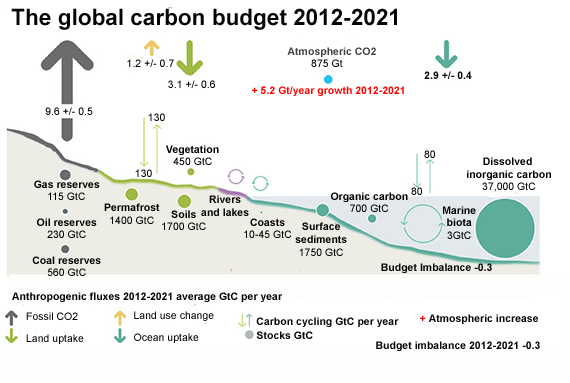
Re: the ocean/atmosphere CO2 exchange, the sign of this flux is spatially and temporally heterogeneous. In one area and one season, the ocean will be a CO2 sink, while at some other place and time it will be a source. Integrating over the globe and the seasons gives a total upward flux of 332 Gt, and a downward flux of 338 Gt. This doesn't show up as a huge swing in the Keeling curve because the two processes are occurring simultaneously and thus mostly but not entirely cancel each other out.
At least that's my understanding.
Is it ever. We're trying to decipher some of this at Ocean acidification.
I may be oversimplifying it a bit, but I visualize the '~330 Gt up/down' as being an equilibrium cycle. Even if we released zero anthropogenic CO2, that cycle would still be there.
Add in the CO2 we release from fossil fuel consumption -- on the order of 30 Gtons annually in recent years -- and you get the annual change in average atmospheric CO2 concentration (+1.5-2.5 ppm by volume). It is not difficult to work out how this excess mass of CO2 in Gtons converts to +2ppm by volume in the atmosphere, as long as approximately 50% of this mass is taken from the atmosphere by land/ocean sinks. You can actually trace the increasing rate of atmospheric CO2 concentration from increasing annual CO2 emissions; data are available here.
Most of that annual cycle has to do with seasonal cycles in carbon stored in terrestrial organic matter as biomass that builds up in spring and is later decomposed. For this reaons the annual cycle gets progressively less obvious as one moves from northern latitudes (with large proportion of surface area as land mass), to southern latitudes (where most of the surface area is covered by ocean).
Biomass can accumulate on land because plants are more complex and there is a lag between formation and decomposition of organic matter (those processes also show lagged seasonal cycles). Plants in the ocean are largely single cells and get quickly eaten or decomposed. So even though there is almost as much photosynthesis in the ocean as on land, it is impossible to store much carbon in biomass in the ocean. Therefore, net CO2 flux into the ocean on the short time scale tends to be driven by abiotic factors (pCO2 in water and air, water temp, wind, currents, upwelling/downwelling).
As for how these numbers are measured, I think that is covered in the IPCC AR4. In both terrestrial and oceanic systems there are areas than act as sinks and sources. We know the ocean is a net sink because it is acidifying as CO2 invades (in fact, becasue of that you can say that we actually know the net flux there better than the gross fluxes back and forth!) We also have calculated maps of CO2 flux based on physical/ biological controls that are consistent with a net influx under current conditions. Those are pretty good, but are improving all the time.
Land use and biomass inventories suggest that overall the land is a net source due to deforestation - but regional reforestation has meant that some areas have been CO2 sinks over the last century. Uncertainty on the inventories is large but getting better - an active area of research. There are also biophysical models of primary production and decomposition that are driven by satellite data and physiological constraints. These are groundtruthed against long term plots used in the inventory studies.
One can cross check both land and oceanic net flux estimates against changes in pCO2 as air masses pass over water bodies and land as constrained by known physical constrains on exchange. That can be done on the small scale (eddy diffusivity measurements in forest or grassland plots) or the very large scale (over Amazonia or the Southern Ocean) using so called inversion techniques which infer exchange rates -- essentially a complex regression whose fit is constrained by physical considerations.
So basically on the budget side the focus has been on measuring net exchange in many ways rather than following individual molecules or plumes of CO2 (although that is interesting in and of itself). You can infer how far a typical molecule of CO2 travels in the atmosphere, but that turns out to be a consequence of the measurements and does not affect them.
Hope that helps...
To use a familiar illustration, here is a 'dynamic exchange' of CO2 in/out of the biosphere. The result is a regular 6-7 ppm peak to trough cycle each year. It is superimposed on the long-term increase of ~2ppm per year due to anthropogenic CO2.
The annual peak is in April, at the start of the growing season in the northern hemisphere; the annual trough is in September-October, aka 'fall'.
"but in what way is a dynamic exchange of CO2 a cycle?"
As noted, there is a lot more spatial variability implicit in that image than can be presented effectively. Also a cycle as used in earth science also implies transitions between different states (inorganic/organic, aqueous/gaseous) that can occur in a single space. That's just the usage.
I spoke about the seasonal variation and terrestrial carbon storage because you were trying to understand seasonal variation in CO2 as a function of ocean CO2 uptake, which is the wrong path to take.
The reason there are large positive and negative fluxes of CO2 into the ocean is because some regions are net sources and some regions are net sinks of CO2. Those arrows indicate the sum release for the net source areas (like the equatorial Pacific), and the sum of uptake in the net uptake areas (like the subantarctic regions north of the Southern Ocean). As you can tell these areas are large. The minimal scale is essentially set by the minimum cell or pixel size of dynamic models of ocean physics and satellite observations (usually >kms) -- the in and out numbers do not refer to both gross flux terms of the net flux at one point...that would be pointless for the reasons you point out.
Scientists study the spatial variability in PCO2 flux because efflux and influx can be decoupled by things like ENSO (on the short term) and ventillation (on the long term). It allows you to explicitly address the ability of the ocean to store CO2 in the future under different climate/oceanographic conditions and different time scales of exposure to increased CO2. We are discussing some of this on the acidicfication page as pointed out my muoncounter above. I think it's good science.
You also have to include those arrows because they are in every global C cycle produced over the last few decades. As a consequence, you can't ignore them because cynics will say your hiding something when you're not. Ackowledging those arrows and explaining why they don't negate the importance of athropogenic CO2 is important.
As for the time and mass units they are years and Gt CO2 (not C). If you go back to the original IPCC figure you can figure that out. In fact, the IPCC report covers all of what I said above pretty well. I'd read it.
These are schematics of the flow of materials in a dynamic system. There is no distance scale involved. This type of figure is the standard, in use for decades; for example, see figure 10 in Post et al 1990.
"would like to have people acknowledg or refute my assertion that the figure is bad science"
An assertion that this is 'bad science' needs some substantiation. There are far more egregious example of bad science to be found on a routine basis in the denialist sources.
CO2 is not driven from one point to another by temperature; rather it is driven by atmospheric circulation. Fisher 2010 presents several good examples; the diagrams in that paper have both physical scale and a time context.
"... when the perturbation (i,e the the seasonal remperaure chage) is removed the system returns ti its original state."
Unless the system oscillates, as your spring/mass example (and some parts of the climate system) would.
"I calculate the forced (no feedbacks) temperature change. I get 1.4 K degrees in the next 100 years. "
I don't know how to evaluate that statement without further information: such as what do you assume for climate sensitivity (often expressed as degC/CO2 doubling), what emissions scenario do you use and why no feedbacks? If you would care to share those key assumptions, certainly some of the folks around here more knowledgeable than I would have some helpful input.
in the ocean decreases at A and therefore some CO2 comes out of solution increasing the partial pressure (proceeding in the direction of the new equilibrium at the higher temperature). This increased partial pressure is swept by moving air masses to point B where the temperature does not increase as much, remains the same, or even decreases. At point B the CO2 spontaneously dissolves because the partial pressure exceeds the equilirium value for that temperature and concentration. Thus a transport of the CO2 is "driven" by the seaonal temperature changes. The process is reversed when the seanon changes back to the starting point. I have another, I think more important, question: Why is the condition of elecrical neutralty not brought into the discussion. All solutions, including the ocean, are to a very, vary close approximation electrically neutral. By my calculation of the total carbon dioxide 93.3% is present as bicaronate and carbonate. If 300 plus GT of carbon dioxide moves from A to B that amounts to about 7 times 10 to the 14th moles. The concentration of the major CO2 containing species in the ocean (bicarbonate) is about 0.0025 molal but that is not free to exchange without some negative charge increase or positive charge decrease. It seems to me possible that raises a serious problem for the 300 GT of supposed transport. I can do the following calculations: 1. assume equilibrium at point A (all CO2 bearing aqueous species, hydrogen and hydroxide ions, water and CO2 gas)at 288K, 2. assume a similar equilibrium at point B at 298K, 3 find the difference beyween the equilibrium CO2 partial pressures at A and B,3. find the mass of air required to move 300 GT of excess (at 288K) CO2. Does anyone want me to do that? I am now going to start a new thread to answer the questions about my ppt. So the two topics don't become confused.
"Thus a transport of the CO2 is "driven" by the seaonal temperature changes. The process is reversed when the seanon changes back to the starting point."
That model doesn't work so well for a number of reasons.
First, lower warmer less seasonal latitudes would have to "see" that CO2 that was evaded in warming high latitude oceans. In other words, the evasion of CO2 would have to have significant effects on the ppm of CO2 above less seasonal waters for the mechanism you suggest to occur. But CO2 is a fairly well mixed gas, so mixing through the atmosphere greatly dilutes any effect of seasonal evasion on atmopsheric CO2 above tropical waters (you can see in that flying carpet diagram that seasonal variations in CO2 are relatively small as one approaches the tropics).
Second, you are treating this as a solely physicochemical phenomenon when biology plays a huge role by altering the aquoeus pCO2 concentration (and thus the saturation displayed by CO2) through photosynthetic uptake of CO2 and subsequent export of organic matter to depth. This is particularly important in the spring when nutrients are abundant, light is increasing and waters are warming. The depression in pCO2 associated with photosynthesis offsets the seasonal evasion effect you are describing.
Third, the process you describe should cancel out over a year (as long as one ignores phytoplankton)...which may be the point you are trying to make. For that reason and the ones I gave above, it is not considered that important from the point of view of understanding the carbon cycle. It's a bit of a red herring. Focusing on it misrepresents what modelers are doing.
Oceanographic processes are more important. Deep water has high CO2 because it is 1) cold and 2) has been accumulating CO2 released by respiration over a long period of time (as in the Equatorial Pacific. If it comes to the surface and warms (and phytoplankton don't take up the CO2), large amounts of CO2 can evade. Also important is the downwelling of water that was warm, but has subsequently cooled (as in the north Atlantic).
CO2 is not only a function of the solubility pump. Organic matter produced by phytoplankton represents trapped atmospheric CO2. The downwelling of water that has experienced massive phytoplankton blooms, as occurs in high latitudes and above south of thesubantarctic front, traps CO2 in organic form. Phytoplankton growth also drives aqueous pCO2 lower, which drives invasion of CO2.
"Why is the condition of elecrical neutralty not brought into the discussion. "
Charge balance is absolutely required to solve chemical equilibrium problems in the ocean - although the presence of organic matter can pose problems for analytical solutions. This statement tells me that you need desperately need to absorb quite a bit more marine chemistry before proceding.