How reliable are climate models?
The skeptic argument...
Models are unreliable
"[Models] are full of fudge factors that are fitted to the existing climate, so the models more or less agree with the observed data. But there is no reason to believe that the same fudge factors would give the right behaviour in a world with different chemistry, for example in a world with increased CO2 in the atmosphere." (Freeman Dyson)
What the science says...
| Select a level... |
Basic
|
Intermediate
| |||
|
Models successfully reproduce temperatures since 1900 globally, by land, in the air and the ocean. |
|||||
Climate models are mathematical representations of the interactions between the atmosphere, oceans, land surface, ice – and the sun. This is clearly a very complex task, so models are built to estimate trends rather than events. For example, a climate model can tell you it will be cold in winter, but it can’t tell you what the temperature will be on a specific day – that’s weather forecasting. Climate trends are weather, averaged out over time - usually 30 years. Trends are important because they eliminate - or "smooth out" - single events that may be extreme, but quite rare.
Climate models have to be tested to find out if they work. We can’t wait for 30 years to see if a model is any good or not; models are tested against the past, against what we know happened. If a model can correctly predict trends from a starting point somewhere in the past, we could expect it to predict with reasonable certainty what might happen in the future.
So all models are first tested in a process called Hindcasting. The models used to predict future global warming can accurately map past climate changes. If they get the past right, there is no reason to think their predictions would be wrong. Testing models against the existing instrumental record suggested CO2 must cause global warming, because the models could not simulate what had already happened unless the extra CO2 was added to the model. All other known forcings are adequate in explaining temperature variations prior to the rise in temperature over the last thirty years, while none of them are capable of explaining the rise in the past thirty years. CO2 does explain that rise, and explains it completely without any need for additional, as yet unknown forcings.
Where models have been running for sufficient time, they have also been proved to make accurate predictions. For example, the eruption of Mt. Pinatubo allowed modellers to test the accuracy of models by feeding in the data about the eruption. The models successfully predicted the climatic response after the eruption. Models also correctly predicted other effects subsequently confirmed by observation, including greater warming in the Arctic and over land, greater warming at night, and stratospheric cooling.
The climate models, far from being melodramatic, may be conservative in the predictions they produce. For example, here’s a graph of sea level rise:
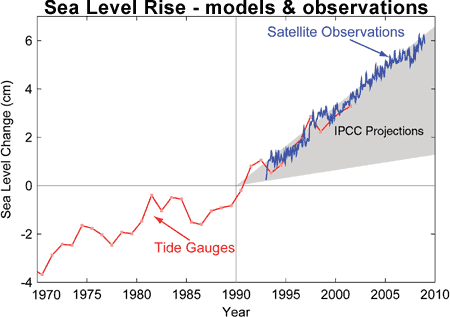
Sea level change. Tide gauge data are indicated in red and satellite data in blue. The grey band shows the projections of the IPCC Third Assessment report (Copenhagen Diagnosis 2009).
Here, the models have understated the problem. In reality the events are all within the upper range of the model’s predictions. There are other examples of models being too conservative, rather than alarmist as some portray them. All models have limits - uncertainties - for they are modelling chaotic systems. However, all models improve over time, and with increasing sources of real-world information such as satellites, the output of climate models can be constantly refined to increase their power and usefulness.
Climate models have already predicted many of the phenomena for which we now have empirical evidence. Climate models form a reliable guide to potential climate change.
Last updated on 26 October 2011 by Sphaerica. View Archives

Arguments


Basic
Intermediate


1. What is the "predictive" variability between climate models?
2. Do they all have the same free model parameters (i.e. fudge factors)?
3. If so, are these parameters set to the same values to accurately fit historical data?
It would raise my "skeptical" level if, in fact, the GCMs contain significant differences in their predictability and technical structure.
TESTIMONY OF PATRICK J. MICHAELS TO THE SUBCOMMITTEE ON ENERGY AND ENVIRONMENT OF THE COMMITTEE ON ENERGY AND COMMERCE, U.S. HOUSE OF REPRESENTATIVES..
I have posted a link to proof of Solar Wind and Magnetism being an active part of the scenario in the "It's the Sun" thread. The alarmists have been playing ignorant of the NASA findings.
Many Climate Scientists are completely unaware of some relevant science and understand other relevant science poorly (it’s not in their curriculum). The missing science proves that added atmospheric carbon dioxide has no significant influence on average global temperature. See my pdf linked from http://climaterealists.com/index.php?tid=145&linkbox=true for the proof. Or email at danpangburn@roadrunner.com
As the atmospheric carbon dioxide level continues to increase and the average global temperature doesn’t it is becoming more and more apparent that many climate scientists have made an egregious mistake and a whole lot of people have been mislead.
The models used in complex systems such as climate can be fundamentally flawed, in exactly the way the bank models were flawed in the financial crisis-modellers simply tell the decision makers/executives what they want to hear, and what the modellers want them to hear (giving themselves promotion and bonuses etc, and reducing the need for costly data gathering etc etc). Major assumptions are played down, and data which doesn’t suit is left out or relegated to 'noise' etc. The real world just doesn’t work like that. Wherever models determine policy these models can be dangerous ie 'weapons of data destruction', especially in any political context.
There is alot more I could say on modelling, as I have worked in this field, but maybe another day.
Using this argument is admitting that there is no such thing as climate science , only climate statistics. It is also a dodgy use of statistics in that the toss of a coin is fundamentally a result of a physical law with a random element of how hard the spin is induced.
If you have any doubts on this score try a simple rig which drops a coin horizontally to catch its edge on a bar placed in its path. It is possible to get about 90% selection either way by moving the bar if the coin lands on a relatively bounce free surface. I was told that it is actually possible to get better than 99% with a fancier rig but never tried to do so as I only needed 75% for my free lunch.
Can anyone point to the references for the IPCC peer reviewed projection of the effect of cloud cover changes in both type and coverage as a result of temperature and the more erratic weather patterns they claim will occur?
I have worked in computer modelling within science and government, and have had some run-ins with those within science who attempt to reduce complex modelling down to one variable-their field of research. I have seen hundreds of millions of dollars of development projects almost shelved because these projects were not supposed to have even been occuring, under one scientists or faction of scientists (generally those who have spent their entire careers within the public service, outside the real world), particular, individual model or dataset. Some of these 'only my field/dataset' modellers don't even bother to check all relevent data, and moreover they want policy decisions to be based on simple models, by default, as away of bringing 'order' to the world. Their 'order'.
This sort of process, is the very reason we don't allow governments to control societies; there are always those within government, including within science, who want to impose their partcular 'science models' on the world, when in fact it is really about imposing their political philosophy (commonly socialist), and self-interest.
There are other patterns that tend to occur in these sort of modellers, and their cohorts that I have noticed:
-They don't like chaotic systems
-They don't like inbuilt uncertainty
-They don't like changes in uncertainty
-They don't think that the common 10% or so of data that doesnt fit into a dominent model, is relevant, or at best think that it can only account for 10% of effect.
-They tend to think all natural systems are smoothly curved.
-They tend to think that fields of research outside the 'dominant' have little relevance.
-They have a common disrespect for market forces in society.
-They think that their field is superior to other fields.
-They don't like being unable to dominate or control human politics
-they get to the point that they believe that the issues are settled, and that debating issues and prolonging the political process is a waste of time and taxpayers money, examining any new data is also a waste of time, and inefficient, since the debate was settled long ago-by their dataset.
They are geniunely astonished when one points out real-world instances which have significant effects (eg >10%), which do not fit into their 'dominant' model. They would have bet their house that these wouldn't occur.
The above assumptions are not based on actual data, but on social and political assumptions that those who hold them tend not to be aware they even have, or that they are even questionable; and are inconsistent at best when applied to the real world, or at worst, simply wrong.
A good example is the 'nature is generally smoothly curved' assumption. It is surprising how common this is in 'modellers' (eg financial and in climate), and how uncommon it is in nature, and moreovoer what effect the common ~10% of data that doesnt 'fit' can have. Some of the best examples I can think of are the element iron in the periodic table (which causes stars to go supernova-there is nothing 'smooth' in this process-and the periodic table in general for that matter), and the process of natual selection itself-where a minority variant can replace an entire pre-exisitng variety/species.
(In both these cases, according to the assumptions innate in many modellers, we wouldn't even be here! since eg our solar system formed from a supernova, and of course from evolution, which are both, not 'smoothly curved' processes. (So much for the ~10% of a dataset having 'low effect').
Note also, if you want historical examples of where intellectualism and modelling/ideology can go drastically wrong:
- Richard Pipes of Harvard blames radical academics for providing the foundation, framework and justfication for radical Bolshevic communism in the late 19th century-early 20th century.
-Weikart blames German Social Darwinists and intellectuals in the late 19th-early 20th century for providing the foundation, framework and justification for radical Nazism
-Social Darwinists/Eugenics movement came from within radical academics and intellectuals, who also attempted to impose their 'science model' on the world in the early 20th century (with Nazism as an offshoot of this).
-The financial crisis of 2000s, where the 'expert banks' and their modellers got it all wrong.
-Human-induced global warming modellers, (>90% sure that there is >90% effect from human activity).
The jury is still out on the last one, but their general manner and methods, in my opinion, are not all that dissimilar to the previous ones.
One consistent and dangerous theme with these three movements is that they all claimed to be based on science, with direct 'links', but were really political agendas masquerading as science. They were all examples of supposedly irrefutable 'science', where doubts were heavily suppressed. Those who advocated their 'causes' were very, very sure of themselves.
The big question is whether or not 'human induced global warming' is also a form of socialist-determinism. Psychologically, the foundations and underlying assumptions are very similar. Human activities are usually elevated above other factors, the future is largely preordained and inevitable, society must be re-ordered acccording to the 'new science' etc etc.
In something so big and fundamentally chaotic as the economy, or climate, is it questionable, at best, that we can ever be so sure about 'links', to re-order entire societies.
There are aspects of general determinism in the politics of the human-induced climate change movement-people want to control and re-order society in the manner that 'human induced global warming' dictates. They 'link' human activities to climate, (which is itself a form of determinism).
Their absolute sureness of the pervasiveness and dominance of the link, without mitigating or confounding factors, is very close to a deterministic style of thought. One dataset or factor is raised in importance above all others, to latter to which they ascribe simple 'noise'. They are, by default, above the squabbling of the market, or democratic process. The future is certain, and pre-ordained, and it is C02. Nothing is more moral or certain, than a re-ordering of society according to the fundamental principles of the new idea. Those who cant or wont change will be discarded, in the new world. It is a matter of life and death. And so on. Trouble is, people have heard it all before-it may therefore be entirely psychological and political,related to peoples pathological need to order and control society, and nothing at all to do with the 'science'.
Is it really true that there is a direct causal link between human activities and climate? Perhaps one should pause at the previously 'certain' links between eg, biology, race and fitness in society; the previously certain links between capitalist class struggle and communist inevitablility; the previous certain links between evolution, race, war, and Aryan racial struggle for Europe.
What was the underlying major problem with these ideas?. It was the determinism, that there was a direct link between the underlying science, and human activities. No wonder people are worried about the 'models'. Should give pause for thought.
"Is it really true that there is a direct causal link between human activities and climate? "
Certainly there is. In the same way that vulcanism or other factors have an effect on climate. But the real question is to what extent do human activities affect climate..and that we have yet to quantify. And therein lies another problem; those who wish to control us( for whatever reason) will turn tentative indications into cast iron certainties in order to achieve their purposes..and both sides are equally guilty of this.
As someone who has built computer models based on natural data, I can make some comments on this. The models I build are based on spatial data rather than time-based data, but I suppoose the methods are similar. It is not surprising that the IPCC's climate models reproduce the past because I would think that the models are based to a large extent on past data.
When I build a model I start with the basic ( past ) data values and come up with a mathematical formula which will model how these values change from place to place in 3 dimensional space. Then the formula is used to predict hundreds of "hypothetical", estimated values within the physical model limits. After doing this it will be apparent that in some places within the physical model, there are places where there exist an original (real) data value and a nearby estimated value in close proximity. The real and estimated values can then be compared to see how well the formula predicted reality. The formula can then be "tweaked" if necessary to give a better fit between real and etimated data values. This process is known as cross-validation.
I assume the IPCC builds its models using historical data and carries out similar cross-validation techniques. Therefore of course the IPCC models can predict the past in a general sense.
With regard to predicting future climate change, only time will tell. I think we would have to wait a minimum of say 30 years to see how the IPCC model's future predictions compares to reality. So I think it is premature to say that the IPCC models predict the future accurately. We do not know yet. However, I understand the IPCC produces lots of predictions based on its computer climate models and these show a large range of possible outcomes ( correct me if I am wrong ). Therefore, if this is the case, which IPCC model do we take as its prediction of future climate ?
Therefore in summary, with regard to your claims quoted above, my responses are :
1. Yes the IPCC models would reproduce the past - that is what the models are based on.
2. It is too early to tell if the future prediction of climate change is correct, but which prediction are we talking about, there are many.
If I compare real data to Hansen's scenario B (assumed to represent CO2 emissions frozen at 1988 levels ), the real data is now about 0.4 degrees below that predicted by Hansen. This may not seem a lot, but these are the sort of anomlalies which the IPCC is describing as catastrophic. I would argue that Hansen’s model is not validated by real-world data and I think that as time passes, it is likely that Hansen's 1988 predictions will diverge even further from real world temperatures.
Arguably, real temperatures should be compared to Hansen's scenario A ( continued growth in CO2 emissions ). If such a comparison is made, Hansen's prediction is about 0.6 degrees above reality.
Not really Neil. You should really familiarize yourself with the data before attempting to trash it! You can read about the Hansen scenarios and the models here [*](see Figure 2 and accompanying text).
Scenario C is the imaginary situation that greenhouse gas emissions were stopped in 2000
Scenario B described as "the most plausible", is a scenario with moderately increasing greenhouse gas concentrations and some volcanic eruptions, much as we've observed in reality.
Scenario A is a model used to bracket the high end of likelihood with rapid exponential increase in anthopogenic emissions and no volcanos.
If one compares the models with reality based on 2005 data, the results are:
predicted temp rise 1998-2005, relative to 1951-198 mean:
model A: 0.59 oC
model B: 0.33 oC
model C: 0.40 oC
real world measurement:
land suface: 0.36 oC
land-ocean surface: 0.32 oC
That seems a pretty good prediction (a 17 year projection into the future). The most plausible scenario has been almost smack on. Of course this is a rather lucky observation, since the models cannot predict the noise in the climate system which is rather large especially on the decadal time scale.
So one can hardly claim a model hasn't been a rather good predictor of future when it's made a prediction that's very close to real world observations!
Of course what happens over very short time periods (a few years) is of little consequence in comparing climate simulations with reality, since as is very obvious, a climate simulation cannot predict as yet contingent events like El Nino's, La Nina's, volcanic eruptions, changes in solar output and so on. So a succesful simulation is expected to produce the broad progression of temperature rise while the fluctuations around the trend is expected to be completely discorrelated with real world observations.
[*] http://www.pnas.org/content/103/39/14288.abstract
We are talking about basically the same thing in relation to Hansen's scenario C. You are saying that
Scenario C is the imaginary situation that greenhouse gas emissions were stopped in 2000. I am saying that it is an imaginary situation in which the CO2 emission's growth was drastically reduced ( as you point out,it represents the case that growth actually stopped ) in 2000.
In your comparison above, why did you stop at 2005, when data is available at least up until 2008?
As you say, "Of course what happens over very short time periods (a few years) is of little consequence in comparing climate simulations with reality". Therefore to my way of thinking, we will not know the "truth" until about 2030. But it should be apparent already that to date the real data is diverging from Hansen's more likely scenarios A and B.
The data in the paper I cited goes up to 2005. That's why I stopped at 2005.
Why wait until 2030? The simulations have done a very good job of predicting reality for almost 20 years. So we can say that the real world has "evolved" in a manner that is consistent with our understanding of the greenhouse effect as it stood some 20 years ago. That seems a rather good indication that even 20 years ago we understood the basic elements of the climate system with respect to radiative forcings and heat retention. Obviosuly we know a whole lot more now and we expect our current models to be considerably better (not to mention the vast improvements in computational speed, efficency and data storage and analysis).
You need to make up your mind about what you think constitutes a long enough period to assess a computational projection into the future! If you consider we won't "know the "truth" until about 2030", how can you possibly say that "it should be apparent already that to date the real data is diverging from Hansen's more likely scenarios A and B"! Those are trwo mutually exclusive notions.
In reality, as i said in my post #118, a projection cannot simulate contingency (giving rise to much of the "noise") in the climate system, and therfore we expect considerable short term divergence of simulated and real word data. That's obvious I would hope! We can see that this is the case by inspecting Hansen's simulated projection (Figure 2 here:
http://www.pnas.org/content/103/39/14288.abstract
and observe that despite the overall good correspondence between scenario B simulation and real world temperatgure evolution, that there are very large short term deviations (e.g. 1974-1976; 1992-1994; 2008 etc.). We can understand these in hindsight since we kbnow what contingent events (volcanic eruptions; El Nino's etc.) caused them. Since these events result in temporary perturbation of the surface temperature evolution, the temperature response recovers and the long term temperature evolution remains driven by the anthropogenic increase in radiative forcing despite short term fluctuations...
We know enough about cars to know that all our cars will start and get us home tonight when we leave work. We aren't afraid as we approach other cars at alarming rates because science guarantees brakes and tires do predictable things.
We know that if we dump lead into rivers the lead gets into fish and human tissue and causes terrible consequences. We can bank on this being true today as well as 1000 years from now. *That* science is done.
But the science of climate modeling is certainly *not* done, at least in the minds of most people. Let's face it; we are talking very tiny numbers - .038% CO2, < 0.2 degree temperature deltas. We are asked to believe that while human emissions are small compared to natural ones, that the earth absorbs *exactly* the amount it emits, and so any tiny perturbation is a disaster. Hogwash.
There was a time where the orbits of the planets were explained by invisible crystal spheres. And they have models too - ones that would even explain the retrogradation of Mars - all of which functioned using the inviolate assumption that Earth was the center of the visible universe. That premise drove the model - which, while far from elegant - was made to work.
Here we are in the same situation. I have to believe that climate researchers have an agenda. People who don't believe in AGW are certainly not going to devote their lives to studying it. And so, we start with one premise - it's all our fault - and work from there. When an objection comes out - say to the magnitude of CO2 and man's contribution to that - out come the curves. Out come the crystal spheres. Out come the graphs showing tiny variations drawn on an offset scale for emphasis. Out comes a vague paper digestable by 'the community' but no one else.
If you truly want people to believe that "the science is done", do some actual physical research. Create a large enclosed simulated atmosphere and show the effect of doubling CO2. Don't slip away saying it's not that simple. Science is all about reduction to experiments that *are* that comprehensible.
Otherwise, the models are about as believable as those that can model old stock market data but won't make a dime.
As normally defined, a "prediction" is a logical proposition about the outcome of a specified statistical event that is made at a specified interval in time in advance of the occurrence of the event's outcome. As it is an example of a proposition, a prediction is true or false.
I understand that the climatologist James Hansen once predicted that the highway outside his office in Manhattan would be underwater 20 years later. Hansen had made a prediction. In the event, Hansen's prediction proved false, invalidating Hansen's hypothesis.
All of the article's examples of "predictions" are computed temperatures. They provide the basis for comparison of computed to measured temperatures. However, by itself such a comparison neither validates nor invalidates the associated model for the events are unspecified. With the events unspecified, the model lacks the property of "falsifiability" that is possessed by every model that is "scientific" in nature.
To render one of the IPCC's models falsifiable, the builders of this method would have to specify the statistical event that is associated with each prediction. According to authorities that include the IPCC itself, this task has not yet been accomplished. In its most recent report, the IPCC states that its models do not make "predictions" but rather that they make "projections." While predictions support the validation of a model, the IPCC's "projections" support only "evaluation."
The distinction is an important one, for to control any sort of system, one must have the capacity for predicting the outcomes from movement of the control system's actuators. Whether the IPCC's models have the capacity for doing so remains unknown pending the definition of the events and conduct of a validation exercise. Thus, whether regulation of carbon dioxide emissions would have the desired effect of controlling global temperatures is also unknown.
Associated with confusion over the differing meanings of "prediction" and "projection" in the language of climatology is a mistake repeatedly made by people who are interested in climatology but unfamiliar with the methodology of science. This mistake is to confuse a model built by scientists with a scientific model. A scientific model makes predictions. A model that makes no predictions is not a scientific model even when built by scientists.
So has anyone seen a model run try to account for the paleoclimatology data?
you might want to read something on weather vs climate.
But if you like straight lines, fit one to the last 30 years or so and you'll end up with about 2 °C by 2100. Not confortable anyway. But you don't need to use "fancy computer models" to do better than a straight line fit and get a better representation of reality.
By the way, you can also do nice fits to the ice ages cycles without "fancy computer models", but guess what?, they do a better job.
your comment was a little bit early ;)
Great site, the best one I've seen yet, especially as you have links to actual journal articles.
One thing that I've noticed is that some "skeptics" have a you feed junk in you get junk out mentality when it comes to computer models. I recall when I used to debate creationists at my university and a very similar argument was used of carbon dating of being exactly like that.
Although I don't want to stretch the comparison any more than that it is just an interesting point.
There is an article that discusses this a little more I've linked to below.
"Are climate change deniers like creationists?"
http://www.csmonitor.com/Environment/Bright-Green/2009/0828/are-climate-change-deniers-like-creationists
It is the comments that are really interesting as people compare global warming alarmists to creationists, but again I feel the science is on vacation in their arguments.
Regarding global temperature data, the very simple point I'd like to make is that Hansen (2006), whose results you cite as the main defence of model prediction, themselves state that "a 17-year period is too brief for precise assessment of model predictions [because of inherent uncertainty within the model]". They continue, "close agreement of observed temperature changes with simulations [for scenario B] is accidental given the large unforced variability in the real world". I think this is appropriate scientific caution and does not necessarily disprove the model - yet this sense of balance is missing from your headline response to skeptics: "[climate models] have successfully predicted future climate change".
I also note that the point at which scenarios A and B divide (ie discriminate between predictions) has not yet occurred, or is occurring now. Overall I would say the Hansen data is not irrefutable evidence that models work.
Incidentally Hansen 2006 also suggest that the volcanic eruption estimated for the 1990s, (which you single out for special mention) was 'sprinkled' there - my reading of the paper is that the authors simply dispersed three eruptions across a 50-year period. Certainly any suggestion that the eruption was a spectacular success of the general climate model would seem to be misleading. I'm not sure that was your intention.
This is very important because as I understand it modeling is the main evidence cited by the IPCC, which in turn is driving the current political process. If they are inaccurate (as, intuitively, they may well be if they do not include unknown forcing) then predictions are scientifically meaningless. As I say, the fit of the Hansen model is described, at best, as tentative by the authors themselves.
I don't believe it's constructive to label critical questioning and rational scepticism as "denial", being "full of junk" or "spouting rubbish" as one blogger has done in this thread. I would also caution against automatically rejecting any article that is not peer reviewed. Peer review is also flawed; it is often not double-blind and therefore can be biased, and because peer-reviewed journals are extremely competitive, articles in them may tend to be those based on well-funded research; funding often following political agendas (and then there is the separate problem of publication bias). The source is simply something that must be weighed along with everything else.
al
The true root and bulk of the evidence is basic physics, with details added in the form of progressively more advanced physics. But the media and public have gotten the misimpression that (a) scientists are merely guessing that human-produced greenhouse gasses are responsible for the portion of warming that scientists' models can't otherwise predict; and (b) there might be no unusual temperature rise needing to be explained, because the temperature hockey stick graph might be wrong.
You will save yourself a lot of time and frustration if you read a quick overview of the wide range of evidence from cce's The Global Warming Debate. (Be patient, his server is slow, and sometimes gets completely bogged down; try again later). Then get a quick history from Spencer Weart's The Discovery of Global Warming; his summary Introduction is nicely short, but the rest of his site is quite rich.
If you want to continue reading background material after that foundation, look at the Start Here section on RealClimate, which has links to materials categorized by level of technical background required.
But if instead you then want to pursue pointed questions, this SkepticalScience site is a great place to turn next. Note there are two types of posts here: the concise Skeptic Arguments linked at the top left of the page (click "View All Arguments"), and the longer "Posts."
a
Human-produced direct heat is trivial compared to human-produced greenhouse gas forcing. For details see (in the post The Albedo Effect) the comment 56 by Steve L, and the subsequent comments 57 and 58 by me.
Rather than make predictions, the IPCC models make what the IPCC calls "projections." A "projection" is a mathematical function which maps the time to the global average temperature. A "prediction" is a logical proposition which states the outcome of a statistical event. A "projection" supports comparison of the computed to the measured temperature and computation of the error. However, it does not support falsification of the model for the apparatus is not present by which the proje3ction may be proved wrong. A "prediction" provides this apparatus.
Are you implying that IPCC uses temperature records that aren't published and we don't have access to?
None of the surface air temperatures or the satellite temperature records that I'm aware of come close to showing the temperature increases in figure 1.
Certainly HadCRUT reflects less than half the increase in figure 1.
Not at all. The IPCC TAR use the HadCRUT record, NCDC and NASA GISS. They just don't indicate which of these records are used in Figure 1 above. As for the trends in Figure 1, just eyeballing the graph, it looks like the trend in the last few decades is 0.2°C which is consistent with all three temperature records.
Cheers!
http://www.realclimate.org/index.php/archives/2009/12/updates-to-model-data-comparisons/
It seems that Hansen's 1988 model is indeed (slightly) overestimating the observed warming trend: "the old GISS model had a climate sensitivity that was a little higher (4.2ºC for a doubling of CO2) than the current best estimate (~3ºC) [...] it seems that the Hansen et al ‘B’ projection is likely running a little warm compared to the real world". Hansen's model shows 0.26 +/-0.05 ºC/dec, whereas the real world shows 0.19 +/-0.05 ºC/dec. However, for this comparison, as well as the climate sensitivity, it must be taken into account that "Scenario B in that paper is running a little high compared with the actual forcings growth (by about 10%)". AR4 models give 0.21 +/-0.16 ºC/dec.
Anyway, this was already highlighted by Hansen et al 2006: "Close agreement of observed temperature change with simulations for the most realistic climate forcing (scenario B) is accidental, given the large unforced variability in both model and real world. Indeed, moderate overestimate of global warming is likely because the sensitivity of the model used (12), 4.2°C for doubled CO2, is larger than our current estimate for actual climate sensitivity, which is 3+/-1°C for doubledCO2, based mainly on paleoclimate data"
IPCC AR4 8.6.4 How to Assess Our Relative Confidence in Feedbacks Simulated by Different Models?
[quote]A number of diagnostic tests have been proposed since the
TAR (see Section 8.6.3), but few of them have been applied to
a majority of the models currently in use. Moreover, it is not yet
clear which tests are critical for constraining future projections.
Consequently, a set of model metrics that might be used to
narrow the range of plausible climate change feedbacks and
climate sensitivity has yet to be developed.[/quote]
Any person on earth knows that clouds can warm and cool. IPCC knows that too. Cloud feedbacks are not well modelled.
IPCC AR4 8.6.3.2 Clouds
[quote]In many climate models, details in the representation of
clouds can substantially affect the model estimates of cloud
feedback and climate sensitivity (e.g., Senior and Mitchell,
1993; Le Treut et al., 1994; Yao and Del Genio, 2002; Zhang,
2004; Stainforth et al., 2005; Yokohata et al., 2005). Moreover,
the spread of climate sensitivity estimates among current
models arises primarily from inter-model differences in cloud
feedbacks (Colman, 2003a; Soden and Held, 2006; Webb et al.,
2006; Section 8.6.2, Figure 8.14). Therefore, cloud feedbacks
remain the largest source of uncertainty in climate sensitivity
estimates.[/quote]
I am a computer scientist with 30 years experience who has no doubt that the theory of AGW is correct.
I want to deal specifically with Poptech's claims about computer science as he claims to be an "expert". As most of his post consists of unintelligible rant it is difficult to nail precisely what "straw man" the hapless Poptech is railing against but he does appear to have an issue with physicists or in particular climate scientists who program in FORTRAN.
Computers have been used for solving problems in Physics since the beginning of the computer age. In fact most universities run degree courses which allow you to major in Physics and Computing. I did a variation of that degree in the mid 1970s majoring in Applied Maths, Physics and Computer Science. There is a whole range of computer algorithms designed for solving complex mathematical problems using computers and as any physicist will tell you mathematics is the language of physics.
He also claims that because some climate scientists use the computer language FORTRAN, their code must be full of bugs.
Why? Because Poptech cannot understand FORTRAN code? Because FORTRAN has been around for a while? He does not say. I no longer use FORTRAN but in my experience ability and training is a much better guide to good programming than choice of language.
The principals of Computer Science are universal and not tied to any specific computer language. In fact computers are language agnostic as they execute machine code. Many of the changes to programming methodology over the years have addressed the issue of software bugs by promoting the use of tested library components or frameworks, structured coding techniques, the use of design patterns and object oriented programming techniques. That is we break our complex code down into smaller testable units and ensure that they work correctly by testing them rigorously before combining them into the whole. This does not guarantee bug free code but these approaches have been proven to reduce bugs substantially.
All these approaches are available to the FORTRAN programmer with the added advantage of having access to a well proven library of scientific and statistical routines.
Does our "expert" check every time he flies as to what programming language the aircraft's control system is written in? Most are written in a specialist programming language called ADA which is of the same vintage as FORTRAN.
His rant against climate models is really a rant against science of any form.
But there is a built in uncertainty in nature so there will always be questions that cannot be answered with absolute precision whether those questions are answered using computer models or with pen and paper. It is the reason why every scientist needs a good handle on statistics because many questions can only be answered within a range of certainty.
Sometimes a general question can be answered with more certainty than a more specific question. Actuaries working for health insurance companies use statistical computer models to work out the average health costs of a range of population groups so their employers can set insurance premiums. But they cannot tell you precisely how many people will get sick next week or more specifically if you are likely to need medical care.
So it is with climate and weather.
Contrary to Poptech's assertion, weather forecasts have actually become much more accurate over the last few years. With better computer climate models, use of satellite measurements and faster computers, weather bureaus now offer five day forecasts which were not reliable enough in past decades. Ironically some forecasters complain that climate change is affecting their forecasts as the changing climate is altering many of the assumptions based on the historical experience that is built into the models.
Computer models which deal with climate change have not been designed to forecast the weather over the next century. They cannot tell you the summer temperature in 2050. They are tools for examining climate science the physics of which, contrary to Poptech's opinion, is well understood. They are able to give a range of projections which examine the effects of C02 as well as other factors on the long term climate. In that they have been remarkably successful.
It's 2010 now and even with El Nino from what I can see from Climate4You (wich I presume is one of the most objective sources there is for climate information), no dataset reaches the 1 degree limit, like the Hansen's "B" scenario seems to have finally gone over.
While indeed if I'm not incorrect and that seems to have happened, we can only hope that we have learned trough the decades (wich Hansen 2006 seems to suggest :) ) and at this day of age have had the resources and the time to create the best damn models we can[/End the dramatic b-grade speech].
Rather than throw up my hands in sorrow over the matter, I think I'll go and try to discover why the model output graphs are not smoothed. It's a choice made by the authors, with good reason I suspect, if nothing else intended to convey that we're not to expect a monotonously predictable rise. I can well imagine the hue and cry over divergence from a smoothed result come to think of it.
pdt wrote Doug Bostrom correctly replied "It's...a rare matter of actual significant uncertainty."
The answer is in the RealClimate post FAQ on Climate Models, the "Questions" section, "What is the difference between a physics-based model and a statistical model?", "Are climate models just a fit to the trend in global temperature data?", and "What is tuning?" A relevant quote from those: "Thus statistical fits to the observed data are included in the climate model formulation, but these are only used for process-level parameterisations, not for trends in time."
Part II of that post then provides more details on parameterizations, including specifics on clouds.
I'm not sure what "process-level parameterisations" means. Presumably one needs a model of cloud properties for a range of atmospheric conditions in order to predict climate trends with time. Either you get the properties from an understanding of the physics of cloud formation and their properties or you infer them from fitting to measured climate data. "Process-level parameterisations" sounds like the fitting. Again, I'm not judging it, I'm just trying to understand it. The language is just not familiar to me. My modeling experience is in a different field.
Mucho references to follow, if you're inclined.
Either way, even the early Hansen models were way better guide to what the future held just hand-waving about empirical guesses. Of course, there may still be unmodelled physics which is going to save us all - but would you want to bet on such possibility? What the models show, is that with the best physics available to us, our continued emissions of GHGs is going to heat the earth rapidly and we ignore that physics at our peril.
The claim (not yours!) I was initially responding to was the misperception that the climate models' predictions are evaluated against the same data that the models were statistically fit to in the first place.
By the way, there is more discussion of parameterization on Open Mind, especially starting with Ray Ladbury's comment. When you get down to Tim's comment below Ray's, skip it because Tim then posted a correction and then a final correction.
I have been asking numerous people around and some of my more skeptical friends seem to wave this around and it appears to make some solid points.
Anyone know how to answer to this one?
not sure about which paper you're refering at, but take a look at this RealClimate post.
I was talking about paper released in 2008 by Spencer and Braswell that discussed a potential positive feedback bias caused by cloud variability. The paper makes a strong claim how this bias basicly makes the models show too much positive feedback.
The link you gave me talks about one of hi's un-peer reviewed blog posts how PDO would affect climate. See that posts comment number 171.
To this day I have not seen a debunking article nor any response from the modelling community about this paper. Considering this paper was released in the pretigius Journal of Climate and even Piers Forsters couldn't but give him a green light, I must wonder.