Empirical evidence that humans are causing global warming
The skeptic argument...
There's no empirical evidence
"There is no actual evidence that carbon dioxide emissions are causing global warming. Note that computer models are just concatenations of calculations you could do on a hand-held calculator, so they are theoretical and cannot be part of any evidence." (David Evans)
What the science says...
The line of empirical evidence that humans are causing global warming is as follows:
We're raising CO2 levels
Human carbon dioxide emissions are calculated from international energy statistics, tabulating coal, brown coal, peat, and crude oil production by nation and year, going back to 1751. CO2 emissions have increased dramatically over the last century, climbing to the rate of 29 billion tonnes of CO2 per year in 2006 (EIA).
Atmospheric CO2 levels are measured at hundreds of monitoring stations across the globe. Independent measurements are also conducted by airplanes and satellites. For periods before 1958, CO2 levels are determined from air bubbles trapped in polar ice cores. In pre-industrial times over the last 10,000 years, CO2 was relatively stable at around 275 to 285 parts per million. Over the last 250 years, atmospheric CO2 levels have increased by about 100 parts per million. Currently, the amount of CO2 in the atmosphere is increasing by around 15 gigatonnes every year.

Figure 1: Atmospheric CO2 levels (Green is Law Dome ice core, Blue is Mauna Loa, Hawaii) and Cumulative CO2 emissions (CDIAC). While atmospheric CO2 levels are usually expressed in parts per million, here they are displayed as the amount of CO2 residing in the atmosphere in gigatonnes. CO2 emissions includes fossil fuel emissions, cement production and emissions from gas flaring.
Humans are emitting more than twice as much CO2 as what ends up staying there. Nature is reducing our impact on climate by absorbing more than half of our CO2 emissions. The amount of human CO2 left in the air, called the "airborne fraction", has hovered around 43% since 1958.
CO2 traps heat
According to radiative physics and decades of laboratory measurements, increased CO2 in the atmosphere is expected to absorb more infrared radiation as it escapes back out to space. In 1970, NASA launched the IRIS satellite measuring infrared spectra. In 1996, the Japanese Space Agency launched the IMG satellite which recorded similar observations. Both sets of data were compared to discern any changes in outgoing radiation over the 26 year period (Harries 2001). What they found was a drop in outgoing radiation at the wavelength bands that greenhouse gases such as CO2 and methane (CH4) absorb energy. The change in outgoing radiation was consistent with theoretical expectations. Thus the paper found "direct experimental evidence for a significant increase in the Earth's greenhouse effect". This result has been confirmed by subsequent papers using data from later satellites (Griggs 2004, Chen 2007).

Figure 2: Change in spectrum from 1970 to 1996 due to trace gases. 'Brightness temperature' indicates equivalent blackbody temperature (Harries 2001).
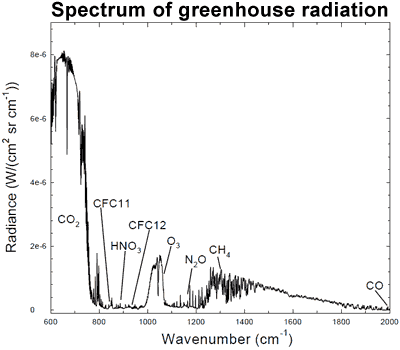
When greenhouse gases absorb infrared radiation, the energy heats the atmosphere which in turn re-radiates infrared radiation in all directions. Some makes its way back to the earth's surface. Hence we expect to find more infrared radiation heading downwards. Surface measurements from 1973 to 2008 find an increasing trend of infrared radiation returning to earth (Wang 2009). A regional study over the central Alps found that downward infrared radiation is increasing due to the enhanced greenhouse effect (Philipona 2004). Taking this a step further, an analysis of high resolution spectral data allowed scientists to quantitatively attribute the increase in downward radiation to each of several greenhouse gases (Evans 2006). The results lead the authors to conclude that "this experimental data should effectively end the argument by skeptics that no experimental evidence exists for the connection between greenhouse gas increases in the atmosphere and global warming."

Figure 3: Spectrum of the greenhouse radiation measured at the surface. Greenhouse effect from water vapor is filtered out, showing the contributions of other greenhouse gases (Evans 2006).
The planet is accumulating heat
When there is more energy coming in than escaping back out to space, our climate accumulates heat. The planet's total heat build up can be derived by adding up the heat content from the ocean, atmosphere, land and ice (Murphy 2009). Ocean heat content was determined down to 3000 metres deep. Atmospheric heat content was calculated from the surface temperature record and heat capacity of the troposphere. Land and ice heat content (eg - the energy required to melt ice) were also included.

Figure 4: Total Earth Heat Content from 1950 (Murphy 2009). Ocean data taken from Domingues et al 2008.
From 1970 to 2003, the planet has been accumulating heat at a rate of 190,260 gigawatts with the vast majority of the energy going into the oceans. Considering a typical nuclear power plant has an output of 1 gigawatt, imagine 190,000 nuclear power plants pouring their energy output directly into our oceans. What about after 2003? A map of of ocean heat from 2003 to 2008 was constructed from ocean heat measurements down to 2000 metres deep (von Schuckmann 2009). Globally, the oceans have continued to accumulate heat to the end of 2008 at a rate of 0.77 ± 0.11 Wm?2, consistent with other determinations of the planet's energy imbalance (Hansen 2005, Trenberth 2009). The planet continues to accumulate heat.

Figure 5: Time series of global mean heat storage (0–2000 m), measured in 108 Jm-2.
So we see a direct line of evidence that we're causing global warming. Human CO2 emissions far outstrip the rise in CO2 levels. The enhanced greenhouse effect is confirmed by satellite and surface measurements. The planet's energy imbalance is confirmed by summations of the planet's total heat content and ocean heat measurements.
For more evidence that humans are causing global warming, check out The human fingerprint in global warming.
Last updated on 26 June 2010 by John Cook.

Arguments


The relative differences in state between the surface and the atmosphere can be that the surface can be warmer than the atmosphere, OR both the surface and the atmosphere are in equilibrium, OR the surface is cooler than the atmosphere.
It is always going to be one OR the other depending on all the variables that combine to produce the climate that exists on this planet.
You wrote:
"it's not clear to me what you mean by "the assumptions in your version of the heat balance equation". Which assumptions did "I" make? Did you find something wrong?"
I used the term "your version" to be simply descriptive, not pejorative. Strictly we have covered three versions of the heat equation:-
Schwartz version:- dH/dt = F * exp(-t/tau)
"Your version":- dH/dt = F(t)−λΔT
"My version":- dH/dt = -f(t)
"Your version" makes the same assumptions that are built into the Schwartz model, and then one additional assumption, which is the curtailment of higher order temperature terms in the exponential expansion (or in the derivative form of S-B apploied to Ts - it comes to the the same thing). I wasn't suggesting that this is "wrong":- each of these versions is founded on its own assumptions. I am claiming that my solution is more general than Schwartz, and hence more general than "your version".
Where are we going with this? With real-world data (CO2), over a wide variety of assumptions imposed on "my version", the rise in OLR cannot be reconciled with the IPCC assertions and assumptions. This whole conversation started because, as I stated, the "hand-waving" arguments about CO2 being the primary driver, BUT thermal emissions overwhelm the OLR response don't hold water for the long equilibration times asserted by the IPCC .
Schwartz is the same as mine, you wrote it wrong.
But anyways, if we agree that H indicates a variation and that your f(t) (apart from the sign convention) includes the forcing and the radiative thermal emission, we have an agreed starting point. You may not want to linearize the radiative thermal emission and write it as εσ(T^4-Te^4) throughout, but in this way you make the solution considerably harder to find. Afterall next term in the expansion is of the order of 10^-4, i'd say it's negligible.
Fact is, that if you go even one iota outside the range you are trying to limit this to O2 becomes a much larger factor than CO2; and O2 has gone down by the same amount CO2 has gone up, not that it's very much.
Another fact, 400ppm of CO2 can't contain anything close to even 1/1000th of a degree, let 7/10ths of a degree.
Increases in input energies explain whats been going on far better; and, that includes both the rises and the falls. The primary source of input energy is the Sun. In addition to the direct IR and the visible light we see, it also emits UV and a variety of other forms of energy as well as impacting how we are effected by more distant energy sources.
Attempting to claim that it must be CO2 because there aren't enough increases in IR to account for it is more childish than just about any argument out there.
If you want to make the lack of input sources argument, then do your homework. Get the UV, CME, Gamma, x-ray, visible spectrum, and other readings, convert them using known atmospheric norms, and add them to the broad spectrum IR increases; then, try the argument again - except, you won't be able to; as, they do explain the temperature variations quite well when taken as a whole.
Final thought - Hanson had nice charts and graphs; and, if they had been accurate Manhattan would have sunk by now.
"they do explain the temperature variations quite well when taken as a whole" This is news. Please supply some evidence or references to support this.
Also please explain to us how convection and evaporation add energy to the atmosphere. They only move the energy around
Convection and Evaporation do not add any energy to any system, they only move energy from areas of high energy pressure (temp) to areas of lower energy pressures with an increasing rate with increasing differences in pressure.
This is precisely the core of my argument.
the enhanced green house effect is what adds the additional energy.
This goes against my understanding. Once you add energy pressure to a system, it is finite and does not add more energy to the system even if a portion is trapped, the 1st and 2nd Laws apply here. Trapped radiation will only serve to slow the radiative cooling exhibited by black body radiation.
My understanding is that should a method of energy transfer experience resistance, then another medium available, in this case convection combines with evaporation, will make up for this resistance in the most efficient manner possible. Preserving the 2nd Law.
A true Greenhouse comes to mind. If it has a constant source of energy and it is perfectly sealed, then it will increase in pressure/temp until it is radiating at the same rate it is absorbing, keeping the emissivity and conductivity of the container in mind.
Place the greenhouse into an atmosphere, and now you include conduction to the atmosphere at the surface. With a uniform surface and in zero gravity convection is not in play so what you'll end up with is a steady stratification of the atmosphere's temperature moving from higher temps to lower temps the farther you get from the surface.
The energy in the system has not increased, we have only added an additional component with the atmosphere. The energy pressure in the greenhouse has decreased by the amount of energy transfered to the atmosphere.
By adding gravity to the equation, we introduce convection. Gravity on Earth is 99% the strength at the top of the troposphere as it is at the surface so gravity will pull more strongly on cooler denser air than it will hotter cooler air that is created at and near the surface. The higher the surface temp the quicker the air near the surface heats of and the quicker it becomes less dense than the volume above it.
Gravity drags cooler air to the surface which creates a larger difference in temp between it and the warmer it it replaced creating a faster rate of cooling.
A uniform surface creates equal pressure going up and will have equal resistance going down. Varying the surface in both energy pressure and specific heat allows for currents to form which allows for an increased convection rate. Land Sea breezes come to mind.
While the surface and atmospheric energy pressures have adjusted, no energy has been created or lost.
Now let's place a resistance on the Radiation rate. If 2 Watts is correct for CO2, that is a .005% restriction at 390 Watts.
Convection rates within the Earth's atmosphere are highly variable, from dead calm to reaching dozens of meters per second. Thermal currents and hang-gliding come to mind.
If a radiative resistance is encountered, and if my understanding of the 2nd Law is accurate, then any energy trapped by radiative resistance will simply be picked up convection given that it very rarely reaches it's physical limits.
No energy has been created or lost, the system has only lost it's ability to cool an additional 2 Watts at the speed of light and instead has to cool at the speed available to convection.
One more cont . . .
From 109
No energy has been created or lost, the system has only lost it's ability to cool an additional 2 Watts at the speed of light and instead has to cool at the speed available to convection.
Now this begs the question, is the difference in the cooling rate enough to create a back pressure that holds the energy at or near the surface increasing that region's pressure/temp?
My understanding is that the elasticity of the atmosphere combined with the readily available room for an increased convection rate will offset that kind of back pressure.
No energy was created or lost from my understanding, I believe I have met all Thermodynamic Laws.
Will save that in the event I am understanding this incorrect.
AGW is real and is caused by an increase in CO2 and other green house gases. No other science can dispute that statement.
At the top of the atmosphere the only energy pathway is radiation. If you look at Figure 2 at the top of this page, the emissivity of the Earth has decreased due to greenhouse gasses - so that since the 1970's, at the 1970 temperature of the Earth, it wasn't radiating as much as it received. Energy accumulated, the temperature of the Earth/atmosphere increased, and and the energy radiated to space increased as well. It got warmer.
In the simplest view possible:
The equilibrium temperature of IR cooling bodies (energy output) with equal energy inputs and different emissive spectra depend on the integrated energy of their emission spectra - objects (or planets) with lower integrated spectra will come to equilibrium at a higher temperature than objects closer to a black body spectra.
Note that greenhouse gasses tend not to affect the visible wavelength energy coming from the Sun - I think less than 1% (numbers, anyone?) of the solar spectra is in the affected IR bands. So the input energy does not change.
CO2 directly reduces the emissive IR spectra of the Earth - and temps go up as a direct response, as the Earth system moves back to equilibrium energy exchange at the top of the atmosphere.
This is just gibberish. I cannot follow what you are trying to say. I doubt that even you know what you are saying.
Sorry, Temperature is a measure of kinetic energy within a given volume. Kinetic energy, when viewed as Force and when divided by Volume, can be represented as Pressure.
The higher the density per unit volume, the higher the temperature or 'pressure'. You can simply replace 'energy pressure' with 'Temp...', and that should clear things up.
Oh, and to be clear, any references in those posts to 'Law', all apply to the 3 Laws of Thermodynamics. 4 if you count the Zeroth Law, which seems obvious, but I imagine it has some use.
You are right to doubt me.
AGW is real and is caused by an increase in CO2 and other green house gases. No other science can dispute that statement.
? That is not gibberish, but understand that I am not so experienced as you, so my ability to read between the lines is not as refined.
For give me but I only got, basic English mind you;
"AGW is real and is caused by an increase in CO2 and other greenhouse gases."
Can you please explain what is wrong in 107?
Note; Should be "Convection combine with evaporation" and I failed to state the assumption 'where evaporation is available".
And Trapped radiation implies an atmosphere where convection is available given Ian's "greenhouse effect".
Other than that, I can see no other areas that could be in question.
Are you saying that restricting a method of energy transfer where another is available will not increase the rate of the other?
Thanks
107 should say COMBINED with a D, with regards to evaporation. HTML tags are causing trouble :) I can see how COMBINES with an S could cause confusion
If you look at Figure 2 at the top of this page, the emissivity of the Earth has decreased due to greenhouse gasses
You know that's not true. Figure 2 only shows it has decreased in certain narrow frequency bands relative to the rest. The offset in the figure is arbitrary, it is not measured with acceptable accuracy at all. Also, it would be very interesting to have a look at the curve below wavenumber 710 cm-1. Arctic window, between 400 and 600 cm-1 plays a crucial role under certain circumstances.
Figure 2
About that and nooks and crannies of arctic clouds read Delamere & al. 2000. As usual, it is not about actual measurements, but modeling. However, it presents the basic concepts quite clearly.The system at issue is not just the Earth's solid and liquid surface. Nor is it that plus the atmosphere. The "system" is the entire Earth, from the outermost wisps of the atmosphere down to the Earth's core, as seen from outer space. Convection, conduction, and evaporation happen only within that system, and do not--can not--exchange energy with anything that lies outside that system. So convection, conduction, and evaporation cannot cool that system.
But radiation from that system can escape that system, thereby carrying energy out of that system, into outer space.
Such radiation is emitted toward outer space by everything in that system that has a temperature above absolute zero--which is everything. All those everythings also emit radiation in every other direction at the same time. Radiation that does not head toward outer space eventually gets absorbed by more things in that Earth system. On average, half of the emitted radiation heads toward outer space at least initially.
But even radiation headed toward outer space faces obstacles--objects that absorb radiation. (But radiation does not get absorbed by other radiation it encounters. Only objects can absorb.)
Some of those obstacles are greenhouse gases. When they absorb radiation, they attain higher energy states. Some of that energy they give to other objects by banging into them (that's "conduction"). But some of that energy they radiate. Just like all the previous radiating, the radiation goes in all directions, but half of it heads toward outer space. But now some of that radiation hits more obstacles in the form of greenhouse gases, and so on.
This process causes a smaller proportion of outgoing radiation to make it all the way out of the system (to outer space) than would make it if there were no greenhouse gases in the way.
To those that think 107 - 110 are gibberish, can at least one of you provide an example?
Pick the first obvious one, the understanding is progressive so an early error will likely falsify the rest of it.
Does Temperature as 'Energy Pressure' not make sense? Makes sense if you take into account that a joule = a newton with regards to Energy. They are equivalent. Energy/Volume = Pressure.
Anyone?
In particular, "Trapped radiation will only serve to slow the radiative cooling exhibited by black body radiation" is completely insensible - random words that don't mean anything to me. How could energy accumulation slow radiative cooling? That completely reverses cause and effect - slowing of radiative cooling traps energy, not the other way around.
You're just not making sense. When you do, great. Until then, well, babble just isn't worth my time.
In the meantime, I would suggest reading up on the Greenhouse Effect, and how it actually works.
"Without going into motivation, Yes, I think many climate scientists are purposely misrepresenting conjecture as empirical and repeatable evidence quite frequently using subjective terms to provide wiggle room and plugging conjecture into GCM's, passing the predictions off as reliable."
Once you actually get back to empirical evidence as opposed to heading back into the 19th century to rehash classic thermodynamics and the like, whatever data you may end up discussing will be dismissed as the result of a vast conspiracy or whatever it would take to support theendisfar's hypothesis of rampant corruption in the scientific community.
So I really wouldn't bother w/rejoinders, attempts at correction or the like. I'll hazard a guess that theendisfar is here for kicks, nothing more.
do you think that in other wavelengths the top of atmosphere (TOA) emissivity has increased?
Yes.
Note that the measured TOA emissivity has decreased at all observed wavelengths in that graph.
In the graph, yes. Not in reality. As I have already told you, the offset in the graph is arbitrary. TOA radiative imbalance, as measured by satellites, have some 6 W/m2 uncertainty.
Can you produce evidence to that effect? If not, I can't take your comment seriously.
You can't produce evidence to the contrary either. The 0.9 W/m2 radiative imbalance at TOA is only assumed, never measured.
In order to be taken seriously you have to be able to tell assumptions and facts apart in the first place.
Delamere et al 2000 is an interesting paper. But they fail to show actual data for TOA emissions.
Of course they don't do that. It is about modeling, not measurement. But they do provide some hints regarding why these quantities are not measured properly yet.
In particular, "Trapped radiation will only serve to slow the radiative cooling exhibited by black body radiation" is completely insensible - random words that don't mean anything to me.
Thank you. I believe I can make it clear.
If an object is radiating at 390 Watts/m^2 (m^2 is meters squared) and a GHG absorbs some of it and sends back 2 Watts, then the rate of cooling via Radiation has dropped to 388 Watts/m^2.
Since a Watt is a joule/second, then the most obvious choice of words to me was to say that it 'slowed'.
Keeping in mind that radiation travels at the speed of light, any IR trapped by CO2 is in effect trapped at the surface since it's frequency at the surface is every 1/150,000,000 seconds if trapped at 1 meter or 1/15,000 seconds if trapped at 10,000 meters.
Temperature changes over such short time periods and so little energy can, for practical purposes, be seen as not changing.
To describe the 'trapped' energy when it is away from the surface requires one to predict it's location within the atmosphere which is highly variable and since everyone is so concerned with it's contribution to surface temps, that is the obvious choice again.
So, if you consider the 'trapped' energy as stuck at the surface, or better yet, when you are measuring it it is at the surface, then in practical terms you have reduced the radiation rate by 2 Watts.
Now consider that a cubic meter of water at 15 C (average Sea Surface Temp) contains about 1.2 Billion joules, a reduction in cooling of 2 Watts is a 12 hour reduction of 86,400 Watts.
Sound like a lot? Consider it takes a 4.1 Million joule increase to raise that 1 cubic meter of water 1 C.
However, the radiative resistance does not impede Convection or Evaporation (where available), in fact, since a slight increase in Temperature will be observed at the surface, the Convection rate will increase accordingly.
Better?
Measured, repeatable (and frequently repeated) numbers. Unless you have measurements to the contrary, convection is 1/3 the energy of latent heat, and 1/16th the energy of IR, not the dominant effect you claim. And of course it has zero effect at the top of the atmosphere, where radiation is the only energy exchange with space.
Next objection to the greenhouse effect?
So it's not so much gibberish in that it can't be clarified, it was gibberish because of a lack of understanding and trust of the source.
This is relevant because if what I have stated is accurate, cannot be falsified, then one of the understandings must be wrong. Barring someone able to falsify the understanding I have, I hold it to be accurate.
And of course it has zero effect at the top of the atmosphere, where radiation is the only energy exchange with space.
This is good, we agree. Convection stops at the Tropopause. Where the Earth was able to cool via Conduction, Convection, and Radiation starting at the surface, it lost Conduction with only a small amount of altitude, and then it loses Convection at the Tropopause.
A transfer of energy means that energy has traveled over distance.
To say that conduction plays no or little part in cooling the Earth's surface because Radiation is the only ultimate escape is nonsense. To say the same of Convection is equally nonsense.
I took a look at Trenberth et al, is this what you're getting your info from? Imagine for a moment I had "provided a review of past estimates", and "performed a number of radiative computations", and "values constrained by", and ""but adjusted to an estimated imbalance", and "Revised estimates", and "radiation is adjusted", and "by making modest changes" in the short understanding I posted above.
It opens far more questions than it would have answered.
Again, just because convection only moves energy to the Tropopause does not mean it is not the primary transport of energy from the surface to it.
Just because Conduction only moves energy from the surface to the immediate atmosphere above it, does not mean it is not the primary transport of energy to it.
Any issues with #129? Make sense?
Clarification.
This is relevant because if what I have stated is accurate, cannot be falsified, then one of the understandings must be wrong.
'Understandings' meaning, energy can be added to a system by slowing, trapping, what have you, the radiation rate through whatever mechanism you like, GHE, enhanced GHE, super enhanced, etc
versus
the 1st and 2nd Laws are kept intact. The Sun is the only source of energy that adds energy to the Earth's system. Well, Star light (entire spectrum) does too if you want to get picky.
This is why I brought up the back pressure that would occur if you slowed the rate of cooling by reducing the radiation rate (speed of light) and instead had to use Convection, several dozen meters per second max. The 2nd Law clearly shows that if you reduce the rate of one means of energy transfer, it will automatically increase the rate of another means if available.
Again, for clarification, convection only moves the energy to the top of the Troposphere where radiation becomes the only means to transfer energy and it again reaches the speed of light.
What I'm saying is that the atmosphere itself can easily absorb the extra 2 Watts from CO2 trapping via increased convection rate and by the elasticity of the atmosphere itself. The altitude of the troposphere is much higher at the equator than the poles far a reason.
Imagine the following conversation about some science conclusion:
"How did you measure your data for X?"
"I used a mass spectrometer."
"Ooo - that's complicated. And that opens more questions than it answers!"
"Then I suggest you try disproving mass spectroscopy - good luck, come back when you have something valid to say."
The various uncertainties in the Trenberth energy budget measures are on the scale of the total convective energy exchange - it's that small a portion of the energies (~18-20W/m^2, listed as "sensible heat"). IR from the ground (and back IR from the atmosphere) was first clearly measured in the 1950's, and has been repeatedly measured since then with a variety of instruments: ~396W/m^2.
So: when you've disproved FTIR and pyrometers, and come up with different estimates for global precipitation and energy of vaporization of water - then we can talk about your new (and measured) energy budget.
Insisting, in the face of actual measurements, that your personal world view is overridingly true (in this case that convection is the major portion of energy exchange) is a Common Sense logical error. It reflects a lack of domain specific experience.
1. The Sun is the only input of energy to the Earth system (combined atmosphere, land, ocean).
2. CO2 traps some of that input energy.
3. Radiation is the only way for that input energy to escape the Earth system (combined atmosphere, land, ocean).
Then surely you must agree that the total energy in the Earth system (combined atmosphere, land, ocean) increases as a result of the CO2 trapping energy. I'm talking about the total, regardless of where or how it is distributed within that system. Do you agree? Please give a simple, short, answer directly to that specific question.
the energy trapped in the atmosphere by GHGs ends up in the form of heat, by those GHG molecules banging into other molecules.
Energy is never actually trapped anywhere.
We disagree on how the energy at the surface it transfered to the atmosphere. You say radiation being absorbed by GHG and then collisions with N2 and O2 molecules, I say via conduction at the surface and slightly, very slightly, by radiation absorption and then conduction to immediate surroundings.
Convection merely helps speed that distribution, not reduce that total amount of energy.
Have I stated otherwise?
The total heat of the system increases.
I believe I see the disconnect now that I quickly looked at #134. If you'll take a detailed look at 107-110, 128, last part of 130, and last paragraph of 131 it will help prepare you for my response to #134.
Please take a moment to refute 107-110. You must understand that the journey of the energy within the system is just as important as to how much is incoming and how much s outgoing.
Regions of the Earth's atmosphere are different temperatures, not only because of the input and outgoing energy, but because of the Transport mediums of available for the flow of energy.
Your top of atmosphere reasoning (radiation only means of escape) has no explanation as to why the Troposphere averages 15 C at the surface and -54 C at the Tropopause (which is highly variable, altitude, from equator to poles).
1) - The viewpoint used in IR budgets is simply wrong for what they try to depict and describe.
At best the viewpoint used is misleading, but more likely the view is partial and inaccurate,
being an instant and 2D view of a 24 hour and 3D planet.
2) - They completely misrepresent the real heat movements, depicting
a ludicrous and physically impossible scene where radiation losses and movements dominate
conduction, convection, and latent heat movements within the atmosphere.
3) - They hide / misrepresent the individual and comparative sizes (volumes) of the various energy flows.
4) - They do not take into account the temperature and
the effects of the relative temperature differences of the energy flows.
An agreed model of the atmosphere has to be arrived at for any meaningful debate to take place.If not agreed there will be nothing but endless nit-picking and confusion of units.All are agreed on units of time and the Earth's divisions and the location of 0deg Longitude.Something the same has to be done with respect to providing the layman with a reasonable working model of the Earth's atmosphere.The whole subject lacks definition.
It provides an exercise in lateral thinking which is probably lost on those who only think logically, which the inhabitants here predominately do.
Just looking for a clarification, when TOA is being discussed, what point in the atmosphere is actually being considered the TOA?
That is what you're saying in that post!
Absolutely not! What I'm saying is that the link you provided was an abstract that didn't even attempt to hide that it was a bunch of number crunching.
Had I sent a similar link to you, I would have expected you, a skeptic of my position, to first note all the subjective terms and data massaging.
Perhaps you would not have objected to such obvious areas of question, and instead you would have objected to the source's organizational affiliations, or font, or hair color or something. Beats me. But I don't need to rely on someone else's understanding when I have one myself.
One that has not been falsified. Surprising given all the 'experts' here.
What you sent me was not complicated, it didn't actually state anything once you added up all the estimates, computations, constraints, adjusted estimates, revised estimates, and modest changes.
That's how AGW is most often explained. I say most often just to keep the possibility that someone can actually explain it in a way that a learned skeptical person could test themselves.
Seriously, if I had sent you an abstract that had all that in the heading, you would not have laughed and said nice try buddy? Simply amazing.
The fact that not one person here can refute my understanding is quite telling.
Nice try gentlemen, but sorry; revising estimates, then adjusting them, adding constraints, and making modest changes + "AGW is real" ain't gonna cut it.
You're not addressing my simple, direct question. The journey of the energy within the system is irrelevant to the bottom line of how much energy is coming in to the entire Earth system (atmosphere, land, ocean) as radiation from the Sun, minus how much energy is going out of that same system as radiation to outer space. Empirical evidence summarized at the top of this page tells us that the "in" energy is greater than the "out" energy. The unavoidable consequence is that energy accumulates inside the system. The distribution of that energy, and even its form (e.g., sensible heat versus latent heat) is irrelevant to that accumulation that results from that imbalance of in versus out.
Do you agree with that? Simple question.
Glad someone is :) It frustrating as heck debating people who only rely on and offer other people's work, but can't find any flaws with your understanding.
If they can't refute plain English how can I reliably think they have any understanding of the works they're offering? So it goes, I suppose.
Just looking for a clarification, when TOA is being discussed, what point in the atmosphere is actually being considered the TOA?
Beats me, but I will offer it plays little role in surface or even tropospheric temps with regards to any radiation that is 'trapped' in the system. As long as it is outside the Stratosphere, that is.
Why/how would it?
Curious, did you get a chance to ponder 107-110?
The answer cannot be answered so simply because we do not agree. I can use simple terms, but the farther we are from having the same understanding, the more simple steps will have to be described.
#139 has given me a better understanding of your understanding, so after I go out and enjoy some of this beautiful day, I will try to bring our understandings together from my end.
Thanks for doing the same from your side.
The distribution of that energy, and even its form (e.g., sensible heat versus latent heat) is irrelevant to that accumulation that results from that imbalance of in versus out.
Do you agree with that?
Not a chance, and I believe that I can accurately describe my position, but later :)
”Energy is never actually trapped anywhere”
Of course it is. Obviously one needs to be specific about what one means in any particular case. However it’s a dull “argument” that attempts to negate truism by semantic quibbling.
The fact that the earth has a biosphere that is conducive to higher lifeforms, not to mention our entire way of life, is due to trapping energy; e.g.:
- the energy of solar photons of visible wavelengths/energies is trapped in photosynthetic reactions, converted to free energy in ion gradients across cell membranes, and chemical bond energies in the form of (initially) generic carbohydrate (CH2O)n. It’s the trapping of solar energy that drives life processes.
- Our societies are largely fuelled by the trapped energies of solar photons, sequestered for eons in the form of chemical energy, and released by controlled oxidation.
- Our earth is around 33 oC warmer that it would be as a blackbody emitter with an earth-like albedo bathed in the solar flux in the absence of an atmosphere. The enhanced warmth is due to the trapping of solar energy by atmospheric greenhouse gases. More energy is retained in the earth system in the presence of greenhouse gases than would be there without them (around 33 oC's worth of surface temperature). Call it something else if you like but you can't negate a reality with semantic "arguments"!
It’s obvious what “trapped energy” means in these real world contexts.
H2O in it's various forms plays the primary role in trying to constantly maintain thermal equilibrium because all sources and sinks are not equal. This is what we know as weather.
Solar radiation is the primary source of heat and before it can heat the atmosphere it must first intersect the planets immediate surface before it undergoes any transformation.
For this reason I believe that any changes begins with any variations on the amount of solar radiation that intersects with the earths surface.
The output of the sun may vary, or conditions in the atmosphere between the sun and the surface may vary causing changes in the amount of solar energy that arrives, and where it arrives.
Clouds are what I believe to be the major factor that drives that.
The main problems with making a case for clouds is that there is little historical data available, and the understanding of the processes involved in the formation of clouds is low.
This makes such discussions difficult, CO2 is a much simpler concept for the average punter to grasp, as you mentioned the thinking has already been done by others, so clouds are mostly consigned to the too hard basket.
"The enhanced warmth is due to the trapping of solar energy by atmospheric greenhouse gases. More energy is retained in the earth system in the presence of greenhouse gases than would be there without them (around 33 oC's worth of surface temperature)."
Surely gravity gives rise to an increase in temp at the surface.P1/T1=P2/T2?
Take out "greenhouse gases" and leave just N2 and O2. Would it make much difference? I don't think so.Sorry but the idea that the 33degC difference is due to 0.03-0.04%"greenhouse gases", I just don't get.....and neither does 90% of the folk I've talked to who have made an effort to understand this so-called "science".
What does gravity have to do with that?
"leave just N2 and O2. Would it make much difference? I don't think so."
It would be interesting to hear you substantiate this opinion, in more depth than 'I don't think so'.
Perhaps you should have a look at Dr. Roy Spenser's backyard experiment verifying that atmospheric greenhouse gas does indeed warm the surface. Talk about empirical evidence! And from a noted skeptic, no less.
"What does gravity have to do with that?"
at TOA T=0degC,P=near 0.
at surface, T=15degC,P=15lbs/squ in
Why the increase in P at the surface? Gravity?
The "I don't think so" means that I have formed an opinion on the matter which I have expressed here for either refutation or retention, dependent on the quality of replies. For that is the raison d'etre of this website, I think.
Heat Transfer Basics and Non-Radiative Atmospheres useful primers. They discuss what would happen if we didn't have greenhouse gases in the atmosphere.
Pump up a bicycle tube quickly and you can feel the tube get warmer from the air being compressed from one atmosphere (outside the tube and pump) to greater than that (inside the tube). But let the tube sit undisturbed for awhile and it (and the compressed air inside it) will exchange energy with the surrounding air until the tube once again is at the same temperature as its surroundings. It does not continue getting hotter, nor remain hot by replacing its lost energy, merely by virtue of being at high pressure.
Air in the Earth's atmosphere does get compressed when gravity drags it down, and so it does heat. But eventually that same air rises and so loses that heat it acquired. Averaged over the atmosphere, across time, the net effect on total atmospheric temperature is zero.
Ah, so the temperature at the surface is merely due to the weight of the atmosphere. Then it follows that gravity causes increased temperature. In classical mechanics, gravity is a force and forces can only increase temperature (a statistical measure of kinetic energy) when work is done. Yes, falling objects gain kinetic energy. So you must believe that all atmospheric gas fell from outer space to the surface of the earth?
"I have formed an opinion on the matter which I have expressed here for either refutation or retention,"
And yet this opinion remains unsubstantiated. The quality of the replies here is excellent (and quite patient). Interestingly, I last heard the same 'I dont think so' opinion over at a competing website, W..T?