Climate Science Glossary

Term Lookup

Enter a term in the search box to find its definition.

Settings

Use the controls in the far right panel to increase or decrease the number of terms automatically displayed (or to completely turn that feature off).

Term Lookup

Settings


All IPCC definitions taken from Climate Change 2007: The Physical Science Basis. Working Group I Contribution to the Fourth Assessment Report of the Intergovernmental Panel on Climate Change, Annex I, Glossary, pp. 941-954. Cambridge University Press.

Home Arguments Software Resources Comments Translations About Donate

Twitter Facebook YouTube Pinterest

RSS Posts RSS Comments Email Subscribe


Climate's changed before
It's the sun
It's not bad
There is no consensus
It's cooling
Models are unreliable
Temp record is unreliable
Animals and plants can adapt
It hasn't warmed since 1998
Antarctica is gaining ice
View All Arguments...


Username
Password
Keep me logged in
New? Register here
Forgot your password?

Latest Posts

Archives

Empirical evidence that humans are causing global warming

The skeptic argument...

There's no empirical evidence
"There is no actual evidence that carbon dioxide emissions are causing global warming. Note that computer models are just concatenations of calculations you could do on a hand-held calculator, so they are theoretical and cannot be part of any evidence." (David Evans)

What the science says...

Direct observations find that CO2 is rising sharply due to human activity. Satellite and surface measurements find less energy is escaping to space at CO2 absorption wavelengths. Ocean and surface temperature measurements find the planet continues to accumulate heat. This gives a line of empirical evidence that human CO2 emissions are causing global warming.

The line of empirical evidence that humans are causing global warming is as follows:

We're raising CO2 levels

Human carbon dioxide emissions are calculated from international energy statistics, tabulating coal, brown coal, peat, and crude oil production by nation and year, going back to 1751. CO2 emissions have increased dramatically over the last century, climbing to the rate of 29 billion tonnes of CO2 per year in 2006 (EIA).

Atmospheric CO2 levels are measured at hundreds of monitoring stations across the globe. Independent measurements are also conducted by airplanes and satellites. For periods before 1958, CO2 levels are determined from air bubbles trapped in polar ice cores. In pre-industrial times over the last 10,000 years, CO2 was relatively stable at around 275 to 285 parts per million. Over the last 250 years, atmospheric CO2 levels have increased by about 100 parts per million. Currently, the amount of CO2 in the atmosphere is increasing by around 15 gigatonnes every year.


Figure 1: Atmospheric CO2 levels (Green is Law Dome ice core, Blue is Mauna Loa, Hawaii) and Cumulative CO2 emissions (CDIAC). While atmospheric CO2 levels are usually expressed in parts per million, here they are displayed as the amount of CO2 residing in the atmosphere in gigatonnes. CO2 emissions includes fossil fuel emissions, cement production and emissions from gas flaring.

Humans are emitting more than twice as much CO2 as what ends up staying there. Nature is reducing our impact on climate by absorbing more than half of our CO2 emissions. The amount of human CO2 left in the air, called the "airborne fraction", has hovered around 43% since 1958.

CO2 traps heat

According to radiative physics and decades of laboratory measurements, increased CO2 in the atmosphere is expected to absorb more infrared radiation as it escapes back out to space. In 1970, NASA launched the IRIS satellite measuring infrared spectra. In 1996, the Japanese Space Agency launched the IMG satellite which recorded similar observations. Both sets of data were compared to discern any changes in outgoing radiation over the 26 year period (Harries 2001). What they found was a drop in outgoing radiation at the wavelength bands that greenhouse gases such as CO2 and methane (CH4) absorb energy. The change in outgoing radiation was consistent with theoretical expectations. Thus the paper found "direct experimental evidence for a significant increase in the Earth's greenhouse effect". This result has been confirmed by subsequent papers using data from later satellites (Griggs 2004, Chen 2007).


Figure 2: Change in spectrum from 1970 to 1996 due to trace gases. 'Brightness temperature' indicates equivalent blackbody temperature (Harries 2001).

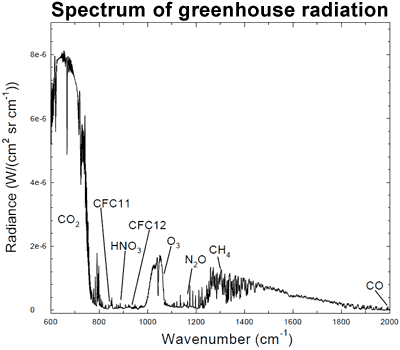
When greenhouse gases absorb infrared radiation, the energy heats the atmosphere which in turn re-radiates infrared radiation in all directions. Some makes its way back to the earth's surface. Hence we expect to find more infrared radiation heading downwards. Surface measurements from 1973 to 2008 find an increasing trend of infrared radiation returning to earth (Wang 2009). A regional study over the central Alps found that downward infrared radiation is increasing due to the enhanced greenhouse effect (Philipona 2004). Taking this a step further, an analysis of high resolution spectral data allowed scientists to quantitatively attribute the increase in downward radiation to each of several greenhouse gases (Evans 2006). The results lead the authors to conclude that "this experimental data should effectively end the argument by skeptics that no experimental evidence exists for the connection between greenhouse gas increases in the atmosphere and global warming."


Figure 3: Spectrum of the greenhouse radiation measured at the surface. Greenhouse effect from water vapor is filtered out, showing the contributions of other greenhouse gases (Evans 2006).

The planet is accumulating heat

When there is more energy coming in than escaping back out to space, our climate accumulates heat. The planet's total heat build up can be derived by adding up the heat content from the ocean, atmosphere, land and ice (Murphy 2009). Ocean heat content was determined down to 3000 metres deep. Atmospheric heat content was calculated from the surface temperature record and heat capacity of the troposphere. Land and ice heat content (eg - the energy required to melt ice) were also included.


Figure 4: Total Earth Heat Content from 1950 (Murphy 2009). Ocean data taken from Domingues et al 2008.

From 1970 to 2003, the planet has been accumulating heat at a rate of 190,260 gigawatts with the vast majority of the energy going into the oceans. Considering a typical nuclear power plant has an output of 1 gigawatt, imagine 190,000 nuclear power plants pouring their energy output directly into our oceans. What about after 2003? A map of of ocean heat from 2003 to 2008 was constructed from ocean heat measurements down to 2000 metres deep (von Schuckmann 2009). Globally, the oceans have continued to accumulate heat to the end of 2008 at a rate of 0.77 ± 0.11 Wm?2, consistent with other determinations of the planet's energy imbalance (Hansen 2005, Trenberth 2009). The planet continues to accumulate heat.


Figure 5: Time series of global mean heat storage (0–2000 m), measured in 108 Jm-2.

So we see a direct line of evidence that we're causing global warming. Human CO2 emissions far outstrip the rise in CO2 levels. The enhanced greenhouse effect is confirmed by satellite and surface measurements. The planet's energy imbalance is confirmed by summations of the planet's total heat content and ocean heat measurements.

For more evidence that humans are causing global warming, check out The human fingerprint in global warming.

Last updated on 26 June 2010 by John Cook.

Printable Version  |  Offline PDF Version  |  Link to this page

Related Arguments

Comments

Prev  1  2  3  4  

Comments 151 to 175 out of 175:

  1. I'd like to point out that SoD's The Hoover Incident provides a delightful Reductio ad absurdum argument supporting the greenhouse gas effect - demonstrating that current conditions cannot hold without the greenhouse effect, and that asserting GHG's have no effect results in a contradiction (temperatures that are not currently observed, an average temperature of -18°C; brrrr....).
  2. Tom Dayton at 06:41 AM, unlike the heat temporarily "trapped" in the bicycle tube, heat within our atmosphere has not been physically constrained as the usage of the word "trapped" by some posters seems to indicate.
    No heat is actually trapped, heat is always being lost, as heat is always being gained.
    What does change is the rate at which it is either gained or lost by the atmosphere, and it is how that balances out that determines whether the temperature is warming or cooling.
    This balance, if able to be controlled by man would either have to control the rate of loss, or the rate of gain.
    Before mankind arrived nature had already put in place processes that must have not only controlled the rate of loss, but the rate of gain.
    If variations in solar radiation was the sole means by which the rate of gain varied, what were the processes that adjusted the rate of loss?
  3. I take the points of Muoncounter and Tom. Yes the temperature of a compressed gas will equilibrate with the surroundings.
    Nevertheless we are starting from TOA of Odeg and near 0 pressure....BUT.... that temperature is 0deg,273K, thanks to insolation, otherwise it would be 3K or thereabouts.
    So that being the case, what must the Temp be at 15lbs/squ in?(at the surface)?

    I have visited the Science of Doom a few times, but the prejudices of the author are very obvious. Why in this age of computerisation of graphics is this medium so seldom employed? One picture is worth a thousand words,mind you it depends on the quality of the picture.
  4. #152: "nature had already put in place processes that must have not only controlled the rate of loss, but the rate of gain. "

    And then we came along and starting releasing all that CO2 that was stored away for millions of years... in the last 150+ years. How do you think nature 'reacts' to that? Seems like the answer is right in front of us.
  5. #153: "what must the Temp be at 15lbs/squ in?"

    Its not a closed system, so the temperature will, as you say, 'equilibrate with surroundings.' Or else we'd only have hot days with high pressure and cold days with low pressure, which would take all the fun out of weather forecasting.

    This is becoming wildly off-topic.
  6. AWoL - yes Science of Doom prejudices are very obvious. He is extremely in favour of textbook physics. As is John Cook for that matter so why are you here? Would you only accept physics if it is explained by an anti-AGW physicist? Not many around but I would be comfortable say Roy Spencer on this pressure nonsense. His take down of Miskolczi and G&T are fine. Has he talked about it?

    There is a "information trust" problem that really makes me scratch my head. When you dont have the expertise to make an assessment yourself, then who do believe? Physicists - or Steve Goddard?
  7. Muoncounter.
    If you think this has gone wildly off topic then you have only yourself to blame.
    You made the claim that the 33deg C difference between the black body calculation and the actual earth surface temp was due to greenhouse gases.
    I say no, and that the effect of gravity and the resultant pressure play a bigger role than GHGs in accounting for this discrepancy.
    That is what my physics textbooks tell me. If I am wrong tell me why.
    If you can't be bothered, then let's not waste time in discussion, and we'll forget about science and the enlightenment, freedom of speech, and thought, and simply cough up a 5% carbon tax and quiescently submit to the rule of totalitarian scientific technocracy and live happily ever after.
  8. AWoL - sadly you cannot take a high school equation useful within its domain and then use it inappropriately somewhere else. If you want to understand it depth (you do dont you?), then I suggested the Science of Doom article with goes through it in depth. Also this .

    If this is going to come up often, then perhaps John should get Chris Colose to right up the argument.
  9. #157: "the effect of gravity and the resultant pressure play a bigger role than GHGs in accounting for this discrepancy. That is what my physics textbooks tell me."

    I'd suggest some new textbooks, although if you have one that mentions greenhouse gases, that's not all bad. My textbooks clearly state that PV=nRT applies to a gas in a closed system. As we said earlier, not the atmosphere.

    But that was your move to take this off topic. I provided some empirical evidence (Spencer); you have yet to reply to that.

    As far as a totalitarian scientific technocracy is concerned, I can't wait. For the rest of your rant, see the comments policy.
  10. Tom,

    The distribution of that energy, and even its form (e.g., sensible heat versus latent heat) is irrelevant to that accumulation that results from that imbalance of in versus out.

    Do you agree with that?

    Not a chance in this universe.

    The distribution of heat is extremely important to the overall heat of the system. And BTW - The imbalance you are talking of gets works out as quickly as nature can muster. 2nd Law. What you seem to be saying is that the imbalance only has a Radiative means to work itself out. Completely true for the entire system, however Temperature by definition is LOCAL.

    I've often spoke about the dangers of Averages when trying to describe a system. Where temperature is at a particular point and time is why there is such a thing as temperature. Same thing for pressure. If you averaged everything out then there is no need to measure it.

    Is there much more heat at the equator than at the poles? Yes, but the overall heat of the entire system is the same.

    Why is the heat at the equator sent mostly to space rather than to the poles? Because space is closer and colder than the poles.

    The average heat of our solar system is far hotter than it is here on Earth. The distribution is not only relevant, it is more important than any imbalance because it tells you where the imbalance is likely coming from.

    Since no one can find any flaws with 107-110 I feel safe in continuing with the availability of convection and the elasticity of the atmosphere as a mechanism to deal with the 'Imbalance' locally within the Troposphere.
  11. I've often spoke about the dangers of Averages when trying to describe a system. Where temperature is at a particular point and time is why there is such a thing as temperature. Same thing for pressure. If you averaged everything out then there is no need to measure it.


    I love this paragraph. No idea what it means but I love it because of that. I suggest reading it out loud. The capitalization of Averages is genius
  12. theendisfar, the only part of your reply that addressed my question was "What you seem to be saying is that the imbalance only has a Radiative means to work itself out. Completely true for the entire system."

    My question was specifically about the entire system--the overall balance of energy, analogous to the overall balance of money in a bank account. That is the point of the section titled "The planet is accumulating heat" in the post at the top of this page. Look at Figure 4. Ignore the breakdown of where that heat is distributed. The top of the curve, showing the total, is what is relevant here.

    Greenhouse gases cause that accumulation of energy in the entire system by blocking the escape of radiation energy to space, thereby causing that imbalance of energy-in-from-space versus energy-out-to-space. You seem to agree with that, as well. That is the greenhouse gas effect. So you do not really think the greenhouse gas effect is "silly."

    Your agreement on those points about the entire system, makes me suspect that your disagreement really is only about how that extra accumulated energy is distributed within the system. Am I correct?
  13. Not sure if the post is closed or just taking some time to update, but I believe I have an exercise that will help clear things up.

    Let's follow the energy. From the Sun to the Earth's surface and back out to space. Toma et al seem to think that where energy is a particular time is irrelevant.

    Let's follow the energy and see.
  14. No, theendisfar, please do not complicate the discussion. Just answer my most recent question first, with a simple answer.
  15. Energy tracking is discussed here

    and excellent relevant discussion of the Trenberth & Kiehl diagram here

    And as for claiming there is no flaws in 107-110. Well we tried to help. I cant even parse what you are trying to say nor could Ian. We've pointed you to a correct interpretation. I give up.
    Response: Yes, theendisfar, if you want to post your version of an energy flow diagram, do it on that thread, not this one.
  16. This may be a rather stupid question given the subject is referred to so often, but I get the impression that at times different people consider it as something different, or perhaps more commonly simply don't know how it is defined and blindly use it.
    So can someone explain where the Top of the Atmosphere (TOA) is actually located, and why that particular point has been declared as such, and what it would mean if different levels were to be considered the TOA instead.
  17. Johnd @ 152 - "If variations in solar radiation was the sole means by which the rate of gain varied, what were the processes that adjusted the rate of loss?"

    Just call it an exercise in deductive reasoning
  18. Moderator,

    If you're going to shut down the ability to post to a thread, can you please notify the audience?

    Thank you
    Response: There is no feature to shut down posting on any thread. If your comments are not immediately appearing, just check that the number of comments isn't just over the 50 or 100 mark (or some other multiple of 50). Your comment might be appearing on the next page over. Or if it appears then is removed, it would be because its violating the comments policy.
  19. The link to Law Dome Ice Core under Figure 1 points mistankingly to Taylor Dome Data.

    This is the correct link to Law Dome Ice Core data.
  20. I just wanted to say thank you for this post. The more available and easily readable evidence in public domain the better it is.
  21. How about the pushing of Human Caused Global Warming is just a distraction to postpone doing the necessary things to reduce consumption of oil, reduce consumption of coal, prepare ourselves and the environment for whatever climate changes occur! Pushing the idea that you are effectively know how it all works is a time waster. Plenty good reasons to reduce oil and coal consumption. Its just pushing the all the blame on to industry when individuals consume the electricity and resources.
  22. cloa513 - if we knew everything, then there would be no need to invest in the science. This site is about the science of climate, and in particular pushing against disinformation. I dont like the disinformation industry - telling lies for financial gain is wrong.

    I think governments should be making the decisions based on best available information, and we will run into trouble with climate before we run out of oil and long before we run out of coal. You are suggesting a PR campaign to sell an idea to an electorate - might work but that would be telling lies too.
  23. Every time I've heard this "empirical evidence" bit the goal posts immediately begin to shift. When I start putting forth the evidence the person's definition of "empirical" and "evidence" start moving all over the place.

    If you promise to stand still we can show you more evidence than you'll ever be able to process on your own.
  24. 171, cloa513,
    Its just pushing the all the blame on to industry when individuals consume the electricity and resources.
    Yeah, and in the seventies it was pushing all of the blame on the tobacco companies when it was the people doing the smoking. It wasn't the tobacco companies' fault that so many smokers believed their arguments that the science was wrong, and smoking didn't cause cancer.

    It wasn't until the government enforced packaging and advertising regulations that people wised up. But then, that's their own fault for being so easily fooled, isn't it? There's no reason in the world why we shouldn't expect history to play out differently this time, right?
  25. The latest preliminary estimates of global CO2 emissions for 2009 and 2010 has been released by the CDIAC

    "These estimates show that 2010 was by far a record year for CO2 emissions from fossil-fuel combustion and cement manufacture. Globally 9,139 Teragrams of oxidized carbon (Tg-C) were emitted from these sources. A teragram is a million metric tons. Converted to carbon dioxide, so as to include the mass of the oxygen molecules, this amounts to over 33.5 billion metric tons of carbon dioxide. The increase alone is about 512 Tg-C, or 5.9%, over the 2009 global estimate. The previous record year was 2008, with 8,749 Tg-C emitted; the 2010 estimate is about 104.5% of that, or 391 Tg-C more."

    I found this graph interesting at the least for the breakdown of sources:

  26. Question: For these predictive models, what is their range of predictions? And what are their assumptions? Do we get access to those assumptions and get to question them?
  27. einhverfr, "assumption" is a loose word in science (about as loose as "consensus"). If you want to learn about what goes into IPCC modeling, you could go directly to the source (noting, of course, that this is AR4 from 2007). Go here for discussion on range.
  28. @einhverfr further to what DSL wrote, the source code for several GCMs are in the public domain, so if the journal papers that explain the assumptions are not sufficient, you can always download the code and find out for yourself exactly how they work and test out the sensitivity of the projections to those assumptions by altering them and running some simulations. If you can show something interesting then there is nothing to stop you from submitting a journal paper questioning the assumptions.

    It is interesting to note there has been no attempt by the skeptics to make a GCM that explains the observed climate without CO2 (they seem to much prefer statistical models). I suspect that there is a good reason for this, which is essentially that it can't be done without making obviously unrealistic assumptions about the physics.
  29. Within chapter "CO2 traps heat" is a pdf download link to:

    Philipona, R., B. Dürr, C. Marty, A. Ohmura, and M. Wild (2004), Radiative forcing - measured at Earth's surface - corroborate the increasing greenhouse effect, Geophys. Res. Lett., 31, L03202, doi:10.1029/2003GL018765.

    The pdf is not (directly, May 2012) reachable through the link (agu.org). I did not check wether it is paywalled or requires registration/login before reading.

    Link to the abstract page on agu.org

    Currently (May 2012) Dr Marty provides the pdf over his personal page on slf.ch (WSL Institute for Snow and Avalanche Research SLF).

    Since this is one of the "directly measured" evidence papers cited by many (IPPC 2007, Rahmstorf&Schellnhuber...), there should be a safer and better accessible place for it.
  30. According to this thread,
    "
    What the science says...
    Direct observations find that CO2 is rising sharply due to human activity. Satellite and surface measurements find less energy is escaping to space at CO2 absorption wavelengths. Ocean and surface temperature measurements find the planet continues to accumulate heat. This gives a line of empirical evidence that human CO2 emissions are causing global warming."

    I have several quesitons:
    1. What percentage of the energy in the absorption bands of CO2 are being absorbed today?
    2. Isn't there information from NOAA that indicates that although Global Heat Content has risen over an extended period, it has recently done an abrupt levelling?


    3. Isn't the information in the argument a collection of items that indicate a correlation, but not a causal relationship? What are the experiments that have been run to prove or disprove the causal relationshio?

    Dave
    Response:

    [DB] Please document the paternity of your graphic (the data sources used and any changes made).

    [Albatross] Please also familiarize yourself with the comments policy. Your questions have been addressed elsewhere at SkS, so your above comment constitutes "sloganeering" which is in breach of the comments policy.

    As for the causal relationship between CO2 and global temperature, statistical tests have determined that changes in CO2 Granger cause changes in temperature (e.g., see here).

  31. matzdj... You're not presenting a chart of "Global Heat Content" as far as I can see. You're presenting a chart of surface temperature. Don't forget that most of the heat energy is retained in our planet's oceans.
  32. matdj... Here is the page I find for NOAA's Global Ocean Heat Content... LINK

    Note specifically the second panel in the series. 0-2000m. I don't think you're going to see any "leveling off."
  33. matzdj, why do you post the same graph as you posted on the 17th May on another thread? Did you read the responses you were given (several detailed responses including at least nine links to follow from myself and DB)? Did you do any analysis to determine whether there has actually been a significant change in trend? Or are you just here to repeat tired old debunked talking points and not listen to the responses you were given?

    The graph you provide is not [ocean] heat content from NOAA - I provided you with the link to NOAA ocean heat content (the same as Rob's above) on 17th May.

    Until you do the analysis to determine whether there has been a change in trend, your comment is empty of substance in any case.
  34. matzdj's questions @180 are either nonsensical or grossly misinformed. Take his first question as an example. His question assumes, falsely, that CO2 has a constant "absorption band" regardless of its concentration in the atmosphere. On the contrary, as the CO2 concentration increases, the current absorption band widens, and new absorption bands form, as can be seen by this comparison of modtran emission spectra for 375 and 999999 ppmv of CO2 in the atmosphere, and with no other greenhouse gases:

    375 ppmv


    999,999 ppmv


    The Modtran model is reasonably, but not entirely accurate. In this instance it introduces a large inaccuracy by preserving atmospheric temperatures as if there was no change in CO2 content. If temperatures were allowed to adjust, the large W shape between wavenumber's 400 and 800 in the 99.99% example would be a large V or U shape instead, indicating much larger "absorption". The reason for this is that the outgoing spectra is not a product just of absorption of surface radiation, but also of radiation from the atmosphere.

    For empirical comparison, here are the IR spectrums of the Earth, Mars, and Venus. Note that the absorption from Venus is from the surface radiation with a blackbody spectrum for 735 degrees K, not the 260 degrees K shown:


    In his second question, matzdj assumes the Earth is just 700 meters deep by using the OHC record for only that portion of the ocean. He would have done far better to use the OHC record for the first 2000 meters of the ocean, as below:


    Better yet, he should have used the data for the entire Earth, as in figure 4 above. So, "Isn't there information from NOAA that indicates that although Global Heat Content has risen over an extended period, it has recently done an abrupt levelling?"

    Umm. No! Not unless you ignore the available evidence from NOAA that you find inconvenient.

    Finally, in his third question, matzjd simply ignores the fact that the correlation between CO2 forcing and temperature was first predicted from physical principles around 200 years ago. The correlation of the Earth's temperature to large changes in CO2 forcing throughout Earth's history for at least the last 600,000 years (the period with any available data) did not come as a surprise to anyone. It was a predicted consequence of the observed fact that CO2 is transparent to visible light, and absorbs Far IR radiation, the observed fact that the Earth re-emits the energy received from the Sun, primarily as visible light and Near IR radiation in the Far IR spectrum, and that energy is conserved.

    I have discussed extensively the experimental observations that make us confident of our understanding of the transmission and emission of CO2 in the atmosphere, and consequently make us certain that there is a greenhouse effect. As matzjd seems determined to ignore that evidence, here I shall simply show the correlation shown by the inexact (because of a lack of a precise temperature and humidity profile), and obsolete (1987 vintage) modtran model and observations:

  35. My apologies for what is likely an off-topic comment, but I wasn't sure of a better place to put the question. Has the Woodfortrees website moved? Google claims it should be at woodfortrees.org, but there's nothing there but an apache tomcat setup page. I hope nothings happened to the site - it's very handy.
  36. Many of us are wondering what's up w/Woodfortrees, Steve. It's much cited and well-liked by folks of all stripes. Hopefully the proprietor is having a nice vacation somewhere and simply hasn't noticed it's down. (OK, that's sounds pretty unlikely but I guess we may as well be optimistic.)
  37. Folks, apologies for the WFT downtime - it was caused by an IP allocation cockup at my hosting provider, and as Doug guessed, I didn't notice for a day!

    Should be fixed now in DNS but it may take a while to propagate.

    Best wishes

    Paul
    Response: [DB] Thanks, Paul. If we can help in any way down the road, let us know.
  38. Good to hear! Thanks for the work in keeping your website going.
  39. Aye, thanks Paul -- it's an obviously highly useful tool and easy enough that people who've never engaged the science can get a toehold for their motivation.

Prev  1  2  3  4  

Post a Comment

Political, off-topic or ad hominem comments will be deleted. Comments Policy...

You need to be logged in to post a comment. Login via the left margin or if you're new, register here.

Link to this page


TEXTBOOK

THE ESCALATOR

(free to republish)

THE DEBUNKING HANDBOOK

BOOK NOW AVAILABLE

The Scientific Guide to
Global Warming Skepticism

Smartphone Apps

iPhone
Android
Nokia

© Copyright 2013 John Cook
Home | Links | Translations | About Us | Contact Us