Do volcanoes emit more CO2 than humans?
The skeptic argument...
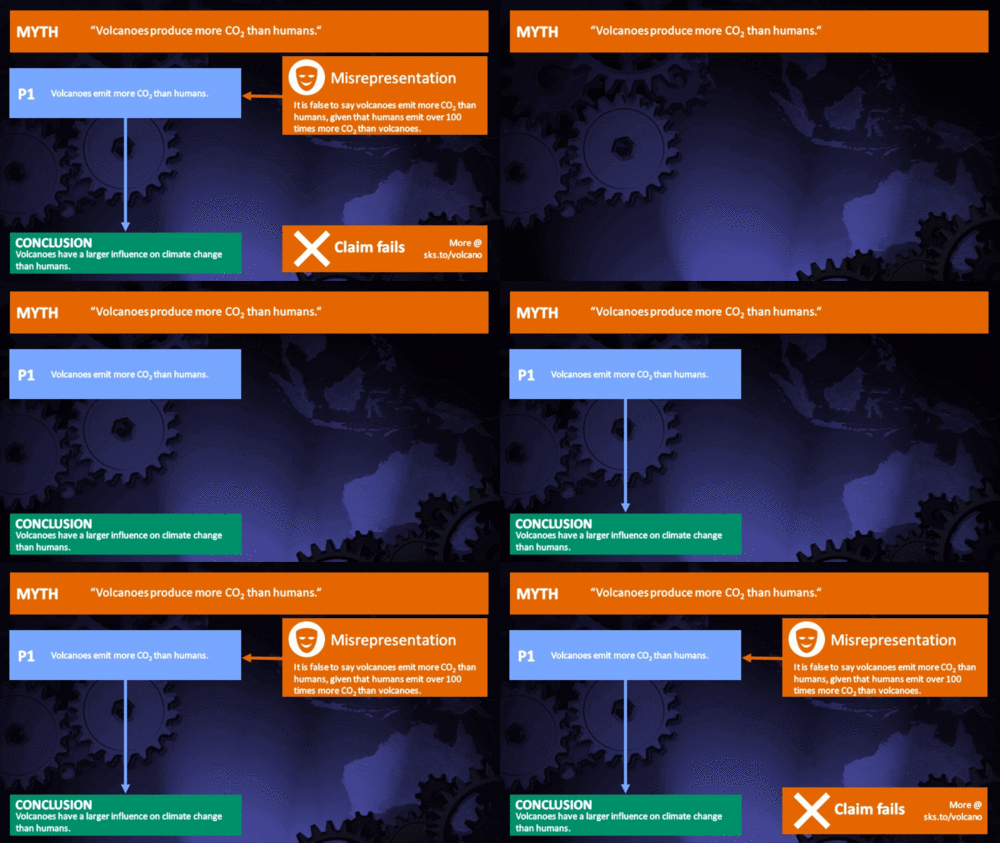
Volcanoes emit more CO2 than humans
"Human additions of CO2 to the atmosphere must be taken into perspective.
Over the past 250 years, humans have added just one part of CO2 in 10,000 to the atmosphere. One volcanic cough can do this in a day." (Ian Plimer)
What the science says...
| Select a level... |
Basic
|
Intermediate
| |||
|
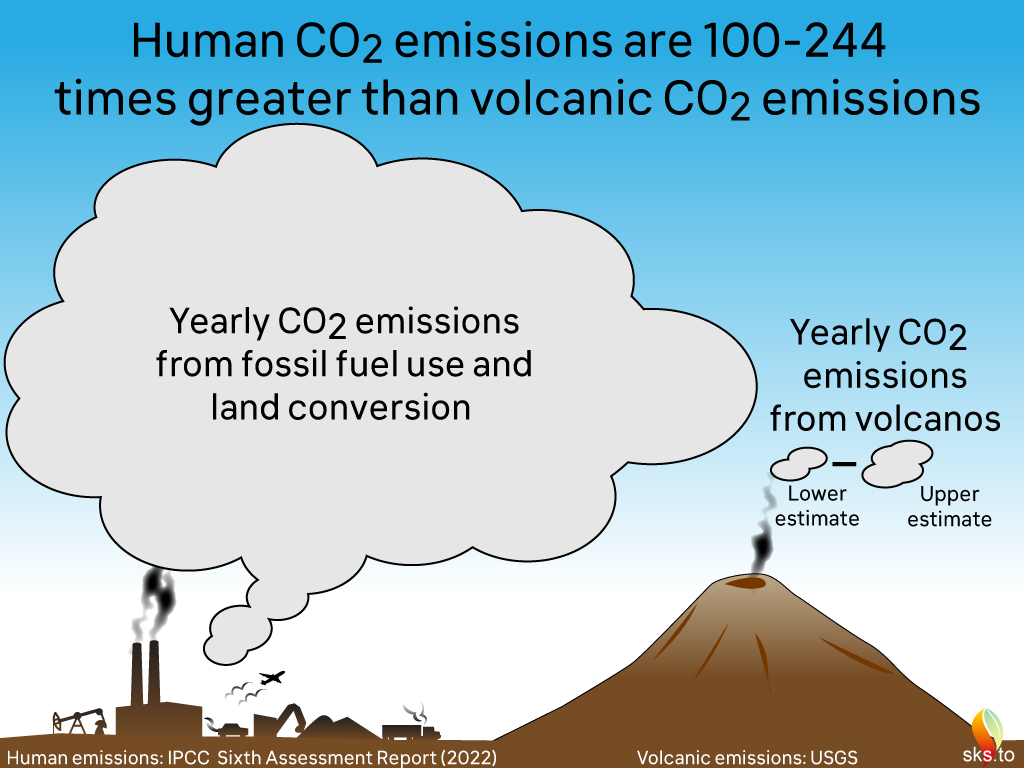
Humans emit 100 times more CO2 than volcanoes. |
|||||
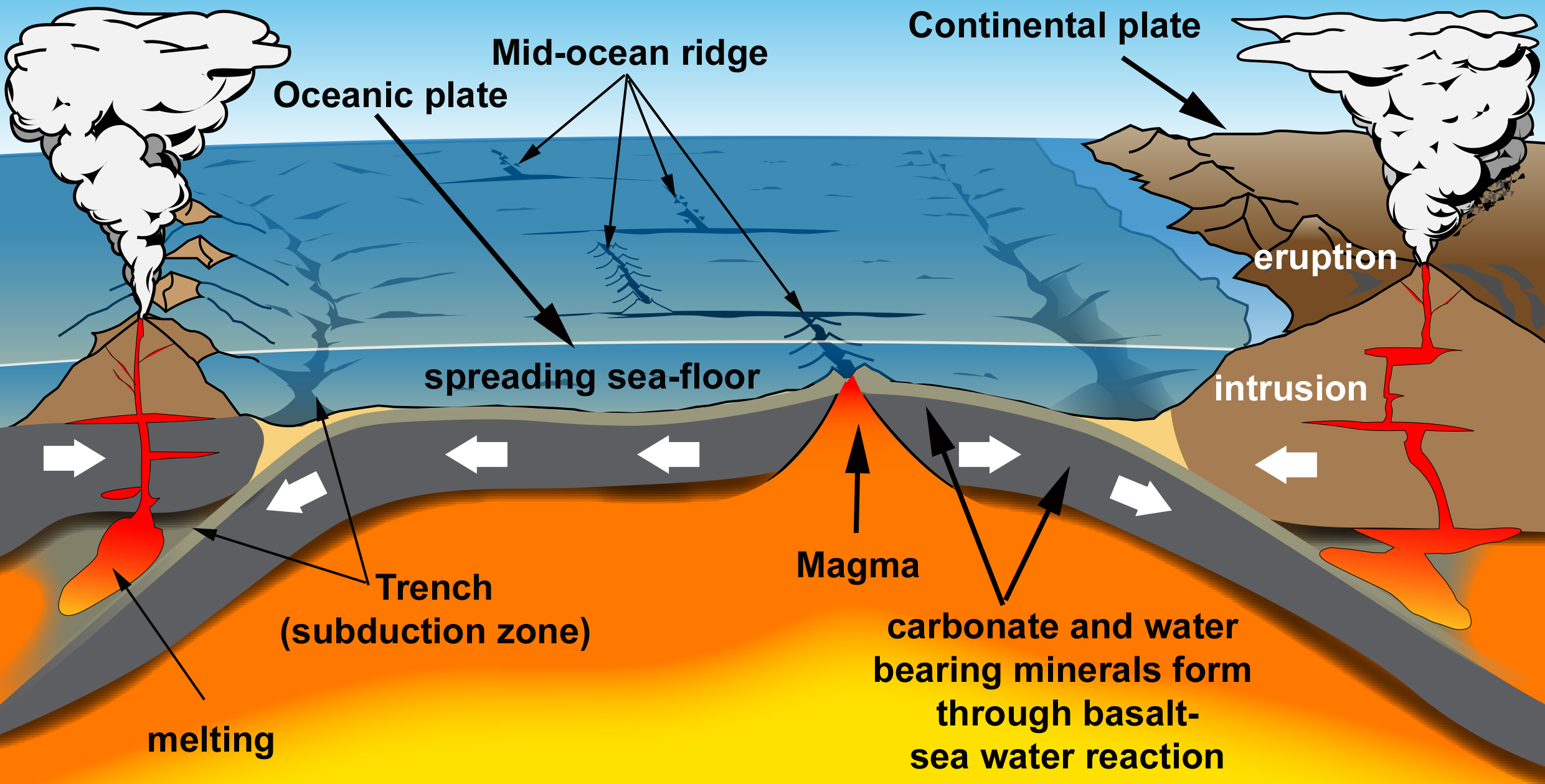
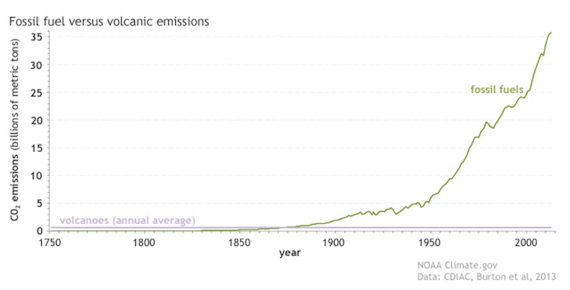
The solid Earth contains a huge quantity of carbon, far more than scientists estimate is present in the atmosphere or oceans. As an important part of the global carbon cycle, some of this carbon is slowly released from the rocks in the form of carbon dioxide, through vents at volcanoes and hot springs. Published reviews of the scientific literature by Moerner and Etiope (2002) and Kerrick (2001) report a minimum-maximum range of emission of 65 to 319 million tonnes of CO2 per year. Counter claims that volcanoes, especially submarine volcanoes, produce vastly greater amounts of CO2 than these estimates are not supported by any papers published by the scientists who study the subject.
The burning of fossil fuels and changes in land use results in the emission into the atmosphere of approximately 30 billion tonnes of carbon dioxide per year worldwide, according to the EIA. The fossil fuels emissions numbers are about 100 times bigger than even the maximum estimated volcanic CO2 fluxes. Our understanding of volcanic discharges would have to be shown to be very mistaken before volcanic CO2 discharges could be considered anything but a bit player in contributing to the recent changes observed in the concentration of CO2 in the Earth's atmosphere.

Volcanoes can--and do--influence the global climate over time periods of a few years but this is achieved through the injection of sulfate aerosols into the high reaches of the atmosphere during the very large volcanic eruptions that occur sporadically each century. But that's another story...
Recommended further reading on CO2 and volcanoes can be found here: Terry Gerlach in Earth Magazine ; USGS
Last updated on 10 August 2012 by John Cook. View Archives

Arguments


Basic
Intermediate


It has been determined that the earth does not work slowly but just like evolution, in fits and spurts, ie. it does not matter if it's a million years or a hundred years. What matters is current phase which is an active phase. This was noted in an article this past year (more new information not taken into account by the IPCC).
Yes, those volcanos are active. And those are only the ones that are under the ice, not the ones on the ocean floor. It's a subduction zone.
We are also looking at overall trends, over millions of years in addition to the current phase. It certainly does pertain.
Here is a couple more new items of increased tectonic activity:
New Fault Raises Threat of Eastern Earthquakes
Yellowstone Earthquake Swarm Puzzles Scientists
We are also looking at overall trends, over millions of years in addition to the current phase. It certainly does pertain. "
To the subject of climate in general, but not so much to AGW specifically in as far as the causes of recent changes (last 100 years, especially last few decades) must be, outside of natural variability contributions, things which have recently changed and in so doing reached states unseen for some longer time.
"What matters is current phase which is an active phase. This was noted in an article this past year "
Which article?
"Yes, those volcanos are active. And those are only the ones that are under the ice, not the ones on the ocean floor. It's a subduction zone. "
But are they unusually active?
The numbers just don't add up to explain much of recent climate changes, if even to suggest some significant multidecadal trend in tectonic activity.
I am referring back to the articles posted above in this thread. Yes the activity increased in the late 1970s and has continued. That is exactly what all of the above links indicate. And what is usual? The realization that tectonic activity is not a constant is a recent realization (the article on this concerns mountain building in fits and spurts). So how can it be more than usual, as there is apparently no usual.
The "new" fault is obviously not new, it just has become active again. I knew it was there, so obviously they should know at LEAST what I was able to learn. It's a very sad state of affairs for the educational system in the U.S.
Are you sure the fault you knew about is the specific one they described as recently discovered? I didn't get the impression from the article that there has been any recent activity at that specific fault (where I heard about it from a different source, my impression was that the bubbling liquefied sand was not an ongoing process but something that had happenned and left a mark in the geologic record, which helped identify the fault), which is near but not the same as the New Madrid fault, which I also already knew about.
"So how can it be more than usual, as there is apparently no usual."
Of course it is not constant, but as with climate and weather, there will be a general state of tectonic activity within which variations and events occur on smaller time scales.
There does seem to me to be more tectonic activity right now than 10 years ago (but is that a false impression created by a very small data set? - in other words, this isn't something I've followed closely). Is this level unusual for the last 100 years? The last 1000? There was an earthquake in Portugal - I think during the little ice age, actually (but I'm not sure) - and it killed something like over 70,000 people. Which is a great tragedy, of course, but what does that imply in as far as tectonic trends or short term tectonic activity - climate relationships? Not much.
When you picture the level of tectonic activity over time - let's say the last 1000 years - what do you picture: (_ low, , - medium, | high, ^ higher, A highest)
(graphs coming soon)
-^^__A|__^||^^|^|__||A|_^-A^^^A-A|A-_^-^-_|^---_-A-|A^^_|A_A_^^^A-AA^^^_-_A-^-_||__--A-_^-^A_||-__^_--_|A-^^_|-
B.
A----A-|A-^|AA^--|A___-|^-A_|_||-|-|^-_^___-_A|_-^^A_-_^AAA_A|^A_^|A_^__-AA_A-__|A|A^^A^^A-_||___^^|__-A^AA^-A-
C.
_|_^^^AAA^_|-__-_|^A|----A^|^_|A-^__|___|_|___A^_AA|_---_-^|--_____A|_|^A--^|_-^A_|A-|-|-__A__A-_^A-_|^-|^^-^A_
D.
__^__^-|^--_AA_^__A____^-||_^||__A__^-_--_-_^_-_-____|-_-||_-A__A__|__^__A^-____||-_|_A_|_____|-___A|-__^___^__
E.
__^____^A____--_|-^--|__-__|A-|^-_|A__-||_A__-A^^-__|-|___|___|_---_^^__|A-^-A__-^-_-__A-_^____|___|__^|_______
F.
___^___--__|-_-_|__|____|___-_-|____|__^-____||_-__-_-|-_-__^____|_-____|_|___--__|-__^_^|^____|___|-_-_-|-_-_|
G.
--|-____-___-A-^__-|---_-__-_A____-_-__--A__---_-__|-|-_|-_A-|_|_|_-_^|_A--_-^^^_-_-_^___-__^--___|___|_|_|____
H.
_____A_--A|__-_^-_-A_^_-_-___--_|_|__----|__--_^A-^---_-|-A____|__---___---__|^___^___|-_____A_-|_^_-|______^|_
I.
-_-__--A|__|-_^^------__|-^-_---__-|__-|__-_|-_-____-_|_^-_-___|_|-__^___A___-||A-|-A_______^__^-__-_-^___A_|_^
J.
_-_A|-_-|---_|^--__---^_---|-__-_A_-_|^-_A-__^-__|-^_-__-_||_^-_-|____-____-_--^|__|_--_--^__-__-|_--|^-A^A-|^A^
I have been assuming that you are up on geology since you are studying climate. Your recent comments have indicated that I made a false assumption. I am sorry if I have confused you.
On the antarctic:
The penninsula of west antarctica sits on a subduction zone, that is the reason that the volcanos are active and mountain building is still occurring in that region. That is the southernmost extent of what they call "the ring of fire".
The New Madrid area is a juncture of a fault line and a fracture zone. In each of these areas there is only one main fault but it has fractures running perpendicular and minor faults running parallel. The appalachian chain follows the main fault. It has many inactive volcanos all along it from Texas to Maine as proof. They are "discovering" old faults that were considered "dead" but they were simply not very active, and that activity has been increasing for about 25 to 30 years now all along that main fault.
Another area of subduction is the northern edhe of Greenland and Arctic Canada. Again this area has only recently increased in activity. The subduction zones along Asia and Alaska have also increased activity, the recent volcanic activity is simply indicative of the tectonic activity.
This is why geologists make good climatologists.
Anyway, even with some correlation between tectonics and climate, one still has to show at least either that the correlation is robust (reoccurs with statistical significance) and/or that there is some reason to expect a predictable (as opposed to butterfly effects) causal relationship.
At least that is met for short term volcanic aerosol cooling, for longer term geologic influences on atmospheric CO2 concentration, and changing geography (but a local land rise of 5 inches isn't generally significant as a regional or global climate cause).
"This is why geologists make good climatologists."
What "This"? - for comment 159 is essentially all about geology. Why not then assume that because I have a grasp of climatology, I might then know more about geology than you do - that would also potentially be erroneous.
Yes a fault, volcano, etc., might be thought dead/extinct and later discovered to still be active or have potential for activity in the not too distant future, etc. But that doesn't mean that all new discoveries of potentially active faults had already been identified as faults, does it?
An example of what I am aware of - The New Madrid seismic zone is a leftover of a failed rift - an aulacogen (aka Mississippi Embayment ?) - from around the time of the breakup of Pangea or around that time (I'm better at the generalities than the exact dates). A much older example of a failed rift underlies Lake Superior and is ~ a billion years old or so - at least roughly in the same temporal territory as the Grenville orogeny (might they be causally linked?).
Well I guess that depends on what you mean by 'up on'. I have a good basic understanding of the rock cycle, plate tectonics, mantle convection, some stuff about the core, geochemistry, how material is processed so as to concentrate some materials in some places in some forms (repeated partial melting and freezing for igneous rocks), crystal lattices, the large scale of geologic history; I could draw a rough map of Pangea; am less clear on Rodinia, I've heard of Mazatzal (spelling?); I know detrital pyrite is an indicator of lack of oxygen; ... But no, there are certainly a lot of minerals (especially the rare ones) that I couldn't identify or have never heard of, I don't know every division of time, I don't know every minor fault, I don't know precisely where the line is drawn between active, dormant, and extinct; I have some more detailed knowledge about a few things, like Baraboo quartzite (it goes back ~ 1.8 billion years, has some association with the Penokean orogeny; color an indication of presence of atmospheric oxygen at the time).
No offense meant. I did assume that you understood more geology than I do. Your questioning if volcanos are active over an active subduction zone threw me a curve. I assumed that you knew where the subduction zones were
(Hansen et. al. apparently doesn't). The pattern of activity has been increasing since the 1970s.
Looking at paleomaps, it is clear that the "canadian shield" is not a solid plate. The rifting really is not a failed rift. What we have is a compression along an old plate edge that we assumed to have fused when beringia was formed. I don't believe anything "fused" is actually a permanent condition.
PS
I don't understand what 158 represents.
To clarify, does J indicate the current time and what time frame are you depicting?
To see what I mean look at this map:
http://www.scotese.com/newpage1.htm
Look at New England and Nova Scotia near the bottom left of the map.
"I don't believe anything "fused" is actually a permanent condition"
- well, that makes sense, but I would guess that, other things being equal, forces would be more likely to reactivate more recently active faults than faults that have been dead for longer.
Re 164 - each is a hypothetical ~1000 year 'graph' of tectonic activity. I altered J in an attempt to show what one might expect it to look like if recent global warming were driven by an increase in tectonic activity.
Even if it did look that way, however, there is still the problem that there is not enough reason to expect one to cause the other. Whereas there is much reason to expect adding CO2 to the atmosphere to cause warming, with or without paleoclimatic and geologic record correlations, though every bit can help clarify matters.
I don't see what your point is about the map http://www.scotese.com/newpage1.htm (458 Ma). The Keweenawan rift (underlying Lake Superior but extending elsewhere) predates this map and within the borders of the portions (or at least mostly so) of North America so far assembled and still together at 458 Ma.
I was referring to New England and Nova Scotia being on a seperate plate. It's actually more than New England but that's irrelavent. The joining of this land mass from the bottom left to the canadian shield is responsible for much mountain building and the primary appalachian fault which is still active. They just had a 3.0 quake in Morristown N.J. a couple days ago - extremely rare event for N.J. which I am assuming occurred along the Ramapo fault (a parallel fault). This makes sense when you realize that the arctic ridge increased speed and is pushing the canadian shield south again.
Isn't possible, though, that there has been no increase in activity? Because:
"They just had a 3.0 quake in Morristown N.J. a couple days ago - extremely rare event for N.J."
(PS I heard about that one. I had known about the New Madrid fault quite some time ago but just a couple or so years ago I was surprised to see on a map that there was significant seismic hazard in South Carolina and elsewhere in eastern North America. I think there've even been a few big earthquakes in the New York/eastern Canada region (historical).)
When events are so rare, it is really hard to tell from a short record just what would signify a trend in activity. Maybe there's an average of one >= 3.0 earthquake in NJ every 500 years or so (pure hypothetical example - I don't know what the number actually is).
You did refer to news about scientific findings from the Arctic ridge, but it was never established that there was an actual significant increase in speed. Mantle convection and the large scale plate motions that follow it are gradual on the scale of many years to many hundreds of thousands of years ... not sure where the long cut-off would be - the point being that, as some portion of the stress is relieved in jolts, I would expect the finer time scale will show some irregularity in motion on the spatial scale of the stress build up and relief by single or a few earthquakes. But this will tend to average out on intermediate timescales because the source of such stress is from the pressure variations due to elevation, composition, and temperature variation, which change significantly only on much longer timescales.
thats 2nc Avenue in Manhatten (NYC).
Was that before or after they realized the fault had a potential for activity?
PS - a little fuzzy on some of this, but I think:
The Keweenaw rift formed (as a rift) just before 1000 Ma, and this may coincide with the Grenville orogeny (to the east if oriented as now) - (perhaps the rift occured over a descending slab of subducted oceanic crust, from the subduction zone to the east (if oriented as now)). Shortly afterward, it reversed from being extensional to being compressional; fallen blocks (The Saint Croix horst?) (having been covered with basalt and sediment) were forced back up again. This occured between 1000 Ma and 900 Ma, during another collision (I believe distinct from and coming after the Grenville orogeny, though not completely sure). But, faults were again reactivated during another collision in the Ordivician, with the former rift absorbing a bit more compression.
"Obviuosly they stopped work on it. "
Was that before or after they realized the fault had a potential for activity?
The blasting caused an earthquake. Not a good thing under downtown NYC. :)
That sounds logical enough. I thought that you were talking about a recent event when you first said "a failed rift". It does not seem to have failed, just old and later compressed.
My cousin has a degree in geology (not a PhD) and showed me some of the features upstate New York some years ago. Where he is now (near Albany) has Devonian rock all over, covered with fossils. Interesting stuff.
Period from 1945 to 1970 (16 major eruptions)
Nomen Year Rank Location
FERNANDINA 1968 4 Galapagos
AWU 1966 4 Sangihe Islands
KELUT 1966 4 Java
TAAL 1965 4 Luzon
SHIVELUCH 1964 4+ Kamchatka
AGUNG 1963 5 Lesser Sundas
AGUNG 1963 4 Lesser Sundas
BEZYMIANNY 1956 5 Kamchatka
CARRAN 1955 4 Chile
SPURR 1953 4 Alaska
BAGANA 1952 4 Bougainville Island
KELUT 1951 4 Java
LAMINGTON 1951 4 New Guinea
AMBRYM 1951 4+ Vanuatu
HEKLA 1947 4 Iceland
SARYCHEV 1946 4 Kuril Islands
Period from 1971 to 2006 (26 major eruptions)
Nomen Year Rank Location
RABAUL 2006 4 New Britain
MANAM 2005 4 N.E.of New Guinea
REVENTADOR 2002 4 Ecuador
RUANG 2002 4 Sangihe Islands
SHIVELUCH 2001 4 Kamchatka
ULAWUN 2000 4 New Britain
RABAUL 1994 4 New Britain
LASCAR 1993 4 Chile
SPURR 1992 4 Alaska
HUDSON 1991 5+ Chile
PINATUBO 1991 6 Luzon
KLIUCHEVSKOI 1990 4 Kamchatka
KELUT 1990 4 Java
AUGUSTINE 1986 4 Alaska
CHIKURACHKI 1986 4 Kuril Islands
COLO 1983 4 Sulawesi
GALUNGGUNG 1982 4 Java
CHICHON 1982 5 Mexico
CHICHON 1982 4+ Mexico
PAGAN 1981 4 Marianas
ALAID 1981 4 Kuril Islands
ST.HELENS 1980 5 Washington
AUGUSTINE 1976 4 Alaska
TOLBACHIK 1975 4+ Kamchatka
FUEGO 1974 4 Guatemala
TIATIA 1973 4 Kuril Islands
Source:
http://www.volcano.si.edu/world/largeeruptions.cfm
Results: 10 more eruptions recently with a VEI >=4 than for the same length preceeding period using 1970 as a cutoff.
Note: I have no access to the additional activity or the undersea volcanos that are not included.
You might find this interesting: Rift Zones: New Understanding Of Incredible Forces, Oil And Gas Reserves Beneath The Earth’s Surface
ScienceDaily (Feb. 12, 2009)
Re 175 - supposing that undersea volcanism were proportional to the number of VEI>=4 eruptions apparent from the surface, and using 16 per 26 years as a baseline:
1970 - 1944 = 26
2006 - 1970 = 36
16/26 ~= 0.615
36/26 ~= 0.722
0.722/0.615 ~= 1.17
A 17 % increase in VEI>=4 eruptions.
A 17% increase in submarine eruptions would be some very small fraction of total geothermal heating, having a heating effect much much less than 0.1 W/m2.
26/36 ~= 0.722
Look beyond the eruptions. Why are there eruptions and what do they implicate? A recent article states "Magma chockfull of silica is viscous (think warm, gooey taffy) and traps lots of gases."
This indicates that the magma is mixing with subducted sea bottom. All of these volcanos near coasts are there because of the subduction. An increase of volcanic eruptions are symptons of tectonic plate movement and that is the "thermostat" that I already referenced.
It's not a slowed process, it's a chaotic process that is now happening but was induced by the 1976 planetary alignment.
Keep in mind that planetary alignments of that nature are extremely rare and take several years to line up fully and several more to unalign.
The combined pull of the planets beyond our orbit is greatly underestimated because of the lack of understanding of gravity.
If you can't see this you can't follow my reasoning for climate changes.
Yes, it is. But geologic emissions are only roughly 2 or 3 percent of anthropogenic emissions and are roughly balanced by the chemical weathering sink.
-------------
"This indicates that the magma is mixing with subducted sea bottom."
The magma comes from subducting crust and some of the overlying crust. Crust is enriched in silica relative to the mantle, so yes, subduction zone volcanism tends to be more silica rich (and produce less mafic and more felsic igneous rocks) than mid-ocean ridge magma. Hot spot volcanism magma comes from the mantle but penetrates overlying crust, as I understand it - well it's quite fluid (and produces basalt, I think) at Hawaii, but can be quite viscous (and typically felsic) at Yellowstone - my guess is the difference in overlying crust composition is the big factor. Continental crust is more felsic and less mafic than oceanic crust; the mantle is ultramafic.
Igneous rocks
----------- felsic --------------- mafic ----| ultramafic
intrusive: granite. grano-diorite diorite. gabbro | peridotite
extrusive: rhyolite dacite....... andesite basalt | komatiite
There are also a class of igneous rocks which are less rich in silica but not mafic; they contain feldspathoids. Chemically, feldspathoid + quartz = feldspar; igneous rocks can contain feldspathoids and feldspar, feldspar, or quartz and feldspar, but not quartz and feldspathoids at the same time because they would have reacted in a molten state to produce feldspar. Of course, during the crystalization process, some crystal grains can form and then (if/when big enough to prevent diffusion toward equilbrium composition) become out-of equilbrium with the composition of the melt...
-----------------
"Keep in mind that planetary alignments of that nature are extremely rare and take several years to line up fully and several more to unalign."
How rare is rare?
"The combined pull of the planets beyond our orbit is greatly underestimated because of the lack of understanding of gravity."
If you're thinking of the invocation of dark matter to explain the rate of revolution around the galactic center at great distances, you should know that doesn't apply to planetary orbits around a star. If it did, Pluto would be orbiting faster.
If you're thinking of 'reduced mass' instead of actual masses, that's important for objects with masses similar to each other, but with the planets all orbiting the sun, and the sun's mass over 1000 times that of the next most massive body involved, 'reduced mass' is a very minor issue for planetary orbits. It plays a bigger role in the Earth and moon's orbits about their common barycenter, but it's still a relatively small effect, furthermore, we do understand it.
Relativistic effects are also relatively minor for the solar system, although it might be necessary to take them into account for Milankovitch-like cycles of various planetary orbits (it makes a contribution to perihelion advance) - where incremental changes build up after many revolutions. This is understood.
If you're thinking of the lack of theory that unifies general relativity and quantum mechanics - that's a nonissue for actually using general relativity and it's approximation, Newtonian gravity, for planetary orbits and even dust-particle orbits, charged particle orbits, etc.
If you're thinking of radiation pressure, that's understood as well.
http://www.etsu.edu/physics/etsuobs/starprty/22099dgl/planalign.htm
http://www.badastronomy.com/bad/misc/planets.html
Re: Quietman - where in the above comments were your friend's and chris's comments about thermodynamics?
It was posted in a different thread. See comment 35 here:. Is Antarctic ice melting or growing?
ps
I had to stop posting in the thread where you asked. Just to open it takes a couple of minutes now (it's too long).
pps
This thread is also becoming a problem but not as bad.
Re: "furthermore, we do understand it."
I don't think so. When we identify the nature of gravity we will understand it. Thus far we only understand it's effects and that not completely.
What we have is a "working knowledge" of gravity. The same as we have a "working knowledge" of climate. We really do not have all the answers yet.
When making models using math it is nest to keep in mind the statements that Einstein and Tesla made on the subject.
“ ...[a] magnificent mathematical garb which fascinates, dazzles and makes people blind to the underlying errors. The theory is like a beggar clothed in purple whom ignorant people take for a king ... its exponents are brilliant men but they are metaphysicists rather than scientists ...[76] " - Wikipedia
I don't remember Einstein's exact words about math versus experiment, but they essentially agreed with what Tesla said about his math (just not about his own theory). LOL
As far as I know, it was a bit of an intuitive leap, but there were reasons for thinking that these conditions might be true. For the first part, the speed of light was predicted by some equations (Maxwell) that involve two constants - permittivity (related to electric fields) and permeability (related to magnetic fields). See:
http://en.wikipedia.org/wiki/Permittivity
http://en.wikipedia.org/wiki/Magnetic_constant
http://hyperphysics.phy-astr.gsu.edu/HBASE/electric/elefie.html
These values can vary as material properties, but have values in 'free space' as well. If space is a material... well...; but anyway, will these material properties change if the materials move? It's concievable but ...
Well, there are two immediately apparent options:
Physics varies among inertial reference frames, suggesting there is a fundamental inertial reference frame (the only one in which the speed of light appears the same in all directions?), perhaps the one which follows the motion of space itself?
- OR -
The speed of light is the same in all reference frames; physics is the same in all inertial reference frames; space and time can be warped.
Anyway, Einstein's theory yeilded predictions; tests have been made (E=mc^2 (actually, that's a special case of E^2 = m^2*c^4 + p^2*c^2, I think), gravitational lensing, the relativistic correction to Newtonian-based calculation of the perihelion advance of Mercury (non-relativistic contributions come from planetary interactions), red-shift due to the expanding universe (actually that may be relativity as evidence of expansion rather than the other way around?) - due to lengthening wavelengths with the expansion of space as the photons are travelling - this is distinct from red shift due to relative motion, which I believe is also altered by relativity relative to the equation for the doppler shifting of sound waves, for example - there is also relativistic gravitational red shift, gravitational distortion of time... so far the theory has not falsified.
I wonder if Tesla's opinion about relativity is analogous to Einstein's opinion about quantum mechanics.
Anyway, where in the scales involved of the solar system and the Earth has General Relativity - or Newtonian approximations, where applicable - been violated? If there is an error it is too small to be detected yet. Which says something about whether we need be concerned with regards to Milankovitch cycles, tides, etc.
---
"See comment 35 here" ... "I had to stop posting in the thread where you asked. Just to open it takes a couple of minutes now (it's too long)."
I don't know about your computer or internet connection, but what I would do is open up multiple windows (or tabs, if you have that option) so that I can do one thing while waiting for another... I'm going to keep posting at the other site; maybe if you only stop by once every few days...
Will do.
Now I'll see if I'm on the right track...
A growing plume - or at least one which is still growing in it's surficial manifestations.
A mantle plume doesn't just happen overnight. This is all very interesting but has no bearing on climate changes over the last century, millenium, the Holocene, ... etc.
That applies also to evolution, the standard model, gene regulation, and everything in between. It's all a matter of how refined the working knowledge is and how precise the working can be. We don't really know what an electron is. We have a theory that we name that, we know how that theoretical unit behaves in a range of conditions, how it interacts with other theoretical units. We have an idea of subunits composing it, to the extent that we have broken it down as far as the energy levels required have been reached, but there may still be other levels waiting to be discovered.
As good as that is, it's still only a "working" knowledge. Science does not provide absolute certainty or exhaustive knowledge, except perhaps at the most basic levels of a field.
Exactly, but we understand more about some things than others. We understand less about gravity than magnetism or electricity for instance. So we can be more certain about the things that we have a better understanding of.
Example, we have a much better understanding of neandertal than australopithecus and therefore can draw better conclusions about the former than we can about the latter.
In what ways, exactly? Surely, quantum gravity and dark matter, dark energy, etc, are not well understood, whereas QED works out quite well, so far as I know (though there will ultimately some underpinning that is not yet understood thoroughly and that is likely to be related to quantum gravity, etc. - for example, string theory).
But what difference does that make to gravitational interactions among the Sun, planets, moons, asteroids, comets, dust particles, ions, etc, of the Solar System?
Meanwhile, there is a complexity to how the solar wind and interplanetary magnetic field, geomagnetic field, and the ionosphere interact, and how that might interact with the fluid mechanics of the atmosphere, and I don't see a good reason to expect this plays a big role in most climate changes.
It is because we tend to look at the last steps in a process rather than the initial steps. I read recently how ENSO is caused bt trade winds. It's the same type of argument as CO2 causing warming. We look at the last step rather than the root cause. Trade winds are caused by ENSO's root cause, vulcanism/tectonics, not he other way around.
I don't know about Australia but here in the U.S. education took a nose dive with JFK. I read articles and papers about "new" discoveries that I was taught in high school. So what do we do? We treat symptoms to cover up a problem and ignore root cause entirely.
So what causes the cyclic natiure of tectonics? Gravity. The relationship of the Earth to other objects with gravity. Our math on this is wrong because we can't even determine what gravity is. By our current math bothing happened in 1976 but by observation of the real world it did. It initiated a change in plate tectonics. The change in spreading rates and subduction is proof positive.
Compounding the problem is that the corruption is at an all time high. Accordiing to his former boss, Hansen would have been fired for incompetance if he did not have Gore's support. The communist/socialist supporters of the radicals are undermining us with their new "green" cover for their "red" agenda, trying to turn people against capitalism.
ENSO is a mode of internal variability that can be excited by external bumps but arises in computer models that do not use any submarine volcanic forcing. Changes in trade winds are both cause and effect - they are part of the package.
You've never supplied evidence or supporting theory for your proposed mechanism of gravity driving changes in plate tectonics on such a time scale and with such subtle effects as the planet-caused tides on other planets.
The theory of CO2-greenhouse effect is much much much much much much much much much better supported by reason and data.
Remind me again what happenned in 1976? I remember you posted something about that...
"Accordiing to his former boss, Hansen would have been fired for incompetance if he did not have Gore's support."
Who was his former boss?
And who would have been and not have been fired except for Bush/Cheney et al?
"The communist/socialist supporters of the radicals are undermining us with their new "green" cover for their "red" agenda, trying to turn people against capitalism."
You've flattered me in the past; now you've irked me. But I don't care about that. The obvious all-encompassing solutions to the problem of cliamte-changing emissions has at its core a fossil fuel sales tax and some similar measures regarding deforestation, cement production, etc. (See some of my comments here:
http://www.realclimate.org/index.php/archives/2009/03/advice-for-a-young-climate-blogger/langswitch_lang/de
(in particular, comments 387 and 388 - feel free to skip over 'PART II' - that's basically a compression of 50 pages of material into one paragraph).
A true communist might not go for such a plan - or maybe s/he would - I really don't care either way. Environmentalists may be somewhat divided about specific policies.
An extremely rare procession of the planets in perfect alignment. Predictions made in the early 1970s were based on the gravitational effects on the earth. But nothing major happened in 1976 as expected. They did not realize that something did happen but it was a delayed reaction which started before the full alignment and continued after. This is because the alignment with the gas giants was earlier by a few years and continued a few years after, stressing the earth with each annual alignment, small tug after small tug.
It altered the plates, but as you are aware, earthquakes and volcanos are not immediate manidfestations, pressure had to build up first. Hence the increase in earthquakes, volcanos, and the record El Ninos. If El Nino is not caused by tectonics how do you explain the signal eruption at every El Nino?
(2.0 +/- 0.5)*(1.0 +/- 0.1)+(2.0 +/- 0.2) + x
=
x + 4.05 +/- 0.9
~= 4.0 +0.95/-0.85 if |x| << 4.05 and |x| << 0.85
(except that if the +/- are 90 % confidence intervals, the limiting values do not add and multiply directly to give the other limiting values (because the probability of two values being simultaneously outside their 90 % confidence interval is smaller than either one in isolation, etc.)
Your argument:
45 +/- 10 + 0.001*? has resulted in 50, therefore 0.001 is HUGE!
(What signal eruptions?
1. Without any reason to expect a strong causal link, a once-off correlation is not sufficient evidence for much of anything - you need a robust, persistent, statistically significant correlation (As with the CO2 - ice age correlations; wherein theory aids in analysis of the actual causal links).
2a. When looking for a correlation, it is not good to just define a broad range of frequencies and search for whatever falls into that portion of the spectrum and automatically conclude that component is correlated to some central frequency.
2b. Looking at a class of events that are relatively common, one can expect to find coincidental correlations with some other such events. One must ask - is this correlation the kind that would happen without actual physical relationship, direct or otherwise?
We THOUGHT thst plate movement was a slow constant process. It is not. Mountain building occurs in fits and spurts (another link I had posted) because plate tectonics are not a constant. Activity increases on a cyclic basis, not just ENSO but all over the planet.
External forces such as lunar tides in the mantle and below are compounded by major alignments but since gravity is a weak force it is not noticed by us unless we look at the symptoms. This is what keeps our planet habitable.