How do human CO2 emissions compare to natural CO2 emissions?
The skeptic argument...
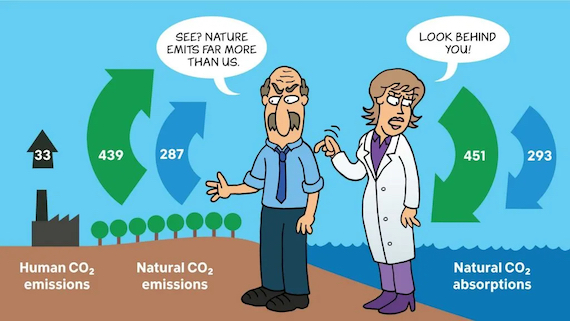
Human CO2 is a tiny % of CO2 emissions
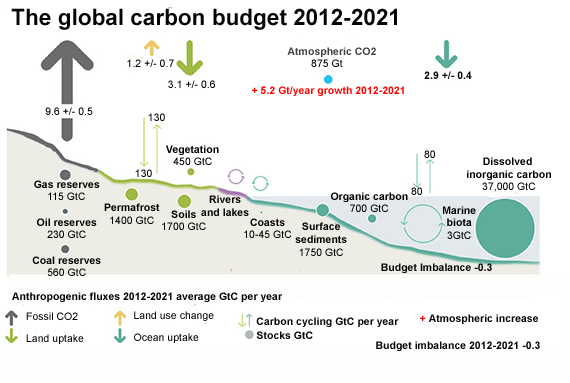
“The oceans contain 37,400 billion tons (GT) of suspended carbon, land biomass has 2000-3000 GT. The atpmosphere contains 720 billion tons of CO2 and humans contribute only 6 GT additional load on this balance. The oceans, land and atpmosphere exchange CO2 continuously so the additional load by humans is incredibly small. A small shift in the balance between oceans and air would cause a CO2 much more severe rise than anything we could produce.” (Jeff Id)
What the science says...
| Select a level... |
Basic
|
Intermediate
| |||
| The natural cycle adds and removes CO2 to keep a balance; humans add extra CO2 without removing any. | |||||
Before the industrial revolution, the CO2 content in the air remained quite steady for thousands of years. Natural CO2 is not static, however. It is generated by natural processes, and absorbed by others.
As you can see in Figure 1, natural land and ocean carbon remains roughly in balance and have done so for a long time – and we know this because we can measure historic levels of CO2 in the atmosphere both directly (in ice cores) and indirectly (through proxies).

Figure 1: Global carbon cycle. Numbers represent flux of carbon dioxide in gigatons (Source: Figure 7.3, IPCC AR4).
But consider what happens when more CO2 is released from outside of the natural carbon cycle – by burning fossil fuels. Although our output of 29 gigatons of CO2 is tiny compared to the 750 gigatons moving through the carbon cycle each year, it adds up because the land and ocean cannot absorb all of the extra CO2. About 40% of this additional CO2 is absorbed. The rest remains in the atmosphere, and as a consequence, atmospheric CO2 is at its highest level in 15 to 20 million years (Tripati 2009). (A natural change of 100ppm normally takes 5,000 to 20,000 years. The recent increase of 100ppm has taken just 120 years).
Human CO2 emissions upset the natural balance of the carbon cycle. Man-made CO2 in the atmosphere has increased by a third since the pre-industrial era, creating an artificial forcing of global temperatures which is warming the planet. While fossil-fuel derived CO2 is a very small component of the global carbon cycle, the extra CO2 is cumulative because the natural carbon exchange cannot absorb all the additional CO2.
The level of atmospheric CO2 is building up, the additional CO2 is being produced by burning fossil fuels, and that build up is accelerating.
Last updated on 29 August 2010 by gpwayne.

Arguments


Basic
Intermediate


I agreed long with your Step 2, just written it in an accurate form (your is too sloppy).
you guy have a problem.I write you: I agreed with your Step 2 long ago.we can rearrange the equation to get
ΔC - E_a = E_n - U_n
Do you agree?
Note I have change dC to ΔC to make it clear we are talking about the change in C, which is completely conventional notation used in physics.
I would happily do so if you were more cooperative, while you are obfuscating at each step it make sense to go in as small steps as possible to give you as little room to obfuscate as possible. So, do you agree, if so, say so explicitly.
[I won't interfere, but you accused me of being argumentative. You are demonstrating the same behavior with Dikran. With small, axiomatic steps this discussion with him will proceed very smoothly and quickly if you are less argumentative. All you need to do at each point is to respond "Yes, I agree" -- unless you truly don't at some point, but as you've pointed out, these steps are fairly trivial and should not involve any side discussion.
If you let the steps flow, the answer will arise incontrovertibly.]
For this to be true globally you would require a similar reduction in terrestrial primary productivity. However this doesn't appear to be the case. According to this paper Net Primary Productivity (NPP) has been increasing by 0.52%/yr between 1980 and 2000.
"Then I will point, at which step I start to disagree with you."
So you have already decided to disagree with Dikran without actually evaluating the full argument, but are merely looking for the proper point in the discussion to insert it?
How "skeptical" of you.
I'm glad you agree with step #3
ΔC - E_a = E_n - U_n
Step #4 is as follows, if the left hand side is negative, then we know the right hand side must also be negative, i.e.
if E_a > ΔC then U_n > E_n
Do you agree (if you state that you agree explicitly and unambiguously, and make no attempt to obfuscate or irritate, then I will have the confidence to proceed in larger steps).
Now we are just figuring out what is the reason for the disagreement.
You want to participate [it] contructively [/it], or just snorking around?
"terrestrial productivity is not really relevant, because it is CO2 neutral."
Again do you have a reference for this? From my understanding terrestrial productivity can also act as a carbon sink.
I have no time to discuss the elementary math with you.
You have to put all the chain of your arguments at once if you wish any further discussion.
Sorry for that!
bugai, the difference is that I disagreed after you had stated your argument, where as you have stated that you will disagree before I have stated my argument. This is possibly not what you meant.
However, I would suggest that you drop the abrasive tone, it doesn't tend to go down to well here, calm rational discussion is better appreciated.
Your withdrawal at this point will be viewed as a tacit admission that you have realized that your position is untenable, and that a very simple and painless, step by step walk through the mathematics that demonstrates this will force you to admit your error.
Rather than do so, you bristle, obfuscate, and then retreat in a huff.
Perhaps, Dikran, perhaps. But then, given the proper usage of the colloquial express "Gosh" by bugai in 164 above, perhaps we have something else entirely.
Globally, soil organic matter (SOM) contains more than three times as much carbon as either the atmosphere or terrestrial vegetation. Yet it remains largely unknown why some SOM persists for millennia whereas other SOM decomposes readily—and this limits our ability to predict how soils will respond to climate change. Recent analytical and experimental advances have demonstrated that molecular structure alone does not control SOM stability: in fact, environmental and biological controls predominate. Here we propose ways to include this understanding in a new generation of experiments and soil carbon models, thereby improving predictions of the SOM response to global warming.
Michael W. I. Schmidt, Margaret S. Torn, Samuel Abiven, Thorsten Dittmar, Georg Guggenberger, Ivan A. Janssens, Markus Kleber, Ingrid Kögel-Knabner, Johannes Lehmann, David A. C. Manning, Paolo Nannipieri, Daniel P. Rasse, Steve Weiner & Susan E. Trumbore: Persistence of soil organic matter as an ecosystem property, in: Nature, 6 October, 2011, DOI: 10.1038/nature10386
Sorry, bulgai, as I said, a truth-seeker would just co-operate in the discussion. All you are achieving with this pointless posturing is highlighting the fact that you do not think you can refute the argument if it is presented step by step.
Yet again you are just spinning it out a bit more by responding in a way that does not allow progress, as I said if you are finding the discussion slow and tiring, the solution is simple; just stop impeding it.
I can't find a free copy of the paper to download. Can you summarize the "environmental and biological controls" they reference?
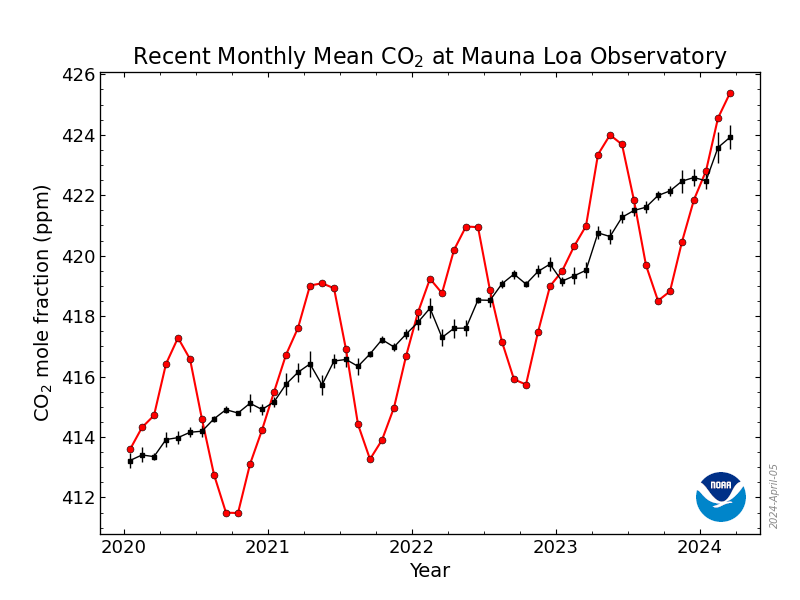
USEIA provides emissions data; this report highlights emissions decrease in 2008 due to the recession. MLO reports annual increases in atmospheric CO2 in ppm: 2002-2005 all above +2ppm/yr; 2008 - +1.62, 2009 - +1.88. See also the 1991 drop in annual increase rate - the port Gulf War recession; 1981-1982 drop in rate following the Arab oil embargo.
If we are not emitting this CO2, why does the atmospheric concentration follow economic activity?
"diurnal changes are (i) local and (ii) too fast to equilibrate with anything. "
So what? Atmospheric CO2 concentration, local or otherwise, increases with traffic density. Transportation is a significant percentage of all anthropogenic CO2 emissions. Where do you think that CO2 goes?
If terrestrial biomass production truly is carbon neutral how could such tremendous quantities of carbon been stored in the ground during the carboniferous period?
The best I can do is to provide a link to a news release about the study posted on Oct 5, 2011 by the University of Zurich.
There is no doubt that short time signal can be observed in CO2 concentration. The CO2 relaxation time is 5 years. Fluctuations shorter than this period are not smoothed out. You cannot see "diurnal" osciillations there, but certainly the seasonal ones. Prooves nothing.
That's the condition.
Given you are disputing a finding which has ample empirically-derived support in the peer-reviewed literature as outlined in the OP and on this website generally with no references to speak of (save for Wikipedia), I do not see how you are in a position to expect conditions from those who are arguing with the evidence on their side.
"Extraordinary claims require extraordinary proof." - Marcello Truzzi
Dikran is attempting to discern where you disagree with the general body of science. In the past I have noted that his technique (of covering all steps in the analysis) has been quite successful in identifying points of disagreement for further and quite useful discussion.
You are more than welcome not to participate in this. However, I will note that leaving a discussion because you don't like how it is progressing, rather than proving your point, may well be taken by most readers as evidence that your hypothesis will not stand the light of day.
Concerning Dikran. I asked him to explain his position. He refused. It is not my fault.
Yet, he is still welcome to put his arguments. But in one posting.
"Yet, he is still welcome to put his arguments. But in one posting."
You are not in a position to set the rules for the discussion. He is free to post them in any way he sees fit and you are free to ignore them. The difference is that Dikran's method looks like he is trying to move a discussion forward and you look like you are trying to stall it.
If bugai or others disagree, they would naturally have to support which step(s) they disagreed with, and why. And if they wander off in obfuscation, that's easy enough to point out.
---
That said:
bugai - You have made a number of unsupported statements.
- "The humans emit just 5% of the total CO2 influx. This is nothing and could increase the CO2 percentage in the air by the same 5%, no more."
Incorrect - a 5% input sustained over centuries, with an observed atmospheric annual increase equal to roughly half of the anthropogenic contribution, certainly shows the anthropogenic input driving atmospheric CO2 rise. See the IPCC CO2 attribution section for any number of references.
- "...where tau is the relaxation time. We know that tau is somewhere between 5 and 10 Years."
Absolutely incorrect. Single molecular residence time is on the order of 5 years - you are conflating that with adjustment time, which is ~70 years halflife as a short term adjustment, with a several thousand year tail, due to the rates of rebalancing the CO2 input to the atmosphere and the multiple pathways. See the IPCC carbon cycle drawdown section.
- "These (plankton die-off, ocean warming) are the two main reasons for CO2 rise, not the tiny emission by the fuel combustion"
Sorry, unsupportable statement contradicted by all the science. We know the rates for those, and for anthropogenic emissions, and the math just doesn't support this claim.
I hate to say this, bugai, but none of your statements on this topic have been supportable (yet - I have hopes). They all sound good, but the data shows otherwise. Skepticism starts with ones own closely held ideas...
Certainly incorrect.
Antropogenic CO2 source:
In year 2005: 30 billion tons.
In year 1945: 5 billion tons.
In year 1850: 0.1 billion tons.
"Centuries" of 5% emission?
Assuming a constant natural CO2 source, the antropogenic CO2-source was just miniscule 0.9% at 1945.
And - (-Snip-) - the striking 0.01% antropogenic emissions there leading to the end of LIA!
2. - "These (plankton die-off, ocean warming) are the two main reasons for CO2 rise, not the tiny emission by the fuel combustion"
Sorry, unsupportable statement contradicted by all the science. We know the rates for those, and for anthropogenic emissions, and the math just doesn't support this claim.
/////////
You know the exact rates? Put them forward.
[DB] Inappropriate tone snipped.
Current anthropogenic CO2 contribution: ~29GT/year.
Current yearly atmospheric CO2 accumulation: 2ppm/yr or ~14GT/year.
delta CO2 (D) = Sources (S) - Sinks (K)
D = (anthro S + natural S) - (anthro K + natural K)
D = (aS + nS) - (aK + nK) = 14GT/yr [ for convenience ]
Anthropogenic sinks (aK) are essentially zero. If we subtract anthropogenic sources (aS) from both sides of the equation:
-15GT/year = nS - nK
Natural sinks > Natural sources by ~15GT/year at present.
So without our contribution to atmospheric CO2, CO2 levels would be declining by >2ppm/year right now. Hence we are indeed responsible for increasing atmospheric CO2. Early in the industrial revolution, anthropogenic contributions were much lower, but the imbalance in CO2 was much smaller, hence the natural sink of CO2 driven by that imbalance was smaller as well. See the history of emissions and CO2 levels for that relationship.
Nature is acting as a net sink - anthropogenic contributions are responsible for rising CO2 levels. That's "1st class school math" - any disagreements?
step #1 The carbon cycle obeys conservtion of mass, so the annual rise in atmospheric CO2 is equal to total emissions minus total uptake
step #2 We can write this as
ΔC = E_a + E_n - U_n
where ΔC is the annual increase in CO2
E_a is annual anthropogenic emissions
E_n is annual emissions from natural sources
U_n is annual uptake by natural sinks
all of these quantities are of course positive.
Step #3 rearranging
ΔC - E_a = E_n - U_n
Step #4 if the left hand side is negative, then the right hand side is negative, so
if E_a > ΔC then we know that U_n > E_n also
I'm assuming that bugai agrees with this as (i) it is elementary mathematics, and (ii) he had plenty of opportunity to say it was wrong but didn't.
Step #5 - look at the data. The blue line is E_a, the red line is ΔC, and the green line is E_n - U_n estimated by ΔC - E_a. The data are all freely available from the Carbon Dioxide Information and Analysis Center (here, here and here).
This clearly shows that E_a > ΔC and so we know that U_n > E_n. In other words we know that environmental uptake has exceeded environmental emissions every year for the last fifty years at least, and hence has been opposing, rather than causing the observed atmospheric increases.
Bugai only had one step left to go, pity he preferred to be obstinate. So bugai, you have three options:
(i) demonstrate that step 5 is incorrect
(ii) demonstrate that the natural environment can be the cause of the observed rise even though it is a net carbon sink
(iii) agree that the observed rise is not a natural phenomenon.
Perhaps you should study the literature on CO2 monitoring a bit more, rather than make quite so many assumptions. Chmura 2005 et al is a good starter, showing that an industrial city is a CO2 source:
The CO2 mixing ratios measured in the urban atmosphere revealed quasi-permanent excess concentration of this gas when compared with near-by background atmosphere. The annual mean CO2 concentration recorded in Krakow in 2004 was almost 10% higher than that recorded at high-altitude mountain site (Kasprowy Wierch). Such effect is occuring probably in all urban centers.
There is indeed a diurnal signal:
In the urban environment, the lowest CO2 mixing ratios are recorded generally during mid-day, when the convective activity of the lower atmosphere and resulting vertical mixing is at its maximum. In contrast, at the mountain site high CO2 mixing ratios are generally recorded during mid-day and early afternoon. This stems from sun-driven convection within the planetary bounday layer over Kasprowy Wierch “sucking” the CO2-laden air from the valleys towards the top of the mountain.
In addition, there is an isotopic signature to anthropogenic emissions:
Seasonal fluctuations of delta13C visible at both discussed sites are shifted in phase. The Krakow record reveals lowest delta13C values during winter season, when local CO2 emissions due to burning of fossil fuels in the city (heating plus car traffic) are most intense.
So the record of CO2 emissions appearing in the atmosphere is unmistakeable. You seem to rest your case on 'it can't be us.' Can you provide anything more substantial than that?
1. >>>>
Current anthropogenic CO2 contribution: ~29GT/year.
Current yearly atmospheric CO2 accumulation: 2ppm/yr or ~14GT/year.
delta CO2 (D) = Sources (S) - Sinks (K)
D = (anthro S + natural S) - (anthro K + natural K)
D = (aS + nS) - (aK + nK) = 14GT/yr [ for convenience ]
Anthropogenic sinks (aK) are essentially zero. If we subtract anthropogenic sources (aS) from both sides of the equation:
-15GT/year = nS - nK
Natural sinks > Natural sources by ~15GT/year at present.
<<<<<<<
Correct. I agree with these numbers completely.
2. >>>>>>
So without our contribution to atmospheric CO2, CO2 levels would be declining by >2ppm/year right now. Hence we are indeed responsible for increasing atmospheric CO2. Early in the industrial revolution, anthropogenic contributions were much lower, but the imbalance in CO2 was much smaller, hence the natural sink of CO2 driven by that imbalance was smaller as well. See the history of emissions and CO2 levels for that relationship.
Nature is acting as a net sink - anthropogenic contributions are responsible for rising CO2 levels. That's "1st class school math" - any disagreements?
<<<<<<<
Disagree.
If we switch out antropogenic CO2 source abruptly, the CO2 levels would be declining by >2ppm/year just for the relaxation time: the 5 years.
Then CO2 level change due to antropogenic source will relax completely and the CO2 level will be moving - in whatever direction! - by the disbalance of the natural sources and sinks.
Because we destroy the CO2 sink by pollution of the oceans, after 5 years have passed, the CO2 level will continue to rise at the same rate as it does now.
This is a point we disagree.
>>>>
(i) demonstrate that step 5 is incorrect
The formula is perfectly correct.
>>>>
(ii) demonstrate that the natural environment can be the cause of the observed rise even though it is a net carbon sink
Yes, it is.
I know, you do not like differential equations, but we do need them to understand the problem.
We write:
dC/dt = E_a + E_n - U_n
Certainly, U_n > E_a, and still it is the nature that is responsible for the CO2 rise.
Not far from equilibrium we can write for the natural sink:
U_n = C/T
where T is the relaxation time, in our case somewhere 5-10 years. It is not constant, but depends on the state of the sink (ocean pollution). So, we write T(t).
If we monitor CO2 on time scales larger than the relaxation time, dC/dt << C/T, the quasistatic (but time-dependent!) CO2 level is
C(t) = (E_n(t) + E_a(t))/T(t)
It is the change in T(t) that drives the CO2-level in the atmosphere, not E_a.
here
Sn is the natural source, Sa
(iii) agree that the observed rise is not a natural phenomenon.
1. >>>>
Current anthropogenic CO2 contribution: ~29GT/year.
Current yearly atmospheric CO2 accumulation: 2ppm/yr or ~14GT/year.
delta CO2 (D) = Sources (S) - Sinks (K)
D = (anthro S + natural S) - (anthro K + natural K)
D = (aS + nS) - (aK + nK) = 14GT/yr [ for convenience ]
Anthropogenic sinks (aK) are essentially zero. If we subtract anthropogenic sources (aS) from both sides of the equation:
-15GT/year = nS - nK
Natural sinks > Natural sources by ~15GT/year at present.
<<<<<<<
Correct. I agree with these numbers completely.
2. >>>>>>
So without our contribution to atmospheric CO2, CO2 levels would be declining by >2ppm/year right now. Hence we are indeed responsible for increasing atmospheric CO2. Early in the industrial revolution, anthropogenic contributions were much lower, but the imbalance in CO2 was much smaller, hence the natural sink of CO2 driven by that imbalance was smaller as well. See the history of emissions and CO2 levels for that relationship.
Nature is acting as a net sink - anthropogenic contributions are responsible for rising CO2 levels. That's "1st class school math" - any disagreements?
<<<<<<<
Disagree.
If we switch out antropogenic CO2 source abruptly, the CO2 levels would be declining by >2ppm/year just for the relaxation time: the 5 years.
Then CO2 level change due to antropogenic source will relax completely and the CO2 level will be moving - in whatever direction! - by the disbalance of the natural sources and sinks.
Because we destroy the CO2 sink by pollution of the oceans, after 5 years have passed, the CO2 level will continue to rise at the same rate as it does now.
It has been pointed out to you repeatedly that the relaxation time is not five years, the residence time is five years. They are not the same thing. Perhaps you would like to look up lieftime in the glossary of the IPCC WG1 report and tell us what it says there.
And now we're on step 2, your conflation of molecular residence time with atmospheric concentration adjustment time.
I'll now refer you (again) to the IPCC 7.3.4.2 Carbon Cycle Feedbacks to Changes in Atmospheric Carbon Dioxide, which actually examines these rates for various sequestration pathways. Short term adjustments to CO2 imbalance have about a 37-40 year half-life, with a very long tail once pH buffering tapers off and biological sequestration and geologic impoundment take over.
[ Source ]
See also the IPCC glossary for "Lifetime", as Dikran mentions, here, on page 948.
Again - residence time for individual molecules is quite short. But in the presence of bi-directional exchanges, it is not the concentration adjustment rate. That's a common mistake - but it's a mistake.
You assume
"Not far from equilibrium we can write for the natural sink: U_n = C/T"
however, the carbon cycle is no where near equilibrium, we are currently 100ppmv over the pre-industrial equilibrium that had held for several thousand years at least.
You are basing your argument yet again on the asumption that the relaxation time is 5 years. This is incorrect, the residence time is 5 years, the relaxation time (as you call it) is much longer. I have done the differential equations, and they give a figure of 74 years.
Reason why I'm asking: Given 2ppm/year decay scaled to imbalance, and an imbalance of ~100ppm, I get a half-life of 34 years (38 years for 2ppm and 110ppm imbalance), decaying to 20% at ~79 years, assuming a single exponential decay model.
Granted, that's wrong, as only the initial decay is primarily the ocean pH adjustment, and longer term exponentials for shell sequestration and deposition are going on at the same time... so the actual decay will take 100's to thousands of years. But I've found showing the fastest possible exponential decay to be useful in these discussions.
Half life = ln(2)/rate = ln(2)/0.02% = ~34.66