How do human CO2 emissions compare to natural CO2 emissions?
The skeptic argument...
Human CO2 is a tiny % of CO2 emissions
“The oceans contain 37,400 billion tons (GT) of suspended carbon, land biomass has 2000-3000 GT. The atpmosphere contains 720 billion tons of CO2 and humans contribute only 6 GT additional load on this balance. The oceans, land and atpmosphere exchange CO2 continuously so the additional load by humans is incredibly small. A small shift in the balance between oceans and air would cause a CO2 much more severe rise than anything we could produce.” (Jeff Id)
What the science says...
| Select a level... |
Basic
|
Intermediate
| |||
| The natural cycle adds and removes CO2 to keep a balance; humans add extra CO2 without removing any. | |||||
Before the industrial revolution, the CO2 content in the air remained quite steady for thousands of years. Natural CO2 is not static, however. It is generated by natural processes, and absorbed by others.
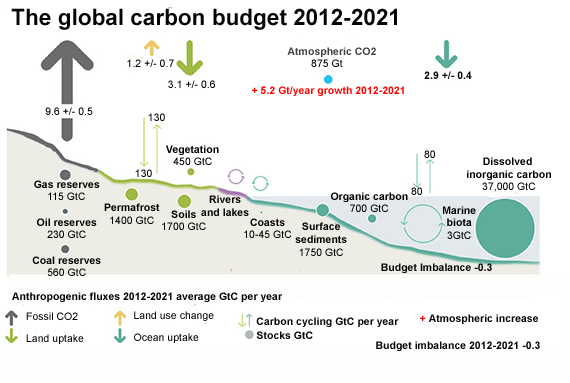
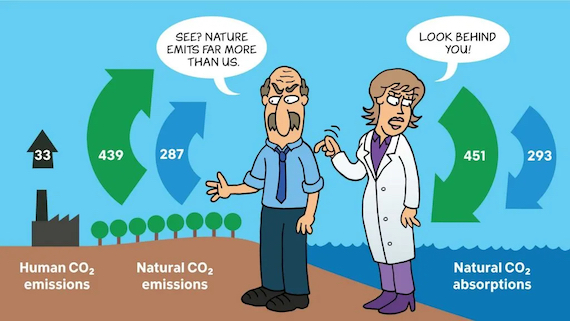
As you can see in Figure 1, natural land and ocean carbon remains roughly in balance and have done so for a long time – and we know this because we can measure historic levels of CO2 in the atmosphere both directly (in ice cores) and indirectly (through proxies).

Figure 1: Global carbon cycle. Numbers represent flux of carbon dioxide in gigatons (Source: Figure 7.3, IPCC AR4).
But consider what happens when more CO2 is released from outside of the natural carbon cycle – by burning fossil fuels. Although our output of 29 gigatons of CO2 is tiny compared to the 750 gigatons moving through the carbon cycle each year, it adds up because the land and ocean cannot absorb all of the extra CO2. About 40% of this additional CO2 is absorbed. The rest remains in the atmosphere, and as a consequence, atmospheric CO2 is at its highest level in 15 to 20 million years (Tripati 2009). (A natural change of 100ppm normally takes 5,000 to 20,000 years. The recent increase of 100ppm has taken just 120 years).
Human CO2 emissions upset the natural balance of the carbon cycle. Man-made CO2 in the atmosphere has increased by a third since the pre-industrial era, creating an artificial forcing of global temperatures which is warming the planet. While fossil-fuel derived CO2 is a very small component of the global carbon cycle, the extra CO2 is cumulative because the natural carbon exchange cannot absorb all the additional CO2.
The level of atmospheric CO2 is building up, the additional CO2 is being produced by burning fossil fuels, and that build up is accelerating.
Last updated on 29 August 2010 by gpwayne.

Arguments


Basic
Intermediate


Their CO2 models strongly depend on the ocean surface temperature. Taking a (-snip-) feedback of temperature rise due to extra CO2, you can (-snip-) any "relaxation time", even millions of years.
I find the Bern CO2 model much more transparent:
http://onlinelibrary.wiley.com/doi/10.1034/j.1600-0889.1996.t01-2-00006.x/pdf
The only drawback of that model is that it discards the dynamics of biologic removal of CO2 from the ocean.
It implicitely assume that it is "constant".
Look at the pulse response in Fig.3 and you see that the relaxation time is 5 years or even less. As it has been numerously measured in 50-ies and 60-ies of the last century.
And yes, I claim it is the problems with a too weak sink of CO2, not with extra emission. That is why CO2 is rising. Even if the oceans are a net CO2 sink now.
[DB] Allegations of fraud and impropriety on the part of the IPCC snipped. It is time to familiarize yourself with the Comments Policy here. Future comments containing such violations will be simply deleted.
Thank you in advance for your understanding and your compliance in this matter.
Let's assume for the moment that your arguments of '5 year relaxation time' and 'CO2 accumulation due to pollution decreasing natural sinks' are correct... I don't see how that changes the conclusion that the increase in atmospheric CO2 levels is entirely due to human emissions.
You concede that natural emissions are less than natural sinks... ergo natural emissions CANNOT be causing the rise in atmospheric CO2 levels. You also agree that humans are emitting enough to increase atmospheric levels by about 4ppm per year, but the actual rate of increase is only about 2ppm.
You argue that this accumulation is due to reduced natural sinks... but even if that were true, it changes nothing. Nature is taking out less than it would if not for pollution. Ok... but the accumulating excess is STILL entirely derived from human emissions since even these 'reduced' natural sinks are greater than the natural emissions.
Your own model suggests that T cannot possibly be 5-10 years. Say we linearize about the pre-industrial level and assume that's the equilibrium. The resulting DE will be
dC/dt=E_a-C/T
Notice that E_n disappears due to linearization. C here is the CO2 above the preindustrial level of 280ppm.
Currently we have dC/dt=14 Gt/yr, E_a=29 Gt/yr gives
C/T=15 Gt/yr
Now the CO2 level has increased by about 100ppm, with is about 770Gt. This yields T of 51 years.
We pollute the oceans, sufficient to 'destroy' the CO2 sink, yet we do not produce the CO2 that goes into the atmosphere? BTW, we also influence atmospheric ozone and produce CO, N2O, NO, among other gases, but not CO2?
Seems like an inconsistent position to me.
Also in the Joos et al. paper you cited, they've set the air-sea exchange to zero for figure 3 (see appendix A1). The curves in their figure shows how quickly tracers move from the surface to deep ocean, and that is certainly not the relaxation time we're discussing.
This cannot be right. The amount of update of CO2 by natural sinks must have some dependence on pCO2. If natural sinks reduce CO2 by 2ppm/ year we would have been ice age long ago.
You position is untenable, because you must solve three intractable problems to support it.
First, humans have burned hundreds of gigatons of carbon that have been sequestered underground for hundreds of millions of years.
1) If this carbon has not gone into the atmosphere and oceans, then where has it all gone?
Second, there must be a source of carbon which has both raised atmospheric levels by 100 ppm, and introduced an equivalent amount of CO2 into the oceans (and very noticeably lowering pH there).
2) What is the source of the hundreds of gigatons of carbon that have gone into the atmosphere and the oceans?
At the same time, if you do propose another source of carbon, and another destination for anthropogenic carbon, there must be some mechanism which somehow preferentially puts anthropogenic carbon in one place (if you can find it) while adding only your other source of carbon (if you can find one) to the atmosphere and ocean, in a fashion which makes the existence and quantity of anthropogenic carbon meaningless in affecting the balance.
3) What mechanism can possibly exist that "knows" how to intelligently separate anthropogenic from natural carbon, adding the former only to some undefined (and presumably bottomless) sink, while putting the latter into the atmosphere and oceans.
No matter what other things you want to argue, the bottom line is that there is a pool of carbon in the system, an additional pool of carbon (fossil fuels) that had been separated from the system but have now reintroduced in a very short time frame, and there are only limited and measurable places for that carbon to go in similarly short time frames (those places being the atmosphere, the oceans, and biomass).
No matter what you come up with, anthropogenic carbon must go somewhere, and in so doing, it must be affecting the balance.
No matter what you come up with, anthropogenic carbon must be contributing substantially (actually, solely) to the CO2 levels in the atmosphere and oceans.
There is no way out of this inconvenient truth.
So, if we were to suddenly stop emitting CO2, the natural sinks would initially absorb 2ppm/year, with an expected decrease over time (multiple decaying exponentials due to the various pathways), as the imbalance decreases. See my post and the IPCC links here, and also here for the curves.
It's definitely rate(s) dependent on the pCO2 imbalance.
However, the data show that the natural sinks are stronger than the natural sources and have been steadily strengthening relative to sources for at least the last fifty years. SO the idea that the sinks are too weak doesn't survive first contact with the data, they are only weak in the sense that they can only cope with half our emissions on top of all natural emissions. Which suggests that CO2 levels have only been rising because of anthropogenic emissions.
Bugai is making an error that many have made before (confusing residence time with relaxation time). Making a mistake that others have made before is nothing to be embarassed about - we all make mistakes. Not being able to accept you have made a mistake on the other hand is another matter. For that reason it is always a good idea to assume you are wrong and take counter-arguments seriously.
You've left the loophole that the unknown sink that surely must exist (by denier argument) is only taking most of the anthropogenic CO2, not all of it. Thus, the unknown natural source is also affected by this same sink, so point 3) is avoided.
To close this loophole we can look at quantities. Current thought is that half the anthropogenic CO2 is removed from the atmosphere. Let's assume that the proportion is larger:
- if 3/4 is removed, then 3/4 of the unknown natural source is also removed, and this means that the unknown natural source is of the same size as the anthropogenic source. Corollary: half the rise is anthropogenic.
- if 80% is removed, then 80% of the unknown natural source is also removed, and this means that the unknown natural source has to be 1.5X larger than the anthropogenic source. Corollary: 40% of the rise is anthropogenic.
- if 90% is removed, then 90% of the unknown natural source is also removed, and this means that the unknown natural source has to be 4X larger than the anthropogenic source. Corollary: 20% of the rise is anthropogenic.
- if 95% is removed, then 95% of the unknown natural source is also removed, and this means that the unknown natural source has to be 9X larger than the anthropogenic source. Corollary: 10% of the rise is anthropogenic.
- if 99% is removed, then 99% of the unknown natural source is also removed, and this means that the unknown natural source has to be 49X larger than the anthropogenic source. Corollary: 2% of the rise is anthropogenic.
To get to a point where most of the rise is not anthropogenic in origin, and (to keep consistency) there is an unknown natural source that plays by the same rules as the anthropogenic one, you have to posit a huge, undiscovered natural source that nobody has noticed.
As they say, that dog won't hunt.
I'm not sure I understand. If you have some sort of sink that takes most of the anthro CO2, then it also has to take most of the natural CO2 as well. But if the rise in CO2 is primarily from this unknown natural source, then for that natural sink to be taking most of the anthro CO2, it has to also take proportionally more (i.e. most of) the natural CO2.
That means that in order to have raised atmospheric CO2 levels by 100 ppm while overwhelming this mysterious natural sink that has sucked "most" of the anthro CO2 out of the air, then that mysterious natural CO2 source must be absolutely huge! A whole order of magnitude greater than the hundreds of gigatons of CO2 we've generated by burning fossil fuels.
What the heck is that source?
[My own conjecture is that an alien race is burning their own fossil fuels, but using special teleportation technology to deposit their CO2 in our atmosphere.]
Problem solved. A new natural sink is emerging before our very eyes. A place where the low salinity surface waters ... are undersaturated with respect to CO2 in the atmosphere and the region has the potential to take up atmospheric CO2, although presently suppressed.
This marvelous new sink for CO2 has tripled over the last 3 decades. Just what the doctor ordered!
Exactly. You appear to understand perfectly. The numbers I calculated were based on the assumption that the extra sucking applies only to anthropogenic CO2 and the new magical natural source that looks just like anthropogenic CO2 (i.e., same isotopic signature, etc.). The numbers I present say that if this removal ratio is 99%, then this mysterious natural source is 49x larger than the anthropogenic one - i.e., the 30 Gt anthropogenic source is running in parallel with a natural source of 1470 Gt. Kind of hard to miss in the grand scheme of things, since we seem to be able to identify the long-existing natural sources of much smaller quantity than this. This new source also seems to be rising at the same rate as anthropogenic CO2. Another astounding coincidence.
...but at least you have a conjecture as to the source. Unlike the "skeptics".
And as muon points out, the same logical applies to any new sink we haven't noticed - it is "emerging before our very eyes". It has some magical property that allows it to turn on and grow at just the right rate.
...but muon's hypothesis seems a bit far-fetched. I think it is more likely that Sphaerica's alien race has introduced a cap-and-trade scheme, and some enterprising alien has realized that they can make oodles of money by scarfing CO2 out of our atmosphere and get credit for sequestering it.
Unfortunately, the same conspiracy that made up the AGW hoax is also hiding the fact that we've made contact with these aliens, and have one of their teleportation devices stored at Area 51. We're not allowed to use it to solve our problem.
[Yes, I know that it is inconsistent to have the same conspiracy both make up the problem and hide a real solution to the same problem. In the People's Republic of Made-up-istan, consistency is not a legal obligation.]
To say "However, natural CO2 emissions (from the ocean and vegetation) are balanced by natural absorptions (again by the ocean and vegetation)" is simply a statement without proof.
Such conclusions totally ignore the impact on the level of photosynthesis which is in turn affected by the quality of plant life, that in turn being affected by the level of carbon dioxide.
Removing the natural carbon sink found in forests, for example, has been shown to have about four times the effect on carbon dioxide levels than that of fossil fuel emissions.
[DB] Link to off-topic website snipped. Please endeavor to stay on-topic to the subject matter of the thread on which you are placing comments.
Please note that posting comments here at SkS is a privilege, not a right. This privilege can be rescinded if the posting individual treats adherence to the Comments Policy as optional, rather than the mandatory condition of participating in this online forum.
Please take the time to review the policy and ensure future comments are in full compliance with it. Thanks for your understanding and compliance in this matter.
The (evil/job destroying) EPA has a GHG Data Page.
Pretty nifty. If this has made an appearance on SkS before I have missed it.
I was trying to find a link to Norville Barnes in the Hudsucker Proxy saying "WOW!" but alas...
There is simply no evidence that shows absolutely that carbon dioxide levels are the root cause of the phenomenon known as "global warming." It is a fact that there is a "greenhouse effect" taking place, but is higher carbon dioxide levels the root cause or just a symptom? A simple look at the data could also suggest that long cycle changes in ocean currents or a cooling/shrinking planet or some other factor could just as easily be the culprit - and, of course, it could also be mankind. There is no evidence that proves that shutting off all man-made sources of carbon output - even if it were possible - would alter the changes taking place.
There is an abundant supply of common sense that says shutting off all carbon generating activities by mankind would cause a great deal of hardship to a lot of people!
Wouldn't our energy be better spent trying to find ways to live on a warmer planet? Why do we assume - with some arrogance - that mankind has all this power to affect global temperature? Why do we assume that mankind is some non-natural force? Isn't mankind just another part of nature?
Like so many dialogues in our society today - this one is taken over by biased people trying to shout over one another, rather than starting with facts and ending with a course of action.
An intelligent and informed look at the data will show you that your statements are false.No one is saying this except for fear-mongers who want to scare other people out of thinking things through. What is necessary is aggressive but moderate action now, rather than complete lethargy and inaction. Failure to act now will simply require more desperate measures later, measures that will hurt society and economies, because they'll have to be too radical and too aggressive.No, because it will be more expensive to do so, and the planet will not simply "be warmer." That's a gross misunderstanding of what we're facing.It's not an assumption, it's an understanding based on knowledge and facts.And finally, in conclusion, you say something sensible. Now that you have all of that shouting and lathered up umbrage out of your system, welcome to Skeptical Science! This site has a wealth of information which will help to educate you on the issues so that you can understand them, rather than shout platitudes based on ignorance and a complete misunderstanding.
Please use the search box in the upper left hand corner. Many articles are presented in beginner, intermediate and expert versions, whichever best suits your own personal starting point and level of understanding.
When you have learned more, and are able to actually make supportable statements, then we can talk. Until then, standing up and shouting as loudly as you can that you are right and everyone else is crazy will not be nearly as effective as first learning and then starting with facts and ending with a course of action.
-We have samples of the air going back 800,000 years in ice cores that show the concentrations of CO2. These are "known facts".
-Recent carbon dioxide increases have been caused by combustion of fossil fuels, even some of the skeptics like Willis Eschenbach and Roy Spencer accept that without reservation. This isn't a disputed hypothesis, this is as close to accepted fact as we get in science.
-What evidence is there that a "shrinking planet" could have contributed to the rise in CO2? Surely, you are not serious.
-Skipping over some of your other assertions, why do you believe that it is "arrogance" to assume that mankind can influence the climate? Do you think, for example, that it is arrogance to think that a nuclear war would be catastrophic? I suppose that your logic would at least lead you to believe that a nuclear war would be an entirely natural phenomenon.
-I agree with you that this dialogue "is taken over by biased people trying to shout over one another, rather than starting with facts and ending with a course of action". But not in the way you think.
-It's perhaps arrogance on your part to think that your "common sense" arguments are sufficient to overcome the consensus opinions of experts who have spent their lives studying this problem.
Straw man. No scientist is saying that.
What they are saying, however, is that the concentration of atmospheric CO2 is increasing in proportion to the (~10) billions of tons of carbon that humans burn annually, and that this rate of increase is significantly greater than it has been for hundreds of thousands - if not millions - of years.
Given that a little less than half of annual human emissions are sequestered, what do you think that this continually-increasing extra greenhouse gas is doing to the planet's climate?
What you mean is that "CO2, temperatures and water levels have fluctuated quite dramatically on occasions far back over geological time"...
And every time that they fluctuated dramatically, there was a concurrent dramatic impact on the biosphere.
And something that seems to completely escape the Denialati is that the biosphere is what keeps humanity alive. If anyone doesn't believe this I am (and I'm sure others would be) quite happy to dissect this concept in fine detail... We are absolutely and inextricably beholden to the primary productivity of solar-driven photosynthesis (and its direct products) for our survival. Hurt the biosphere, and humanity is hurt.
With the passing of abundant fossil energy this dependency will only become more - and permanently - stark.
Consensus climatology and ecology absolutely do start with "known facts". You seem to be either oblivious to, or entirely ignoring, them.
"[D]ata can be used to support any bias" only if one does not use the data correctly. If you adhere to your statment then it is only a reflection on how you and your associates are wont to "use data".
The only absolute in science is that there are no absolutes. If your presumption of irrefutable absoluteness is replaced with something such as "strong certainty", then your statement is completely refuted.
To the extent that there are no absolutes, as noted above, it is still defensibly - strongly defensibly - possible to ascribe most (if not all) contemporary global warming to human CO2 emissions.
No.
"Could" in the same way that falling from 2 000 metres without a parachute "could" kill you.
Eh? Were's your evidence for that?
"Common sense" is not science, and is not even a reliable guide for objective correctness. This is a basic tenet of high school level scientific philosophy.
No.
If you don't understand why, try teaching a mountain pygmy possum to live without winter snow, or a penguin to live on a tropical beach, or walrus and polar bears to live without sea ice.
The same issues apply to humans, if in slightly more subtle and complex (but no less important) ways.
Why not?
Simply, because human intelligence is an emergent phenomenon of a type and magnitude that has not previously had expression in the history of the planet.
To the extent that human intelligence distinguishes our species from the rest of the planet - the answer is an emphatic "no".
This is the only accurate thing that you've said. Unfortunagely for you, the "biased people" are those who have the temerity, if not the objective evidence or even the intellectual capacity, to contradict parsimonious science.
In other words, your crowd...
I completely agree. In which case you ought to start by presenting the evidence that says there were substantial fluctuations in CO2 prior to the industrial revolution, since say the end of the last major glaciations (of course glaciations have a large effect on CO2 levels, but this doesn't explain recent changes). Another line of evidence that might support your position would be evidence that CO2 levels had been higher than present over the last 800,000 years or so.
Starting with facts would be great, but it is exactly the thing you did not do. Present your evidence piece by piece and we will happily engage in a scientific dialogue with you.
Note I say "piece by piece" because scientific discussion requires depth as well as breadth; so building an argument gradually assessing each pice in turn and progressing onto the next step when agreement is reach has been found to be thebest way to make progress.
To have a serious debate, we must start with known facts - not a bunch of hypotheses inferred from data
and
Like so many dialogues in our society today - this one is taken over by biased people trying to shout over one another, rather than starting with facts and ending with a course of action.
I find it unusual, because data (results derived from empirical observation or from calculations based on observation) are to me synonymous with facts, and you don't infer hypotheses from data - you infer conclusions and then postulate hypotheses.
In addition as others have stated upthread, serious scientists and their organizations and synthesis reports (such as the IPCC) do, in fact, draw their conclusions (AGW is real and action to prevent it where possible is required) from known, easily-verifiable facts.
It's not out of line to say that there is a rather natural chain of inference such that:
1 - basic physics predicts humans can alter the global climate for the worse
2 - empirical observation shows that humans are altering the global climate, for the worse - and at a rate nearly unprecedented in geological history
3 - the costs and drawbacks to simply allowing this process to go on unchecked and trying to adapt to the resulting changes can be shown to be much greater than the costs and drawbacks to mitigating its effects and preventing its growth
4 - as such, there is a clear imperative for action, in the form of reducing human emissions of known heat-trapping gases
Since this position, as far as I can tell, is essentially what the IPCC, prominent climate scientists, large bodies of science (the National Academies, Royal Society, & such) and of course Skeptical Science are espousing, once again I must emphasize primespot's attempt to castigate SkS on this thread on this account mystifying.
One should never allow one's argument to become contaminated with facts
(or data for that matter).
800 years of minimal fluctuations in atmospheric CO2 (at what might be called a 'pre-industrial level'), followed by an abrupt upswing. Why would anyone base a hypothesis on that?
The Earth has five short term reservoirs of CO2, and two long term reservoirs. The short term reservoirs are, in order of size:
1) The deep ocean;
2) The soil;
3) The surface ocean;
4) The atmosphere; and
5) The biosphere.
Flows between these reservoirs is very large, and very rapid. The result is that soil, surface ocean, atmosphere and biosphere maintain equilibrium on a time scale of around a year, while the deep ocean maintains equilibrium on time scales of a century or so. These reservoirs are shown in this diagram from wikipedia (note, black ink indicates storage, blue ink indicates fluxes):
Because fluxes between these reservoirs are rapid, equilibrium is maintained between them. Consequently the normal fluxes between these reservoirs cannot increase the total CO2 (or chemical derivatives such as cellulose) in the aggregate of the reservoirs. What is more, because equilibrium is maintained, except for circumstances which shift the equilibrium they will not result in changes in any particular reservoir.
For example, increased aridity will result in less carbon being stored in soils and the biosphere. As a result, more carbon will be stored in the atmosphere and ocean. If it is a short term change in aridity, it will not effect the deep ocean, but if it is a change that lasts for a century or so, the excess CO2 (and derivatives) in the atmosphere and surface ocean will be depleted partially to re-establish equilbrium with the deep ocean.
Similarly an increase in sea surface temperatures will result in diminished CO2 storage in the surface ocean, resulting in more CO2 being stored in the atmosphere, soils and biosphere (from the CO2 fertilization effect among other effects). Such changes in SST are responsible for much of the small changes in CO2 concentration prior to 1750 and visible in the graph @224 above. They are also responsible for the strong correlation between ENSO and the short term fluctuations in CO2 concentration as observed by modern instruments.
In addition to the short term reservoirs, there are two long term reservoirs. They are sedimentary rocks, particularly lime stones but including coals and other fossil fuels, and the Earth's mantle. Transfer between these reservoirs and the short term reservoirs is normally very slow. This occurs by the formation of sedimentary rocks, which are then subducted to the mantle, which returns the CO2 to the surface through volcanos. Currently the rate at which volcanos return CO2 to the surface is about 1/100th of the rate at which humans emit CO2.
In effect, humans have increased the transfer from the long term reservoirs to the short term reservoirs by a hundred fold. Because the short term reservoirs are in equilibrium, it is far more logical to consider that transfer as the cause of increase in CO2 storage which has been measured in all five of the surface reservoirs than to assume that the cause is a transfer from one surface reservoir to another (as you are doing).
Indeed, it is only possible to consider the high relative flux from the biosphere to the atmosphere through respiration as the cause of the increase in atmospheric CO2 if you firmly ignore two points:
a) The equally large flux from the atmosphere to the biosphere by photosynthesis; and
b) The fact that the atmospheric CO2 has been effectively stable for 10 thousand years even in the presence of the large flux from biosphere to atmosphere, which as remained essentially unchanged.
The thing is, of all things, the accounting of CO2 is done and solid. There is no wiggle room there. We know how, we know how much, we have multiple lines of evidence to prove that it cannot have come from any place else.
I personally think the most complete link is this one but there are many others. Click the "View All Arguments" link below the thermometer at left, search the the page for CO2, and you'll find that every thing you have brought up has been thought of by others, and holds no weight whatsoever.
Please take the time to study the information that is already available. You can "believe" what you choose, or you can educate yourself. The choice is yours, but falling back on your "belief" hardly entitles you to lay claim to the mantle of "skeptic."
The article here states "While fossil-fuel derived CO2 is a very small component of the global carbon cycle, the extra CO2 is cumulative because the natural carbon exchange cannot absorb all the additional CO2." - well apparently it can, and this is what negative feedback means, when the level of CO2 rises, the 'system' reacts to counteract it.
"ad hominem comments will be deleted.", unless they are directed against 'skeptics' it seems.
The airborne fraction is the increase in atmospheric CO2 as a fraction human emissions. Fortunately for us, as Dr Knorr says, the increase in atmospheric CO2 is currently 40% of total emissions. Where it not for that, CO2 concentrations would not have increased by 100 ppmv since 1850, but by 250 ppmv - with disastrous results. It is widely predicted that as the oceans warm, the airborne fraction will increase, as warm oceans can absorb less CO2. Dr Knorr shows that as yet, evidence of that increase is not yet statistically significant.
What he does not show, and does not purport to show, and indeed, explicitly disagrees with, is the claim that "the rise in airborne CO2 since 1850 is statistically negligible". On the contrary, if atmospheric CO2 has increased by 40% of total emissions since 1850 (Knorr's claim), then the increase is about 40% over 1850 values, which is certainly statistically significant.
A word to the wise, moderation complaints are normally snipped on this site, and if there is no reason to preserve a comment, moderators will save themselves trouble by simply deleting the entire post. That is particularly the case when the moderation complaint is entirely specious - as yours is.
Knorr said no such thing (see here. Hutch, are you actually reading the articles?
Even if you only read the abstract from Knorr, you should understand that what you claim and what he claims are different. He points out that 40% of human emissions stays in the atmosphere. That's significant. Now, is the trend in airborne fraction of human-sourced CO2 increasing?
You know what the mass balance argument is, yes? Yes, the natural sinks are trying to absorb the additional CO2, but they're not doing a very good job of it, and, worse yet, they're not going to do a better job in the future, because 1) land use changes will likely involve cutting down carbon-sucking forests and 2) the warmer the oceans get, the less able they are to hold their carbon. We are part of the system, and we are overwhelming the "negative feedback."
What ad hominem are you talking about?
This is wrong. "Man-made CO2 in the atmosphere" has increased by orders of magnitude since the pre-industrial era.
What you mean is "Man-made CO2 has increased CO2 in the atmosphere by [more than] a third since the pre-industrial era"
However this statement is commonly misconstrued as "human beings produce 3 per cent of the carbon dioxide in the air" (Alan Jones 19 Oct 2012).
That statement is not just misleading, it is false, because it concerns atmospheric CO2 levels, not emissions. Humans have increased "the carbon dioxide in the air" from 285 ppmv to 390 ppmv since 1850. That means human beings produced 27% per cent of the carbon dioxide in the air, not 3%.
Note that I use the past tense produced while Jones used the present tense produce. Taken literally his statement is meaningless. However his intended meaning is clear: he is falsely claiming that CO2 from human sources is insignificant.
bullsh*tbullet.The reason for this is that the vast natural exchange fluxes continually swap atmospheric CO2 (some of which is of directly anthropogenic origin) with CO2 from the oceanic and terrestrial reservoirs. These exchange fluxes have no net effect on atmospheric CO2 levels, but they do mean that relatively little CO2 in the air is of directly anthropogenic origin as it only takes on average 4-5 years for each molecule of CO2 to be exchanged with "natural" CO2.
The thing that matters though is not whether the CO2 in the atmosphere is of directly anthropogenic origin, but what is causing total emissions (natural+anthropogenic) to be greater than total uptake, as that is what is causing atmospheric CO2 to rise, and the answer to that is "anthropogenic emissions".
About 50% of Humanity's output of CO2 is absorbed by carbon sinks, partly the biosphere. Obviously that photosynthetic activity uses solar energy to convert CO2 and H2O into carbonates, carbohydrates and (eventually) hydrocarbons.
How much solar energy is absorbed in this process? Obviously that absorbed energy will not find its way out of the top of the atmosphere. Is that energy accounted for in the energy budgets and climate models?
Climate models certainly account for the change in albedo with changes in vegetation. I am not sure whether, or to what extent they account for the change in timing of the release of energy.
a tiny co2 link would be helpful to direct sceptics to
[DB] Per SkS contributor Gary McGuigan, here is another interesting example of how trace concentrations can have a large effect:
The Brazilian Wandering Spider (Phoneutria) or banana spider appears in the Guinness Book of World Records 2007 for the most venomous spider and is the spider responsible for most human deaths. This spider is believed to have the most potent neurotoxic venom of any living spider. Only 0.006mg (0.00000021oz) is sufficient to kill a mouse.
'Without atmospheric CO2 all green plants would die. Without green plants nearly all animals would die. Trace? Yes. No effect? Don't be stupid.'
The official SkS writeup for that myth (#76) is here.
I have a question, is there any way of reducing some of the CO2 natural emissions or making other ways to absorve more CO2 preventing it from going to the atmosphere, such as planting more threes or something like that?
My question is, the only way to stop globar warming is reducing the human CO2 emissions?
(sorry for my english)
Juanss, due to albedo changes, replacing the world's agricultural areas with trees will not necessarily be of any aid in stopping global warming. Scientist Ken Caldeira has shown that replanting all available boreal forests and even mid-latitude temperate forests will lead to warming.
Only replanting all tropical areas with trees produces cooling. And there simply isn't enough of it to be effective (an area greater than the surface area of the United States must be replanted and no such sizable area exists). Only a drastic reduction in CO2 emissions will have any effects.
• First Link
• Second Link
• Third Link
• Fourth Link