CO2 lags temperature - what does it mean?
The skeptic argument...
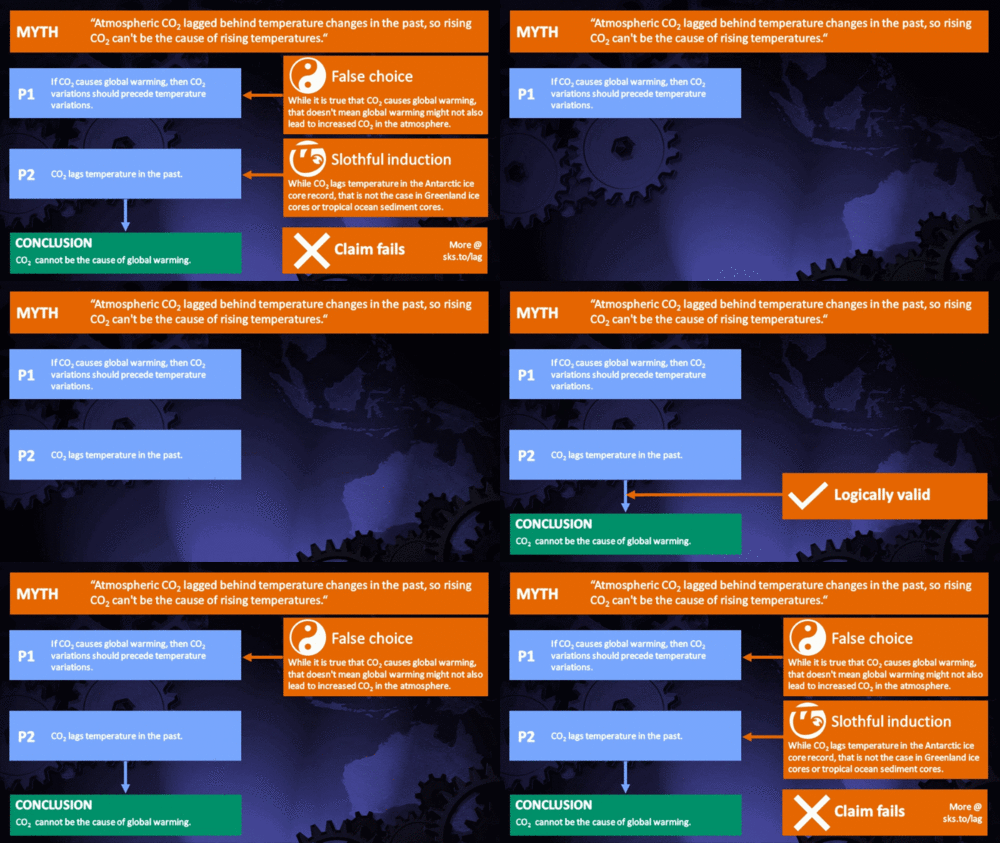
CO2 lags temperature
"An article in Science magazine illustrated that a rise in carbon dioxide did not precede a rise in temperatures, but actually lagged behind temperature rises by 200 to 1000 years. A rise in carbon dioxide levels could not have caused a rise in temperature if it followed the temperature." (Joe Barton)
What the science says...
| Select a level... |
Basic
|
Intermediate
| |||
|
CO2 didn't initiate warming from past ice ages but it did amplify the warming. In fact, about 90% of the global warming followed the CO2 increase. |
|||||
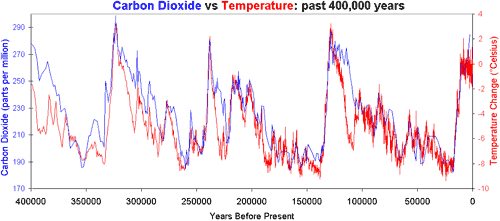
Earth’s climate has varied widely over its history, from ice ages characterised by large ice sheets covering many land areas, to warm periods with no ice at the poles. Several factors have affected past climate change, including solar variability, volcanic activity and changes in the composition of the atmosphere. Data from Antarctic ice cores reveals an interesting story for the past 400,000 years. During this period, CO2 and temperatures are closely correlated, which means they rise and fall together. However, based on Antarctic ice core data, changes in CO2 follow changes in temperatures by about 600 to 1000 years, as illustrated in Figure 1 below. This has led some to conclude that CO2 simply cannot be responsible for current global warming.

Figure 1: Vostok ice core records for carbon dioxide concentration and temperature change.
This statement does not tell the whole story. The initial changes in temperature during this period are explained by changes in the Earth’s orbit around the sun, which affects the amount of seasonal sunlight reaching the Earth’s surface. In the case of warming, the lag between temperature and CO2 is explained as follows: as ocean temperatures rise, oceans release CO2 into the atmosphere. In turn, this release amplifies the warming trend, leading to yet more CO2 being released. In other words, increasing CO2 levels become both the cause and effect of further warming. This positive feedback is necessary to trigger the shifts between glacials and interglacials as the effect of orbital changes is too weak to cause such variation. Additional positive feedbacks which play an important role in this process include other greenhouse gases, and changes in ice sheet cover and vegetation patterns.
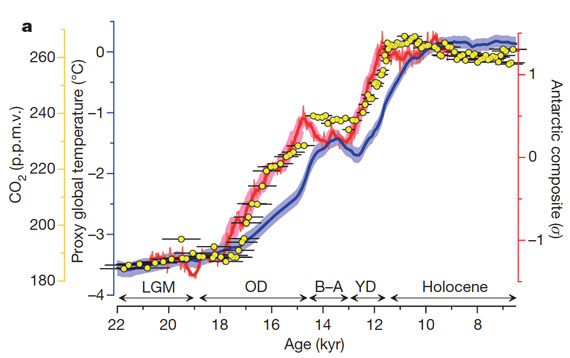
A 2012 study by Shakun et al. looked at temperature changes 20,000 years ago (the last glacial-interglacial transition) from around the world and added more detail to our understanding of the CO2-temperature change relationship. They found that:
- The Earth's orbital cycles trigger the initial warming (starting approximately 19,000 years ago), which is first reflected in the the Arctic.
- This Arctic warming caused large amounts of ice to melt, causing large amounts of fresh water to flood into the oceans.
- This influx of fresh water then disrupted the Atlantic Ocean circulation, in turn causing a seesawing of heat between the hemispheres. The Southern Hemisphere and its oceans warmed first, starting about 18,000 years ago.
- The warming Southern Ocean then released CO2 into the atmosphere starting around 17,500 years ago, which in turn caused the entire planet to warm via the increased greenhouse effect.
Overall, about 90% of the global warming occurred after the CO2 increase (Figure 2).
Figure 2: Average global temperature (blue), Antarctic temperature (red), and atmospheric CO2 concentration (yellow dots). Source.
Last updated on 9 April 2012 by dana1981. View Archives

Arguments


Basic
Intermediate


I thought Sharkhova et al (2010) had rather clearly shown this to be incorrect. Warming will be worse as will Arctic amplification and its effects on the GIS.
While I dont doubt Shakhova et al, results, what we dont have is an idea as what is "normal". This was discussed at Realclimate last year.
2. At the top of the atmosphere, using the same figures, but adjusting line shapes and amplitudes for temperature and pressure, it is clear that the greater portion of the 15-18W/m^2 emitted to space by CO2 is being emitted by the ~10% of the atmosphere lying ABOVE the Tropopause. Rough figures are: from 11-12.5km, 5%; 12.5-15km, 10%; 15-17.5km, 12%, 17.5-20km, 13%;20-25km, 20%; above 25km, 40%. If you increase CO2 concentrations, emissions are from higher levels, and an even higher proportion will be above the tropopause. IE more CO2 has a strong cooling effect.
3. Notwithstanding the above, the claimed feedback effect of CO2 on the ice-core temperatures is very shaky. I looked at the figure and note the long lag in the FALL in CO2 concentration. Why does the CO2 not hold up the temperature fall? Where is the mathematical model and its comparison with the data? At present the data does not seem to support the hypothesis.
4. The data unequivocally shows a lag between temperature and CO2 concentration. It is being claimed that CO2 makes temperatures hotter than they otherwise would be. There does not seem to be support for this in the data presented in the headline post.
That CO2 causes higher surface temperatures (aka 'the greenhouse effect') was first proven by John Tyndall more than 150 years ago. Articles explaining how this works and correcting other fundamental errors in your analysis above can be found on this site at;
Has the greenhouse effect been falsified?
and
The greenhouse effect and the 2nd law of thermodynamics
Has the greenhouse effect been falsified?
and
The greenhouse effect and the 2nd law of thermodynamics"
I thank CBD for his response to my post. I would be grateful if he would identify all the "fundamental errors" in my post rather than referring me to vague and unspecific articles. My main ponts are:
1. The undisputed absorption figures for CO2 mean that an increase in concentration cannot directly greatly (I mean by more than 0.5W/m^2) increase the absorption of surface energy by the atmosphere.
2. The increased absorption of sunlight by the upper atmosphere means a drop in insolation at the Surface of about 1W/m^2. The increased back radiation due to the decreased average altitude of the CO2 surface-bound emissions is about 0.5W/m^2, so the NET direct effect of doubled CO2 on the Surface is a cooling forcing of 0.5W/m^2.
3. At the other boundary, it is clear from the outgoing spectra that CO2 is responsible for between 15 and 18W/m^2 of the emissions to space. It is also very clear that the emissions at the stronger wavenumber 670 are stronger than the rest of the CO2 band. Because emissions to space have to get through the overlying gas, it is also clear that the more strongly absorbed wavenumber 670 emissions are coming from higher in the atmosphere than say the wavenumber 650 emissions. So in this case, Higher = hotter, ie the wavenumber 670 emissions are definitely coming from the stratosphere.
4. All very well, but what about the rest of the CO2 band? At STP 50% of wavenumber 650 emissions are absorbed in the first 25m of atmosphere. At say 17km the same number of CO2 molecules occupy about 250m. The pressure decrease over these 250m means only a small narrowing of the emission/absorption lines, so absorption rate will not be greatly affected: at 17km just under half the wavenumber 650 photons are absorbed within 250m.
5. I calculate that the published absorption data for CO2 means that the great majority of emissions from CO2 must be coming from above the Tropopause.
The headline post makes the assertion that CO2 amplifies temperature.
It is my view that the ice core data shown does not support that assertion.
If temperature was being amplified proportionately to CO2 concentration then we would expect to see some influence of this on falling temperatures.
I don't see this effect at all in the data.
The Milankovitch cycles driving the repeated glaciation of the Earth only supply a very small forcing (both up and down), not enough to change temperatures very much by themselves. They do induce CO2 feedbacks (vegetation changes, but primarily changes in solubility of CO2 in the oceans, which is inversely related to temperature); these act as positive feedback, amplifying the Milankovitch changes. The ocean CO2 feedback takes 500-1000 years due to deep circulation - hence the lag seen in the ice cores.
Both also affect water vapor (more powerful a greenhouse gas than CO2), which takes a matter of weeks or so to respond.
Further amplification occurs (in both directions) with changes in ice coverage and albedo. Once a swing in base forcing occurs, that change is greatly amplified.
The total effect with feedback amplification (each feedback having it's own time frame) is to produce the temperature swings seen in the glacial cycle.
---
Now we're inducing a very large and very fast temperature forcing by artificially increasing CO2 levels to amounts not seen since the Pliocene, when global temps were 2-3°C higher than today, global sea level 25 meters higher than now. This forcing is larger than the Milankovitch cycle changes.
And that can't be good.
Do I understand you correctly in that you are expecting co2 to drop as soon as the solar forcing drops the temperature, but that you don't see that?
Carbon feedbacks with temperature are mostly very slow. The change in solar is the driver. Once temperatures drop it takes time for the changes in the carbon cycle to remove carbon. Putting carbon back into the atmosphere when temperatures rise can happen faster (eg methane release from thawing permafrost).
"Do I understand you correctly in that you are expecting co2 to drop as soon as the solar forcing drops the temperature, but that you don't see that?"
No I expect to see elevated CO2 affecting the rate of Tdrop, and also drooping CO2 to affect the low temperature base. I see neither of these effects in the graphs and they should be there.
Basically once temperature has fallen it generally remains flat, even though CO2 concentration is falling. If CO2 drives temperature we sgould see a corresponding droop on the low temp but we don't.
That's the problem with Milankovitch - not enough oomph. All should note that Milankovitch is not the only shot in the locker. I think those who are not aware of the cosmic theory of Ice Ages should take a dekko at Fred Hoyles "Ice".
This seems to me to be a more coherent and less ambiguously weak possible cause of Ice Ages. Hoyle correctly points out that these typically happen very fast - on the order of 20 years.
A second alternative is the Svensmark hypothesis, again a cosmic origin.
Sorry, but solar IS what is drives temperature here. CO2 and albedo just amplify. Together these have no problem driving the ice age cycle using standard physics. An alternative theory has to explain a vast amount of observations including isotope signatures for methane and CO2 in ice core, spatial distribution of cooling etc etc which current climate theory does quite well. I frankly find it unbelievable that anyone can look at even the original, pre-ice core data and seriously doubt that Milankovich cycles are not involved. I suspect a few seconds on google will find you the problems with Hoyle's theory.
The lack of oomph is only a problem if you are determined that GHG changes cannot affect the temperature of the planet. Does your alternative model no-GHG effect correctly predict the surface temperature of venus, earth and mars?
Not much value in either Hoyle (debunked here) or Svensmark. See Its cosmic rays
We know that isnt true. The isotope ratios for fossil fuel produced CO2 is different from that produced by carbon cycle feedbacks. If you look at the isotopes in CO2 from ice core bubbles, the increased CO2 during warming is from carbon cycle. If you look at isotope ratio in current atmosphere, you see increase is due to fossil fuel. At the moment, the carbon sinks are cleaning up about half our emissions. Over longer time, this will reverse.
As for the simple effect of methane released by life forms, it may be a small factor; yet I suspect it pales in comparison to the huge amounts released by the thousands of years of bacteria production in the whole of the earth soils being released over a short period of time.
I also recommend watching this video on why CO2 is the biggest climate control knob in Earth's history.
Further general questions can usually be be answered by first using the Search function in the upper left of every Skeptical Science page to see if there is already a post on it (odds are, there is). If you still have questions, use the Search function located in the upper left of every page here at Skeptical Science and post your question on the most pertinent thread.
Remember to frame your questions in compliance with the Comments Policy and lastly, to use the Preview function below the comment box to ensure that any html tags you're using work properly.
However, the corollary of your question seems to imply that you think either:
1/ GHG do not cause warming - or
2/ the CO2 increase in atmosphere is causing warming rather than other way round.
Both of these can be discounted from other evidence.
I'd like to answer your question, but I can't puzzle out what you mean by it. Can you re-phrase it in a clearer, more meaningful way?
"Show me. You have just long lectures and "climate models"."
What is the point of showing you if you refuse to engage all reasonable attempts to show you?
But this question reminded me that I often think people do not understand why the ice core CO2 temp relationship is such a compelling proof of the effect of CO2 on climate because they don't understand know the scientific story behind those ice core records. Sometimes, constructing a historical narrative, like Specncer Weart does, clarifies what can seem counterintuitive in hindsight.
In the 70s we knew that glacial periods existed in the past, and we guessed that Milankovitch forcing provided the initial cue - the corrletaion was simply to amazing to be chance. But we could not explain the large deviations in global temp during glaciation cycles as a function of Milankovitch cycle forcing. Albedo effects helped related to northern hemisphere ice and snow cover helped, but were similarly too small to account for the change - even taking account of temp-water vapor feedbacks. - without using unreasonable assumptions about the physics. (Yes, we knew this based on models -although they were relatively simple at the time). It was a quandry for a decade or so.
One solution posed to this quandry was that changes in temperature could alter the global carbon cycle, thereby causing changes in CO2. That change in CO2 could then result in enough forcing to cause the glacial cycles given a small initial input. The ice core data were collected partly to test this theory, and they indeed showed that CO2 increased with temp sufficiently to cause the forcing required.
So the ice core records were a test of the idea that CO2 affects climate. But it was never part of anyones thinking that CO2 would lead the temperature change, quite the opposite in fact. Asking to see such a pattern just doesn't even make sense. It's also impossible to understand why it is so compelling unless you embrace the physics behind the greenhouse effects and global climate models - and the feedbacks being discussed now by KR and jpat. To understand that, you actually do need to roll up your sleeves and read lectures/textbooks and do calculations yourself.
Luckily we do pay people to do what you seem too impatient to do. Good for you!
I will give you a hint, however. CO2 rises with temperature increases, and temperature rises with CO2 increases. They are interlocked. So an initial orbital forcing sparks a small temperature rise, which in turn sparks a CO2 rise, which raises temperatures further, which raises CO2 levels further. This cycle results in an ongoing upswing in temperature, up to a point where CO2 levels reach about 280 ppm. At that point things stall because the relationship between CO2 and temperature is logarithmic.
Unfortunately, mankind has found a way to pump well beyond 280 ppm of CO2 into the atmosphere for the first time in millions of years.
But the main point is that a small temperature increase starts a feedback cycle involving CO2 that results in a large temperature increase. Without accompanying increases in CO2 you would not see the temperature rise much beyond -8 ˚C.
Yes? Then your actual question should be "how do we know the CO2 concentration before direct instrumental measurement of the atmosphere?" because you accept that an atmosphere with CO2 is warmer than an atmosphere without CO2, all other things being equal.
No? You need to either provide evidence that contradicts decades of high-quality research and the engineering that has relied (and still relies) on that research, or you need to do a bit more studying on the physics of CO2, CH4, H20, etc. For a simple demonstration, see this video (just about a minute in).
You seem to be saying that correlation is not causation, but there's a big "unless" involved here, and that is the physical connection. If there's a physical connection between CO2 and temperature, then it's reasonable to assume that the connection didn't just spring into existence of its own will. It's been around as long as CO2 has been around.
[DB] "If you cannot show that, you can take your "climate models" and "deep research" and run around like chicken little and ask for carbon taxes."
Now you are acting childish. And churlish. If you don't understand the explanation than ask for a simplified version.
I asked you a simple question--simple as in basic/fundamental, not as in "simple-minded". You have yet to answer it. I'll ask it again: "does atmospheric CO2 absorb and emit radiation at particular, pressure-broadened frequencies?"
Well you can always try the Middle Eocene Climate Optimum or the more dramatic
Paleocene-Eocene Thermal Maximum.
CO2 has repeatedly changed slowly over geological time because of mismatches between volcanism, weathering, etc. But other factors that affect climate also change on these time scales (ocean circulation, albedo, solar input), so it can be hard to disentangle the influences. That doesn't mean they aren't there.
As others will attest, the physical attributes of CO2 are what indicate that it must have an effect. Nothing about the rock record disagrees with that, as far as I know.
The fact that you do not understand or accept the evidence is irrelevant.
I suggest that rather than throwing around derogatory comments and dismissing what you do not understand that you go read Spencer Weart's The Discovery of Global Warming.
When you are done with that you will be able to intelligently use this site to learn how very thin the "skeptical" arguments are, how serious the problem is, and what all of the science that you dismiss and do not understand actually means.
P.S. The climate models are a small (but very useful) part of the vast base of knowledge behind the issues. You will understand that when you've finished with a serious effort to learn the science.
But for the glacial cycle, the problem is more one of arithmetic. The NH solar forcing and albedo are not strong enough to explain the temperature response by themselves. This was one of the original objections to Milankovitch theory. Furthermore, why is a NH forcing able to cool the SH, whereas same forcing in SH doesnt have an effect? The reason being that the CO2 feedback is global rather than hemispheric.
On top of this, you have difficult problem of explain why the directly measurable effect of GHG on surface irradiation does not change temperature if you wish to discount GHG as having an effect on climate.
This is in response to your point 4 here.
No, this information is not being used in that way. Our understanding of physics and myriad other observations tell us what increases in CO2 will do. The ice cores (and other proxies, and other periods of time besides the ice ages) simply confirm this understanding by demonstrating that increasing CO2 levels did affect global temperatures (as would be expected) in the past. But the ice core inference is not the source of the conclusion, but rather simply one of many sources of confirmation.
A drop in carbon dioxide appears to be the driving force that led to the Antarctic ice sheet's formation, according to a recent study led by scientists at Yale and Purdue universities of molecules from ancient algae found in deep-sea core samples.
The key role of the greenhouse gas in one of the biggest climate events in Earth's history supports carbon dioxide's importance in past climate change and implicates it as a significant force in present and future climate.
..."The evidence falls in line with what we would expect if carbon dioxide is the main dial that governs global climate; if we crank it up or down there are dramatic changes"
It may be time to reinvestigate that whole 'lag' thing.
If I understand you correctly, you are of the persuasion that believes in cycles, and that the next cycle of an ice age is imminent. Of course, that would be ignoring a very great deal of established physics, based on centuries of research, by many thousands of scientists. Not to mention that these are the same physics that underpins the technology of today.
So I recommend that Newcomers, Start Here and then learn The Big Picture, plus The Big Picture Look at Global Warming.
I also recommend watching this video on why CO2 is the biggest climate control knob in Earth's history.
As an FYI, assertions lacking support in the science and the literature tend to get ignored. Failure to back up repeated assertions with source citations tends to get comments moderated or deleted.
I understand that "Northern ice sheets melt less during summer and gradually grow over thousands of years. This increases the Earth's albedo which amplifies the cooling, spreading the ice sheets farther."
However, before that can happen, the cooling effect to prevent the melt via the top end Milankovitch factors must overcome the very powerful warming effect that the high level of CO2 has. At this point, of course, CO2 is still rising and ought to be more powerful than any other time during the cycle. The Imbrie, et all papers don't deal with this that I can see.
I realize that this issue isn't novel having been discussed on this forum before, but what peer reviewed authority engages this issue?
Thanks!!!
Also the feedback from CO2 is self limiting in the sense that IIRC the outgassing of CO2 due to heating of the oceans is linear, so in the absence of external forcings it would rapidly (on geological timescales) reach a new equilibrium. Thus by the time Milankovic cyle went into a cooling phase CO2 would no longer be on the way up.
Studies have shown that a Milankovitch Minimum NH summer warming will initiate a new glacial only if CO2 levels are at around 240 ppmv (+/- 40 ppmv). The large range is due to the fact that there are a range of studies giving partly overlaping results in that interval, and also because the level of CO2 that will stop the initiation of a glaciation depends critically on the strength of the Milankovitch Cycle. Historically, at least on glacial commenced when CO2 levels where at around 280 ppmv, but most initiate with levels around 240 ppmv, and Berger and Loutre show that even in a weak cycle, glaciation will initiate with CO2 levels around 210 ppmv.
No, this is an inaccurate view of the situation. Cooling from the 'negative Milankovitch forcing' does not have to 'overcome' the total accumulated warming from the 'positive Milankovitch forcing' and all feedbacks before cooling sets in. The transition is 'immediate' save for a very short (geologically) lag time. Once the Milankovitch forcing passes the 'warming peak' there is then progressively less of a warming forcing, which results in progressively less atmospheric water vapor (and thus lower water vapor feedback), more ice formation, oceans cool and absorb more CO2, et cetera. There is no (long term) 'inertia' to overcome... when the sign of the forcing changes all the feedbacks do as well.
I don't refer to the "accumulated warming" or "inertia" of the temperature rise. However, all of those gasses that are present at peak temperature contribute to warming just by being there.
It is not as if they are a "fuel" that burns out, they warm by trapping radiation.
Does not that warming need be overcome by the downward Milankovitch forcing in order for other positive cooling feedbacks to kick in? Of course as temperature lowers, CO2 is absorbed, and that contributes to cooling. But first it must start its descent despite the presence of these warming gasses.
Again, thanks for helping me with this, any citation to the peer reviewed studies would be much appreciated.
Then the Milankovitch forcing changes downward. If there were no feedbacks whatsoever, such a change in energy will of course cause the climate to cool. With feedbacks (water vapor, CO2 after 500-800 years, albedo changes, etc.) the climate will cool to a larger (positive feedbacks) or smaller (negative feedbacks) extent than the direct forcing change alone would cause. Feedbacks are a response to forcing, not an independent entity. If forcing changes, the feedbacks will as well - they will not (independently) hold the climate energy stationary, or they would instead be independent forcings.
Over geological time frames feedbacks are very fast - amplifiers of forcing changes. If you are speaking into a microphone, and drop your voice to a whisper, would you really expect the amplifier to keep the output volume unchanged?
Or would you instead expect the output volume to change as per your input volume change times the amplification?
Think about the actual physical factors involved. The Milankovitch forcing is due to orbital tilt. Why/how would GHG have any impact on when the 'sign' of that forcing changed? Yes, "it must start its descent despite the presence of these warming gases"... but there is absolutely no reason that it wouldn't do exactly that. That is, the change in atmospheric composition is obviously not going to change the orbit. You then agree that once the cooling from the orbital shift kicks in "CO2 is absorbed, and that contributes to cooling". So what exactly are you arguing for... in terms of a physical process?
You seem to be stuck on some sort of idea that, 'because GHG make it warm, it cannot cool until the GHG are gone'... which is incorrect. The Milankovitch change in orbital forcing is not in any way restrained by the presence of GHGs. It switches to cooling as the orbit of the planet shifts. That cooling lowers the temperature of the oceans and allows them to absorb more CO2... which causes more cooling.
Temperature is function of X+Y+Z.
If X stays same, and Y goes down, then temperature must drop. Now there is a lag, X will rise slightly while Y goes down, but once Y goes lower than X, the cooling starts and the negative feedbacks kick in to reduce first albedo, then water vapour and then CO2.
It is worth noting though that the nature of milankovich cycle is that first change when cycle goes negative will be to albedo, as the effect is primarily on NH mid-high latitudes (where is forcing change is quite large compared to both GHG and global solar change).
How do you square that with Roe, G. (2006), In defense of Milankovitch, Geophys. Res. Lett., 33, L24703, doi:10.1029/2006GL027817
"In other words, variations in melting precede variations in CO2. Thus, the relatively small amplitude of the CO2 radiative forcing and the absence of a lead over dV/dt both suggest that CO2 variations play a relatively weak role in driving changes in global ice volume compared to insolation variations."
and "Furthermore, variations in atmospheric CO2 appear to lag the rate of change of global ice volume. This implies only a secondary role for CO2 – variations in which produce a weaker radiative forcing than the orbitally-induced changes in summertime insolation – in driving changes in global ice volume."
Thanks!
'CO2 amplifies the warming which cannot be explained by orbital cycles alone.'
does not in anyway imply the CO2 was the driver - the milankovich insolution variation was clearing the dominant forcing. However, the magnitude of the effect (and change in SH to NH forcing) is extremely difficult to explain from insolution and albedo change alone. See the paleoclimate chapter of AR4 WG1 for details of the relative forcings.
Did you read Roe? Roe doesn't say that CO2 has no effect, just that it is not necessary to drive the glacial interglacial cycle. Roe states that the variations in insolation forcing exceed direct CO2 radiative forcing by a factor of five. When you say it is extremely difficult to explain from insolation alone, Roe does just that. Read the whole thing, if you haven't, and then I would like to hear what you think.
Thanks.
ie CO2 is important in explaining how a forcing operating at 65N can overwhelm an opposite forcing in the SH and drive the cycle there too.
From AR4 - the global GHG forcing for LGM cf today is -2.8W/m2. Albedo at -3.8, and vegetation change and aerosols estimated at -1W/m2 each.