





Galactic cosmic rays: Backing the wrong horse
Posted on 24 September 2011 by muoncounter
The popular press is still pushing the preliminary CERN CLOUD results as proof that galactic cosmic rays (GCRs) are a major influence on climate. We've already had an excellent rebuttal here on SkS, featuring Jasper Kirkby's own words urging a more sober interpretation of his preliminary results. Yet those who do not fully understand the science are willing to bet that they have proof positive of the GCR-climate connection. Here is another look at the science of cosmic rays, in which we find out that's not a very good bet.
In horse racing, there's a payout for the 1st, 2nd and 3rd place finishers. All the other horses in the race finish 'out of the money.' One way to go broke very quickly is to repeatedly back the wrong horse.
Let's Check the Odds
The GCR-climate connection is based on well known science: cosmic rays do indeed contribute to ionization of the earth's atmosphere (known as CRII, for cosmic ray induced ionization). Whether CRII leads to enhanced cloud formation is the basic conjecture that GCR supporters want to establish. They must then show that GCR-induced clouds (if any such exist) in turn produce observable climatic effects.
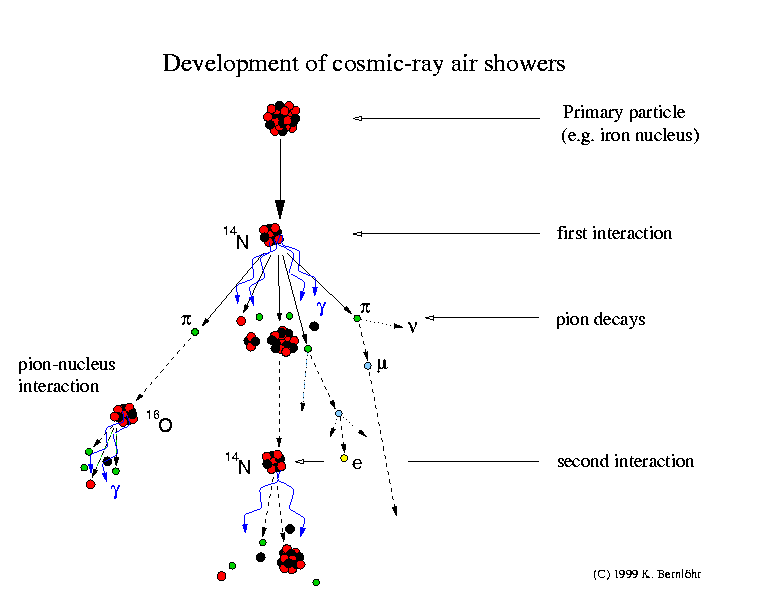
If this is to be a horse a race, we must examine the field of entrants and study their track records. The full family of particles observed when an energetic primary GCR particle enters the atmosphere is illustrated below.
-- source
The CERN CLOUD experiment uses a positive pion beam of 3.5 GeV energy, a relatively middle-of-the-road energy on the spectrum of GCRs. Thus CLOUD backs only one horse in this race: the right-most interaction, pions (π) decay to muons (µ) and neutrinos (ν); note that this interaction does not produce neutrons and is thus invisible to neutron monitors around the world. What of all the other particle interactions on the diagram above? Which horse is the favorite in this race?
Picking a Favorite
Cosmic ray particles sourced by the sun are known as Solar Energetic Particles (SEPs) -- these are typically fast-moving solar wind protons. The energy associated with SEPs runs as high as 5 GeV, equivalent to a flux of 3x10⁻⁶ to 2x10⁻⁵ W/m2. Those on the lower end tend to penetrate only the upper atmosphere; these are the events that can lead to Forbush Decreases (FDs). Even higher energy SEPs can lead to significant increases in particle count rates at the earth's surface known as Ground Level Enhancements (GLEs). These events produce the additional particles shown in the illustration above; we do indeed see these events on neutron monitors.
The image below is a composite of neutron monitor records, illustrating the distinction between the appearance of FDs and GLEs. FDs have been observed as precursors to GLEs. In this example, the count rate multiple is approximately 25%, so the GLE is not particularly energetic.

-- source
Usoskin et al 2009 investigated ionization by GLEs (emphasis added):
"There is a strong correlation between the GLE magnitude (in Neutron Monitor %) and the ionization effect in the stratosphere ... – all strong GLEs led to a more than 10% enhancement of CRII in the polar region. There is still some weak relation in the upper troposphere ... – all strong GLEs lead to a slight positive ionization effect. ...
SEP play a role in the ionization only in the upper-middle polar atmosphere. In all other regions the ionization is suppressed due to the accompanying Forbush decrease. ... There is no ionization effect at mid- or low-latitudes, even for the strongest events. It is clear ... that there is no straightforward relation between the strength of GLE (as measured by neutron monitors) and the ionization effect in polar atmosphere. The net atmospheric ionization effect is defined by an interplay between the SEP event itself and a Forbush decrease, which often accompanies it."
That last statement is key to understanding just how
difficult it is to establish a cosmic ray-climate connection: Not all cosmic ray increases ionize the atmosphere. This horse race went from a walk in the park to a long, slow steeplechase on a very muddy field.
Jumping the Ionization Hurdle
Many GLEs originate as X-class solar flares and are thus relatively rare. The neutron monitor at Oulu, Finland observed 55 GLEs during the 50 year period 1960-2010. The neutron count rate increased by more than 10% in only 21 of these recorded GLEs. One of the largest occurred on 20 Jan 2005, as reported by a number of authors. From Bieber et al 2005,
"Within a 6-minute span on January 20, 2005, the count rate registered by a neutron monitor at the sea level station of McMurdo, Antarctica increased by a factor of 30, while the rate at the high-altitude (2820 m) site of South Pole increased by a factor of 56."
Inuvik and Fort Smith, Canada reported count rate multiples of 4-5; at Oulu the increase was 269%. High multiples of the background count rate persisted for several hours. Per Moraal et al 2008, the protons in this GLE contained a spectrum of energies from ~1.5 - 5 GeV; they also reported that the GLE was composed of at least 3 distinct pulses of particles arriving at the surface of the earth (the first of which caused a Forbush Decrease). Mironova et al 2011 looked at ionization due to this GLE (emphasis added):
"The very high level of neutron monitor count rate increase implies that the ionization of the polar atmosphere was dramatically increased during the event ... the calculated ionization due to the SEP event of 20 January started dominating over the GCR ionization already at 10-km altitude and reached its maximum at about 30 km altitude. In particular, the CRAC:CRII model calculations suggest that the SEP event produced additional ionization in the polar atmosphere in the altitude range 12–23 km, with the number of ions being greater by a factor of 3–30 than the averaged GCR-induced daily ionization in January 2005."
Mironova also looked for atmospheric effects due to this GLE (emphasis added):
"We would like also to emphasize that the observed atmospheric effect for this extreme GLE event was barely significant. No clear atmospheric effect was found beyond statistical fluctuations for the weaker SEP event of 17 January 2005, which is a typical SEP event. This implies that only extremely hard-spectrum (high energy) GLE/SEP events can produce a noticeable direct effect on aerosols in the polar low-middle stratosphere."
Thus one of the strongest known GLEs, producing much more ionization than the typical GCR, had no direct affect on the weather - and the sum of many such events will have no connection to climate.
In this horse race, until the CLOUD experiment can cl
ear the ionization hurdle by investigating the complex relationship between FDs and higher energy GLEs, it will continue to be tripped by this hurdle and always finish out of the money. Those who've put their money on CERN CLOUD finding a GCR-climate connection are backing the wrong horse.
Note: Revised 9/24/2011

Arguments


"Thus one of the strongest known GLEs, producing much more ionization than the typical GCR, had no direct connection to WEATHER."
A sudden increase in ionization, no matter how strong, would only affect the weather for a short amount of time so in the context of those experiments it's seems to me that it's not right to talk about climate.
The things is, the odds of GCRs leading to a reassessment of AGW is even more unlikely than the odds of GCRs being important to climate. The physics of GHG is pretty clear, and we're doing a fine job of prediction without GCRs. If GCRs are playing a role, understanding that role is likely to put the effect of GHG on climate into even more relief by reducing the background "random" noise a bit more.
That gets buried in this terrible framing of climate science as GHG vs everything else. It's a complete distortion of the real scientific debate. This is not an alternative hypothesis counter to AGW, it is an additional hypothesis that could move the science forward.
Per Guillou 2004, the global decrease in magnetic field at 40kya was "revealed in polar ice as an abrupt change in the rate of cosmogenic nuclide flux."
No one is questioning modulation of GCR flux by the interplanetary magnetic field and geomagnetic field. But did whatever internal mechanism that caused the Laschamp also affect temperatures? That makes GCR flux a symptom, not an agent of climate change.
A geomagnetic excursions hasn't happened any time lately:
These events, which typically last a few thousand to a few tens of thousands of years, often involve declines in field strength to between 0-20% of normal.
Are you suggesting recent climate change is due to a new Laschamp-type event? Are we in the midst of one? Where's your evidence of that?
Agreed. However, the basis of the GCR experiment rests on proxies for increased GCR flux during past cold events (see any of Kirkby's papers, especially Fig 2 in Cosmic rays and climate 2008). The popularizers and non-science media fixate on this unsupported mechanism with such insightful remarks as, 'Its the sun, stupid'.
Good point.
There is a simplification we use called "the rate limiting step". In multi-step reactions, the slowest reaction governs the rate of the ensemble. Thus a chemist naturally asks what the rate limiting step in a droplet nucleation process is. It may not be the initial nucleus formation. Depending on conditions a droplet may form only to rapidly evaporate again, and only if a critical size is reached will the droplet be stable under the conditions. Thus the rate of formation of droplets of a given size becomes the rate limiting step, NOT the rate of nucleation by contact with aerosol particle or ionization by cosmic rays. The degree of supersaturation is important here.
The next consideration is auto-catalysis. Given droplets, they can split, regrow and split again. This process can dominate ab initio droplet formation (and in crystallization processes usually does). Thus only a very low threshold rate of droplet formation is required and other process dominate after that. This kind of process could make cosmic ray triggers irrelevent.
I haven't seen any summaries of cosmic ray nucleation discussing these kinds of issues, and it could be there. Is it?
Kirkby's language is qualified on this point:
Time-resolved molecular measurements reveal that nucleation proceeds by a base-stabilization mechanism involving the stepwise accretion of ammonia molecules. Ions increase the nucleation rate by an additional factor of between two and more than ten at ground-level galactic-cosmic-ray intensities, provided that the nucleation rate lies below the limiting ion-pair production rate. --emphasis added
This point was buried deep within the Nature News press release:
Lockwood says that the small particles may not grow fast enough or large enough to be important in comparison with other cloud-forming processes in the atmosphere.
The press release ranks as a low point in science journalism, complete with this factually incorrect description:
... bombard the chamber with protons from the same accelerator that feeds the Large Hadron Collider, the world's most powerful particle smasher. As the synthetic cosmic rays stream in, the group carefully samples the artificial atmosphere to see what effect the rays are having.
CLOUD uses pions, not protons; small detail to some, but then again, this is science and we're supposed to get small details right. But all of that is entirely ignored by the pro-GCR crowd because the headlines give them what they want.
The first sentence says the rebuttal features his own words, not contradicts.
Here are those specific words:
The headline of the press release stated: "Cloud formation may be linked to cosmic rays." OK, they may be, but that is not what Kirkby actually says.
Writers ranging from Nigel Calder to the Forbes 'science' blogger picked this up and turned it into 'Hooray! Its proven that cosmic rays cause climate change!' in spite of the Kirkby quote. One has to suspect (and in Calder's case, it is a certainty rather than a suspicion) that is what they wanted to hear. Worse still, they started throwing around the sham argument that 'there's a conspiracy to keep Kirkby quiet' or some such twaddle.
But I suppose there are some who still believe the moon is made of cheese.
"Despite an excellent rebuttal here on SkS featuring Jasper Kirkby's own words to the contrary (PAUSE) the popular press is still pushing the preliminary CERN CLOUD results..."
One could read the 'contrary' being applied to the first part of the sentence rather than the second part. I think you need another comma after 'own words'. The 'to the contrary' is a break in the flow of the sentence. Alternatives are to use dashes or parentheses depending on grammar style.
eg.
"Despite an excellent rebuttal here on SkS featuring Jasper Kirkby's own words, to the contrary, the popular press is still pushing the preliminary CERN CLOUD results..."
or:
"Despite an excellent rebuttal here on SkS featuring Jasper Kirkby's own words - to the contrary - the popular press is still pushing the preliminary CERN CLOUD results..."
http://www.atmos-chem-phys.org/10/10941/2010/acp-10-10941-2010.pdf
The CERN experiment was much more abstract but this is a real world experiment using nature itself. The CERN experiment is really a confirmation and refinement of results already obtained in 2005 by Svensmark in his SKY experiment:
http://www.space.dtu.dk/English/Research/Research_divisions/Sun_Climate/Experiments_SC/SKY.aspx
lowclouds%20and%20gcr).pdf
I did not read it as you did, but I can see that it could cause confusion. Perhaps:
"Despite an excellent rebuttal here on SkS, supported by Jasper Kirkby's own words, the popular press is still pushing the preliminary CERN CLOUD results..."
Your first link is to the familiar Laken 2010, discussed here. This 'real world experiment' compared cloud fractions computed via general circulation models.
And no, CERN is not duplicating/confirming Svensmark.
The SKY experiment was done in frustration because the CLOUD experiment was delayed by over a decade. It was done inexpensively by using natural muons and essentially turning them off with a strong electric field. Here is the link:
http://www.space.dtu.dk/upload/institutter/space/forskning/05_afdelinger/sun-climate/full_text_publications/svensmark_prsa_oct2006.pdf
Actually you can buy your own Wilson cloud chamber kit for $23 which will demonstrate the principle nicely. Natural muons from space will leave clear tracks in the supersaturated vapor clearly demonstrating how cosmic rays can produce clouds.
That must've been some electric field, as natural muons reach the surface with an average energy of 3-4 GeV (that's G as in billion). SKY used 580 MeV electrons; CLOUD uses 3.5 GeVs.
So here's a puzzle: 'Natural muons' are largely a product of solar wind protons. If they are so good at making clouds, why doesn't cloud production (and the cooling or warming that is supposed to result) more closely match the solar wind output?
Another puzzle came to light here: electrons, like cosmic rays in the real atmosphere, are ionizing molecules in the air and so cause water molecules to stick together. Furthermore, the researchers found that this effect also took place when they used a radioactive sodium source, which produces gamma rays
The basis of Svensmarkism is that solar variation modulates cosmic ray flux and thus cloud production. If natural gammas are of sufficient energy to ionize and thus are also producers of clouds, how can the interplanetary magnetic field be relevant to that process? Gamma rays aren't touched by magnetic fields.
And thanks for the cloud chamber reference. Demonstrating a 'principle' in a closed chamber is nowhere near as difficult as demonstrating that the mechanism is viable in the atmosphere.
To quote from the Laken et al 2010 paper you linked to.
"This work has demonstrated the presence of a small but statistically significant influence of GCRs on Earth’s atmosphere over mid-latitude regions."
and
"The climatic forcings resulting from such solar – terrestrial links may have had a significant impact on climate prior to the onset of anthropogenic warming, accounting for the presence of solar cycle relationships detectable in palaeoclimatic records."
So the authors doing active research and promoting this idea see this as a small effect possibly contributing to past variation, but not to current warming. As I said before, it'd be cool if it panned out, though it's unlikely to for all the reasons mc has mentioned. Even if it does pan out, it will allow us to account for more short term natural variability, which will only make the effects of anthropogenic GHGs more obvious.
This whole debate sounds like a disguised version of the fallacy that climate scientists think that only GHGs affect climate.
1) showing that in the atmosphere other mechanisms for cloud nucleation are insufficient to account for cloud formation. Given the enormous amount of anthropengenic dust, nitrogen oxides etc have come to reside in the atmosphere this seems more than a little challenge. What evidence is there that supersaturated air masses do not form clouds with great ease?
2) Showing that there has been some (any) variation in cosmic ray flux coincident with the rise in GMST. Not hypotheses about how it might occur....real data here.
3) Overturning the physics of CO2 and showing why every calculation has been overstating the direct forcing from its increasing levels in the atmosphere. This will also require an explanation of the CO2 signature in TOA emissions and back emissions to the earth.
Those were among the key points of the prior 'Saying nothing' thread.
What I wanted to do here was demonstrate that even putting aside all those hurdles, the record is this: We've seen events (like the Jan 20 2005 GLE) that should have done the job -- and they did not. That horse was scratched from this race.
(-Snip-)
[DB] Inflammatory deleted. Please refresh yourself with the Comments Policy and ensure that future comments fully comply with it.
The article is well worth the read, the final paragraph is especially noteworthy:
"While reported observed correlations between cosmic rays and clouds are suggestive of effects of cosmic rays on clouds, cosmic rays rarely change without other inputs to the Earth system also changing (e.g. total solar irradiance or solar energetic particle events, both also driven by changes in the sun, but distinct from cosmic rays). Thus, we must understand the physical basis of how cosmic rays may affect clouds. However, it is clear that substantially more work needs to be done before we adequately understand these physical connections, and that no broad conclusions regarding the effect of cosmic rays on clouds and climate can (or should) be drawn from the first round of CLOUD results. Finally, there has been no significant trend in the cosmic ray flux over the 50 years, so while we cannot rule out cosmic-ray/cloud mechanisms being relevant for historical climate changes, they certainly have not been an important factor in recent climate change."
Backing the GCR hypothesis as a silver bullet for explaining the observed climate change the last 50 years is backing the wrong horse.
He pointed out that the paleoclimate data show that a significant variation in the amount of cosmic rays did not cause climate change.
"There's really good science to be done on this. But we have reason to believe its a fine tuning knob...."
"People say the Sun doesn't change much but the Sun modulates the cosmic rays, the cosmic rays modulate the clouds, the clouds modulate the temperature, so the Sun is amplified hugely...."
"Now the Sun modulates cosmic rays..."
"And 40,000 years ago the magnetic field basically zeroed out in what we call the LasChamp anomaly for a millenium or so. And when it did, cosmic rays came screaming into the Earth system and you see, in basically all sedimentary records, this peak of cosmic ray produced nuclides.
[ He displayed this chart ]
"We had a BIG cosmic ray signal, and the climate ignores it. And its just about that simple. These cosmic rays didn't do enough that you can see it."
Thanks for posting that. That was actually one of the examples that came to mind when was referring to the paleo record and GCRs in a post on another GCR thread. Would you mind reposting this on that thread too? Thanks.
@31 - Dr. Alley wasn't critical of anyone who wanted to look into this line of research. He was forceful when expressing what he thought would come of it - "a fine tuning knob, at best".
What is incredible is how so many who observe the overall climate debate believe deniers making third rate arguments on issues like this should be taken as equally credible as types like Dr. Alley.
Dr. Alley's previously mentioned AGU presentation is extremely entertaining. The AGU is the largest gathering of planetary scientists that occurs annually in the world, and the Bjerknes Lecture is one of its high points.
Dr. Alley started his presentation by reading out an email sent to his superiors at Penn State which called on Penn State to fire him because he was misleading the world about the role CO2 plays in determining Earth's climate. This greatly amused those present at the lecture. He then proceeded in his inimitable way, with broad brushstrokes, to outline why climate scientists believe CO2 is the "biggest control knob" controlling climate.
The video is worth watching and studying.
My point was that I believe there was a lot of infighting over whether to fund the CLOUD research in the first place (though, admittedly I've done little research on this). Of course AGW deniers call this out to "prove" that the climate research community is against them but there are lots of people with lots of research projects and CERN has to pick and choose what research goes forward and what gets rejected. The CLOUD project, obviously, was approved. My point was, reinforcing what Alley was saying that "it's a small control knob at best." Based on previous research it's unlikely that the CLOUD project is going to turn up anything BIG with regard to cloud nucleation and climate effects.
A paper is in press at J. Climate by Agee et al. (2011), they conclude:
"An updated assessment has been made of the proposed hypothesis that “galactic cosmic rays (GCRs) are positively correlated with lower troposphere global cloudiness.” A brief review of the many conflicting studies that attempt to prove or disprove this hypothesis is also presented.
It has been determined in this assessment that the recent extended quiet period (QP) between solar cycles 23–24 has led to a record high level of GCRs, which in turn has been accompanied by a record low level of lower troposphere global cloudiness. This represents a possible observational disconnect, and the update presented here continues to support the need for further research on the GCR-Cloud hypothesis and its possible role in the science of climate change."
In other words, the increase in cosmic rays has not been associated with an increase in lower tropospheric cloud cover as predicted by the GCR hypothesis, in fact it has been associated with a record low level of lower troposphere global cloudiness.
This finding also points to a positive feedback between warming and clouds.
I assumed the people involved with creating this site are well aware of Dr. Alley, his AGU presentation, and his body of work. I think Dr. Alley's point about cosmic rays and their influence on climate is very strong.
Hansen often makes his points citing paleo data because as he says all possible feedbacks and factors are in there.
Whatever the exact processes are, that may or may not affect clouds, that are influenced by variations in cosmic rays, the paleo data shows that a dramatic variation of the abundance of cosmic rays on a millenia time scale in the past had no climate effect.
Its the kind of data that would really take the wind out of your sails if you were saying you felt like you were on the brink of discovering some new major factor to climate science. If you were at all rational that is.
One thing's for sure, some spectacular auroral displays the past few nights - if you're not far enough north, see the pics at spaceweather.com
Here is the GCR over 100's of millions of years from Shaviv http://www.blc.arizona.edu/courses/schaffer/182h/Climate/CelestialDriver.pdf:
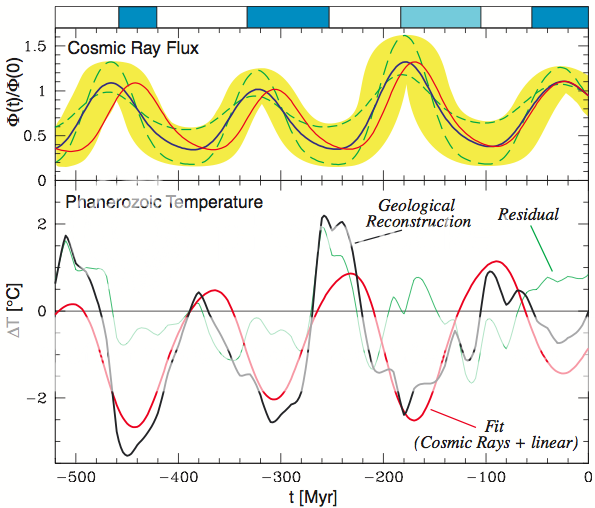
You need to look up the criticisms of Shaviv 2003. In particular, the graph you just posted looks sort of good... until you realize that each little hash mark represents a span of 20 million years. Given how very fuzzy the correlation is (it lags by tens of millions of years at 400 million years and 300 million years) and the questionable nature of how values were arrived at in the graph... I don't put any weight in it whatsoever.
Even the paper's own conclusion says:
You need to be a lot more skeptical about papers like that, and it doesn't take a lot of research to find out that the paper, while published, did not stand up to scrutiny.
Real Climate on Shaviv
Peer Review: A Necessary But Not Sufficient Condition
From that last link:
Suffice to say, solar-modulated GCR is a control knob, solar itself is another, and GHGs are another.
That still is mere conjecture.
#40: "But there is still the medium range evidence of a GCR control knob (Mercurio link above)"
Mercurio is a summary article written for the 'Encyclopedia of Human Ecology,' whatever that is. His 'evidence' consists largely of rehashed Svensmark with some Willie Soon graphs thrown in. A hodge-podge of other concepts shows up as well:
In my hypothesis for the control of climatic cycles by geomagnetically modulated GCR levels, greater inclination of the earth with relation to external gravitational attraction results in stronger geomagnetism and therefore lower GCR levels which, in turn, result in less condensation and low cloud cover and generally warmer conditions.
External gravitational attraction results in stronger geomagnetism? Did I miss when that relationship was established?
But at least he's up-front about his 'hypothesis':
I do not know whether the values of geomagnetic intensity on my curves indicating glacial-interglacial chronology are what would be necessary to modulate GCRs to develop the climates predicted for them.
In other words, it's pure correlation without a mechanism. But let's call it evidence anyway.
Much of the remainder is good old climastrology:
The next ~80 year cycle maximum is likely to be around the year 2013 and this is one of the reasons it has been getting warmer over the last several decades since the last minimum around 1975
And here's a prediction (circa 2002):
Dust Bowl type droughts on the North American western Great Plains and Southwest as occurred on and off for several years following the last solar minimum around 1997 should not occur in the years following the next solar minimum around 2007. Dust Bowl type droughts could be expected around and after the minimum of the following antiparallel solar cycle around 2020 or a little over 22 years from 1997.
So 2011 droughts should not have happened until 2020. That merits an "Oops."
I'll have to read the Mercurio paper, but it does not seem to ever have been published in a peer-reviewed journal (or even one that pretends to be, like GRL). As such, it's hard to figure out what flaws it might hold. No one seems to have paid much attention to it.
I'll take a peek, at his paper, but everything I've ever seen shows little correlation between GCR and climate. It's possible that there is a vague connection there, but without a proven physical mechanism or clear correlation in the evidence, it's hard to put much weight on it at all.
Sorry, I can't concede it as a "control knob" without a lot more evidence to support it.
Obviously the GCR/TSI knob, such as it is, is completely moot in light of our increasing GHGs. Our only worry right now is warming from GHGs.
Isn't the entire GCR argument based on 'some causation we don't understand'?
"lower GCR's and corresponding higher TSI allow warming to take place, otherwise, for the most part, we would be stuck in a glaciated state"
Are you suggesting here that a change in GCR flux is necessary to initiate deglaciation? If so, why - and on what evidence? Why isn't it simply sufficient for a change in TSI to start the warming process?
"GCR appears moot in our current interglacial because it does not seem to happen in reverse"
An odd sort of control knob, only working one way. That is not how I recall the Svensmark model - more solar, fewer GCRs, fewer clouds. Less solar, more GCRs, more clouds. That has to work both ways.
A recent paper, Laken and Calogovic 2011, is relevant:
We find no evidence that widespread variations in cloud cover at any tropospheric level are significantly associated with changes in the TSI, GCR or UV flux, and further conclude that TSI or UV changes occurring during reductions in the GCR flux are not masking a solar - cloud response.
How is that a control knob?
Also on your first sentence in #44 - if there's an increase in piracy alongside global warming, do you "have to agree that there is some causation that we don't understand"? Bit of a non sequiter. Your final sentence is correct, however!
(from http://alliance.la.asu.edu/temporary/students/Phil/Hughen.pdf)
Skywatcher, the GCR spike shown in #29 took place in full glaciation so I would not expect a GAT response. My purpose in resurrecting this thread was to respond to the claim in Spharican's latest post "It took an increase of 105 ppm, or a factor of 1.6, to get us from an "ice age" into the world in which we currently not only live, but thrive" As I said there, it took more than CO2, it required a control knob, with the 1.6x CO2 functioning as an amplifier. The control knob could be TSI, and not GCR as there is considerable overlap in their effects.
1) Shaviv's temperature reconstruction is almost certainly wrong, both because it has been shown to not compensate for the effects of changing ocean pH, and because it is incompatible with the record of Earth's cryosphere. The oxygen 18 record from Royer et al, 2004, essentially reproduced below, although from a different paper is Shaviv's record as corrected for pH. Further, if Shaviv where correct, the absence of glaciation around 200 and 450 million years ago is astonishing, given the temperatures relative to current global temperatures.
2) Further, given a GCR connection to climate change, it seems unlikely that the early Earth would ever exit a snowball state. Essentially, the early Earth had 70% of the current TSI. That also meant a weaker magnetic field, and hence more GCM reaching the Earth. The logical conclusion with both a weaker sun and higher cloud albedo due to GCM's is that a snow ball state would have been a permanent feature of the Earth's climate until at least the last 200 million years.
3) Finally, I am uncertain that you can simply assume Be10 cannot be a dependent variable for climate. Specifically, Be10 is formed by spalliation from Oxygen or Nitrogen. It is then washed from the atmosphere in solution. When a particular sediment dries, the Be10 is left behind in proportion to its concentration in the water. Intuitively, there are then two controlls on Be10 concentration. The rate of formation, which determines concentration in the atmosphere; and the rate of rainfall. Larger quantities of rainfall, by washing the Be10 out of the atmosphere more frequently, and with a larger volume of water would result in a lower concentration of Be10 in the water, and hence in the resulting sediment. Alternatively, dry times such as the last glacial, would result in higher Be10 concentrations.
This is just a suggestion by me, and may be entirely wrong. It would, however, neatly explain the correlation shown by Mercurio, and explain why Be10 concentrations do not always vary with fluctuations in the Earth's magnetic field (as indeed, is shown by Mercurio during the last glacial), and also why Be10 and C14 concentrations do not always correlate.
For the record, I was saying the same thing that you are, that in those cases CO2 was an amplifier tied to temperature itself, and not a control knob. It's fairly well accepted that the trigger for the event was a change in orbital configuration that changed not TSI but simply the duration and strength of Northern Hemisphere summers, which in turn triggered the retreat of the ice sheets, reflecting back less sunlight (and in that way causing a lower TSI).
The main issue in the glacial termination debate is the main mechanism for the abrupt surge in methane and carbon dioxide that let the whole thing get from "there" to "here."
I should point out, too, that in this sense I'm simply using the term "control knob" in a different sense that Dr. Alley. It's still a "knob" in that it affects temperatures, but it wasn't a knob before 1751 because no intelligent civilization had until then been able to change CO2 in the atmosphere.
From that perspective, no, it wasn't a control then, but it is now.





