




Frauenfeld, Knappenberger, and Michaels 2011: Obsolescence by Design?
Posted on 2 May 2011 by Daniel Bailey
We know the planet is warming from surface temperature stations and satellites measuring the temperature of the Earth's surface and lower atmosphere. We also have various tools which have measured the warming of the Earth's oceans. Satellites have measured an energy imbalance at the top of the Earth's atmosphere. Glaciers, sea ice, and ice sheets are all receding. Sea levels are rising. Spring is arriving sooner each year. There's simply no doubt - the planet is warming.
And yes, the warming is continuing. The 2000s were hotter than the 1990s, which were hotter than the 1980s, which were hotter than the 1970s. In fact, the 12-month running average global temperature broke the record 3 times in 2010; according to NASA GISS data (2010 is tied with 2005 for the hottest year on record for GISS and tied with 1998 using HadCRUT). Sea levels are still rising, ice is still receding, spring is still coming earlier, there's still a planetary energy imbalance, etc. etc. Contrary to what some would like us to believe, the planet has not magically stopped warming.
Humans are causing this warming
There is overwhelming evidence that humans are the dominant cause of this warming, mainly due to our greenhouse gas emissions. Based on fundamental physics and math, we can quantify the amount of warming human activity is causing, and verify that we're responsible for essentially all of the global warming over the past 3 decades. In fact we expect human greenhouse gas emissions to cause more warming than we've thus far seen, due to the thermal inertia of the oceans (the time it takes to heat them). Human aerosol emissions are also offsetting a significant amount of the warming by causing global dimming.
The Original Frozen Tundra
In October of 2010, The National Oceanic and Atmospheric Administration (NOAA) released the Arctic Report Card. The report contains a wealth of information about the state of climate in the Arctic Circle (mostly disturbing). Especially noteworthy is the news that in 2010, Greenland temperatures were the hottest on record. It also experienced record setting ice loss by melting. This ice loss is reflected in the latest data from the GRACE satellites which measure the change in gravity around the Greenland ice sheet (H/T to Tenney Naumer from Climate Change: The Next Generation and Dr John Wahr for granting permission to repost the latest data).
Figure 1: Greenland ice mass anomaly - deviation from the average ice mass over the 2002 to 2010 period. Note: this doesn't mean the ice sheet was gaining ice before 2006 but that ice mass was above the 2002 to 2010 average.
Additionally, Tedesco and Fettweiss (2011) show that the mass-loss experienced in southern Greenland in 2010 was the greatest in the past 20 years (Figure 2 below).
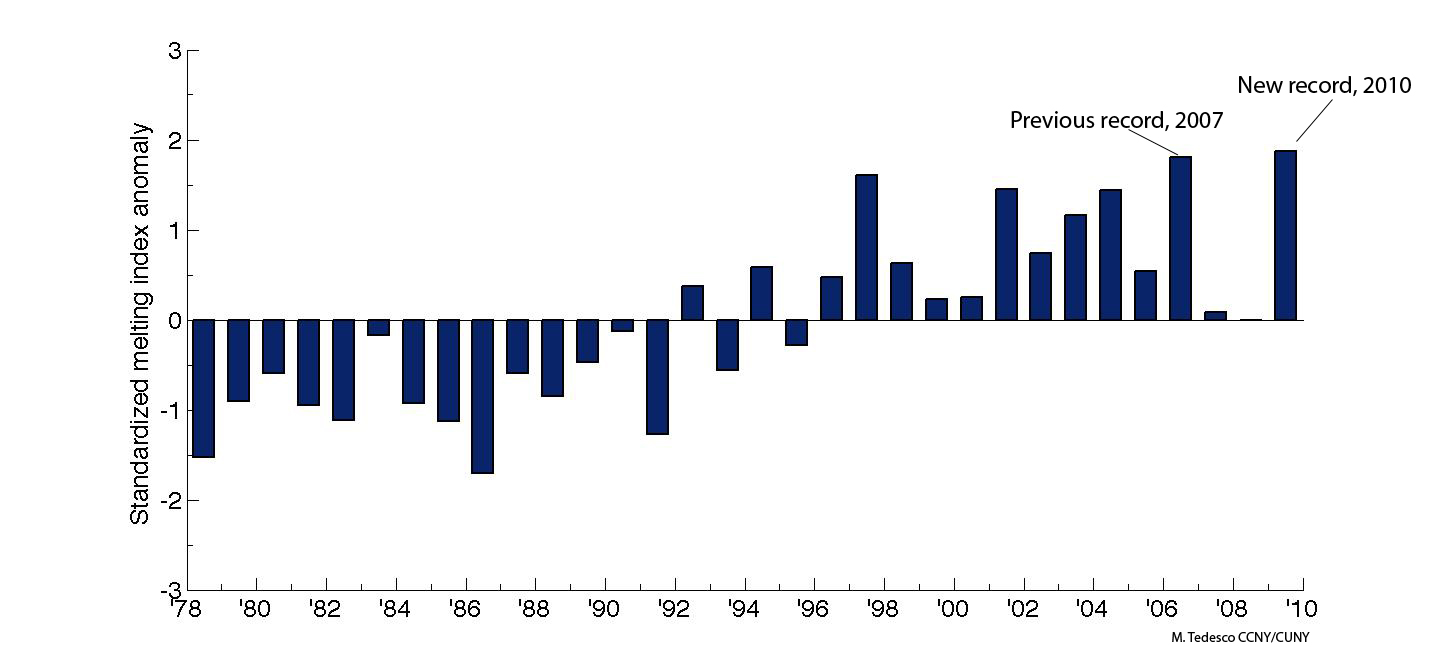
Figure 2: Greenland melting index anomaly (Tedesco and Fettweiss (2011))
The figure above shows the standardized melting index anomaly for the period 1979 – 2010. In simple words, each bar tells us by how many standard deviations melting in a particular year was above the average. For example, a value of ~ 2 for 2010 means that melting was above the average by two times the ‘variability’ of the melting signal along the period of observation. Previous record was set in 2007 and a new one was set in 2010. Negative values mean that melting was below the average. Note that highest anomaly values (high melting) occurred over the last 12 years, with the 8 highest values within the period 1998 – 2010. The increasing melting trend over Greenland can be observed from the figure. Over the past 30 years, the area subject to melting in Greenland has been increasing at a rate of ~ 17,000 Km2/year.
This is equivalent to adding a melt-region the size of Washington State every ten years. Or, in alternative, this means that an area of the size of France melted in 2010 which was not melting in 1979.
Selective Science = Pseudo-Science
Into this established landscape comes a new paper which presents a selective Greenland melt reconstruction. During the review process the papers’ authors were urged to, yet chose not to, include record-setting warm year 2010 temperatures. Had the authors considered all available data, their conclusion that ‘Greenland climate has not changed significantly’ would have been simply insupportable.
They write:
“We find that the recent period of high-melt extent is similar in magnitude but, thus far, shorter in duration, than a period of high melt lasting from the early 1920s through the early 1960s. The greatest melt extent over the last 2 1/4 centuries occurred in 2007; however, this value is not statistically significantly different from the reconstructed melt extent during 20 other melt seasons, primarily during 1923–1961.”
Designed Obsolescence?
Their selective ‘findings’ were obsolete at the time the paper was submitted for publication in December of 2010. In the review process, the authors and journal editors were made aware that important new data were available that would change the conclusions of the study. Unfortunately, the paper represents not only a failure of the review process, but an intentional exclusion of data that would, if included, undermine the paper’s thesis.
Dr. Jason Box has chosen to share for the record a timeline of important events associated with this article’s publication:
- 26 August, 2010, I was invited by Dr. Guosheng Liu – Associate Editor – Journal of Geophysical Research (JGR) – Atmospheres to review the article. Sara Pryor was the JGR chief editor ultimately responsible for this paper’s review.
- 27 August, 2010, I accepted the review assignment.
- 22 September, 2010, I submitted my review, in which I wrote: “The paper may already be obsolete without considering the extreme melting in 2010. I would therefore not recommend accepting the paper without a revision that included 2010.” I post my review posted verbatim here. At this time, I indicated to the editors that I did not wish to re-review the paper if the authors chose not to include 2010 temperatures. It was clear by this date, from the readily-available instrumental temperature records from the Danish Meteorological Institute and other sources such as US National Climate Data Center and NASA GISS that the previous melt season months were exceptionally warm.
- 16 October, 2010, a NOAA press release publicized record setting Greenland temperatures. The press release was linked to this Greenland climate of 2010 article, live beginning 21, October 2010.
- 27 December, 2010, I was invited to re-review the paper. I again stated that I did not wish to re-review the paper if the authors chose not to include 2010 temperatures. By this date, it was more clear that 2010 temperatures were exceptionally warm.
Another very important point: the excuse that the data was not available just is not reasonable given that both the Tedesco and Fettweiss 2011 and Mernild et al 2011 papers each managed to reference this 2010 data in publications that came out prior to that of Frauenfeld, Knappenberger, and Michaels.
Dr. Box:
"The Editor’s decision whether or not to accept the paper would have been made sometime in early 2011. This paper should not have been accepted for publication without taking into account important new data."
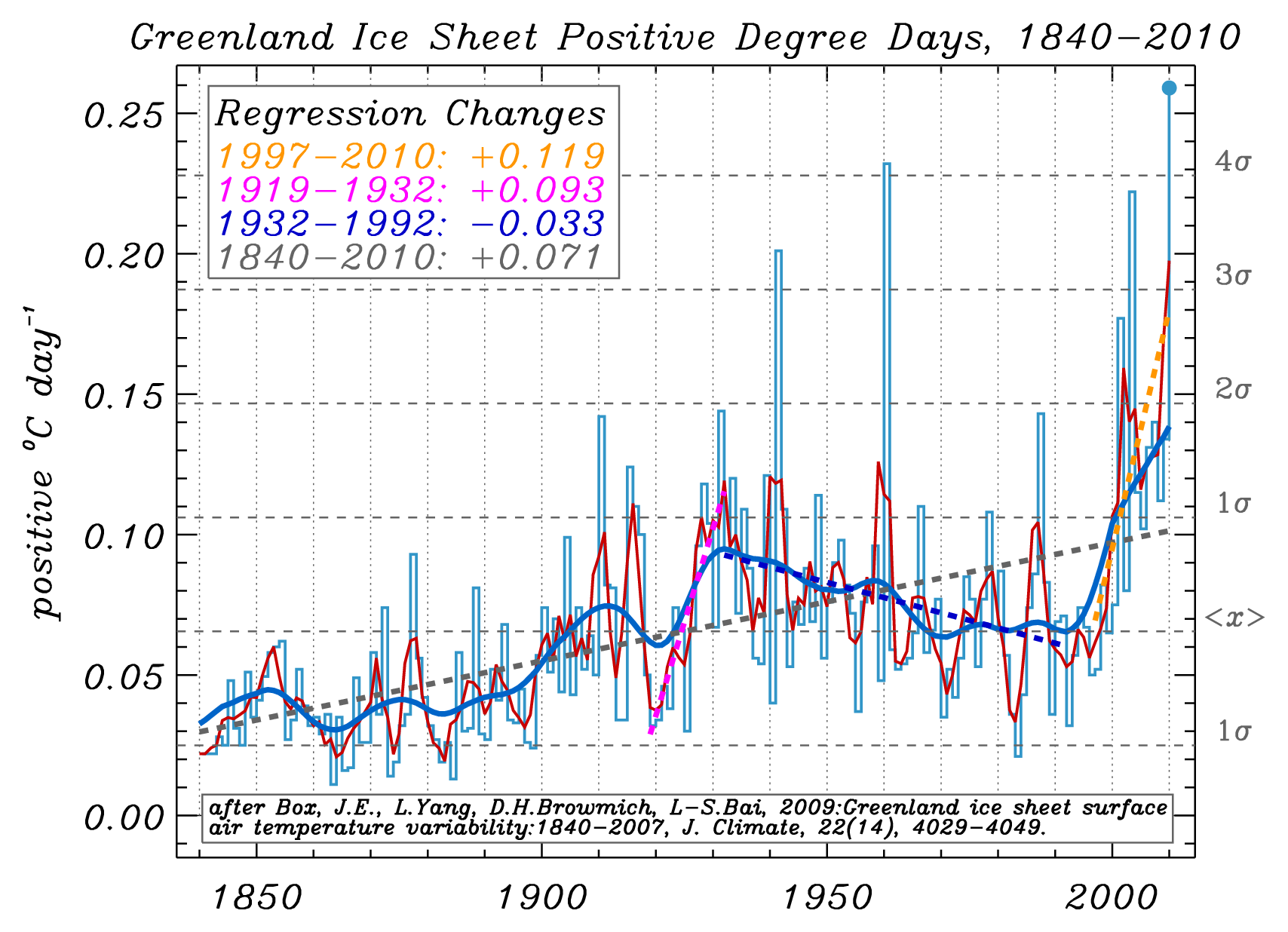
Figure 3: Positive Degree Day reconstruction for the Greenland ice sheet after Box et al. (2009). The "regression changes" presented here are equal to the linear fit (dashed lines in the graphic) value at the end of the period minus the beginning of the period, for example, the 14-year change is the 2010 value minus the 1997 value. The blue Gaussian smoothing line is for a 29 year interval. The dark red smoothing line is for a 3 year interval. PDDs are the sum of positive temperatures. A PDD sum of 10 has twice the melt potential as a PDD sum of 5. Note that not only is the recent melting convincingly distinguishable from that of the 20th Century, but that summer and annual average temperatures in recent years are increasingly above values in the 1920s-1930s. (Courtesy Dr. Jason Box)
Greenland’s past temperatures
Including year 2010 data reveals (as seen in Figure 5 at bottom), in contrast to the message of the Frauenfeld, Knappenberger, and Michaels paper, that recent Greenland temperatures are warmer than at any time during the 20th Century for the summer, autumn, and annual periods. The 1925-1935 spring season was warmer in 1930 than 2010, but not warm enough to make the corresponding annual average exceed that of the recent times. Important for a melt reconstruction, what Frauenfeld, Knappenberger, and Michaels neglected to include, was that recent summer temperatures exceed those of any time during the past century. As a result glaciers in southern Greenland have retreated far behind their meltlines from the early 20th Century. Evidence of this can be seen in Mittivakkat Glacier (Figure 4 below):
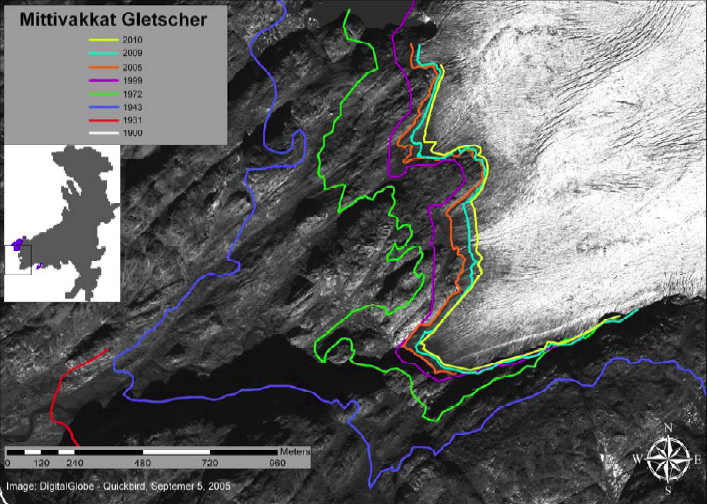
Figure 4: Mittivakkat Glacier in Southern Greenland. Note the red line indicating the 1931 extent of the glacier relative to the yellow line depicting its position in 2010 (Mernild et al, 2011)
One thing to remember is that the regional warming that Greenland experienced in the early 20th Century came at a time when the world overall was colder than it is today. And that the warming then was a result of multiple forcings (in which GHG warming played a role) and is thus fundamentally different than the anthropogenic global warming of the most recent 30 years (in which GHG warming plays by far the predominant role). Additionally, the global cryosphere (the parts of the world covered in ice) has experienced much greater warming (in terms of volume and global extent) in this the most recent period than in the time of supposedly similar warming (the early 20th Century).
Given the thermal lags of oceans and ice, it is clear that Greenland has yet to fully respond to the warming forced upon it, so a reasonable approximation of another 1-2° C is yet in its pipeline. This will translate into yet greater mass losses to come, which evidence indicates may be experienced in non-linear fashion.
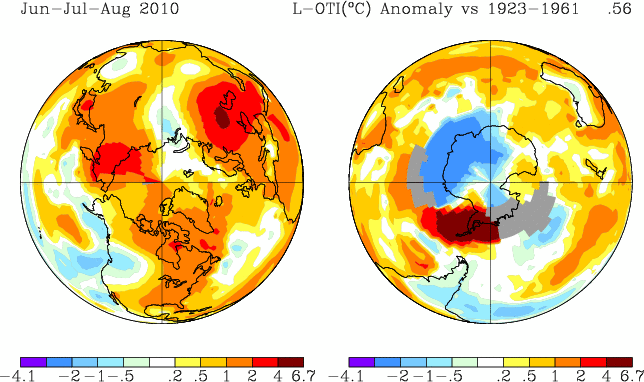
Figure 5: Where 2010 ranks relative to the warm period observed from 1923-1961 by Frauenfeld, Knappenberger and Michaels (Source)
Two lingering questions remain:
- Why did Frauenfeld, Knappenberger, and Michaels not include year 2010 data when they were asked to and when the data were readily available, yet the other papers containing the 2010 data published before theirs did?
- Why did the journal publish this paper without the requested revisions?
Climate Warming is Real
Dr. Box:
"Multiple lines of evidence indicate climate warming for which there is no credible dispute. No scientific body of national or international standing has maintained a dissenting opinion. I personally have found no credible science that disproves that human activity significantly influences climate.
An enormous and overwhelming body of science leads rational thinkers to the conclusion that humans influence climate in important ways. For decades, the science has indicated that human activity has become the single most influential climate forcing agent."
National and international science academies and scientific societies have assessed the current scientific opinion, in particular on recent global warming. These assessments have largely followed or endorsed the Intergovernmental Panel on Climate Change (IPCC) position of January 2001 which states:
An increasing body of observations gives a collective picture of a warming world and other changes in the climate system… There is new and stronger evidence that most of the warming observed over the last 50 years is attributable to human activities.
Acknowledgements
- Dr. Jason Box, Assoc. Prof., Department of Geography, Byrd Polar Research Center, The Ohio State University, Columbus, Ohio, USA for his invaluable assistance, advice, knowledge and patience
-
Dr. Mauri Pelto, Professor of Environmental Science, Science Program Chair; Director, North Cascade Glacier Climate Project, Nichols College, Dudley, MA, USA for his timely insights and suggestions
Without the expertise of these two fine climate scientists this article could not have come to pass.

Arguments


What's going on at JGR that this didn't happen?
On Dr Box's site he notes that they are already preparing a review. I'm sure it will be scathing. You can tell Dr Box is not happy about this paper getting through.
[DB] "What is indisputable is there is a gradual warming since 1820."
Actually, while the first part of your "warming since 1820" may have been gradual, in reality the warming since about 1980 is nearly unprecedented in the paleo record.
"The cause is in dispute."
Not by those who have taken the time to educate themselves on the science.
"But it's odd that the "rising sea levels" have not had any effect on ocean front property prices."
Just because birds fly towards warmer climes in winter doesn't mean the price of tea in China has anything to do with the Yankees chances of winning the World Series. There, that made as much sense as your statement and was as nearly on-topic.
"It seems the market, distilling all the information available, is not particularly worried."
IBID.
I must congratulate you, sir. You have served up a textbook example of the spin used by "skeptics" to sow the seeds of doubt and cause confusion:
Well-done.
Really ? Would you care to define "gradual" and give what you believe the cause to be - with proof, of course.
mozart wrote : "But it's odd that the "rising sea levels" have not had any effect on ocean front property prices. It seems the market, distilling all the information available, is not particularly worried."
What's odd is that you can bring up the housing market as an example of...well, are you trying to use it to disprove sea-level rise or what ?
As for "ocean front property prices", are you referring to them all, or just some in particular - I believe there may be some in Japan going cheap. Do you have any figures ?
Ultimately, though, could it be true that property prices operate in a bubble which has little firm basis in the real world ? Surely that would lead to record foreclosures...
From Will climate change alter liability risks?
On one issue the experts are in agreement: Anthropogenic climate change will have an impact on the environment, society, and the economy. A subject that has not yet received much attention, however, is: How will climate change alter the field of liability insurance?
Coming soon to a theater near you: Clash of the Titans 3 - Oil industry vs Insurance industry!
However, both links to the Tedesco paper are not working.
Hansen repeats his view, first published in 2007 but widely ignored, that a 5-metre sea-level rise is possible. In fact, recent research by Blancon et al published in Nature in 2009, examining the paleoclimate record, shows sea-level rises of 3 metres in 50 years due to the rapid melting of ice sheets 123,000 years ago in the Eemian, when the energy imbalance in the climate system was less than that to which we are now subjecting the planet.
I take it that by declining the invitation to re-review the paper, that he would then be unaware of any changes the authors may have made, creating a situation that his initial review may not be still relevant, thus excluding himself from the process.
The publishers generally would be the only ones able to evaluate and balance the worth of each reviewer, obviously having to risk someone getting their nose out of joint if there happened to be divergent views.
This sounds suspiciously like another breakdown in the editorial process, a la Soon and Baliunas style.
Plus ça change...
This proposition is not true.
See e.g. Trenberth 2009: "There is a TOA imbalance of 6.4 W m-2 from CERES data and this is outside of the realm of current estimates of global imbalances that are expected from observed increases in carbon dioxide and other greenhouse gases in the atmosphere".
Or Trenberh 2010: "The difference between the incoming and outgoing energy -- the planetary energy imbalance -- at the top of the atmosphere is too small to be measured directly from satellites".
Yes, that should probably read "Satellites have helped infer an energy imbalance at the top of the Earth's atmosphere". There are many things in the science of measurement that we can not observe directly for a variety of reasons. I assume that you're not suggesting that none of these things exist.
One might think that, after the experiences of the last few years, people would realise that "the market" does not magically distil all available information. In fact the behaviour of "the market" is determined by the prejudices and misconceptions of those individuals acting in it.
And, as is only too clear there are powerful, moneyed forces intervening in particular markets to create confusion and misinformation.
The clearest thinking on climate change, outside the climate scientists themselves, appears to be in the insurance industry, which stands to lose badly from climate change if it gets the facts wrong. And it takes the science seriously.
Yes, that should probably read "Satellites have helped infer an energy imbalance at the top of the Earth's atmosphere".
As Trenberth puts it "the satellite measurements are sufficiently stable from one year to the next, so that by measuring incoming solar radiation and outgoing infrared radiation it is possible to track changes in the net radiation". That's all.
One only has to integrate net radiative imbalance (the derivative of heat content anomaly) for an extended period. It could help infer an energy imbalance at the top of the Earth's atmosphere if the offset is given. But it is not given.
Therefore there is an unknown additive linear term in the energy content, that is, no trend can be determined this way. Which means it does not even help to infer the imbalance.
[DB] Anyone who wants to respond to this needs to do so on the Tracking-the-energy-from-global-warming thread, where this subject more properly belongs. Thanks!
Our Western way of living is dependent on using far more energy than is our share. But everybody demands the same quality of living which they reasonably equate with the amount of energy we use. It is the available energy that we have now that provides for the energy-dependent foods we squander. By 2060, that is only fifty more years, this abundant energy will have been used up. The consequences of this is that we will be dependent on the food we grow ourselves within walking distance of where our one-room house is. Perhaps you might believe the people who constantly tell us that by then we will have found some new energy source. But consider this: in 1950 the wisest scientists predicted that fusion energy would cater for all future energy needs, and so squillions of dollars have been spent in the past 60 years trying to get it to work, without success. We are no nearer to achieving it than we were 60 years ago. That is probably because of the physical problems of containing and using the pressures and heat of fusion energy. Remember, it was less than a kilogram of hydrogen that produced the largest ever explosion.
There is some questionable evidence that the temperature rise which we are experiencing now, may be faster than we might expect. However, this would more likely be due to the heat caused by our energy-dependent lifestyle, because practically all energy sources are fossil fuels which produce heat and electricity which is eventually converted to heat. So if is that extra heat you want to get rid of, you must reduce the demand for energy, and that consequently means reducing the number of people demanding energy — one of those kinds of difficult problems that politicians just don’t have the guts to tackle, so they create imaginary scapegoats like carbon dioxide.
Raymond F. Smith
Retired, formerly:
Senior Lecturer in Communications Media at the Regional Centre for Education in Science And Mathematics, Malaysia.
Area Specialist with the Australian Science Education Project
I also recommend watching this video on why CO2 is the biggest climate control knob in Earth's history.
Further general questions can usually be be answered by first using the Search function in the upper left of every Skeptical Science page to see if there is already a post on it (odds are, there is). If you still have questions, use the Search function located in the upper left of every page here at Skeptical Science and post your question on the most pertinent thread.
Remember to frame your questions in compliance with the Comments Policy and lastly, to use the Preview function below the comment box to ensure that any html tags you're using work properly.
As a communicator, I'm sure you understand the need to be properly informed on an issue before speaking on it.
The Mernild paper was accepted on 8 April 2011 while the FCM paper was accepted on 31 January 2011. The 2+
month intervening period seems sufficient for the fully QC'd data to become publically available for Mernild to be able to introduce the 2010 data. It's also notable that the FCM review process took 5 1/2 months while the Milnild took 2 1/2 months. I think FCM have responded to these allergations, it would have been useful for the sake of balance to have seen what they had to say.
Knappenberger explanation of the situation is provided in the link below, it seems fairly convincing even given the fact these are the bad guys! It's telling that he thinks 2010's data would not have changed the overall conclusion.
http://rankexploits.com/musings/2011/reviewer-outs-himself/
Rather than make allegations about the authors motives it strikes me the more scientific thing to do would be to take the authors methodlogy and data and apply the 2010 data to it. Then tell us if the 2010 data has had any impact on the FCM conclusions. It seems Jason Box would have been in a perfect position to do this rather than write a less satisfactory blog post full of difficult to prove allegations. In fact such work would surely be publishable as a comment on the FCM paper if it added anything new.
An attempt at a 226 year Greenland ice melt seems like a worthy attempt at extending our knowledge of the climate system. I think it's the general conclusions of the paper that is upsetting some people not the inclusion or not of one years data.
[DB] The Tedesco & Fettweis paper can be found here. Dr Box is an expert on Greenland glaciology. As for Knappenberger's thoughts on 2010 not making a difference, perhaps you both should read the original post at top, where it clearly DOES make a difference, to the point of completely invalidating the FKM paper's conclusions.
Any worthy attempt at extending our knowledge of the climate system would surely have included the latest data (especially considering the record melt of the GIS was common knowledge, widely known even in the lay community by September), which was available to the authors of the FKM paper. Which they opted to not use.
Science:Fail.
Nope, sorry. You can still estimate 0 from that, without having a precise measurement of 0. Your argument is invalid, as it is a variant of the old so-called-skeptic canard that inexact knowledge is equivalent to no knowledge.
Wow, talk about 'Garbage In, Garbage Out'. For the record, temperatures during the height of the MWP were *lower* than what they are today-& it took several centuries for temperatures to reach that peak. Also, Greenland was *never* a green & temperate land. Springs/Summers on the Southern Coast of Greenland were certainly more temperate during the MWP than in the periods before & after it-but Winters were still extremely harsh & cold, & there is little evidence that Glacier retreat in 1100AD ever reached levels like those we've been seeing over the last 40 years.
1. You should remove the quotation marks from the apparent quotation in the sentence in the top post:
Nowhere in FKM2011 does that quotation appear. On the contrary the very first two sentences of FMK2011 read:
So FKM2011 do state both that 2010 had record high temperatures and that the cryosphere has likely been significantly altered. That doesn't sound like a conclusion that "Greenland climate has not changed significantly".
2. You should correct the statement that ”Their selective ‘findings’ were obsolete at the time the paper was submitted for publication in December of 2010.” The paper was submitted for publication in August 2010, and so the findings (why ‘findings’?) weren’t obsolete when the paper was submitted.
3. The reason that the editor didn’t consider that FKM2011 should update their analysis to include 2010 is likely rather different to what your article indicates. FKM2011 determined historical and contemporary melt using a model based on S. Greenland temperature/ice melt that was compiled from three separate groups. According to the authors this data doesn’t become available until 6-9 months following the previous year’s melt season (I guess one might want to check whether this is actually the case). If FKM2011 were to have waited to update the analysis in their paper to include 2010, they would have effectively had to wait a year, and would be left in the same situation of a referee saying: ”come on, why don’t you include the data for 2011?”. In my opinion it was appropriate that the editor over-ruled Dr. Box’s recommendation on this point.
4. The most problematic statement in FKM2011 is the one in the abstract that is reproduced in the top article, viz:
This shouldn’t have been allowed. And yet Dr. Box didn’t make any specific recommendation on this. He was offered the opportunity to re-review the paper on Dec 27th 2010 and declined to do so. It was very easy for the editor to over-rule Box’s main point [see (2.)] above following submission of Dr. Box’s review in September (after all the melt season was barely over). However Box was in a very strong position to make extremely forceful recommendations if he had taken the opportunity to re-review in early Jan 2011. But he didn’t. If I were reviewing the paper I would have insisted at this point that that sentence be removed from the abstract, since it was now clearly factually incorrect. Sadly Dr. Box chose not to do so.
5. Dr. Box’s review of the paper (he’s dumped it on his blog) is poor and sends a mixed message to the editor. Box rated the paper as “good” which is a clear indication to the editor that the paper is likely to be publishable. Clearly he doesn’t think it is “good” at all, as indicated by the storm he’s brewing up on his blog – so why give it a pass on that score in his review??. The review is a mess of grammatical errors, sentences lacking consequent clauses and gives the impression that he (Dr. Box) couldn’t be bothered to spend half an hour putting together a carefully thought out and convincing set of recommendations. He didn’t bother to address what seem to be dubious statistical analyses in FKM2011. He just threw his hands up in the air.
6. Dr. Box wrote a paper on a similar topic in 2009 [L.M. Wake et al (2009) Surface mass-balance of the Greenland ice sheet since 1866, Annals of Glaciology 50, 178]. The abstract concludes:
(concerning Surface Mass Balance = “SMB”):
One might argue that FKM2011 is rather more accurate in its conclusions (at least they say that Greenland’s cryosphere has likely been significantly altered!). If present day changes in Greenland were unexceptional in Box’s own words in 2009, then FKM2011 merely serves to reconfirm Box’s own conclusion. Clearly 2010 is anomalous. It remains to be seen whether this is a blip or the start of a greater period of rapid melt. Box’s own analysis from his (Box’s) excellent 2009 paper on historical Greeenland ice sheet surface air temperatures supports the latter conclusion, and I personally think his arguments are quite convincing in this respect.
7. Overall I think Box is playing into the hands of those that misrepresent the science. He was in a strong position to address some serious problems with FKM2011 and declined to do so. He indicated to the editor that the paper is "good" when it clearly isn't - considering that the paper is a purely descriptive and rather unenlightening confirmation of Wake et al (2009) [see (5)] above, I'm surprised Dr. Box didn't recommend it's rejection on that basis. Now he’s turned the issue into exactly the form of nonsense that the misrepresenters are more than comfortable with – a blog circus. He's made it all the easier for those that dump confidential reviews on their blogs as part of a complaint about unfair treatment during review - they can now say "well Dr. Box did it".
To answer the “lingering questions” posed in the top post:
1. ”Why did Frauenfeld, Knappenberger, and Michaels not include year 2010 data when they were asked to and when the data were readily available, yet the other papers containing the 2010 data published before theirs did?”
The answer is (see [2] above), that data to include 2010 in the FKM2011 model for Greenland melt based on independently compiled S. Greenland temperature data wasn’t available either at the time of submission or right through the review process, and may still not be available.
2. “Why did the journal publish this paper without the requested revisions?”
The answer is because the major requested revision was considered unreasonable (a justifiable decision in my opinion), and because other obvious revisions that would have improved the paper apparently weren’t requested (at least by Dr. Box). It’s a little late in the day to complain about this now, and isn’t very professional to do so on a blog!
And one might as well point out that it's bleedin' obvious that Greenland temperatures were extremely high during 2010, and that this was the (so far) record melt season. It's not as if this can be hidden! An unnecessary storm in a teacup...
I've got to agree with 14 - Rob Honeycutt
Article reviewing isn't a democratic process. Normally each comment from each reviewer and the editor (not, normally, the publisher) should be answered by the author. The editor may advise the author regarding some comments from an individual reviewer if it's clear that comments are to far 'out of scope' (lets say; normally because some reviewer is having a rant - it happens!). If there is conflict between two reviewers, the Author has to find his way round that, normally by making both points-of-view and the alternatives obvious in the paper. As the editor sees fit, the paper may circulate several times till everyone is satisfied - so that a good editor/review team tends to add substantially to quality of the final paper.
Apparently, what Dr. Box said is that he "did not wish to re-review the paper if the authors chose not to include 2010 temperatures." - so he did not 'point blank' decline to re-review the paper. This indicates to the editor the strength of his feelings on this issue...
... it's pretty clearly a message to the editor and, I'd read it as indicating that Dr. Box had his doubts about the editorial process at that stage.
But yes you're right that Dr. Box declined to re-review the paper. That's pretty unfortunate and likely a reason that an unjustifiable statement was left in the abstract. Too bad....
However he was in a very strong position in early January 2011 to make some very forceful recommendations. He should have categorically insisted that the offending sentence (see point 4. in my post above] be removed from the abstract since this is a categorically incorrect statement. In my opinion the statistical analysis in the paper is also flawed (I am happy to be corrected, but the question of assessing satistical significance between contemporary melt data determined using one method with a reconstruction of historical melt using a different method is simply unjustified).
Sadly, Dr. Box declined to address these points.
In Arctic regions, ice shove formerly generated thick natural sea walls protecting the coasts. Those ridges of shorefast ice now melt out in summer. The result is a rate of soil erosion about 1/2 meter per year on average.
Want to buy some nice beachfront property in Alaska or the Aleutians?
http://environmentalresearchweb.org/cws/article/yournews/45803
#22 - Raymond F. Smith.
Unless I am mistaken about your areas of expertise and your environmental concerns, my above reference to coastal erosion should be of interest to you.
As to 'natural unstoppable' processes, there are none, just as there are no irresistible forces or immovable objects. Were you testing to see who is awake around here?
As to a navigable Arctic - various dating techniques by various scientists show that the Ellesmere ice shelf began forming circa 5500 years ago and existed virtually unchanged in area until about 1945. Given that the shelf could not break up when held in place by the thick multi-year ice of the main pack, I strongly dipute any assertion that the Arctic was navigable in any meaningful sense until the USSR opened up the North East Passage with icebreakers circa 1930s.
Given the overwhelming evidence that the Arctic ice is retreating faster than at any time in human history, that the Arctic generally is warmer than - and warming faster than - any time in human history, it is unsurprising that Greenland is warming also.
What I find incredibly surprising is that any scientist would publish a paper excluding the latest data which would reaffirm such warming.
But I take your point. He could have recommended rejection at that point, but if he's already indicated to the editor the paper is methodologically sound (I have doubts about the validity of the statistical analysis but Box didn't even bother to address this), that's a clear statement to the editor that the paper is broadly acceptable.
Note that the editor doesn't have to take account of a reviewer's recommendations and I think it's understandable that he didn't in the first instance back in September. It's possible that he might have reconsidered following a re-review in Jan 2011 (but we'll never know). I suspect he would have still allowed the paper through in it's present form, but with some very obviously required alterations of some key statements ('specially in the abstract). We'll never know that either!
It happens frequently that the editor/reviewer will accept a paper which still needs work - at initial review it's normally not much more than a 3 level assessment; reject/good/excellent. On the whole, people (editor, maybe reviewers) are pretty charitable and can often be putting in quite a lot work to get a paper up to scratch.
One might also argue that it's in the best interest of a paper to suggest inclusion of the most recent results so that it's not 'obsolete' (as this post indicates) the moment it's published... which reflects poorly on both the journal and editorial board; particularly when those results materially impact the conclusions.
Depends on the kind of paper - if the interest is in the method; there's no need to be bang-up-to-date; one can compare this method with that, as applied to any old data (if chris is right that the methods are poor, that's a different issue; I don't know).
But if the methods are standard and the overall assessment of the state of affairs is key then, sure, they better be solid and up to date.
Note if you read some of the papers that have been published giving guidelines on how to review papers, you will find they pretty much all tell you that you need to comment on the good aspects of the paper as well as the not so good. It seems to me that Box has a good grasp of how to write a useful review. Sadly they are only useful if you are willing to write them! ;o)
I don't think there is much point in speculating on whether the editor was happy with the paper as it stood, simply because without a second review from Box, the editor may not have had enough justification for rejecting the paper given positive reviews from the other reviewers. Papers do occasionally get rejected despite positive reviews, but it doesn't happen very often, simply because the editor is not usually an expert on that particular topic.
As I'm sure you are aware, two of the main criteria that a reviewer uses to assess a paper (and thus to give clear guidelines to the editor are):
1. Is the data robust and the analysis of the data methodologically sound.
2. Are the interpretations consistent with the data.
Dr. Box gave a clear thumbs up on 1.
We can look at [2.] ourselves and conclude (especially with the categorically incorrect statement in the abstract) that there are problems there. Unfortunately Dr. Box chose not to address that. I don't see much point in complaining about it now.
We're going to start going around in circles, but putting myself in the editor's shoes, I think it was very straightforward for him/her to reject Dr. Box's stipulation in September 2010 that data for 2010 be included in a revision. The authors would be quite right to state that this is an unreasonable stipulation since the data for updating their model to include 2010 wouldn't be availabe for a full 6-9 months. In other words they would find themselves in a situation where they might never be able to publish their data.
Under these circumstances, the reviewer(s) should really have then stipulated (e.g. in a re-review) that (a) very strong statements about the very high temperatures and likely high melt be included in the paper (to be fair to everyone, some of this was done), and most importantly the categorically incorrect statement in the abstract be removed....
I agree les. And as far as we can tell the data were up to date. The authors used the available data covering the latest possible year (2009).
Compare the paper on a very similar subject that Dr. Box wrote published in 2009:
[L.M. Wake et al (2009) Surface mass-balance of the Greenland ice sheet since 1866, Annals of Glaciology 50, 178].
This paper was presumably submitted in 2008 or 2009 and it analyzed Greenland mass balance. Did they included data through 2009? No. In fact they included data only through 2005. Why is that? I expect because that was the data available at the time.
This all seems completely silly to me. You can't included data that doesn't yet exist, in a paper! It's completely acceptable to publish a paper that has a well defined end point that incorporates all of the available data that is used in your particular methodology. . You don't have to wait until another years data is available.
And it's obvious that 2010 was a very warm year with a large melt. We don't have to pretend that FKM2011 are somehow hiding this reality.
At the end of the day, the real problem was that Box did not participate in the second round of reviews. Once Box was not willing to recommend rejections, it limits the editors scope for rejecting the paper.
Box was doing the authors a favour, we should all be aiming for quality rather than quantity. There is little (scientific) point in publishing a paper that is very likely to be obsolete (or at least questionable) by the time it appears in print. If the methodology is sound, the authors (and the journal and the scientific community) are better off for delaying publication to get produce a paper of genuine value, rather than a paper that is principally of interest to blogs, but otherwise of little impact. Of course if the additional data reverses the finding, then that completely vindicates Box. If it doesn't, then the FKM11 is vastly stronger for having done their best to disprove the result* (self-skepticism is key to being a good scientist).
The role of a good reviewer is to provide clear and unambiguous recommendations to the editor. I take his statements to mean that the full analysis employed by FKM2011 be updated to include 2010. After all he stated:
"I would therefore not recommend accepting the paper without a revision that included 2010."
That seems pretty clear to me. But you've apparently found a sentence that indicates that the data needn't be included but only considered. Perhaps we can now undertake to see how many angels we can fit on the head of a pin!
And if Box had really meant that "All the authors had to do was remove any assertions that were not well supported by all observations and/or added a section containing a caveat explaining the implications of the 2010 observations on their findings." then why, of why, didn't he say so??? It's not the editors job to attempt to assign meaning to ambiguous reviewer's staements.
Yes, it is in the first paragraph of Box's review. " The paper thus, in the very least, requires a revision that includes consideration of 2010 data.".
Also, the sentence before "I would therefore not recommend accepting the paper without a revision that included 2010." is "The paper may already be obsolete without considering the extreme melting in 2010.", which again implies that "including" 2010 data, does not necessarily mean a full reanalysis, but merely "consideration".
If FKM were unsure what was needed, they could simply have asked the editor for clarification.
There was nothing particularly ambiguous about Box's review, but perhaps you are not familiar with the language used in reviews of scientific papers.
You quote the paper as saying:
(My emphasis)
What is note worthy about this quote is that the last four decades prior to "recent years" indicates the period of approximately 1960 to 2000, ie, the period following the "...period of high melt lasting from the early 1920s through the early 1960s".
In fact, the paper also says (according to one of its authors) that:
(explications by Michaels, emphasis mine.)
The highlighted sentence looks very much like a claim that "‘Greenland climate has not changed significantly’", and the entire passage looks like a claim that the appearance of significant change is just a product of the start point of satellite observations. That certainly the way Michaels is interpreting it on his blog.
[DB] The recession line history mutely evident on the picture of Mittivakkat Glacier in Figure 4 directly contradict Michaels' and the FKM paper's position.
And you think FKM might have been unsure what was needed??? It would be a dereliction on the part of the reviewer if they were. Neither the editor nor the authors should have been unsure. It's the job of the reviewer to make his recommendations clear!
I'm very familiar with the language of reviews in scientific papers. I've eased around 80 of my own papers through the scientific review process. I don't know how many papers I've reviewed, but since I probably review 1.5-2 papers for every one submitted, I expect I've reviewed the better part of 150 papers.
I would never submit a review as poorly written as the one we're discussing. If you feel strongly about something in a paper or a review, then you make sure your comments properly convey your meaning. I would never send a review with grammatical errors, ambiguities, vague statements and sentences that start but don't finish.
And you say that the review isn't particulalry ambiguous...yet you've apparently come to a differnt conclusion than me (and everyone else??) about what Dr. Box meant in his sentences using variously "considered" and "included"....well....how ambiguous does a review have to be before it becomes more than not-particulalry ambiguous!
As we know from Pat Micheals' Cato ties, he was going to use the results from his study to promote what he wanted to. The point is made obvious by the fact it is exactly what happened . So I guess we can use all the angel pin dancing McIntyrian-isms we want to complain about how Jason Box went about what he did, but the facts remain. The paper is obsolete. It has been used as political tool. Box predicted this. Now the usual defenses against publishing crap are to attack what real scientists say about it. It's handwaving. Predictable.
PS. Not attacking chrris here, just ranting.
Though I'll admit when I read meltfactor.org a couple days back, Box's approach felt unsettling. OK I'm just laymen, but it seemed like he was enabling another distracting "skeptical" dogfight.
I think Chris has done a nice job of defining what I couldn't.
On the other hand, I think you did a great job of putting the Greenland situation into perspective. After all it is that data that's more important than academic bickering over distracting minutia.
You know how them “skeptics” love their mud wrestling.
~ ~ ~ ~ ~ ~ ~
As for: "It seems the market, distilling all the information available, is not particularly worried."
Right... perhaps if there were something like a real market out there. Unfortunately, our current free market’s dedication to Profits Über Alles has tossed out all notions of sober assessment.
Here’s a apropos interview with Bill Black Associate Professor Economics and Law University of Missouri. Over at Harry Shearer’s Le Show {May 1, 2011} {litigation inspector for the Federal Home Loan Bank Board during the Reagan administration (S&L meltdown)}. Examines the endemic fraud within our banking and home loan system, and where it’s leading to. It’s a jaw dropping expose of what our “market” has to offer our people.
Yes I agree with you Tom. There's no question that Michael's is using this paper to misrepresent current understanding of Greenland temperature progressions and ice melt. Unfortunately the reviewer(s) chose not to address the comments that support these interpretations.
On the other hand, leaving aside the marked changes in 2010, the Greenland mass-balance changes were sufficiently "mild" (if that's the right word), for Dr. Box to state in 2009 that (concerning surface mass balance ("SMB") of the Greenland ice sheet):
It's obviously very easy to misrepresent these data. I think Daniel Bailey's top post is very good in putting recent Greenland changes into proper context. My main beef (which I've probably overdone by now) is that a tiny victory for the misrepresenters is in danger of being amplified by turning what is supposed to be a confidential scientific review process into a circus....