






Latest Posts
Archives
|
 |

Is the science settled?
Posted on 24 March 2010 by John CookA common skeptic refrain is that "the science isn't settled", meaning there are still uncertainties in climate science and therefore action to cut CO2 emissions is premature. This line of argument betrays a fundamental misunderstanding of the nature of science. Firstly, it presumes science exists in a binary state - that science isn't settled until it crosses some imaginary line after which it's finally settled. On the contrary, science by its very nature is never 100% settled. Secondly, it presumes that poor understanding in one area invalidates good understanding in other areas. This is not the case. To properly answer the question, "is the science settled?", an understanding of how science works is first required. Science is not about absolute proofs. It never reaches 100% certainty. This is the domain of mathematics and logic. Science is about improving our understanding by narrowing uncertainty. Different areas of science are understood with varying degrees of confidence. For example, while some areas of climate science are understood with high confidence, there are some areas understood with lower confidence, such as the effect on climate from atmospheric aerosols (liquid or solid particles suspended in the air). Aerosols cool climate by blocking sunlight. But they also serve as nuclei for condensation which leads to cloud formation. The question of the net effect of aerosols is one of the greater sources of uncertainty in climate science. What do we know with high confidence? We have a high degree of confidence that humans are raising carbon dioxide levels in the atmosphere. The amount of CO2 emissions can be accurately calculated using international energy statistics (CDIAC). This is double checked using measurements of carbon isotopes in the atmosphere (Ghosh 2003). We can also triple check these results using observations of falling oxygen levels due to the burning of fossil fuels (Manning 2006). Multiple lines of empirical evidence increase our confidence that humans are responsible for rising CO2 levels. We also have a high degree of confidence in the amount of heat trapped by increased carbon dioxide and other greenhouse gases. This is otherwise known as radiative forcing, a disturbance in the planet's energy balance. We can calculate with relatively high accuracy how much heat is trapped by greenhouse gases using line-by-line models which determine infrared radiation absorption at each wavelength of the infrared spectrum. The model results can then be directly compared to satellite observations which measure the change in infrared radiation escaping to space. What we find in Figure 1 is the observed increased greenhouse effect (black line) is consistent with theoretical expectations (red line) (Chen 2007). These results can also be double checked by surface measurements that observe more infrared radiation returning to Earth at greenhouse gas wavelengths (Evans 2006). Again, independent observations raise our confidence in the increased greenhouse effect. 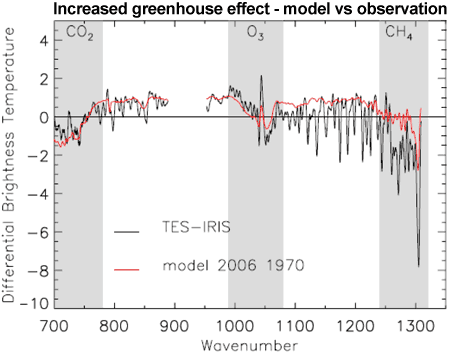
Figure 1: Increased greenhouse effect from 1970 to 2006. Black line is satellite observations. Red line is modelled results (Chen 2007).
So we have a lower understanding of aerosol forcing and a higher understanding of greenhouse gas forcing. This contrast is reflected in Figure 2 which displays the probability of the radiative forcing from greenhouse gases (dashed red line) and aerosol forcing (dashed blue line). Greenhouse gas forcing has a much higher probability constrained to a narrow uncertainty range. Conversely, the aerosol forcing has a lower probability and is spread over a broader uncertainty range. 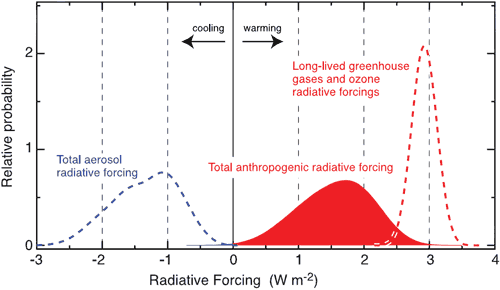
Figure 2: Probability distribution functions (PDFs) from man-made forcings. Greenhouse gases are the dashed red curve. Aerosol forcings (direct and indirect cloud albedo) are the blue dashed curve. The total man-made forcing is the solid red curve (IPCC AR4 Figure 2.20b)
The important point to make here is that a lower understanding of aerosols doesn't invalidate our higher understanding of the warming effect of increased greenhouse gases. Poorly understood aspects of climate change do not change the fact that a great deal of climate science is well understood. To argue that the 5% that is poorly understood disproves the 95% that is well understood betrays an incorrect understanding of the nature of science.  0 0  0 0
Printable Version | Link to this page
There is another strong reason for considering the general picture of AGW as settled. The reason is that there is no alternativ theory that explains the climate record we have.
With a "theory" I mean a model with an underpinning in theoretical science (physics), which does give precise verifiable predictions. Such a theory is vulnerable in many ways - a climate theory can be falsified by inconvenient data from this century, by various historical data going back millions of years, by attacks on its theoretical foundations etc. The more possibilities to falsify it, the better for the theory: If the attacks don't kill it, they strengthens it.
AGW has survived a strong onslaught for a long time. There is no alternative climate theory which has an even faintly resembling status. There are some thoughts which have ended up as "skeptical arguments" on this site, but nothing coherent, nothing that has a strong theorertical backing and gives predictions (or post-dictions) for a large number of measurable quantities.
The fact that there are so many "skeptical arguments" shows that AGW is a strong theory - it can be attacked in many ways.
Don't misunderstand me. Actually I see a lot of weak spots and unclear areas in the AGW theory. But it is an honest, falsifiable theory. And no one has been able to come up with a competing explanation with an even faintly resembling status.
I'm sure there will be modifications of the climate models, as we come to understand the climate better. But I don't see even the beginning of a "paradigm shift" away from AGW. There is no new paradigm in sight to build that shift around.
 0 0  0 0 0 0
BTW, the Trenberth paper is available here:
http://www.cgd.ucar.edu/cas/Trenberth/trenberth.papers/EnergyDiagnostics09final2.pdf
A great paper for the science provided but it is also a great paper because it clearly shows how scientists think, i.e. they are not looking for reasons to support AGW, they are just looking for answers and using data get those questions answered.
0 0
oracle2world:
"How about the default assumption is that the result is uncertain?"
Well, when I drive to work tomorrow, there is a low probability that I will be involved in a car smash, the outcome is undertain so it is ok not to wear my seat belt? I will be dropping my daughter at school - should I tell her not to bother with her seat belt because the chance of a car smash is "uncertain"?
The possible negative consequences would be so catastrophic that I fully intend to wear my seatbelt, even with the low expectation of a smash, and make sure my daughter has "belted up".
Suppose out best theory says that the global surface temperature will change by between -1C and +4C between now and 2100. Should we bet the farm on the -1C being more correct than the +4C, given that a rise over +1.5C would be catastrophic for large regions of planet earth?
There is a very important Prudential Principle that says we act in good time to take preventive action as efficiently as possible.
0 0
Marcel (#27) - Well said.
As for the on-going policy discussions on this thread, keep in mind:
1. Climate science and policy are 2 different things. The consensus is that the science of AGW/ACC is real. Policy consensus is highly debatable.
2. The timing of the effects of climate change are still unclear. We see changes now. We can predict other changes, given different rates of rising global temperatures. But there will be effects. Some too rapid for societies or ecosystems to adjust. Food riots? That's nothing compared to water riots.
Overall though, there is growing concern that even if we halt all CO2 output, and other forcing effects of humans immediately, we may not be able to stop these effects.
We just don't know where that tipping point is with a high degree of certainty. (That's where we continue to learn more about the positive/negative forcings on our climate.) Have we passed the tipping point? Are we near it? Is it far enough in the future that we can stem the tide of negative effects with proposed policy changes? That's the uncertain part of climate change.
But the science proving our contribution to AGW/ACC to the point of consensus is solid and sound.
0 0
I found this a very well written article addressing the most fundamental concern I have always had for AGW -
CO2.
Correlation or causation.
Do any models and charts show the margins of error of the instruments used to gather the data and then compare it to the CO2 correlations? Can the effects of water vapor be removed from the studies to better isolate the effects of CO2? It all seems to easily be explained as results that are well within the noise characteristics of the studies!
Having close friends who design space stations where deciding whether to paint portions white or black because they caused drastic effects on the thermal expansion of the material and the localized heat effects constantly points me back to the issue that black soot resting on the ground from coal power plants probably cause more radiative energy collection than an entire atmosphere of increased CO2 levels produced by man (by probably orders of magnitudes). Our knowledge of clouds and how they function in regards to reflecting or absorbing the suns energy is still a complete mystery(being the largest contributor by 20x more than any other to atmospheric warming effects). I feel the information showing we have increased the levels of C02 in the atmosphere are clear. The effects are extremely unclear (isolation of only gas effects in parts per million in effecting thermal radiation have never been shown).
We need to step back, try to isolate as many components as possible so we can scientifically determine what we actually know and what we do not know. Trial and error. True isolated research studies of CO2 gas fluctuations in parts per million in atmospheric conditions, removing effects of containers, liguids, and solids which may bias the results tremendously.
By taking a complex system, isolating the components and understanding their effects, then putting them together piece by piece into a system we can begin to understand the truth. I have not seen anything close to this approach yet in looking for the scientific evidence to support AGW. Just correlation papers without proving causation.
Can anyone help steer me to meaningful scientific information?
0 0
Like so many other skeptical “cocktails”, this one is 2 parts straw man, 1 part red herring, with a dash of plausibility, shaken, not stirred.
The "straw man" misrepresents the degree to which scientists both recognize and acknowledge that there are still legitimate areas of uncertainty and imprecision in our understanding. In this regard, the IPCC and the climate community have been very frank, in general. For example, see:
NASA: Global Climate Change Uncertainties
One almost never hears actual climate scientists saying, "The science is settled" (or if they do say something like that, it's usually misunderstood), whereas one hears this frequently from skeptics. I'm particularly bothered when skeptics precede their complaint that ‘the science isn't settled’ with the disingenuous lead-in, "I'm tired of hearing... (that the science is settled)" If they are so tired of hearing this, why do they keep saying it?
The "red herring" aspect of the argument represents an apparent effort to shift the dialog away from the actual scientific evidence toward a contrived argument over whether the scientific "gestapo" is trying to stifle dissent and suppress alternative views. There is, unfortunately, a tiny dash of plausibility to this, although there’s no indication that it has posed a serious problem in the peer-reviewed literature. Focusing on an imagined conspiracy to suppress debate is a distraction from consideration of the real evidence.
One recurrent straw man entails confounding of two distinct conclusions reached by the IPCC: 1) "Warming of the climate system is unequivocal..." and 2) "Most of the observed increase in global average temperatures since the mid-20th century is very likely due to the observed increase in anthropogenic GHG concentrations."
Here's how one AGW skeptic combined these two statements in a recent Op/Ed piece in the Wall Street Journal (21 Feb 2010):
"'Unequivocal." That's quite a claim in this skeptical era, so it's been enlightening to watch the unraveling of the absolute certainty of global warming caused by man."
Tragically, what is unraveling in this “skeptical era” is honest debate.
0 0
The sceptics now tend to say, "the science isn't settled", because for a long time politicians and others have been saying, "the science IS settled".
And from their standpoint those politicians are right. I would suggest that from any practical, meaningful point of view anyone but a scientist would be very sensible to believe that at 95% probability, to all intents and purposes, the science IS settled. At those odds, to stake one's children's future on that 5% doubt is sheer irresponsibility.
Of course, that's not to say scientists should not constantly test and retest the theories while ever any doubt remains; until a time arrives when to continue questioning whether the world is really flat puts the remaining sceptics firmly in the lunatic fringe. Though, of course, there's still a very faint chance they could be right...
0 0
The "it will cost too much" or "it will wreck the economy" arguments are among the most misdirected. In relative terms, fixing the levees around New Orleans would have been much more economical than repairing the damage - without accounting for the human consequences. If you apply Occam retrospectively it becomes pretty apparent that, on the off chance the still "unsettled" science has some probabilistic merit, it will be far less costly to act now than wait until every property within surge distance of an ocean or tidal estuary is rendered valueless.
0 0
Re # 21 Danish energy comes at a price... from the EU official source here: http://www.energy.eu/#domestic it's not so outrageously expensive as the Wiki article clims.
0 0
Ken Lambert's argument in #4 has been irritating me for quite a while (on a separate forum). My understand of the physics is not good enough to understand the energy balance equations fully enough, but there are three problems I see with it.
1. He assumes that co2 sensitivity is at the lower range predicted. As far as I can see the minimum co2 sensitivity should be about 1.6ºC - the observed data does not support lower figures.
2. that the negative feedback effects are at the upper range of the confidence interval and the positive feedback effects and co2 responses are at the lower end of their confidence intervals - i.e. he is assuming non random distribution of the parameter estimates, which is a big nono without evidence to back it up.
3. There's a bit of wishful thinking - I think he's making the assumption that co2 sensitivity figures apply only to the first doubling in co2 levels - so to take his conservative estimate that if co2 doubles on pre-industrial levels by 2050 then we get 1.6ºC warming, but then a further doubling by say 2100 will not cause the same warming. This seems to me theoretically suspect.
So can anyone help me understand the problems with Ken's argument better, or have I already hit the nail on the head?
0 0
John you might want to look at the "95% probability" business, which, as on this thread, gets misinterpreted wildly. The kind of probability being referred to in science is to do with an individual experiment. You do an experiment, you get a set of results, you do statistical calculations to work out what is the probability (based on number of samples, number of results in a certain direction) that the result could be due to chance.
This isn't the case, in any meaningful sense, with global warming. There is no "experiment", there are multiple observations of an astonishing range of different kinds. Some of these observations do lend themselves to statistical analysis - for example storm frequency, numbers of record high temperatures, Arctic ice extent, comparison between temperatures in different decades. Others do not - for example species movements, glacier retreat, droughts, ocean acidification, breeding and flowering seasons.
But the point is that ALL of these observations, statistically based or not, head in the same direction. So the question really becomes - what is the probability that all of these observations would trend in the same direction? You can't, as far as I know, calculate a formal statistical probability on this, it would be meaningless. But even taking the ones where you can work out individual probabilities, what are the chances that you would get 95% here, 90% there, on a series of individual observations, where these observations all rely on a well known physical property of greenhouse gases? And then add the non-statistical trends. The "chances" of this set of observations all being due to chance must be trillions to one, not 20 to 1.
0 0
#32 Turboblocke at 08:26 AM on 25 March, 2010
"it's not so outrageously expensive as the Wiki article claims"
On current rate 0.2671 € cents is 35.59 US cents. It is not much cheaper than the 42.89 US cents found in the wiki article. Remember, US price is 9.28 US cents/kWh.
Also, only about 20% of Danish electricity is generated by (extremely expensive) wind turbines. The rest is produced by nuclear plants and/or imported from Sweden and Norway.
0 0
So apparently 95% certainty isn't high enough to take "expensive" actions to curtail CO2 emissions. If a doctor told you he was 95% sure that the black mark on the X-Ray was a malignant tumor-a tumor which will kill you without expensive & debilitating chemotherapy-would you say "oh well, I'd rather just take my chances"? Unlikely.
The whole cost thing is a total straw man anyway. Most of the best methods for GHG mitigation also come with numerous side-benefits. For example using car-pooling or public transport to commute to work every day, instead of driving yourself, will reduce transport-related CO2 emissions, but they'll also reduce your commuting costs, reduce on long-term vehicle maintenance costs, reduce commuting-based stress (& hence lift worker productivity) & reduce levels of harmful emissions such as benzene (a carcinogen) & particulate emissions (a cause of lung disease & asthma). Of course there's the added benefit that it will make oil last longer too. By the sound of it, the only *cost* will be borne by the oil industry, who will see reduced profits due to less petrol being sold. So that leaves me of the view that most contrarians are simply acting to protect the financial interests of the fossil fuel industry!
0 0
Berenyi, by world standards the United States pays an unusually low price for electricity. Here in Australia the average price of electricity is around AU$0.25/kw-h, yet we get very little of our electricity from renewable sources-so there seems little correlation between electricity type & electricity costs (a fact further emphasized by a look at the domestic energy price list provided by Turboblocke). Also, whilst the cost of renewable energy technologies has actually fallen over the last 20 years (& is predicted to continue-due to improvements in materials costs & storage technologies) the price of electricity from coal & nuclear have risen, & are predicted to rise further as the fuels become more scarce & as the price of oil & diesel continue to increase. Might I also remind you that the price of coal-fired electricity in the late 1800's & early 1900's was around US$3.00/kw-h (in today's terms), but this didn't stop the development of an electricity grid!
0 0
kdkd> I am not an expert on this stuff, I'm trying to learn, but I think that the numbers quoted by Ken Lambert are not directly relevant to the question. In the paper, Trenberth tries to figure out how heat moves around different parts of the Earth. The "imbalance" is heat that has not been accounted for. However, the global warming does show up in the balance as the "radiative feedback" of -2.8 W/sq.m, which is supposed to correspond to the observed increase in temperature of 0.75 degrees C.
According to Trenberths paper, the imbalance was very small 40 years ago, but has now grown substantially. It seems that we don't know exactly where it goes. That we don't know what happens to it makes Trenberth sad (cf the purloined letter), but he assumes that besides warming the surface of the planet, it goes into warming the ocean, making clouds and such.
Clever guys, please correct me if I have misunderstood.
0 0
nernt, #28:
Isolating the effects of the different greenhouse gases can be done using models, but is not trivial, because they do not just add up linearly: The effect of water vapor and CO2 is not the same as the sum of the effects of each alone: It just doesn't work that way.
Unfortunately, the atmospheric physics involved in understanding how the models work is not too simple either. You could look at Pierrehumbert's book, if you're up for the math. A historically oriented approach is Weart's "The discovery of global warming", at the AIP website: http://www.aip.org/history/climate/summary.htm
The scientific support is not based only on correlations, as if people had seen a trend and then tried to explain it. The PREDICTION of global warming was made over 100 years ago, and argued for several decades. The correlation comes as a CONFIRMATION of an expected result: That's very different from a "post hoc, ergo propter hoc" ("after this, therefore because of this") approach. It's more like "I was looking for this, and here it is!"
0 0
I take your point on the evolutionary development of science. I also think that most, if not all, of paragraphs 2 and 3 are non-contraversial for alarmists and nearly all deniers.
You skipped an important and contraversial point with regard to CO2 radiative forcing. The energy trapped by CO2, as shown by figure 1, is insufficient to cause the catastrophic effects imagined by the IPCC. It requires help from water vapour, whats the certainty around that? Because this seems more contraversial than CO2 itself. Again most thinking skeptics seem to accept CO2 as a mild GHG.
About the last paragraph. It seems that many of the possible 'natural' variations in the system a poorly understood and this lack of knowledge seems to strengthen the case for CO2. Convince me that the certainty we have about CO2 isn't in some part derived from the uncertainty we have about other parts of the sytem such as clouds, aerosols, the bioshpere etc.
Something missing from this article is future projections. Take this work from Loehle which suggests many possible snenarios for future CO2 levels, many of which fall below the IPCC lower limit. I wonder about the speculative nature of this process.
You seem to have highlighted some of the less contraversial aspects of climate science.
0 0
loehle link
http://www.ncasi.org/publications/Detail.aspx?id=3282
0 0
"what's the certainity about water vapour?
What's the uncertainty? Straight dependence on temperature. Can you point me to the controversy?
As to others, the uncertainties are bounded. To cause a rise in temperature you have to a trend in the others.
At the moment we have a model for climate which does an excellent job of accounting for past and present climate at many different levels. This does not discount the possibility of some unknown which will give rise to an even better model - but that's not the way to bet. Got grandchildren you want to stake on the possibility of some future better model giving us less rapid warming? Me, I am too risk-averse. The prediction is at least good enough for killing all subsidies on fossil fuel and investment in sustainable energy instead.
0 0
"Straight dependence on temperature."
What stopped natural runaway warming in the past? Negative feedbacks?
Moralising about grandchildren is pointless - I see your future warming and raise you stunted economic growth in the developing world.
0 0 Response: "What stopped natural runaway warming in the past? Negative feedbacks?"
This is a very interesting question - I've been reading about this in Hansen's Storms of my Grandhildren. There are a number of factors. One is that the sun's output was lower back in the days when CO2 was much higher (in fact, it is BECAUSE the sun's output was lower that CO2 was higher but that's a discussion for another time).
Another factor is that warming in the past was over geological time periods, thousands or millions of years, so over these periods, negative feedbacks have stopped natural runaway warming. This is because negative feedbacks also act over thousands or millions of years - continental weathering removes CO2 from the atmosphere, terrestrial sinks absorb CO2, etc.
The difference between then and now is that current warming is happening so fast that these long-term negative feedbacks don't have time to make a significant impact in slowing down the warming. I find this a particularly fascinating (albeit disturbing) subject and would like to take some time to track down Hansen's references and write a post about it. Now, to find some time...
From what I've read, CO2 by itself, can raise atmospheric temps by maybe 2oC, and the global climate models have to assume that cloud effects must provide positive reinforcement for CO2 to raise temps further. It also is my understanding that scientists are divided on whether clouds provide positive or negative reinforcement, and by how much.
Is it not the case that until cloud effects are better understood, the case for AGW will remain truly unsettled?
0 0 Response: "Is it not the case that until cloud effects are better understood, the case for AGW will remain truly unsettled?"
Arguably the key question surrounding global warming is climate sensitivity. I didn't touch on it in this post as I'm planning to devote a post on this subject shortly. We've established empirically that more CO2 is trapping more heat which raises temperatures. The big question is whether feedbacks amplify or reduce this warming. When you add up water vapor, clouds, ice sheet albedo, etc, is the net feedback positive or negative? And how big is it?
We can sidestep the issue of all the various individual feedbacks and jump straight to the question of net feedback by looking at empirical data - how has climate responded to forcings in the past? A multitude of studies, looking at different periods, using different metrics, all tend to cluster around a single answer - the climate sensitivity for doubled CO2 is 3°C.
This gives us the final overall answer to how climate will respond to rising CO2. The net feedback is positive and the climate is fairly highly sensitive to changes in energy balance. So while we have a lower understanding of the individual feedback components, multiple lines of empirical observations give us a higher understanding of the net feedback response.
'Moralising about grandchildren is pointless - I see your future warming and raise you stunted economic growth in the developing world."
I see one as more deadly than the other and I am unconvinced about the "stunted economic growth" bit in developing world. They can use renewables too. At least they are no WORSE off if their fossil fuel use is capped and developed world reduces.
This is still frankly dodging the risk analysis. You want to trust an unknown and probably non-existent model rather than a known and working one on grounds that have no basis in science.
daisym: There is at least a reasonable convergence between model estimates of sensitivity and empirical estimates. These alluded to uncertainties have been greatly reduced between TAR and AR4.
0 0
HumanityRules, as to the Loehle link in #41 you posted; I find his various curves oddly chosen, lacking (as he states) any kind of descriptive model, and selected to fit 1/4 of the data in the paper he's arguing about. I've discussed that in a few posts here, which I'll link to rather than boring people again...
I can over-fit a near infinite number of curves to data given choices as to the number of free parameters and error levels. That has no consequence to the consensus view unless (a) the consensus view fits the data poorly, (b) the alternative view fits better, (c) this points towards a different model, and (d) this alternative model allows predictions, testing, and confirmation.
Loehles curves only satisfy (b) for a subset of the data.
0 0
#35 Berényi Péter:
Yes, Denmark's electricity prices are about triple those in the USA. But Denmark also uses about half the electricity per capita as the USA does. Slightly less than half the total energy usage per capita, in fact (including all sources of energy).
So the *real* cost of electricity in Denmark is only about 1.5 times what it is in the USA.
Enforcing energy-efficiency standards could easily reduce consumption in the USA by 20-30% over the next few decades. In nearly all cases, the net cost would be zero or negative (i.e. people would save money) in the long term, even just based on current cost (ignoring any future increases in the cost of oil, coal, or any form of carbon tax). Why is that not worth doing?
Personal anecdote: I recently bought a diesel-powered car. I now spend about $25 per week on fuel, where I used to spend $45 (diesel & petrol are about the same price per litre here at the moment). Going for a more fuel-efficient vehicle saves me $1000 a year on fuel costs, and it didn't cost any more than an equivalent petrol vehicle. What's not to like? (I'm unsure of how well the new car would go on 100% biodiesel, but that's a possibility, too).
0 0
"What's the uncertainty?" I don't know but.....
This analysis which takes the data through to 2007 (beyond trenberth). It shows a mixed picture of water vapour trends in the troposhere. It also suggests that present models have got things wrong. It also says
"Put the other way around, increases in total column water vapor in response to global warming do not necessarily indicate positive water vapor feedback, since very small decreases of water vapor in the mid-to-upper troposphere can negate the effect of large increases in the boundary layer."
Trends in middle- and upper-level tropospheric humidity
from NCEP reanalysis data.
Garth Paltridge & Albert Arking & Michael Pook
Theor Appl Climatol (2009) 98:351–359
So a "Straight dependence on temperature" seems a little to simplistic.
0 0
Humanity Rules, given the cost of fossil fuels these days, I'd argue that our continued reliance on them will have a far, *far* greater chance of stunting the economies of developing countries than a shift to a low carbon economy. The US DoE is already trialling a number of Biomass Power plants which make use of waste methane to efficiently generate both electricity & heat-all whilst removing a potent greenhouse gas from the atmosphere. Also, as the source of fuel is local-& cheap-it will allow for more rapid economic development. No doubt the fossil fuel industry will do its level best to kill projects like this-as it hurts their bottom line. Thats the real choice we face here HR: allowing our planet to keep warming vs hurting the profits of the fossil fuel industry. Guess which option I'll pick?
0 0
1 2 3 Next
You need to be logged in to post a comment. Login via the left margin or if you're new, register here.
|
|




The Consensus Project Website
THE ESCALATOR

(free to republish)
|




 Arguments




- Atmospheric carbon dioxide level is increasing
- CO2 does absorb (and emit) IR radiation at certain wavelengths
It is a far cry from demonstrating it makes Earth warmer indeed.