Meet The Denominator
Posted on 13 February 2011 by Rob Honeycutt
As most here have followed the climate issue for some time I'm sure we have each been faced with climate skeptics throwing out big numbers related to different aspects of climate science.
There is the ever present "31,000 Scientists Who Challenge Global Warming," the infamous Oregon Petition.
And then many of us have run into the ever ravenous PopTech (Andrew) and his, now, 850 Peer-Reviewed Papers Supporting Skepticism of "Man-Made" Global Warming (AGW) Alarm
These folks have yet to meet…. The Denominator!

Fig 1 - Okay, this is really the Terminator but bear with me, the effect is about the same.
In this exercise we are going to give both the Oregon Petition and PopTech's 850 papers the benefit of the doubt. We know there are many many reasons to challenge the assumptions of their claims but there is one thing they can not defend. They are only presenting one side of the equation.
First, let's look at the Oregon Petition. They define "scientist" as anyone with a BS degree or better. They state, "This includes primarily those with BS, MS, or PhD degrees in science, engineering, or related disciplines." Thus, 31,000 is their numerator.
According to the US Census for 2000, 28 million people had bachelors degrees and 16 million had graduate or professional degrees. We'll safely assume that half of the bachelor degrees are BA's and not BS degrees. In 2000 that represented about 10% of the population. If the proportions hold today it leaves us with a total of 31 million people of the current US population of 312 million (Note: the Oregon Petition is limited to the US).
Numerator, meet The Denominator! 31,000 over 31,200,000 comes to 0.00099. Or roughly 0.1% of persons holding a BS or better have signed the petition challenging anthropogenic global warming, assuming that every single signature on the list is legitimate. This is what The Denominator does. He crushes big numbers into itty-bitty numbers.
Now let's look at PopTech's 850 papers. Even mainstream skeptics like Roger Pielke Jr. as well as others have taken exception to PopTech's list but again, we're going to give him the benefit of the doubt and allow him the concept that 850 peer reviewed papers actually do challenge AGW alarm. (I know it's a stretch but we're going to cut him a break, this time.)
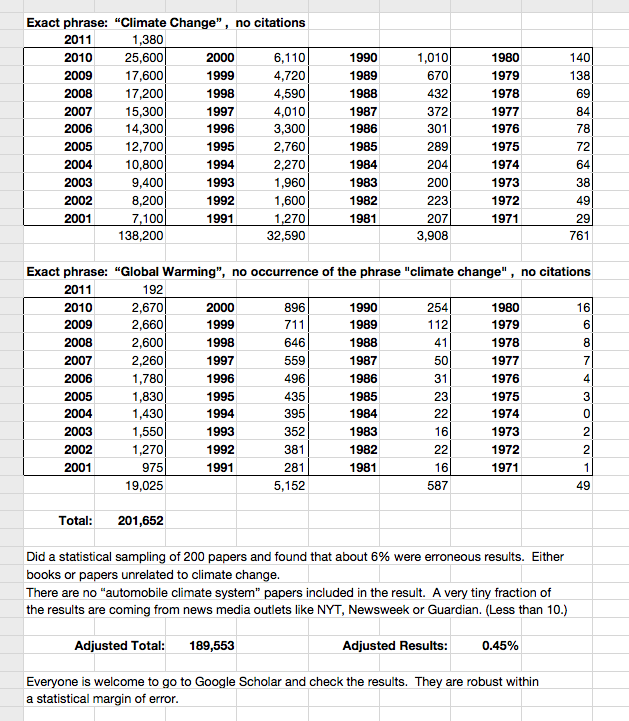
Here I just went to Google Scholar. I limited the search to the term "climate change" and only searched articles in the subject areas of 1) Biology, Life Science and Environmental Science, and 2) Physics, Astronomy and Planetary Science. That returned 954,000 articles. I did a pretty thorough perusal of 200 articles of the 100 pages of results and it looks like they are all actual papers and not just references to any blogs or websites. A number are listed as "[citation]" so we might pull out about 10% for good measure. But everything else looks to be published works in a very wide variety of scientific journals. I intentionally left out the 177,000 papers that result when I do the same search on "global warming" since I don't know how many of those will be duplicate hits.
Numerator, meet The Denominator! What we are left with is about 850,000 peer reviewed papers on climate change for the 850 peer reviewed papers that PopTech presents. That leaves our friend with 0.1% of peer reviewed papers that challenge AGW alarm, as defined by him.
I'm sure some folks will find ways to quibble about the numbers but I don't think even the very best debater can appreciably alter the resulting percentages. And if they try…
"I'll be back."

Arguments


Quite, E&E is a peer-reviewed journal (although it seems evident that the quality of the peer review is seriously defficient). However, it is more than sufficient to point out the scientific flaws in the papers concerned; that alone demosntrates that their inclusion in the list devalues the list as a resource (unless the criticisms can be adequately refuted). The ad-journalem if anything detracts from that.
RickG: "I didn't ask you whether or not there are any published comments on it. I asked if "you" thought the article was credible science."
Poptech: I have seen nothing published to suggest otherwise.
By that response I gather that you consider the Archibald (2006) article as scholarly science. Is that correct?
Dikran Marsupial, "The majority of papers that are substantially in error are never corrected by a peer-reviewed comment."
"This is an unsubstantiated statement."
You don't publish, do you, Poptech?
If a paper is viewed as correct, and especially if considered seminal, original work, it will get cited. If it's irrelevant or worse yet, wrong, it won't. Most of these just vanish away, although they are occasionally the subject of coffee-room humor.
The only time anyone takes the not inconsiderable effort to write a peer-reviewed comment on a wrong paper, and publish it, is if said paper is being treated as accurate when it isn't, if it's getting wrongly cited or bandied about. So - if you see a peer reviewed comment on a paper, it's one that (a) had important errors missed in the original review, (b) is being incorrectly relied upon, or (c) in some cases is just an embarrassment to the journal that they are being called on. It means the paper is not just considered wrong, but loudly wrong.
If a paper is viewed as worthwhile it gets cited. If not, or if it's just wrong, it won't. If it's wrong and someone cites it, you might get a peer-reviewed comment.
Sonja Boehmer-Christiansen (editor of E&E) in an interview with the Chronicle of Higher Education on 3 September 2003:
"The journal’s editor, Sonja Boehmer-Christiansen, a reader in geography at the University of Hull, in England, says she sometimes publishes scientific papers challenging the view that global warming is a problem, because that position is often stifled in other outlets. “I’m following my political agenda — a bit, anyway,” she says. “But isn’t that the right of the editor?”
Enough said.
err, no. ;o)
P.S. I am aware that poptech wrote an attempt to put that quote into context, but in a scientific journal, there is no context in which following a political agenda would be acceptable. Science should have a bearing on politics, but politics has no bearing on science.
"So all papers that are cited are correct?"
Please refrain from strawman arguments, Poptech - I clearly did not say that.
If a paper is viewed as correct, judged as a worthwhile contribution by others in the field, it will get cited. If it is not, it won't, and will vanish away. And if it is viewed as incorrect, but still cited by some, it may get a peer-reviewed comment. Most often not - usually it's not worth the considerable effort to publish about what is being ignored.
Sometimes (quite rarely, actually) a paper will be controversial yet correct, will attempt to overturn large parts of the consensus but be rejected. Early plate tectonics papers did not receive acceptance - not until a mechanism (liquid mantle movement) was proposed in a testable fashion. Extraordinary claims require extraordinary evidence - when the evidence was forthcoming the consensus changed.
Like it or not (and your list seems to indicate that you do not), consensus views and the incorporation of worthwhile work into further research built on it is a key part of science. Scientists stand on the shoulders of giants - and on the shoulders of midgets, too - everyone who adds a piece to the puzzle contributes. Junk gets ignored.
"By the way, E&E is not a science journal and has published IPCC critiques to give a platform critical voices and ‘paradigms’ because of the enormous implications for energy policy, the energy industries and their employees and investors, and for research. "
Sonja A Boehmer-Christiansen 3 September, 2009
emphasis mine.
Denier-bots live! Why are online comments’ sections over-run by the anti-science, pro-pollution crowd?
I told ya so...
Interesting that many do not consider E&E to be a peer reviewed journal.
Since you do not admit to any data, now or future, that is able to change your mind, I dont think further debate is warranted.
"Can a scientifically valid paper not be cited? (Yes or No)" - Maybe. Papers that are irrelevant, repetitious, or poorly written can be valid, yet not worth citing. It used to be (>25 years ago) that valid and useful papers could slip through, as nobody reads all of the journals, but with today's search engines that's become quite the rarity.
"So all papers that have had comments on them are incorrect? (Yes or No) " - Again, Maybe. It means that someone in the field objected to that particular paper enough to submit a comment. It definitely means that at least some of that paper is contentious - whether poorly argued, poorly evidenced, or contradictory to other work. Usually the comments are clear enough - they will either break the paper or the comment itself.
The thing is, Poptech, citations are the 'vote' of people in the field, indicating what is relevant, meaningful, and worth consideration. It's like a jury - trial by a body of your peers. And as I stated earlier, in the post you really didn't respond to - a lack of citations indicates a lack of worth to the field, and some of the worst papers out there are simply ignored. They don't need or get peer-reviewed comments pointing out problems unless somebody is using them as an arguing point - they'll vanish on their own.
To declare someone's personal impression as 'incorrect' is not only breathtakingly arrogant and insulting, but also logically impossible - In the context of my original remark, it could only be incorrect if it's not what I really felt (and only I can know that!).
Instead, he's condemmed himself to saving face to the point of absurdity.
In my personal impression, he has been demoted from politician to logic troll, and for that, he only has himself to blame.
Nicely put, sir. You have a way with words that serves as an excellent example. Unfortunately, a conversation requires two to meaningfully engage -- and often sinks to the lowest common denominator.
My reply was in reaction to Alex's comment here. You are free to read either Alex's statement or my reply in whatever manner you choose; subject, of course to the conventions of normal English usage.
KR - "The thing is, Poptech, citations are the 'vote' of people in the field, indicating what is relevant, meaningful, and worth consideration. It's like a jury - trial by a body of your peers."
"It is still subjective and does not determine if a paper is scientifically valid."
What it does is show the judgement of those in the field, those who study the data, the effects, the interactions, who understand the topic. Subjective? Certainly. The best judges available? Most definitely.
If a paper isn't cited, it has failed to impress the most qualified audience possible. And a lack of citations is the fate of most bad papers.
Some of those citations will, of course, disagree with the conclusions of those papers; that's the fate of all papers that are actually discussed. And these many pieces of science, discussed, hashed over, considered, accepted or abandoned, make up the consensus view.
Which takes us right back to what the consensus is. 97% of those working in the field (a higher number than those outside the field, who don't look at the data) say it's AGW. Disagree? Then write your own paper(s) - present a theory that encompasses all the data indicating a human contribution to the climate, that accounts for the various data we have (ocean heating, tropospheric warming, stratospheric cooling, rapid temperature changes over the last 100 years, radiative physics of greenhouse gases, etc.). Convince the consensus.
Enough said - I'm out of this thread.
Poppy, dearest... Let me educate you.
Real science actually involves a lot of review and improvement; clarification, removing week (even if not, provably wrong) data, adding strong data, qualifying data, comparing with sister arguments etc.
This is part of the real meaning of peer review. What a lot of people don't understand is that it isn't just that someone has read a paper, maybe corrected some typos and said 'yay' or 'Neigh'. Normally results are discussed with colleagues, at conference, in pre-prints, by email etc. way before publication. At the last hurdle the editor and reviewers will send back comments which may require more work, input, removal of information, consideration of related work and so on... maybe for several iterations before the paper is accepted. By far the majority of good science publications have been through this. Most researchers are masochistic; They repeatedly bare their chest to the slings and arrows of criticism, knowing that this will improve their output... if they take note and improve.
And you will notice that the comment policy of this site follows that - discussion should be on the post, in the posts thread etc.
People who do sciency work (i.e. the output look similar to real science, but the processes are broken) don't really understand this. Instead, like here, they take every criticism as being something to be shot down rather than learned from. You've been told that often enough and don't seem to understand it... maybe your programmer will get on the case? Shall I rise a trouble-ticket?
your loss.
you completely (and not for the first time) missed the point.
You say "I am well aware how the process works." but that wasn't the point. I was referring to your 'work', not the papers in your list.
You clearly are not working within science bounds nor within the review process. That is what we are trying to teach you; but, as you say, you don't seem to have the ability to learn.
2/10 to they guy who programmed your AI engine.
This is, perhaps, the saddest statement I have ever read on this website.
Personally, it's my aim to be learning until the day I die - from children, from the experienced, from fools, and from geniuses.
"Learning, n. The kind of ignorance distinguishing the studious." - Ambrose Bierce
Poptech, please go and read up on the Dunning-Kruger effect. I would agree that nobody is able to teach you anything, but only because you are apparently unwilling to learn, judging from the comment above, largely becuase you have an unrealistic view of your own ability.
I think the above quote is one of the most shocking and absurd things I have seen from a "skeptic" on a climate blog, and a great pity.
I find it very very sad. By your own admission you are not a climatologist but a computer dork like myself*. There are, at least on occasion, actual climatologists and experts who show up on this site to share their knowledge. If you think they can not teach you anything about this subject then you are deluded.
* not exactly like me since I am eager to learn
But Poptech has yet to learn the lesson that I was teaching in that numbers require context.
Poptech's position is somewhat like a guy running down the street screaming, "I've got $850!!" quickly followed but a creditor with a bill for $85,000.
'Popular' in science means 'useful' and 'accurate'. People don't cite the work of others because they like it. They cite the work of others because they find it useful and, yes, valid. Why build your own work on the flawed work of others? The development of modern science is based on this very principle.
You're utterly wrong on this, Poptech, and your misunderstanding suggests that you're purely in the rhetoric business. You are a politician, in the sense that you attempt to manage the politics of the reader. Politicians will cite anything they think is useful for this management. You built a list of instruments--850--that you hoped would serve to manipulate the beliefs of your trusting readers, but you don't have enough scientific understanding to recognize garbage in the presence of those whose business it is to recognize garbage. You should never have come here, Pop. I know the slight sense of self-respect you have drove you to do it, but now the fine details of your misunderstanding are a matter of public record.
I suggest that we end this thread. It's like arguing with a smoker about the physical and psychological effects of smoking. In other words, it's like shooting fish in a barrel, except that the dead fish have no actual value: Poptech is not here to argue and learn, as some "skeptics" are. He's here to simulate an argument. He's not invested in the ongoing outcomes of the argument (so he thinks; perhaps he doesn't have children, either); he's invested in the process of argumentation itself.
Keep in mind that these assessments of your ability to critically think are not ad hominem attacks. They are observations based on the evidence (the written expression of your thought process, or the thought process of your Poptech persona) given on this 700+ post thread.
But you have failed to demonstrate that by the standards you define yourself. By your own standards, it's entirely subjective. You can't even begin to prove it.
"Credentialed scientist"? That is exactly the kind of thing you were arguing against, earlier, at some point. You've been doing this all along this thread, strongly defending against a semantic issue only to use it when it suited your argument. Just like you tried to argue that quality is subjective and then turned around to say that one could not objectively claim to be qualified as a reviewer from having a track record of numerous "mediocre papers". That is obviously a concept that you failed to objectively define. Nonsense on top of more nonsense.
This is by far the most accurate assessment of your ramblings: "he's invested in the process of argumentation itself."
You have nothing of substance to say other than "I have a list." That is so laughably limited as to be irrelevant to anyone who can think.
I don't doubt that this is the perception you get from reading E&E on a regular basis.
In any case it is a sweeping accusation against all scientists, formulated with words that you have declared yourself as leading only to subjective statements. Your accusation must be substantiated with objective criteria, otherwise, even by your own stanadrds, it is null and void.
You're demonstrating again and again that you're arguing for the sake of argument and that reality has no bearing whatsoever on said argument. It has come to a point that's beyond grotesque.
The 97% figure comes from the Doran 2009 study as discussed on the argument #3 thread There is no consensus.
Please respond to this point on that thread.
You are arguing with a professional troll that has spellbound you for years. And by pro I mean he is definitely hired by vested interests to do this. He has A+ skills.
I don't want to rain on your parade, but this shill is wasting everyone's time.
So, can we please just ignore him? No matter how "fun" these threads may appear, there are more pressing issues to address.
Let's face it, we have been pwned.
The only people who take your inconsequential list seriously are you and your group think enthralled friends. The rest of us can see that it's seriously lacking on many many levels. End of story, and hopefully the end of this thread :)
Thanks for the fascinating insight into the psychology of climate change denial; where group think (assertion that poor quality evidence is good quality evidence) is not group think, and logical exposition of quality empirical evidence of climate change is group think. Welcome back to 1984! My work here is done :)
Do most papers on evolution explicitly endorse evolution? No. That's because it's well established. Same with climate change.
The IPCC itself used "500 Lead Authors and 2000 Expert Reviewers" and it "confirms that climate change is occurring now, mostly as a result of human activities; it illustrates the impacts of global warming already under way and to be expected in future, and describes the potential for adaptation of society to reduce its vulnerability; finally it presents an analysis of costs, policies and technologies intended to limit the extent of future changes in the climate system".
That is the conclusion, based on all that work.
Makes you see how insignificant that other little list is, doesn't it ?
[W]hy don’t you go and do a point by a point refutation of every single one of the (200+ recent) papers on MothIncarnate's list. [W]hen there are over (200+ genuine recent) scientific papers supporting AGW, surrely to any same person, that would at least provide some reason to back the theory.
I had directly cut-and-pasted a comment thrown at me by an advocate of Poptech's silly list (spelling mistakes left for added hilarity - the character "indulges" in "humouring" and educating me, whilst continually demonstrating really basic spelling errors).
I don't personally think that demanding the other to "debunk all these papers" is logical - hell, that's what the science community already does. But I am surprised that Poptech and his fan "Adam" (whom I'm quoting) and many others really think Poptech's list means anything.. But then again, they also support Monckton...
Such people define the meaning of "unreasonable" beautifully.
Why is there so much work in this area? People are "alarmed" about the potential consequences.
All the papers coming out are about "AGW alarm."
My argument continues and has always been that only a small fraction of these explicitly endorse "anthropogenic global warming".
=====
What exactly is required for research to explicitly endorse AGW? Is it enough that the findings of a study consistent with predicted effects of AGW? Do the researchers have to state that it is consistent with AGW? Do they have to say the results are due to AGW? Just like with your AGW Alarm refrain, only you know what the subjective criteria are.
PS - Your scare quotes around anthropogenic global warming make it difficult to take you seriously.
For another example of a double standard, you dismiss arguments based on impact factors as being subjective (which isn't actually true, but we can neglect that for the moment), when your choice of peer reviewed papers forming your list is entirely subjective. Whether a paper supports your personal skepticism of AGW alarm is entirely subjective - I have already given an example of a paper on your list that provides better support for "alarmists" as it describes the fall of civilisations brought on by climate change.
BTW, regarding your comments here, I am very much in support of your project to provide a resource for skeptics; but that doesn't mean I support every argument you make. In this case a shorter, but more robust list would be a better resource for the skeptic. It is very much your loss that you are to obstinate to take advice from those who offer encouragent and constructive criticism (that is what peer review is all about, so there is a certain irony there!).
Not at this rate they don't. Papers come out on string theory because people interested in that. But there are not 20,000 papers a year coming out on string theory.
Climate is a hot topic because of people's alarm about AGW.