





SkS Responses to Pielke Sr. Questions
Posted on 21 September 2011 by dana1981
On his blog in response to our post One-Sided 'Skepticism, Roger Pielke Sr. asked SkS to respond to some questions. We would like to note that these questions are totally unrelated to the initial discussion initiated by Dr. Pielke's unsubstantiated criticism of SkS (see Chasing Pielke's Goodyear Blimp). However, in the interest of establishing what we hope will be a productive discourse, we have agreed to answer Dr. Pielke's questions.
Dr. Pielke's questions are underlined in the text below, and the answers from SkS follow.
1. Of the two hypotheses below, which one do you conclude is correct? (see Dr. Pielke's post for the two hypotheses offered)
The two aren't mutually exclusive, and both are correct. CO2 is the dominant radiative forcing causing the current global energy imbalance.
2. Of the two perspectives below [from Mike Hulme], which one do you agree with? (see Dr. Pielke's post for the two perspectives offered)
Again, the two perspectives are not mutally exclusive, and both are correct. As Hulme notes, they are simply two different framings. In terms of climate policy, the second framing is probably more appropriate, as addressing climate change will involve more than just CO2 emissions reductions.
3. What is your preferred diagnostic to monitor global warming?
SkS doesn't have a preferred diagnostic - all lines of evidence must be taken into account. It's important to look at all the data in totality to monitor global warming (surface temperature, ocean heat content, atmospheric temperature, TOA energy imbalance, sea level rise, receding ice, etc.).
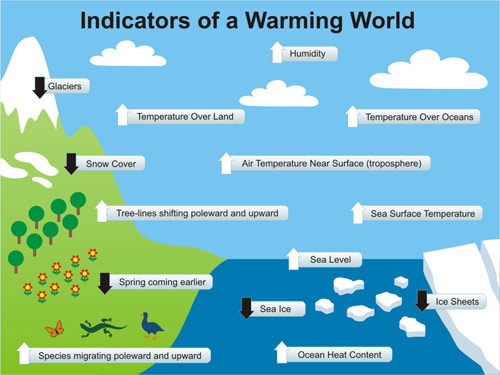
What is your best estimate of the observed trends in each of these metrics over the last 10 years and the last 20 years?
10-year trends are generally not statistically significant (see Santer et al. 2011, for example). The approximate best estimate observed trends for some of these metrics over the last ~20 years are as follows. TLT: 0.18°C per decade. Surface temperature: 0.18°C per decade. Ocean Heat Content (OHC) upper 700 meters: 6.3 x 10²² J per decade. Sea level rise: 32 mm per decade. Arctic sea ice volume: -2900 km3 per decade. Glacier mass balance: -180 mm w.e. per decade.
4. What do the models’ predict should be the current value of these metrics?
The surface temperature change is roughly consistent with model predictions, though perhaps a bit on the low end. The predicted TLT trend is approximately 0.26°C per decade. Sea levels are rising faster and Arctic sea ice is declining far faster than models predict.
OHC in the upper 700 meters increased more than the models expected from 1961 to 1999, and has increased less than models project since 2003. There are a number of factors that may explain the recent discrepancy:
- as noted above, this is too short of a timeframe for a valid statistical evaluation;
- models generally do not take the increases in aerosol emissions over this period into account;
- there is a wide range of estimates of upper 700 meter OHC trend since 2003, varying by nearly two orders of magnitude; and
- the oceans are much deeper than 700 meters, and the so-called "missing heat" may very well reside in the deeper oceans (i.e. see Meehl et al. 2011).
We have discussed this subject previously here and more recently here, taking the deep ocean into account.
One reason that we like to rely on multiple lines of evidence, rather than depend on one single indicator, is that any one can be wrong. The history of the UAH measurements comes to mind: the measurements were in conflict with other methods for tracking temperature change (and with climate model projections) for over a decade; eventually, most of the discrepancy was resolved (in favor of the models) only after very subtle analysis of the physical behavior of the instruments.
5. What are your preferred diagnostics to monitor climate change?
That depends on how "climate change" is defined, but again, it is necessary to look at all lines of evidence and data.
6. Is global warming (and cooling) a subset of climate change or does it dominate climate change?
Again, that depends on how "climate change" is defined. Long-term global temperature and climate changes are both ultimately caused by global energy imbalances.
Now that we have answered your questions, there are a few issues on which we would like to understand your perspective, Dr. Pielke.
SkS Questions for Dr. Pielke
1. Approximately what percentage of the global warming (increase in surface, atmosphere, ocean temperatures, etc.) over the past 100 years would you estimate is due to human greenhouse gas emissions and other anthropogenic effects? And the past 50 years?
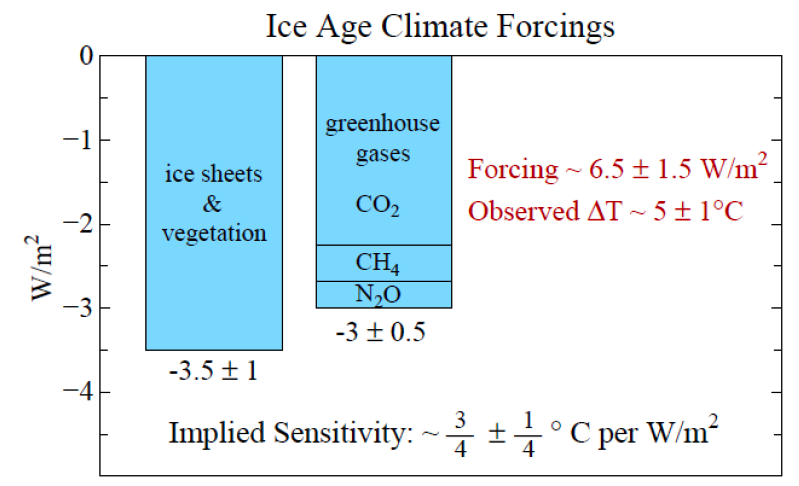
2. Do you find Spencer, Lindzen, and Christy's arguments that equilibrium climate sensitivity is in the ballpark of 1°C or less for doubled atmospheric CO2 plausible? If so, how do you reconcile this low climate sensitivity with the paleoclimate record, for example needing to explain ~5°C swings in average global surface temperature between glacial and interglacial periods (i.e. see the figure below from Hansen and Sato 2011)?
3. Do you agree that continuing on our current business-as-usual emissions path presents an unacceptable (in your opinion) risk to the biosphere and to human society in general within the next century?
4. Do you agree that continuing on our current business-as-usual emissions path presents an unacceptable (in your opinion) risk to marine ecosystems in the form of ocean acidification within the next century?
5. Do you think that we should begin to move towards a low-carbon economy, thereby reducing anthropogenic GHG emissions?

Arguments


Second, you write
"As someone with numerical modeling experience, I'm confused by Dr. Pielke's (who is a modeler) claim that "Models themselves are hypotheses", in his book "Mesoscale Meteorological Modeling" which is on my bookshelf here, he says on page 1 that "....it is necessary to understand the basic physical and mathematical foundations of the models...". Quite different from what he said in his testimony. He then says "There is no way to test hypotheses with the multi-decadal global climate model forecasts for decades from now as step 2, as a verification of the skill of these forecasts, is not possible until the decades pass." This leads me to conlcude that Dr. Pielke is of the opinion that models are nothing more than untestable hypotheses...it would be a great shame if he thinks that his life's work amounts to that."
Models have a basis in fundamental physics (their dynamic core) and also include engineering components (i.e. tunable paramters) as discussed in my book. Their forecasts can be tested, and if the model prediction and the observations are in a large enough disagreement (e.g. determined by skill scores or other tests), the model is rejected as providing skillful forecasts. For forecasts from the climate models, decades from now, we have to wait for those decades to pass.
I hope your misunderstandings are corrected. I am pleased that you have my book. :-)
Pielke Sr., R.A., A. Pitman, D. Niyogi, R. Mahmood, C. McAlpine, F. Hossain, K. Goldewijk, U. Nair, R. Betts, S. Fall, M. Reichstein, P. Kabat, and N. de Noblet-Ducoudré, 2011: Land use/land cover changes and climate: Modeling analysis and observational evidence. Wiley Interdisciplinary Reviews: Climate Change, Invited paper, accepted. http://pielkeclimatesci.files.wordpress.com/2011/09/r-369.pdf
where we write
"For those regions that have undergone intensive LULCC, or will undergo intensive change in the future, failure to factor in this forcing has profound consequences. Investments in adapting to ongoing human-induced climate change and natural variability will remain founded on incomplete and potentially misleading information. This in turn leads to a higher risk of misaligned investment in climate adaptation, which is a vastly more expensive outcome than the costs of resolving the impact of LULCC on the Earth’s global and regional climate. Unless we undertake a thorough assessment of the role of LULCC on climate, an incomplete understanding of the role of humans in the climate system will persist."
"The first is correct because the climate is driven by CO2. The major forcings are CO2, methane, etc. and their positive feedback through water vapour, as illustrated diagrammatically on the Sks site."
Climate is driven by the spatially and temporally variations in solar heating of the Earth by the Sun. CO2 and the other greenhouse gases represent one major way the climate system responds to this source of energy.
Christy, J.R., B. Herman, R. Pielke, Sr., P. Klotzbach, R.T. McNider, J.J. Hnilo, R.W. Spencer, T. Chase and D. Douglass, 2010: What do observational datasets say about modeled tropospheric temperature trends since 1979? Remote Sensing, 2(9), 2148-2169.
http://pielkeclimatesci.files.wordpress.com/2010/09/r-358.pdf
"Human influences are dominated by our use of fossil fuels causing the emissions into the atmosphere of both greenhouse gases, the most important of which is CO2, and aerosols."
The human effects on the enviroment are certail much more than from fossil fuel emissions, so I assume you mean human influences on the climate system. Your way of framing as a hypotheses fits with hypothesis #2b, which has been rejected, in my view (and that of many of my colleagues, as exemplified in the WIREs paper I included in an earlier comment.
It is also commendable that the Heartland Institute was willing to provide a forum for alternative viewpoints (much as Skeptical Science is doing with my comments although I do not fit in the label of "climate skeptic"). We need more reaching out between the different groups. The Heartland Institute and Skeptical Science have this reaching out in common.
I note that the paper you reference cites the Douglass et al paper as "pointing to the potential for fundamental problems with the models", however it hardly provides support for such a contention as the methodology used did not show that the observations were inconsistent with the models as claimed.
Do you think the method used by Douglass et al. is statistically sound? A direct answer would be greatly appreciated.
By the way, on page 2161, Christy et al. (2010) says "This implies there is a 3% chance that the trend is non-positive in a statistical sense". This appears to be a clear example of the p-value fallacy. A 3% probability of observing a trend at least as great assuming the null hypothesis is true is not the same as there being a three percent probability that the null hypothesis is true. N.B. I will happily discuss Christy et al. (2010) (which appears to also have statistical errors) with you after you have answered my question regading the Doulgass et al. paper.
seems to be relevant to adaptation policy but is not helpful in consideration of mitigation policies, unless you mean that it is the local scale consequences that should impel us to address mitigation at the global scale (which I guess is a pretty obvious point, but maybe you could confirm that you agree with this).
For example if our best understanding on warming-induced precipition regime changes to global warming indicates progressive latitudinal expansion and severity in the currently drought-susceptible latitude bands, then this is something that can only really be addressed by mitigation on the global scale, even if we are already committed to having to make local scale adaption policies. Once the terrestrial environment stops being a net sink for anthropogenic greenhouse gases, these considerations will become ever more pressing.
The same could be said for sea level rise. Efforts at mitigation requre global scale consideration. Impacts and adaptation will occur on the local scale [The Dutch Delta Commision on sea level rise is taking local implications of 21st sea level rise on the 1 metre plus scale very seriously, whereas presumably the inhabitants of North India have little concern about 21st century sea level rise, but do have concerns about warming induced attentuation of mountain glacier sources of water supplies and so on.]
So we're stuck with adaptation at the local scale. The extent to which these become difficult and then possibly unacceptable burdens on our resources depends on our willingness to make the difficult decisions at mitigation on the global scale I'm glad that you (Dr. Pielke) respect the views of Dr. Denning and hope that you agree with the sentiments he presented in his recent short talk where he highlights both the reality of the issues and a mature approach to addressing them. He clearly consders that consideration of greenhouse gas forcing on the global scale is the issue that needs to be addressed.
I don't see the need to restrict attention to ONE focus.
Surely we can walk and chew gum at the same time?
"3. Do you agree that continuing on our current business-as-usual emissions path presents an unacceptable (in your opinion) risk to the biosphere and to human society in general within the next century?
Pielke Sr:
Of course. The emission of CO2 into the atmosphere, and its continued accumulation in the atmosphere is changing the climate. We do not need to agree on the magnitude of its global average radiative forcing to see a need to limit this accumulation. The biogeochemical effect of added CO2 by itself is a concern as we do not know its consequences. At the very least, ecosystem function will change resulting in biodiversity changes as different species react differently to higher CO2. The prudent path, therefore, is to limit how much we change our atmosphere.
By continuing to argue on global warming and its magnitude, I feel you, and others, are missing an opportunity to build up a larger consensus on how to properly deal with the myraid ways we are altering the climate and the environment, in general. Even if there were no global warming (or even cooling) in the coming decades, we still need to limit how much we change the environment (including land use change, nitogren deposition, CO2 etc)."
In the long run, your assertion is correct; we need to limit how much we change the environment.
In the short term, the magnitude of global warming is important, because it will dictate how we should proceed with our limits. If the magnitude is great and the timeframe is short, then drastic actions need to be undertaken immediately. If the magnitude is low and the timeframe long, then we can take the time to implement the best possible adaptive measures with minimal impact on the populace.
Although it is an amended version of your (amended) 2b as presented in your post @32, the shift from a regional to a global focus is fundamentally important. By making that shift it states a hypothesis which I suspect most SkS commentators will agree with, but which you clearly disagree with.
In contrast, I (at least) believe that whether purely regional forcings or global forcings are most significant to changes in climate in a particular region at present depends strongly on the region in question. The recent, and unusual aridity of South West Western Australia, for example, is almost certainly due to changes in the Hadley Cell brought about by global warming. I have no doubt that you can point out regions in which the regional forcing is clearly more significant. But I have no doubt that by 2100 the climate response will be dominated by global forcings at all scales.
You attempt to rebut this perspective in responding to KR @49, but frankly I am not buying it. I live in a state whose weather is dominated by wind patterns in the central Pacific, thousands of kilometers away, wind patterns I have never personally experienced. It is true that the rain that fall on my head falls only in Brisbane, and the wind that blows in my face blows only in Brisbane. To conclude from that that we can determine the strongest influence on the weather I experience by determining the strongest forcing in the immediate vicinity of Brisbane is a non-sequitor; and indeed, a complete failure to understand the distinction between weather and climate.
From a different perspective, the largest seasonal influence on my quality of life is the Northern Hemisphere Winter. The increased consumption of oil for heating drives up petrol prices while I enjoy summer sun, and has a far larger direct impact on my quality of life than any regularly recurring event relating to Brisbane weather. And note that it is the NH Winter. It is not the Seattle Winter, and the Moscow Winter and the Oslo Winter, as if these are somehow separable and could occur at distinct times. If they could, they would have little or no impact on me. But they are not separable. The NH winter is an irreducibly hemispheric climactic event, and any attempt to analyse it as the sum of many regional events will completely misunderstand it.
Of course from the emission point of view land use change from agriculture and forestry accounts for 30% of GHG emission. Increasing emissions from these sector has a significant impact on atmospheric GHG forcing. With increasing global population and demand for food it is very likely that emission will continue to rise. Better management is required to meet global demands while preserving existing forestry.
Incidentally, I should point out that I came across Dr. Denning's lecture while perusing Bart Verheggen's excellent blog, and so owe him a hat tip!
I cover Scott Denning's Heartland talk
I introduce free market ideas for Libertarians
scaddenp's GHG emission mitigation solutions - a challenge for the Right?
I also discuss climate ethics that I believe can be a bridge between the political divide
As far as your son's "Climate Fix", while I can't personally endorse that this will solve the overwhelming problem we face, there are certainly ideas in there that we can all agree on. SkS, as far as I know, is not against any particular policy, just agrees with the science institutions asking for legislation that will fulfill the needed purpose of assisting us through the coming global challenge.
The first two topics seem very closely related, and have received about 60 comments. I think the SPCA should be concerned!
It's called a joke. I cannot believe KR was offended by that.
I consider posing repeated statements that you attempt to get agreement to a rhetoric exercise, and am (personally) quite done with that. Cattle prods may be appropriate there.
But as a different issue, framing the question of climate as regional, when the changes in regional climate are driven by global climate change, is disingenuous. And (again, my opinion) an attempt to avoid dealing with those global issues. And I think Tom Curtis agrees with me, and has expressed it quite clearly.
In that case, it may be useful to document items of agreement, which can be recorded; and items for further discussion (if that seems to be fruitful).
I believe Dana is taking a few notes, so maybe if we can spell out the agreements and isolate the items where no further progress is likely today, we will be able to cover more ground before everyone runs out of steam.
Does that make sense to people?
Notably
1) “If we don’t know everything, we must know nothing” fallacy. Expertly done with the "as we don’t know detailed regional impacts, global warming is irrelevant” line.
2) Cherry picking of datasets. Firstly, brilliant delivery on the “OHC is the only measure that counts” issue being at the same time basically scientifically sound (most of the heat does, of course, go into the ocean) yet at the same time spectacularly myopic in ignoring the rather inconvenient multiple other lines of evidence. Secondly, in using only the most recent data from ARGO on OHC rather than the whole record.
3) Shamelessness. Showing truly admirable chutzpah in switching seamlessly from the UAH temperature to OHC as preferred metric when UAH ceased to show the right trend.
4) Obfuscation. When challenged, don’t answer the question but move on. Magnificent examples in the current brouhaha: moving the discussion on from his attack on SKS to his preferred topic of the OHC issue. Also throughout the thread referencing largely irrelevant papers rather than actually answering questions.
5) Avoidance (via taking the moral high ground). He has carefully avoided defending the obviously unjustifiable elements of Christy’s testimony - by claiming to want to move the discussion on the science. And who could argue with that, on Skeptical Science?
You've got to hand it to him, he's a class act
Having said that, it still remains true that the initial reduction in sea ice extent was a consequence of the enhanced greenhouse effect, a global factor. So even when regional factors dominate the particular evolution of regional climate (an hypothesis 2a situation) understanding of the long term evolution of the regional climate may only be understandable by reference to global factors.
Well said. I also noticed Pielke's devotion to balance in his "We need more reaching out between the different groups. The Heartland Institute and Skeptical Science have this reaching out in common".
You know, the "two equal sides"-tactic.
That said, I think Pielke sr. actually this time has answered at least some of the questions. Kudos to Dr. Pielke for that.
Yes, spot on - "The fallacy of balance" is another common tactic.
Pielke has IMHO very carefully chosen which questions to answer and which not to.
DSL @78
Indeed - although Pielke's (and Curry's) stated admiration for WUWT is probably primarily intended as a wind up to other academics. In which it is highly effective, another masterclass from RPSr.
While I find your tone a little abrasive, and I'm not sure how I would feel if I were Dr. Pielke, I think you make very valid points. It relates somewhat to my concerns, which I will broach once things reach the last three SkS questions and Dr. Pielke's answers to them. At that time your points will, I think, be more applicable. For now, however, I think the discussion should proceed as it is, without reference (yet) to your points.
When your points do arise again, I (personally) would like it to be in terms of an honest and fruitful discussion with Dr. Pielke, rather than being perceived as an assault. That will require a modified, less caustic and direct approach.
We all greatly appreciate you taking the time to read our questions and comments and responding as you can. Just bear in mind that it's an internet forum and even with heavy moderation can get somewhat cacophonous at times.
"Although Dr. Pilke's relationship with Anthony Watts is a bur under many of our saddles, let's confine this discussion thread to the science of climate change."
This is exactly why personalising the science with "Christy Crocks" etc was a mistake. It implies that certain scientists paper are favoured over others because of who they are.
The inevitable result has been a focus on personalities and politics rather than the science.
Christie, Pielke et al have little to offer on the science, and the debate is now where they want it.
6) Preemptively framing the debate using false dichotomies.
This tactic can bog down the discussion in fruitless discussions of semantics or terms of debate, making it seem hopeless (apparent draw = "skeptic" win). Or it can trap those who are unwary in apparent self contradictions if they accept said false dichotomies as the terms of the debate.
alan_marshall (#43): "It is likely that Pielke thinks he can entrap Sks, cherry-picking words or phrases in Sks’s response in an effort to discredit it, outside of the context of Sks’ well structured and comprehensive analysis of the evidence."
I think that's right. For example, when I wrote "At any rate, I don't see how anyone could state the IPCC is at odds with Hypothesis 2a"
Dr. Pielke responded with "I am pleased, however, that you see the need to move towards hypothesis 2a. "
Dr. Pielke was eager to frame my position, although I made no statement to that effect. It's an easy observation to note that both 2a and 2b are compatible with the evidence (see the radiative forcing chart SPM.2) and are not mutually exclusive, an observation he seems to have a hard time conceding, perhaps because it's critical to his argument.
Thank you for your responses. Just wish to deal with some outstanding issues:
"But nowhere, at least where I can find does he indicate the magnitude of this forcing in W m-2 (with error bars) or in terms of his preferred units, Joules. He appears to be stating a fact without providing a quantifier to justify his assertion."
Dr. Pielke has still not provide a number (or range) as requested, instead referring us to yet another roof his papers.
Dr. Pielke has not commented on the paper by Sitch et al. (2005)?
I'm sorry, but I am still not clear on exactly what transpired in the publication of your EOS manuscript. I find it hard to believe that EOS would have subjected the opinion piece to peer review when they state that "Eos does not publish original research results". How many people reviewed your manuscript? The header says nothing about when it was submitted or accepted for publication.
I demonstrated that the the IPCC and are not ignoring or laying down land use and land cover, and that this issue needs more attention, and it is receiving attention with some AOGCMs now including dynamic vegetation. That has not acknowledged by Dr. Pielke. Dr. Pielke also seems to be operating under the sadly correct presumption that most of he government representatives have not read the IPCC assessment reports.
I showed that his position on the urgency on taking action is not shared by the AGU to whose authority he tried to appeal and that he did not communicate his urgency on taking action when he addressed the House of Representatives.
Re models, I am very familiar with models and validating and verifying models thanks, have read the literature extensively on verification and validation have even published papers speaking to model verification. But I must insist that telling the public and government representatives that models are hypotheses is factually wrong and misleading. One can use various metrics and methods to validate and evaluate models-- in fact, in Chapter 12 of your book you discuss several options for evaluating models, and I did not see the term "hypothesis". Of course, one can use t-test to determine whether a newer model configuration is superior to an older one using t-tests, for example. Regardless, nowhere in your book, that I can see, (even in Chapter 12 "Model Evaluation") do you entertain the notion that models are "hypotheses". So I find the epature from wha you right in your text and what you tell policy makers and government officials unfortunate.
Response 1
Response 2
Some quotes:
"In terms of an effect on the global average radiative imbalance, Forster et al. suggest that this direct biogeophysical radiative impact of LULCC [Land use and land cover change] since pre-industrial times is a reduction in the global average radiative forcing of 0.2 W m-2 ±0.2 W m-2 which is small relative to other global climate forcings. Reasoning of this kind has led to the role of LULCC being mostly omitted from the climate models used in previous Intergovernmental Panel on Climate Change (IPCC) assessments of climate projections and historical reconstructions (although deforestation is included via emission scenarios of CO2)."
More work is being done in this area.
"The role of LULCC is not limited to radiative forcing of climate and is not adequately assessed as a globally averaged forcing. LULCC is a highly regionalized
phenomenon with regional-scale climate impacts that can vary in the sign of the change."
Mostly in agreement, although when it comes to driving global climate the globally-averaged radiative forcing is what counts, and you seem to be reluctant to provide a number in that regard.
"We still do not know if global-scale teleconnections may result from LULCC. We hypothesize from models that they are possible but LUCID showed that models did not agree on such remote impacts. Moreover, the assessments by the IPCC shows considerable regional divergence from a given forcing so it is premature to conclude that LULCC does [or does not]trigger remote effects".
Indeed. Yet you appear to be continuing to assert quite adamantly and confidently (especially in public) that LULCC is a first-order affect the global climate, and inflate the associated uncertainty to distract from taking prompt action on reducing our emissions. Your book chapter seems to raise more questions than answers though. I think occam's razor applies here. Dr. Richard Alley agrees, "The biggest control knob: Carbon Dioxide in Earth's climate history".
We Agree on:
1) The need to reduce human GHG emissions
2) That while CO2 is the largest single contributor to global warming, there are other factors which we must also address
3) Climate models are certainly not perfect, but are useful tools which have made fairly accurate climate projections thus far
Dr. Schmidt's response
Dr. Pielke seems to retreat to the fact that he got 18 AGU members to agree with him. That does seem remarkable, but Rob Honeycutt might beg to differ.
This can be combined with my last post if mods prefer.
Do you agree with the findings of the paper summarized below?
"Over recent decades, a scientific look at the temperature on the surface of the Earth has shown that surface temperatures are rising. But surface temperature is only one element of energy content in the lowest part of the atmosphere. Wind speed and humidity are two other types of energy on the Earth's surface that are factors when looking at what is going on with the climate on the ground. In a paper just published August 23, 2011 by the Geophysical Research Letters entitled "Observed Changes in Surface Atmospheric Energy over Land" (Peterson, et al., 2011), scientists at NOAA National Climatic Data Center, the U.K. Met Office, and the Cooperative Institute for Climate and Satellites-North Carolina, determined that in addition to surface temperature, humidity levels have also been increasing since 1973 and providing approximately equal contribution to increases in the heat content of the Earth. Increases in both temperature and humidity are also consistent with what we expect to see in a warming world. The paper quantifies how much energy the air is gaining, concluding that the bottom two meters of the atmosphere over land is gaining 1.9 x 10¹⁷ Joules of energy per decade."
Source: ‘New Paper on Surface Energy” posted on the National Climate Data Center’s “What’s New?” webpage on Aug 23, 2011.
"Dr. Pielke, we would like to do a post summarizing where we agree and disagree. Do you concur or have any comments on the following summary of agreements?"
As a skeptic, I will never, ever agree with the statement that "the science is settled and the data is incontrovertible". [accusation of dishonesty deleted] No branch of science can make such a claim and its foolish to promote such an idea as it relates to a branch a science as nascent as climate science. By insisting on such "absolutism", the proponents of the AGW are missing an opportunity to find common ground with their critics.
This community should give some thought as to what they want from the skeptics.
If you simply want to win an argument, then I have no time for that. If, on the other hand, you want to influence public policy, I would suggest that you can find a lot of common ground in the view that "the science is not settled but we are making great advances in our understanding. There is enough evidence today to support the view that releasing the byproducts of fossil fuels into the atmosphere at large scale is harmful and that changes in public policy should be undertaken" then I could get on-board with that.
I also recommend watching this video on why CO2 is the biggest climate control knob in Earth's history.
Further general questions can usually be be answered by first using the Search function in the upper left of every Skeptical Science page to see if there is already a post on it (odds are, there is). If you still have questions, use the Search function located in the upper left of every page here at Skeptical Science and post your question on the most pertinent thread.
Remember to frame your questions in compliance with the Comments Policy and lastly, to use the Preview function below the comment box to ensure that any html tags you're using work properly.
Please read the comments policy, accusations of dishonesty are not acceptable, please also avoid inflamatory statements, the beginning of your final paragraph is sailing very close to the wind.Is there a place where I can take MPaul to task for the no-such thing as any settled science Meme?
As someone who IS a working scientist, albeit not a climate scientist, I have great objections to non-scientists making such context-free statements. I run into this all the time in the real world...it reflects, if mpaul is American the long-running anti-intellectual streak that equates one person's willing ignorance with another perons's years of experimental research.
Gravity is settled. The germ-theory of disease is settled. DNA as the stuff of heredity is settled.
And given mpaul's last statement, I think he's a AGW proponent unable to confront the fact that he's in denial about it. Presumably there are elements that stick in his craw, but the weight of evidence is smothering him.
Pielke Sr., R.A., C. Davey, and J. Morgan, 2004: Assessing "global warming" with surface heat content. Eos, 85, No. 21, 210-211. http://pielkeclimatesci.wordpress.com/files/2009/10/r-290.pdf
Davey, C.A., R.A. Pielke Sr., and K.P. Gallo, 2006: Differences between near-surface equivalent temperature and temperature trends for the eastern United States - Equivalent temperature as an alternative measure of heat content. Global and Planetary Change, 54, 19–32. http://pielkeclimatesci.wordpress.com/files/2009/10/r-268.pdf
Fall, S., N. Diffenbaugh, D. Niyogi, R.A. Pielke Sr., and G. Rochon, 2010: Temperature and equivalent temperature over the United States (1979 – 2005). Int. J. Climatol., DOI: 10.1002/joc.2094.http://pielkeclimatesci.wordpress.com/files/2010/02/r-346.pdf
In the last paper, we also found that
"Even though most of the magnitude of TE is explained by T , the moisture component nduces larger trends and variability of TE relative to T." [note" TE is the measure of the moist enthalpy and T is the dry bulb temperature].
There remains the issue, however, as to how spatially representative are the surface land observations used in their study (and ours).
Unless similar amount of water (per kg) went into the lower troposphere, however, the difference between surface air and lwer tropospheric heat content trends will be even larger than we found for the dry bulb temperatures; see
Klotzbach, P.J., R.A. Pielke Sr., R.A. Pielke Jr., J.R. Christy, and R.T. McNider, 2009: An alternative explanation for differential temperature trends at the surface and in the lower troposphere. J. Geophys. Res., 114, D21102, doi:10.1029/2009JD011841. http://pielkeclimatesci.wordpress.com/files/2009/11/r-345.pdf
Klotzbach, P.J., R.A. Pielke Sr., R.A. Pielke Jr., J.R. Christy, and R.T. McNider, 2010: Correction to: "An alternative explanation for differential temperature trends at the surface and in the lower troposphere. J. Geophys. Res., 114, D21102, doi:10.1029/2009JD011841", J. Geophys. Res., 115, D1, doi:10.1029/2009JD013655. http://pielkeclimatesci.wordpress.com/files/2010/03/r-345a.pdf
Dr. Pielke, we would like to do a post summarizing where we agree and disagree. Do you concur or have any comments on the following summary of agreements?
We Agree on:
1) The need to reduce human GHG emissions
As I wrote in my earlier answer
"I am very much in favor of energy sources which minimize the input off gases and aerosols into the atmosphere. Much of my career has been involved with reducing air pollution (both in research and in policy). What we should move towards is an economy with as small a footprint on the natural environment as possible."
2) That while CO2 is the largest single contributor to global warming, there are other factors which we must also address
No; I am not convinced that CO2 is the largest annual global averaged positive radiative forcing [and I am interpreting that you mean human climate forcings and the global annual average). Sott, and a variety of other aerosols have quite substantial positive radiative forcings in the atmosphere, and for soot,at the surface on snow and ice also. These other positive radiative forcings arr discussed in some depth in
National Research Council, 2005: Radiative forcing of climate change: Expanding the concept and addressing uncertainties. Committee on Radiative Forcing Effects on Climate Change. The National Academies Press, Washington, D.C., 208 pp. http://www.nap.edu/openbook/0309095069/html/
3) Climate models are certainly not perfect, but are useful tools which have made fairly accurate climate projections thus far.
No, they models have not shown skill at predicting changes in regional climate statistics. They are not ready to be used for accurate regional impact assessments as we discuss in
Pielke Sr., R.A., R. Wilby, D. Niyogi, F. Hossain, K. Dairuku, J. Adegoke, G. Kallos, T. Seastedt, and K. Suding, 2011: Dealing with complexity and extreme events using a bottom-up, resource-based vulnerability perspective. AGU Monograph on Complexity and Extreme Events in Geosciences, in press. http://pielkeclimatesci.files.wordpress.com/2011/05/r-365.pdf
In terms of significant failings in the global climate models, as just two examples, see
Stephens, G. L., T. L’Ecuyer, R. Forbes, A. Gettlemen, J.‐C. Golaz, A. Bodas‐Salcedo, K. Suzuki, P. Gabriel, and J. Haynes (2010), Dreary state of precipitation in global models, J. Geophys. Res., 115, D24211, doi:10.1029/2010JD014532. http://europa.agu.org/?view=article&uri=/journals/jd/jd1024/2010JD014532/2010JD014532.xml&t=jd,2010,stephens
Insightful Interview In EOS Of Dr. De-Zheng Sun “Climate Dynamics: Why Does Climate Vary?” http://pielkeclimatesci.wordpress.com/2011/09/02/insightful-interview-in-eos-of-dr-de-zheng-sun-climate-dynamics-why-does-climate-vary/
I also have concluded that the computationally expensive climate models, when used for multi-decadal predictions, have not told us anything of demonstrated added value beyond what can be achieved with just global energy balance models. By so closely linking policy to these models, we are doing more harm than good in developing effective climate and energy policies.
You did not responded properly (to at least clearly) to John's question-- we do not really care whose idea it might have been (also the idea of moist-static energy and its role in say convection, has been around for a long time). John asked:
"Do you agree with the findings of the paper summarized below?"
I am also rather perplexed that you insist on keep touting Klotzbach et al. (2009) when that paper is known to have issues (some would argue serious issues). That fact was pointed out in the second post of this thread, but I'll post links here. Link 1, Link 2.
Dr. Annan concludes:
"Funny how this inconvenient result is now relegated to a "time period and location examined" when it was previously hypothesised to be representative of the global picture.
There were no fewer than three other places where L07 was originally cited as being consistent with the K09/PM05 hypothesis, but it would obviously have been too painful for them to mention that their own observations of boundary layer lapse rates contradict their theory. Therefore, these statements have just been deleted."
And I speak for my (and your) colleagues too when I say that it is considered poor form and inappropriate to repeatedly quote/cite one's own work as you seem to have a propensity to do. The reason being is that it limits the scope of the discussion and subject at hand, suggests the person is not open to alternative ideas beyond their own and also indicates that they are reluctant to consider the body of scientific evidence, and for these reasons it does not facilitate the advancement of science.
'Dr. Pielke asserts quite confidently here and elsewhere that land use and land cover change are first-order global climate driver. As I mentioned before, he is reluctant to place a figure on that in terms of global radiative forcing."
Lets assume it is zero as regions of positive and negative radiative forcing average out. Land use/land cover change, however, is still a first order climate forcing as it can alter regional climate more than that caused by the radiative forcing of added CO2. Also the alterations in spatial diabatic heating from this heterogenous forcing may alter large scale circulation features such as Asian monsoon, the NAO etc.
I do recommend you read our paper.....
Also, you write
"Regardless, nowhere in your book, that I can see, (even in Chapter 12 "Model Evaluation") do you entertain the notion that models are "hypotheses".'
you will see this in the 3rd Edition which is due to the publisher later this Fall.
Finally, on EOS, since I have actually reviewed Forum articles, I know they are reviewed. A paper does not have to be an original contribution to be reviewed.
I hope I encourage others on all sides to contribute and debate on all of the climate weblogs. I am disappointed to see the snide (snarky) comments from some and hope they realize that a positive interaction, even when we disagree, is not only more pleasant but also permits the development of consensus on at least some of the issues.
and other links on soot that I included there. Soot appears to be a major factor also in the Arctic sea ice. In terms of glaciers in the Himalayas, several years ago Lonnie Thompson showed me ice core data from several glaciers there. The appearance of soot in recent years was obvious, and I remarked to him than that this needs to be factored in in terms of melt.
"3) Climate models are certainly not perfect, but are useful tools which have made fairly accurate climate projections thus far.
No, they models have not shown skill at predicting changes in regional climate statistics."
With respect, you are shifting the goal posts and arguing strawmen. Dana was very likely referring to 'global climate', and you insist on focusing on regional impacts. Yes, those are of course important, and you seem to be dismissing out of hand the wealth of work that has been done on downscaling. Additionally, you know as well as I do that because NWP models (e.g., WRF) accurately or perfectly simulating certain mesoscale features/processes does not render them useless or of no value. Besides, we know that despite their imperfections and limitations NWP models are very useful, as are AOGCMs; you also ignore the fact that they continue to improve.
I find it odd that AOGCMs are good enough to support your view that regional and local land use change is a first-order global climate driver (e.g., you citing Takata et al.) and by extension that we should place less focus on Carbon, but you then turn around and say that those same models are no use for guiding climate policy. Regardless, paleo climate shows us that we best take the most prudent path and significantly reduce our emissions to avoid some major changes. Models are but one of several tools that we can use for guidance.
"I also have concluded that the computationally expensive climate models, when used for multi-decadal predictions, have not told us anything of demonstrated added value beyond what can be achieved with just global energy balance models."
I respectfully disagree, and so do many of your colleagues. I also note that this is a logical fallacy on your part. You are at the same time arguing that simple models are good at today's sophisticated AOGCMs while also arguing that the models are not complex enough and do not account adequately for land cover and land use changes or adequately simulate the surface processes. You seem to want to have it both ways.
And no, simple energy balance models do not cut it, just as Roy's simple one-box model does not cut it (see Trenberth et al. 2011). Those type of models are useful for teaching students the basic concepts and for conducting simple experiments.
As we write in
Matsui, T., and R.A. Pielke Sr., 2006: Measurement-based estimation of the spatial gradient of aerosol radiative forcing. Geophys. Res. Letts., 33, L11813, doi:10.1029/2006GL025974. http://pielkeclimatesci.files.wordpress.com/2009/10/r-312.pdf
'This paper evaluates the mean and spatial gradient of
aerosol radiative forcing in comparison with that of the
well-mixed GHG. The appropriate metric to assess the
importance of the gradient of diabatic heating is the resulting gradients in the horizontal pressure field that fundamentally drives the atmospheric circulation [Gill, 1982]."
Diabatic heating from land use/land cover change, if of a similar magnitude as with aerososl, would alter atmospheric circulations. These include the PDO, ENSO, NAO etc which, in my view, are hemispheric atmospheric-ocean circulation features. This is what land use/land cover change could also have a larger scale effect on the climate system than the very well documented regional effects where land use/land cover has occurred.





