





Newcomers, Start Here
Posted on 15 August 2010 by John Cook
Skeptical Science is based on the notion that science by its very nature is skeptical. Genuine skepticism means you don't take someone's word for it but investigate for yourself. You look at all the facts before coming to a conclusion. In the case of climate science, our understanding of climate comes from considering the full body of evidence.
In contrast, climate skepticism looks at small pieces of the puzzle while neglecting the full picture. Climate skeptics vigorously attack any evidence for man-made global warming yet uncritically embrace any argument, op-ed, blog or study that refutes global warming. If you began with a position of climate skepticism then cherrypick the data that supports your view while fighting tooth and nail against any evidence that contradicts that position, I'm sorry but that's not genuine scientific skepticism.
So the approach of Skeptical Science is as follows. It looks at the many climate skeptic arguments, exposes how they focus on small pieces of the puzzle and then puts them in their proper context by presenting the full picture. The skeptic arguments are listed by popularity (eg - how often each argument appears in online articles). For the more organised mind, they're also sorted into taxonomic categories.
Good starting points for newbies
If you're new to the climate debate (or are of the mind that there's no evidence for man-made global warming), a good starting point is Warming Indicators which lays out the evidence that warming is happening and the follow-up article, 10 Human Fingerprints on Climate Change which lays out the evidence that humans are the cause. More detail is available in empirical evidence that humans are causing global warming. Contrary to what you may have heard, the case for man-made global warming doesn't hang on models or theory - it's built on direct measurements of many different parts of the climate, all pointing to a single, coherent answer.
Another good starting point is the SkS climate graphics page, with each graphic featuring links to informative SkS material. Good introductions to climate science can be found at Global Warming in a Nutshell and The History of Climate Science. You could lose yourself for hours in those pages!
Smart Phone Apps
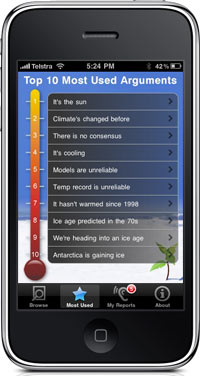
For smart phone users, the rebuttals to all the skeptic arguments are also available on a number of mobile platforms. The first Skeptical Science app was an iPhone app, released in February 2010. This is updated regularly with the latest content from the website and very accessible in a beautifully designed interface by Shine Technologies. Shine Tech then went on to create a similar Android app which has some extra features missing from the iPhone version. A Nokia app was also created by Jean-François Barsoum (this was one of the 10 finalists in the Calling All Innovators competition).
As well as the list of rebuttals, Skeptical Science also has a blog where the latest research and developments are examined and discussed. Comments are welcome and the level of discussion is of a fairly high quality thanks to a fairly strict Comments Policy. You need to register a user account to post comments. One thing many regulars are not aware of is you can edit your user account details (to get to this page, click on your username in the left margin).
Keep up to date by email, RSS, Facebook or Twitter
To keep up to date on latest additions to the website, sign up to receive new blog posts by email. There's an RSS feed for blog posts and for the engaged commenter, a feed for new user comments. I recommend you follow the Skeptical Science Twitter page as I not only tweet latest blog posts but also any other interesting climate links I happen upon throughout the day. New blog posts are also added to our Facebook page.
About John Cook
Lastly, for those wondering about who runs Skeptical Science, the website is maintained by John Cook. I studied physics at the University of Queensland but currently, I'm not a professional scientist - I run this website as a layman. People sometimes wonder why I spend so much time on this site and which group backs me. No group funds me. I receive no funding other than the occasional Paypal donations. As the lack of funding limits how much time I can spend developing the site, donations are appreciated.
My motivations are two-fold: as a parent, I care about the world my daughter will grow up in and as a Christian, I feel a strong obligation to the poor and vulnerable who are hardest hit by climate change. Of course these are very personal reasons - I'm sure everyone comes at this from different angles. I go more deeply into my motivations in Why I care about climate change.
The SkS Team
However, there are many more who make invaluable contributions to Skeptical Science. There are a number of authors who write blog posts and are currently in the process of writing all the rebuttals in plain English. Translators from all over the world have translated the rebuttals into 15 different languages. There have been contributors to the one-line responses to skeptic arguments, proofreaders, technical support from boffins who understand computers a lot better than myself and commenters whose feedback have helped improve and hone the website's content. Skeptical Science has evolved from a small blog into a community of intelligent, engaged people with a commitment to science and our climate.

Arguments


"We have found that polar bears actually survived the interglacial warming period, which was generally warmer than the current one," Lindqvist says, "but it's possible that Svalbard might have served as a refugium for bears, providing them with a habitat where they could survive. However, climate change now may be occurring at such an accelerated pace that we do not know if polar bears will be able to keep up." Ultimately, she notes, the polar bear species may prove less adaptive. "The polar bear may be more evolutionarily constrained because it is today very specialized; morphologically, physiologically, and behaviorally well-adapted to living on the edge of the Arctic ice, subsisting on a few species of seals," she says.
Ancient DNA from Rare Fossil Reveals that Polar Bears Evolved Recently and Adapted Quickly
Charlotte Lindqvist, Stephan Schuster, Yazhou Sun, Sandra Talbot, Ji Qi, Aakrosh Ratan, Lynn Tomsho, Lindsay Kasson, Eve Zeyl, Jon Aars, Webb Miller, Ólafur Ingólfsson, Lutz Bachmann, and Øystein Wiigd. Complete mitochondrial genome of a Pleistocene jawbone unveils the origin of polar bear. Proceedings of the National Academy of Sciences, Mar. 1, 2010
'Rubbish !', says the so-called skeptic, I believe what I want to believe...
How about humans? How do they benefit from increased human/bear interactions? You have to realize bears who raid garbage dumps near human settlements are also likely to be shot, which isn't very good for them either.
"That aside, temperatures were much warmer during the Eemian and the HCO for thousands of years."
Actually, there were no actual polar bears in the Eemian: they started to diverge from brown bears 150,000 years ago, but the real differentiation occured later, perhaps even as late as 20,000 years ago.
Also, temperatures weren't "much warmer" everywhere in the HCO (according to your map). What's to say polar bear populations didn't congregate to Northern Quebec, where it was actually colder, or Greenland and the Behring strait, which were as cold as today?
Overall temperatures may have been as high as 1C above the baseline, but we're already past the 0.5C mark, and likely to go above the highest estimates for the HCO before 2050.
Furthermore, not everyone agrees the HCO was warmer overall. Some studies claim only a 0.2 to 0.6 increase (which means we could have passed the HCO already), while others claim there was an actual decrease in SST at the time.
From the abstract of Tropical Pacific climate at the mid-Holocene and the Last Glacial Maximum simulated by a coupled ocean-atmosphere general circulation model:
"Simulations for the mid-Holocene (6000 years before present: 6 ka) and the Last Glacial Maximum (LGM: 21 ka) have been performed by a global ocean-atmosphere coupled general circulation model (GCM). After the initial spin-up periods, both runs were integrated for about 200 years. For 6 ka the model shows an enhanced seasonal variation in surface temperature and a northward shift of the African and the Indian summer monsoon rain area. Overall circulation features in the tropics correspond to a strong Walker circulation state with negative sea surface temperature (SST) and precipitation anomalies in the central Pacific and positive precipitation anomalies over the Indian and Australian monsoon regions. It is noted that there is about a 0.35°C cooling of the global mean SST."
(emphasis mine)
"Sorry ladies,"
Stay classy.
"this is one of the most egregious errors of the global warming campaign."
First, it's not a "campaign", it's science. Second, you have yet to make successfully make the case for any of your affirmations.
Careful, your bias is showing, and it's kind of ugly.
The white color of the polar bear is useful in its present habitat. This white color was developed because the survival rate of white variants was higher than of dark variants. If the bear has to change its habitat, it will adapt again, and probably lose its white color. This is simply how evolution works. It's the same as when humans migrate from Africa to Europe, as they did 50,000 years ago. They lost their black skin pigments, because in Europe their skin needed more intense UV-exposure to produce vitamin D than in Africa.
So what's wrong with adaptation of the polar bear? If it does not need its white color any more, so what?
The bear as a species is not threatened by climate change, but by human overpopulation.
Unlike in the Arctic, the Hudson Bay sea ice disappears completely during the summer. So entire subpopulations there are forced onto land. The good news is that the polar bears have evolved the ability to survive a summer long fast. The bad news is that in a warming world the time on shore is getting longer.
Ironically, when the multi-year ice becomes even thinner, there will be some new areas that the polar bears can move into. These are areas where the ice is now too thick for the seals to maintain their breathing holes.
fydijkstra @ 5:59Am.....The other evolved traits that make it the perfect maritime bear, work against it on land. Its big and slow. Its calorie requirements that are currently met by seals (an adult polar bear eats only the fat) can't be met on shore. And, most importantly, its the grizzly bears that win in fights with polar bears (if only the polar bears learned to use their nose butt...).
And how long did that earlier adaptation take? 50 generations, 100 generations, 1000 generations? This kind of evolution does not happen in the space of a few years or a few generations.
Nobody's suggesting that we should stand in the way of natural evolution. The kind of time scale our emissions are imposing is not conducive to natural evolution.
It's important to protect species for obvious reasons, but I keep saying that polar bears are the canary in the coal mine. They should be a sign to us that something serious is afoot.
ClimateWatcher (#6)... I would point out that what you are claiming here does not account for any further rise in temperature. By this chart you might not conclude that the HCO was warmer than today. But that placed aside, what we are looking at is a rise of another 2-3C in global average temps (more in high latitudes) in this century. As a species polar bears have very definitely never seen such conditions.
This appears to be an example of learned behaviour which is quite different from evolved behaviour (or evolved physical characteristics). So it's quite possible that the bears will learn to adapt to ice free summers where possible as they are intelligent long-lived animals. However this has absolutely nothing to do with evolution.
For some fresher Arctic paleo information, see
History of sea ice in the Arctic (Polyak et al, 2010)
and
Temperature and precipitation history of the Arctic (Miller et al, 2010)
Changing light bulbs (preferabley to LEDs) and driving hybrid/electric cars is just smart, regardless of the overwhelming amount of evidence supporting AGW theory. Oil is too valuable to use as fuel.
Plus, mass 'extinction' is perhaps a misnomer, as some events are marked by extinction rates dramatically elevated above background levels, while others are marked by dramatically reduced speciation rates. I think our double wammy of human encroachment and environmental change is causing both to occur at the same time.
I don't think those who fear the inability to adapt fully appreciate just how rapidly most species can adapt to new completely different environments.
Unless there is some special genetic makeup within the polar bear DNA that gives it an inability to adapt, it should be able to adapt as many other species have adapted in the past, and are still doing so, moving from one region to another transported over land or shipped by sea, or now days at times by air.
Is there any accumulated evidence where the polar bear has demonstrated a special inability to adapt to different climatic conditions or is it just supposition?
This seems to be a common misconception - that animals will simply adapt to climate change. Throughout Earth's history, there have been periods where climate has changed so abruptly, animals have not been able to adapt quickly enough. These periods are known as mass extinctions. In the Permian mass extinction, between 80–95% of all marine species went extinct. In the Triassic mass extinction, around 80% of all land quadrupeds went extinct. Virtually no large land animals survived the Cretaceous mass extinction 65 million years ago (this is famous for the demise of the dinosaurs). Our current period is being described as the 6th mass extinction in Earth's history.
the word adaptation is used both in the sense of evolutionary adaptation or of adaptive capacity of the individuals. The former is a very slow process, it is passed to offspring and it takes many generations for small gradual changes; fast reproduction and short lifecycle would be an advantage. The latter is much faster but it is not passed to offspring.
Polar bears cannot count on evolutionary adaptation, it's much too slow. Also, they are a very specilized and occupy a narrow ecological niche. Theese facts strongly limit their capability to adapt.
In any case it's a race with time, the faster the change the less the odds that a specie will survive a change. And don't forget that climate change adds to other stresses.
Changing climate also results in changing diseases and vulnerabilities to other changes, which are indirect issues.
eg. species of tree may be able survive a changed climate, but they may be susceptible to a disease that climate brings with it or other invasive species.
Polar bears have led a relatively isolated existence, warmer conditions may wipe them out because of a lack of immunity to invasive disease carried by other species that migrate into Polar bear territory.
Humans have a high track record of introducing invasive species that wipe out complete populations of native species. Climate change can do the same thing.
Apparently there's some sort of desperation to suggest that loss of habitat for polar bears is a neutral influence on their population, which seems unlikely.
Perhaps they should have an emblem of a polar pear playing hockey on lovely thick ice, with a big cheesy smile on its face. And a knowing wink - visible only to those who know the 'real' truth of AGW.
The polar bear is probably already committed, even with significant mitigation efforts. Who cares? After all, for most people, a polar bear is a fantastic creature most will never actually see in its natural habitat. It might as well be something from Tolkien's imagination. yet a flippant attitude toward this top predator (well, "top" doesn't mean anything, since bacteria etc. will eat the dead body of the bear) suggests a flippant attitude toward dying and rapidly expanding species that will (and are) having a direct impact on every day human life.
This warming is different--more akin to the rapid extinctions that punctuate the fossil record. It's not the pathetic, slow deaths of the woolly mammoth and sabretooth tiger. It's the discordant rapid loss and rapid expansion of habitat.
Even a simple throw of the dice would show that the odds are even that some species will benefit from warmer temperatures and some will suffer.
Another throw of the dice would show that photogenic cuddly species would be equally represented in the benefit or suffer stakes.
Is there any wildlife out there which humans like that will benefit from AGW?
The same situation has been seen in Afrika with Elephants and India with Tigers. Humans win the habitat war, so lets assume the bears migrate and adapt, they aren't going to compete with humans.
I take it you haven't heard about global warming impacts on mosquitoes or marmots.
Maybe some experts on Skeptical Science can help us novices understand what motivates objectors to relentlessly hold onto their positions in the face of solid scientific data and majority consensus.
What percentage of objectors know they are correct, what percentage are unsure, and what percentage know they are lying.
An objector may be novice or expert. A novice objector may be motivated by fear or ignorance; an expert by knowledge or greed. Novice objectors are too often shepherded by greedy objectors.
It is now 7:30 a.m., October 9, 2010 in central Illinois. The temperature is predicted to reach a balmy record high of 88°F today and 87°F tomorrow.
"What a wonderful weekend this is shaping up to be. If global warming is causing this gorgeous weather, should I be hating it? Should my hard-earned dollars be spent on fixing something that doesn't seem broken to me?"
These are not my words, but of many around me who clearly have different attitudes toward global warming.
How can Skeptical Science experts help to change these attitudes?
Well if "global warming" is responsible for a specific autumn weekends weather, why is it not be responsible for Katrina or the Lake Mead drought or floods in Pakistan ?
Attribution of any specific weather event to changes in climate is problematic (which is one reason why John Cooks favourite phrase "Climate trains the boxer, but weather throws the punches" is so apt - does the trainer know when the boxer will throw his next punch ?) but the suggestion might be that your wife is biased in attributing favourable events to AGW so that she can avoid thinking about the adverse affects.
By the time we could get the majority of the citizenry to demand action on CO2 emissions reductions, it will be too late to avoid all but the very worst of climate change's anticipated deleterious effects.
Even a PETM-like extinction may become unavoidable if BAU continues much beyond 2050.
The Yooper
Not all is gorgeous weather. See the recent examples here. And then look here for the new paradigm.
Let me play the devil's advocate for a moment. And please understand that the following scenario does not reflect my attitude toward global warming.
Maybe global warming did have something to do with Katrina or Lake Mead or Pakistan, but I wasn't there. People shouldn't be associating global warming with occasional high temperatures, rainfall, or droughts. What about the 11 straight days of record high temperatures in central Illinois back in the middle of July, 1936? Peoria, Illinois had some of its highest temperatures ever recorded, up to 113°F. Temperatures around here haven't exceeded 95°F in years. So did they have global warming 75 years ago too?
Yes, parts of the Midwest have had significant rain the past two years, and we've had equally wet seasons before. But we've now had almost no rain the past six weeks, and little is forecast for the coming weeks. Is global warming causing this too? I've seen much worse droughts than what we are heading into now.
I don't know anything about El Nino and La Nina, but experts say they are responsible for our changing climate conditions, not global warming. And there's nothing we can do about it.
I'm a Patriotic American, and I generally don't go around telling people that the government shouldn't be wasting my money or telling me what to do about something they know nothing about. But I've had enough.
Related to global warming, it is likely that for a long time to come, uninformed public attitude will carry much more clout than frantic scientific outcries.
You paint an interesting, albeit gloomy, picture.
"Maybe global warming did have something to do with __ or __ or __, but I wasn't there."
Does this person believe that the only things that happen are wherever he or she is? Nothing else matters? I wasn't at Pearl Harbor or Normandy or Hiroshima, but I believe they happened. (Rather than continue with the awkward 3rd person, I'll switch to 'you,' realizing that we're still talking about some hypothetical 3rd party).
"People shouldn't be associating global warming with occasional high temperatures, rainfall, or droughts."
Yeah, they should: If one frames the question slightly differently: "Would an event like the Moscow heat wave have occurred if carbon dioxide levels had remained at pre-industrial levels," the answer, Hansen asserts, is clear: "Almost certainly not."
The frequency of extreme warm anomalies increases disproportionately as global temperature rises. "Were global temperature not increasing, the chance of an extreme heat wave such as the one Moscow experienced, though not impossible, would be small," Hansen says.
"don't know anything about El Nino and La Nina, but experts say ..."
And you believe those experts, as opposed to the experts who say its a more global problem. Wouldn't it be sensible to check out for yourself what these experts are saying? Because if you don't, I wouldn't go out to buy a car if I were you.
"I'm a Patriotic American ... the government shouldn't be wasting my money or telling me what to do about something they know nothing about. But ..."
And isn't that the crux of the issue? A true patriot would be concerned with something larger than himself. The welfare of the country as a whole, perhaps? Or beyond? See this essay, from a Fox News personality no less, for some examples of the real concerns of a patriot.
We're in this mess because we've said 'I only care about what's happening to me' for far too long.
Maybe global warming did have something to do with Katrina or Lake Mead or Pakistan, but I wasn't there.
I chose these examples because it seems to me that they all have potential financial costs for the American economy. (The, perhaps rather fanciful, case for Pakistan is made here, for example)
However the idea that doing nothing results in a cost, is not an intuitive idea, and so I too am somewhat pessimistic about wholesale public acceptance of AGW. I think education, such as sites like SkS, can help - if only by a "trickle down" effect. (Personally, I think that some of the "robust" conversations with contrarians on this site, whilst well intentioned, often end up hardening their already entrenched, if illogical, positions and I have tried, unsuccessfully, to think of a better approach). Sadly, I think appeals to the future good (such as the excellent addendum to my previous post by Daniel) do not enthuse the public (especially in a fragile economy); Doug @45 is on stronger ground arguing the national and personal interest. Ultimately, and sadly, I think it will only be a big event (such as summer ice disappearing from the Arctic) that will grab the wider public's attention, and change peoples minds.
John Cook summarized another source of the problem here.
According to John's post, about three quarters of the news media and three quarters of the general public are not convinced or deny that humans are causing global warming. Since the numbers match so closely, I tend to think that public opinion is heavily influenced by the news media. News is just another part of our entertainment, so we tend to watch the type of news we agree with and enjoy. And if our newscasters are are not convinced or deny that humans are causing global warming, then it is likely that we are not convinced or deny that humans are causing global warming.
Another contributor to the problem, at least in the United States, is that We Don't Care about important national and world issues, but only those little things that make us happy and save us money.
I have been watching (lurking)on this site for some months now and it has really helped my understanding of the subjects. I am rather overwhelmed by the expertise of some of the people who post here. I hope that I am typical of a large number of people who just look and gain from the discussions.
The exposure to all the expert comment,has exposed the paucity of many arguments. I find it very regrettable the way some people post comments that seem to have no purpose than to obfuscate and to waste the time of others. I do really enjoy discussions where points of real uncertainty are brought up and thrown around. Science in action. I do not enjoy wading through refutations of tired old arguments that have long been comprehensively dismissed. Especially annoying are the plaintive requests to explain something which is thoroughly discussed elsewhere on the site. Pure time wasting.
Thank you John.
It would seem to me that the blog posts on this site comprise three types:
(1) The 'meat and potatoes' of the site: parsing and skeptically analysing the generic arguments posited by climate contrarians/skeptics
(2) Critical analysis of specific instances of (to borrow from Ben Goldacre) 'bad science' on the part of contrarians/skeptics (e.g. blog posts on WattsUpWithThat, or by Goddard or Nova, or posts describing takedowns of Monckton)
(3) New and interesting research in climate science
Is there a possibility of the other two categories of post getting their own meta-posts, with some sort of permanent link on one of the menu bars?
ECOS Climate Change Debate
It's definately worth a look; particularly the most recent post from Peter.
Dr. Wilson Flood from the Royal Society of Chemistry has joined the debate and contributed a link to interpretation of data from Meteosat that shows cooling in the Northern Hemisphere since 2001.
Meteosat data interpreted by Dutch meteorological analysts
What do you make of this? What could have caused this phenomenon?
As for yuor question, there's several things to note:
A 10-year old trend for HADCRUT3 NH data doesn't show a decrease, but a small increase:
The second is that 10 years is much too short to derive a statistically significant trend. Otherwise, you'd be able to say temperatures have risen by 2C/decade in the Norther hemisphere since 2008... (the short blue line above). That doesn't mean much. In climate science, the longer the data set, the more accurate the trends.
Finally, why only consider the NH hemisphere? The two hemispheres are part of the same system.
I could not find any usefull information following the EARS link you provide. They show a picture of the "Meteosat/MSG derived surface temperatures" between the 10 yearly periods 2000-2009 and 1983-1992.
The MSG satellite has on board just visible and IR spectrometers; I wonder how they extracted surface temperature from them.
Probably they used the GERB (Geostationary Earth Radiation Budget) instrument and measured the outgoing IR and claim that it's equivalent to temperature. It's not, of course, not even nearly so. This is what ESA says (emphasis mine):
"By measuring the Earth's radiation balance on a continuous basis across day and night, from a higher orbit than any comparable instrument, GERB is helping climate scientists measure the energy source driving the general circulation of the atmosphere and assess if Earth as a whole is indeed warming up. "
So, the satellite measures energy, not temperature, and not (only) from the ground. They awfully misunderstood (euphemism needed to stay in line with the comment policy :)) what's actually measured.
On the basis of this I could and will (if necessary) respond to Wilson Flood on the BANC website. However, I think it would be far more effective if you could post a response on the site if at all possible.
Wilson also says this:
"Carbon dioxide absorbs heat energy only at specific wavelength bands. Once all the energy at that wavelength band is absorbed adding more gas has no effect whatsoever. There is already enough carbon dioxide in the atmosphere such that all the energy at the centre of the band is absorbed."
I guess there's already evidence to refute this assertion somewhere on this site. If you're aware of it, I'd really appreciate a link to it or your take on it if possible.
Many many thanks for your responses.
David
mine was just a guess, you'd better ask how they evaluated temperature before giving my possible interpretation on what he (the Dutch meteorologist) did.
As for commenting there, well, there are hundreds of blogs around and no one can follow them all.
Dr. Wilson ended one of his comments (the very point where i didn't continue reading) with "Here endeth the first lesson."; he's not going to learn anything, anyway. And finally, each skeptic has his own view in contraddiction with others; untill there's no alternative theory it's impossible to follow them all.
For want of a better place to put this I came across yet another foolish individual who firmly believes that sunspot activity is responsible for the climatic changes and he even goes so far as to advocate doing nothing about temperature rising but more about temperature falling. The web item is at this location under the heading of GM (Genetic Modification) believe it or not:
http://canadafreepress.com/index.php/article/30098
Anyway if you can make some use of it then feel free to let me know. As for Tweeting responses or even tweeting I haven't got a clue so I am not even able to get started on that line of communication. Only just getting the hang of writing:) Yeah if you believe that you'll believe that climate change is a scam. But seriously this tweeting lark is beyond my skills.
Thanks for the resources. Got the app on my new android phone and it has already put a few folks straight within 24 hours of me having it. I recommended it to everyone with an Android or i phone
Ball ceased to have credibility long ago (geography professor gone emeritus, as they say). BTW, Barton Paul Levenson removed Ball's main thesis off the playing field 3 years ago with this post.
Mythago Wood...read that a long time ago. Any connection to you?
The Yooper
Are you doing anything to get this information out there? Are you the top link in google searches on these topics for example? I realise that it's easier said than done but I think promoting this website and it's content is very important





