



 Arguments







The Day After McLean
Posted on 29 March 2011 by dana1981

John McLean is a climate data analyst (but apparently not a very good one, as we'll see in this post) and member of the Australian Climate Science Coalition. He's a global warming "skeptic" who has co-authored a few peer-reviewed studies, including most notably being the lead author on McLean et al. (2009), which grossly overstates the influence of the El Niño Southern Oscillation (ENSO) on global temperatures. As John Cook has previously discussed, the McLean et al. attempt to blame global warming on ENSO suffered from a serious divergence problem.
Now McLean is continuing his exaggeration of the influence of natural oceanic cycles on global temperatures with a rather stunning prediction:
"it is likely that 2011 will be the coolest year since 1956 or even earlier"
When I read this prediction, I was floored (Skeptical Science authors can attest to the fact that my initial reaction included some colorful language). It's hard to overstate the magnitude of this prediction. As the saying goes, a picture is worth a thousand words:
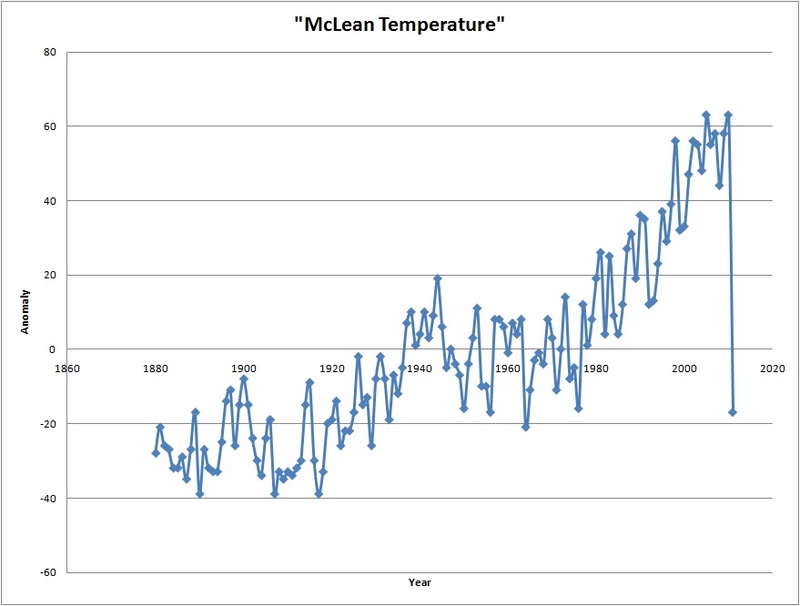
Figure 1: NASA GISS land-ocean anomalies, in hundredths of a degree Celsius (courtesy of MartinS)
Now that's a decline!
According to NASA GISS, the average land-ocean global temperature anomaly in 1956 was –0.17°C. Matching 1956 would require a 0.8°C drop from the average 2010 temperature. It's true that the current La Niña cycle is a strong one, but it's not that strong! There was an equally powerful La Niña cycle in the mid-1970s, for example:
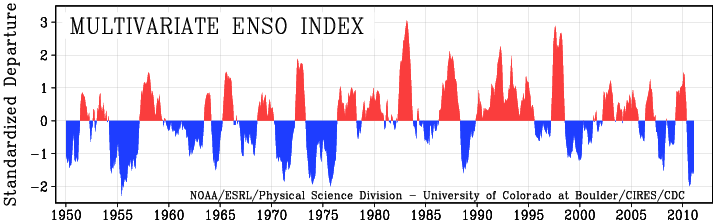
Figure 2: Multivariate ENSO index (Source: NOAA)
The largest year-to-year cooling in the mid-1970s was 0.22°C. The largest year-to-year average land-ocean global temperature change on record is 0.29°C. McLean is predicting at least a 0.8°C drop in temperatures from 2010 to 2011, which is 2.75 times larger than the previous largest year-to-year temperature change on record.
The first two months of 2011 are in the books, and not surprisingly, McLean's predictions are not looking good. According to NASA GISS, the average anomaly for January and February 2011 was 0.45°C. This means to cool to 1956 levels, the average anomaly over the last 10 months of 2011 must reach nearly –0.3°C. Average global temperatures haven't been that cold for an extended period of time since 1918.
This just goes to show how physically incorrect it is to blame global warming on these oceanic cycles; clearly doing so leads to some very, very wrong conclusions. However, if anybody would like to wager that McLean's 2011 temperature prediction is correct, there are a number of Skeptical Science authors who would love to take that bet!


 0
0  0
0 -- NOAA solar cycle
 --NOAA annual







Comments