





Carbon Dioxide - Everyone's Favorite Pollutant
Posted on 5 October 2010 by dana1981
Before assessing whether or not CO2 is a pollutant, we must first define the term.
What is an Air Pollutant?
The US Clean Air Act was incorporated into the United States Code of Federal Regulations, Title 42, Chapter 85. Its Title III, Section 7602(g) defines an air pollutant:
"The term “air pollutant” means any air pollution agent or combination of such agents, including any physical, chemical, biological, radioactive (including source material, special nuclear material, and byproduct material) substance or matter which is emitted into or otherwise enters the ambient air."
Clearly this is a very broad definition. More importantly, its Title 1, Part A, Section 7408 states that the US Environmental Protection Agency (EPA) Administrator must publish a list of certain air pollutants:
"emissions of which, in his judgment, cause or contribute to air pollution which may reasonably be anticipated to endanger public health or welfare"
In Massachusetts v. Environmental Protection Agency (in 2007), the US Supreme Court held that the Clean Air Act gives the EPA the authority to regulate tailpipe emissions of greenhouse gases. Two years after the Supreme Court ruling, in 2009 the EPA issued an endangerment finding concluding that
"greenhouse gases in the atmosphere may reasonably be anticipated both to endanger public health and to endanger public welfare....The major assessments by the U.S. Global Climate Research Program (USGCRP), the Intergovernmental Panel on Climate Change (IPCC), and the National Research Council (NRC) serve as the primary scientific basis supporting the Administrator’s endangerment finding."Greenhouse gases including CO2 unquestionably fit the Clean Air Act's broad definition of "air pollutants," and must be listed and regulated by the EPA if it can be determined that they endanger public heath and/or welfare.
"the addition of any substance (solid, liquid, or gas) or any form of energy (such as heat, sound, or radioactivity) to the environment at a rate faster than it can be dispersed, diluted, decomposed, recycled, or stored in some harmless form."
Is Increasing CO2 Dangerous or Harmless?
Humans are Increasing Atmospheric CO2 Concentrations
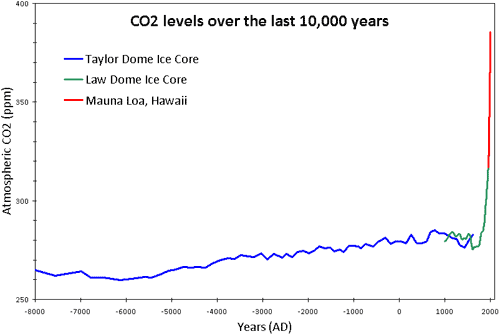
Figure 1: CO2 levels (parts per million) over the past 10,000 years. Blue line from Taylor Dome ice cores (NOAA). Green line from Law Dome ice core (CDIAC). Red line from direct measurements at Mauna Loa, Hawaii (NOAA).
We know that the increase in atmospheric CO2 is anthropogenic from a number of lines of evidence. Atmospheric oxygen is decreasing at approximately the same rate as the atmospheric CO2 increase, which tells us that the source of the change is from a release of carbon combining with atmospheric oxygen rather than a natural release of CO2. We also know that the 30 billion tonnes of CO2 released by human activity must go somewhere, and in fact atmospheric CO2 is only increasing by about 16 billion tonnes per year (the rest is going into the oceans). CO2 produced from burning fossil fuels or burning forests also has quite a different isotopic composition from CO2 in the atmosphere, because plants have a preference for the lighter isotopes (12C vs. 13C); thus they have lower 13C/12C ratios. And indeed we've observed this ratio decline in the atmosphere.
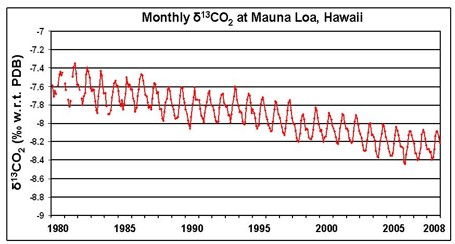
Figure 2: Atmospheric 13C ratio as measured at Mauna Loa (CDIAC)
The Increasing CO2 is Causing Global Warming
Thus we know that human emissions are increasing the amount of CO2 in the atmosphere, which as a greenhouse gas, in turn increases the greenhouse effect. This increases the amount of energy (in the form of longwave infrared radiation) reaching the Earth's surface. We've observed this increase through spectroscopy, which measures changes in the electromagnetic spectrum. Climate scientists have also quantified the amount of warming we expect to see from the energy imbalance caused by this increased downward radiation, and it matches well with observations. Given the amount of CO2 humans have added to the atmosphere already, once the planet reaches a new equilibrium state, it will have warmed approximately 1.4°C from pre-industrial levels. Additionally, we have observed numerous key 'fingerprints' of anthropogenic global warming which confirm that the warming we've experienced is due to an increased greenhouse effect.
How Much Warming is Dangerous?
There are some positive effects of global warming from increased CO2 emissions. For example, improved agriculture at high latitudes and increased vegetation growth in some circumstances. However, the negatives will far outweigh the positives. Coast-bound communities are threatened by rising sea levels. Melting glaciers threaten the water supplies of hundreds of millions. Species are already becoming extinct at a rate 100 to 1000 times higher than the “background” rate of long spans of geological time, partially due to the effects of global warming and climate change.
Quantifying exactly at what point global warming will become dangerous is a difficult task. However, based on the research and recommendations of climate scientists, more than 100 countries have adopted a global warming limit of 2°C or below (relative to pre-industrial levels) as a guiding principle for mitigation efforts to reduce climate change risks, impacts, and damages. This 2°C warming level is considered the "danger limit". During the last interglacial period when the average global temperature was approximately 2°C hotter than today, sea levels were 6.6 to 9.4 meters higher than current sea levels. Large parts of the Antarctic and Greenland ice sheets melted, with the southern part of Greenland having little or no ice.
As discussed above, the CO2 we've already emitted has committed us to about 1.4°C warming above pre-industrial levels. Given a climate sensitivity to a doubling of atmospheric CO2 of 2-4.5°C and the fact that on our current path we're headed for a CO2 doubling by mid-to-late 21st century, we're fast-approaching the danger limit.
How Soon Will we Reach Dangerous Warming?
Meinshausen et al. (2009) found that if we limit cumulative CO2 emissions from 2000-2050 to 1,000 Gt (approximately an 80% cut in global emissions), there is a 25% probability of warming exceeding the 2°C limit, and 1,440 Gt CO2 over that period (an 80% cut in developed country emissions) yields a 50% chance of 2°C warming by the year 2100. If we maintain current emissions levels, there is an approximately 67% chance that we will exceed 2°C warming by 2100.
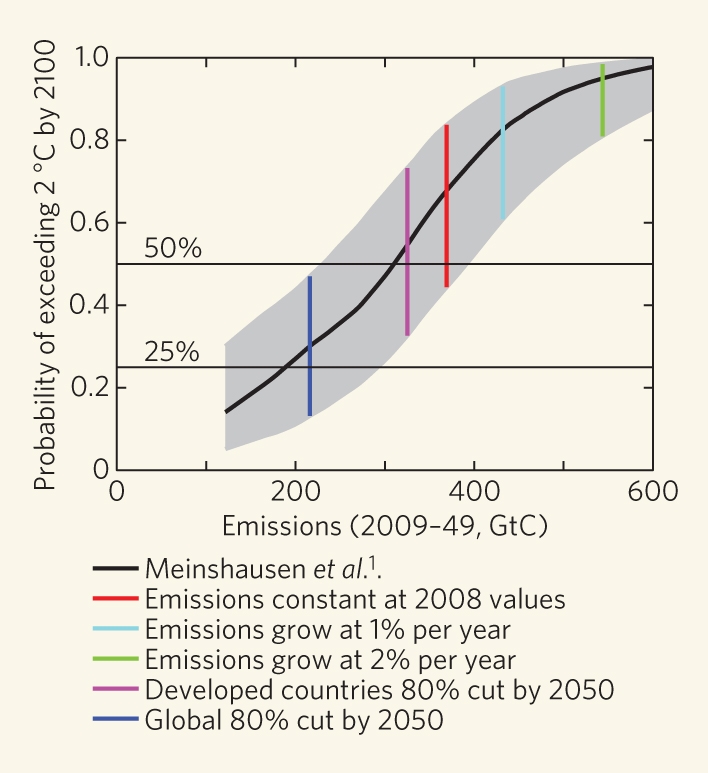
Figure 3: Probability of exceeding 2°C warming by 2100 in various emissions scenarios in gigatonnes of carbon (RealClimate)
In short, to avoid the amount of global warming which is considered dangerous based on our understanding of the climate and empirical evidence, we need to achieve major reductions in global CO2 emissions in the next 40 years. Thus it becomes quite clear that not only is CO2 a pollutant, but it also poses a risk to public health and welfare.
Ocean Acidification
Another impact of increasing atmospheric CO2 emissions is ocean acidification. When CO2 dissolves in seawater, it increases the hydrogen ion concentration though the chemical reaction CO2 + CO32- + H2O → 2HCO3-, thus decreasing the pH of the oceans (NOAA 2008). Among other impacts, this decreasing oceanic pH has a damaging effect on corals, which form the habitat of approximately 25% of marine species (Karleskint et al. 2009). A seminal study co-authored by 17 marine scientists (Hoegh-Guldberg et al. 2007) found:
"Many experimental studies have shown that a doubling of pre-industrial [CO2]atm to 560 ppm decreases coral calcification and growth by up to 40% through the inhibition of aragonite formation (the principal crystalline form of calcium carbonate deposited in coral skeletons) as carbonate-ion concentrations decrease"
Thus not only does anthropogenic CO2 act as a dangerous pollutant due to its impacts on global warming and climate change, but it also has a major effect on marine ecosystems through ocean acidification.
CO2 is a Pollutant
When considering the legal definition of "air pollutants" and body of scientific evidence, it becomes clear that CO2 meets the definition and poses a significant threat to public health and welfare.
This post is the Advanced version (written by Dana Nuccitelli [dana1981]) of the skeptic argument "CO2 is not a pollutant".

Arguments


Where is the causal link between lead in gasoline and a specific injury to children?
Come on, lead is known to be toxic since antiquity.
That is not what oil companies said. Lead was used in gasoline from 1923 until 1996 in the USA. Laws were started in 1973 (in the USA) to deter lead use, but lead was not banned until 1996. Lead is still used in gas in many countries- tell them lead is a known pollutant.
If you don't like the lead argument try freon. The problem with the ozone layer was theoretical until after the agreement to ban freon was signed.
In any case, the problem is your defination of pollution, see Coal Geologists post #149.
As to your concerns about legal attribution of pollution to polluters, given the known emissions from anthropogenic CO2, assigning CO2 pollution to those emitters is extremely simple - much simpler than dividing costs/fees/taxes/etc., mind you. But it's extremely easy to establish those causal links. Simple accounting of how much coal/oil/natural gas is burned in a power plant, of the CO2 emitted by concrete manufacture based on total amount of concrete, etc etc.
As to who is being harmed? Well, all of us, quite frankly. Your argument reminded of the tobacco industries attempts to deny responsibility for cancer, since any one particular case couldn't be directly attributed to a singular cause - that didn't hold up in the end, as the statistical data demonstrated that they were responsible for the majority of those who suffered.
Societal damage and significant impacts on groups are perfectly reasonable to attribute - even if individual cases can't be causally linked, if you can determine that 80% of the suffering are suffering due to pollution, that's attribution.
That's a rather odd comment. You are aware that the EPA has done a rather comprehensive review of the scientific information available, and responded to submissions? So the anti-scientific assertion seems to be incorrect.
The EPA is going to regulate carbon dioxide as a pollutant. 'Skeptics' say they can't because it isn't a pollutant under 'definition XYZ'. However, by the definition of the term in the legal documents binding EPA action carbon dioxide IS a pollutant. So this redefinition nonsense is just a shell game. The relevant definition for the EPA is the definition in the law. That should be obvious.
So why do skeptics continue to make an argument that is obviously wrong?
More of your "anti-scientific" nonsense, I see.
The Yooper
Reality check on "anti-scientific nonsense":
Endangerment and Cause or Contribute Findings for Greenhouse Gases under the Clean Air Act (PDF) (52 pp, 308K)
Technical Support Document for the Findings (PDF) (210 pp, 2.5MB)
Beyond its immediate findings, EPA bent over backwards to entertain a vast number of comments and criticisms. I'm willing to bet the word "nonsense" may be found in the compilation of this interaction but more to the point, lots of people devoted more effort than launching a single adjective to attacking the regulation of C02 by EPA, only to be found less than compelling.
There are 11 volumes of comments and responses in all, but the key discussions from the perspective of vistors to this site are probably mostly to be found here:
Volume 1: General Approach to the Science and Other Technical Issues
Volume 2: Validity of Observed and Measured Data
Volume 3: Attribution of Observed Climate Change
Volume 4: Validity of Future Projections
Volume 9: Endangerment Finding
However, by the definition of the term in the legal documents binding EPA action carbon dioxide IS a pollutant.
That particular legal definition found in documents binding EPA is valid for the US of A, especially after that silly Supreme Court decision. However, the last time I've checked US jurisdiction was not extended beyond the internationally recognized borders of said entity yet.
So please let the rest of us take our liberty to keep impugning if it is expedient to include carbon dioxide under the same umbrella term as other substances where the connection between polluter and individuals suffering actual damage from said pollution is immediate and undeniable.
The legal path taken by the US of A leads to preposterous cases like Comer v. Murphy Oil.
So...your position is that you object to the world's biggest emitter of greenhouses gases is finally trying to clean up its act?
Pretty contorted logic.
The Yooper
That's why I believe that carbon taxes or cap/trade efforts are far more appropriate. There are definite costs involved in agricultural zone shifts, sea level rise, pest migrations (the beetle infestations in Western USA, for example), precipitation changes, etc., and extracting those costs from ALL contributors is really the only fair way to approach the issue.
In terms of legal attribution, did you read my post on the subject? In the USA at least, there is significant precedent under the Tobacco Master Settlement Agreement for recouping those costs, including attribution of social and statistical harms and costs to the population.
One-to-one attribution and liability is not always appropriate - an individual cancer case, for example, might be genetic or due to environmental toxins. But if the statistics show that the majority of cases are due to environmental problems, that is attribution on a group scale. This is what we're dealing with in regards to climate change.
CO2 is accumulating faster than it can be dispersed/absorbed without harmful effects. Sounds like pollution to me, and I would suggest to anyone without an interest in redefining terms.
Barring that this is pure semantic flim flammery. BP wants a definition of 'pollutant' where the damage is "immediate and undeniable" (though I think we've seen that some people will deny ANYTHING). Fine. BP likes that definition of 'pollutant' - which just happens to exclude CO2 since he denies the damage it causes. However, any remotely reasonable person must acknowledge that different people sometimes have different concepts in mind when using the same word. In this case it is very clear that others (like say... the Encyclopedia Brittanica, the Oxford English Dictionary, and the US Government) have different definitions of the word, which would include CO2.
Without a specific frame of reference (e.g. 'for purposes of EPA action') arguing over which definition is 'correct' is completely meaningless.
In terms of legal attribution, did you read my post on the subject?
Yes. But you still don't get my point.
Consider for example the Doñana National Park mass-pollution in Southern Spain, committed by Canadian-Swedish owned Boliden Mineral AB on April 25, 1998. Cleanup cost $270 million so far (taxpayer's money of course), company payed nothing, filed for bankruptcy to avoid a meager $45 million fine.
Cases like this abound.
The only reasonable way to make those responsible pay full cost of reparations is to impose a compulsory liability insurance policy by law on companies trading in a business prone to wreck havoc on the public.
However, the fuzzy attribution scheme you are advocating makes rational calculations impossible for insurance companies, therefore they'd refrain from getting involved.
Also, as long as a major power like the US keeps sticking to this legal madness, in this gravely demodularized world it's quite impossible to implement the concept in international law (by a multilateral treaty of course). In absence of such an agreement each state unilaterally introducing these measures only forces companies to move out to countries where they are still allowed to harvest public money.
This scheme would have the additional benefit of lifting most of the supervision burden off of government bureaucracies (making them way cheaper for taxpayers and less prone to corruption), since it would be the prime interest of insurance companies to do a full audit then keep monitoring sites like toxic sludge dams for their safety while providing liability insurance.
Unfortunately it does not work if anyone can be held liable for anything - even if individual cases can't be causally linked to it.
As to apportioning tax liability - we know exactly how much CO2 industries and power generation put out.
But this (social structures for imposing costs on polluters) is a bit off-topic. This thread is about the classification of CO2 as a pollutant, in reference to the US, and here CO2 legally falls under EPA guidelines by the very definition of "pollution" under US laws. Regardless of monied interests attempts to redefine terms.
You are focusing on acute incidents of pollution to the exclusion of chronic pollution and claiming that chronic pollution does not exist.
What insurance company will cover the general health care expenses of a person who smokes two packs of cigarettes a day?
taxes can be applied continuously as the damage occurs
Fine. How would you spend the money collected this way?
* Alternative energy (e.g. solar, novel fusion) R&D
* Subsidizing the implementation of alternative energy generation, both residential & industrial
* Rebuilding the electric grids to be capable of handling the mass-distributed generation that the previous point will lead to
* etc...
Back on topic, a pollutant does not cease being such when its release becomes continuous rather than a tragic incident.
- Development/conversion to renewable and carbon-neutral power generation (wind/solar/nuclear, fusion research) [primary expenditure].
- Infrastructure, such as the proposed US East Coast power backbone, making variable supplies such as wind/solar manageable by incorporating spread sites over large areas.
- Agricultural subsidies to aid in zone change and pest/invasive species issues.
- Conservation work on habitats affected.
A major motivation for such taxes, however, would be to penalize CO2 emission, providing an economic incentive for current power companies and industries to individually (i.e., not by state-directed mandates or methods) transition away from CO2 heavy methods, and over to profitable alternatives.
Why not give it to those who are supposed to be harmed?
Unless you think preventing a meter of sea rise over the next century or so, increasing numbers of record heat waves (recall Europe 2003 - 40,000 dead? 2006?), agricultural disruption, etc., isn't worth anything???
This is exactly the (correct) reasoning behind the Clean Air Act and other anti-pollution measures. Prevention of harm is worth a huge amount.
This site specializes in, and focuses on, issues of science. Although the definition of "air pollutant" we've been discussing is admittedly a legal one, there are relevant scientific issues related to it, which I feel we have largely resolved through dialog. Questions related to response and remediation are much more complex and difficult and, to my understanding, are outside the domain of this site... or at least this specific topic.
I would only add that although the underlying scientific theory of AGW has been around since ca. 1895 (Arrhenius), the hard data to prove it has been available only within the past 10-15 years. During the intervening time, the fossil energy industry has contributed substantially to improvement in the quality and longevity of life for billions of people. Admittedly, there have been negative consequences that have come along with this, some of them unforeseen, and certainly unintended. AGW is a problem we jointly face as a human population, as is the issue of energy supply. "Pointing fingers" will only complicate efforts to find solutions.
How easy it is to find the odd example that gives you what you want, if you are so pre-disposed.
How easy it is to find more examples, and ignore them if needed, if they don't give you what you want :
Bhopal - Union Carbide paid $470 million
Gulf Oil Spill - BP covering the costs
Love Canal - Oxy paid $129 million
Minamata Bay - Chisso paid $80 million
Abidjan - Trafigura paid $198 million
Ok Tedi - BHP paid $28.6 million
Exxon Valdez - Exxon paid $2.1 billion
Fossil fuel has given us a lot, as you point out; I don't think it's unreasonable to deal with the consequences of what we've gained.
As many have noted, however, the semantic games regarding "pollutant" are quite silly - the US legal definition is clear, and it would require a rather impressive re-definition of terms to change that.
Unfortunately, that's exactly what we seem incapable of dealing with as a society. An economy fueled by generations of relatively cheap energy, with no thought of the cost of disposing of the waste product -- CO2. And now we have an industry dedicated to labeling any form of cost recovery as a "carbon tax" and thereby destroying it.
Exactly the same mindset that allowed dumping of medical waste in the oceans until Title 3 was law - in 1991; exactly the same EPA doing the regulating.
Prevention of harm is worth a huge amount.
Indeed. If there's harm done it is. But the money belongs to those who have suffered and it is surely not government sponsored projects that are exposed to loss of life, health and property.
So as well as refusing to accept the bulk of scientific evidence that CO2 is causing global warming and has the potential to gravely harm the infrastructure of civilisation ...
You imply that chronic pollution is not a valid form of pollution, and that only acute incidents should be considered.
And that government should have no role in the provision of infrastructure.
What an absurd set of positions!
Arguing against a solution does not invalidate the problem.
The effects of ocean acidification, on the other hand, is another story altogether, since the effect is cumulative, the oceans acting as a "finite" and fragile terminus. CO2 is upsetting the food chain, and thus affecting all life on planet Earth negatively. This fact should be sufficient to qualify CO2 as a pollutant, but instead the emphasis is place on its effects as a "greenhouse gas", which may or may not ultimately lead to warming or undesired results (i.e., ice free shipping lanes in the Artic have been sought by some for centuries).
In addition, CO2 as a "pollutant" in virtue of its greenhouse gas effects is extremely vulnerable in that support of this idea depends on observable changes in climate. All it takes is for one significant radiative forcing to offset warming for public opinion to be lost altogether, (i.e. increased aerosols, etc), whereas the oceans will never stop absorbing the fallout.
The point here is that CO2 should not be considered pollution for its potential greenhouse gas effects, unless the same should be done for asphalt highways given that they are also warming the Earth in permanent fashion. However, as the chemical effects of CO2 on the environment are becoming a problem, then, yes, CO2 could be considered a pollutant.
However, as I stated in earlier posts, there is a very sticky problem in terms of CO2 sources, as they can be natural or "unnatural", and thus it makes more sense to legislate the use of chemical sources as opposed to their byproducts.
You imply that chronic pollution is not a valid form of pollution, and that only acute incidents should be considered.
And that government should have no role in the provision of infrastructure.
What an absurd set of positions!
If CO2, although non-toxic, is supposed to be harmful in some intricate way, putting a price tag on emissions is a possibility.
As KR #170 puts it "A major motivation for such taxes, however, would be to penalize CO2 emission, providing an economic incentive for current power companies and industries to individually (i.e., not by state-directed mandates or methods) transition away from CO2 heavy methods, and over to profitable alternatives.
The shift in costs alone should be enough to provide an incentive. But having accomplished that much, there is no legitimate justification whatsoever for governments to keep the money and use it for inflating bureaucratic power structures through sponsoring pet projects with public money. Government is seldom wiser than the people in allocating resources, therefore carbon taxes should be fully refunded, let's say through VAT allowance.
But this solution still lacks conceptual clarity, for two reasons.
First if taxation is based on the theory CO2 is a pollutant the general message is that anyone who can afford it, is free to pollute the environment. A detrimental message, especially because there are actual pollutants causing immediate harm, but still released into the environment unabated because it's much cheaper to pay the fine than to control emissions.
The second reason is even more serious. There are legitimate, even natural sources of carbon dioxide emissions, in fact life on Earth as we know it would cease to exist as soon as one would succeed in stopping all emissions. Therefore the theory goes on differentiating between natural and anthropogenic sources. However, at the point of emission no such difference exists. The CO2 we exhale (up to 300 kg/person annually) is produced by oxidizing food while the food production and distribution chain involves massive use of energy generated by burning carbon-based fuels reclaimed from the Earth's crust.
Of course one could attempt to make wearing gas masks obligatory in order to be able to measure this particular source of emission and tax it accordingly, but I don't think any politician who would go for such a move could keep his office for long.
This is a general problem with CO2 emission control. There are so many points and ways of emission, that controlling them all is both exceedingly expensive and quite impossible with no infringement on private life. The alternate solution is of course to go only for large scale industrial emitters, for even if all emissions are equal, but some must be more equal than others.
You can surely see what a mess it is. I tell you anyone who maintains only recycling of carbon withdrawn long ago from the carbon cycle by age old geological processes poses public danger, should go for regulation targeting this very step, not emissions.
Cap and trade is a preposterous bubble scheme and it is used exactly that way.
Therefore if some market intervention is supposed to be necessary in order to reduce digging up carbon, the only rational way is to increase mining fees, refund the excess government income to everyone immediately through tax reduction and let people decide how to spend it.
But it can't be done based on the theory CO2 is a pollutant, because in case of real pollutants it is the emission that should be regulated (as opposed to simply taxed) and rightly so. On the other hand with carbon dioxide, as we have seen, it is not the case. Here a separate set of rules and regulations should be applied which is practicable only if CO2 is assigned to a different category under public nuisances, other than pollutants.
It is still rather difficult to negotiate a proper price to carbon mining. In theory it should be equal to all the environmental costs its use imposes on the public (even if actual pollutants like soot or sulfur are handled separately by emission control). Unfortunately the science is surely not settled enough to make such a rational calculation possible, so it would be a political decision anyway. But at least it's not a move toward even more concentration of power and away from common sense as present day pseudo-solutions are.
Yes, I agree.
BP continues: But having accomplished that much, there is no legitimate justification whatsoever for governments to keep the money and use it for inflating bureaucratic power structures through sponsoring pet projects with public money. Government is seldom wiser than the people in allocating resources, therefore carbon taxes should be fully refunded, let's say through VAT allowance.
That's a purely subjective political preference. There's nothing inherently wrong with, say, taxing carbon and using the money to support health care or the military-industrial complex or whatever. That said, I happen to agree that the best option would be to refund effectively 100% of the revenue from a carbon tax to individuals (on a per capita basis). But I try to avoid saying things like "there is no legitimate justification whatsoever" for subjective policy preferences that happen to differ from my own.
BP continues: [I]f taxation is based on the theory CO2 is a pollutant the general message is that anyone who can afford it, is free to pollute the environment. A detrimental message, especially because there are actual pollutants causing immediate harm, but still released into the environment unabated because it's much cheaper to pay the fine than to control emissions.
Different pollutants have different impacts. There are some cases where essentially no release into the environment is acceptable. At the opposite extreme, in other cases (CO2, SO2, agricultural fertilizers, etc.) the total elimination of anthropogenic fluxes into the environment is neither necessary nor cost-effective ... but limiting the magnitude of the flux is necessary (to prevent AGW, acid rain, harmful algae blooms, etc.)
Two methods for doing this are (1) directly regulating emissions, or (2) using taxes or other incentives to keep emissions low. It's true that (2) will "allow anyone who can afford it to continue to pollute the environment", while (1) is more "democratic". On the other hand, given your dislike for "big government" I would think you would prefer option (2), which doesn't involve governments making decisions about who can emit how much for what purpose.
BP: The second reason is even more serious. There are legitimate, even natural sources of carbon dioxide emissions, in fact life on Earth as we know it would cease to exist as soon as one would succeed in stopping all emissions. Therefore the theory goes on differentiating between natural and anthropogenic sources. However, at the point of emission no such difference exists. [...] Of course one could attempt to make wearing gas masks obligatory in order to be able to measure this particular source of emission and tax it accordingly, but I don't think any politician who would go for such a move could keep his office for long.
Please don't waste our time with stuff like that. Talk about forcing people to wear gas masks, stopping all non-fossil-fuel emissions, and ending life on earth just degrades the quality of the discussion. You would be much better off if you made a bit more effort to resist the inclination to set up and defeat absurd straw-man arguments that no actual person supports.
BP then returns to the sphere of the reasonable, by suggesting that the appropriate way to impose a cost on fossil fuel emissions is by a tax on mining (coupled with his ideologically preferred redistribution of the resulting revenue to everyone). This is fine, and could have been usefully expressed without all the preceding baggage.
Unfortunately, BP then goes on to conclude with But it can't be done based on the theory CO2 is a pollutant, because in case of real pollutants it is the emission that should be regulated (as opposed to simply taxed) and rightly so. [... For CO2,] a separate set of rules and regulations should be applied which is practicable only if CO2 is assigned to a different category under public nuisances, other than pollutants.
This is purely circular reasoning. You've created a definition of "real pollutant" that essentially translates to "things that behave a certain way different from CO2" and then conclude that CO2 isn't a pollutant.
However, many people on this site, and many national and international organizations, don't agree with your strictly limited definition of "pollutant".
CO2 *is* toxic, though not at the concentrations we're talking about.
CO2 meets the legal criteria to be a pollutant.
CO2 *is* toxic, though not at the concentrations we're talking about
That's the point. Table salt is also toxic. Just try to consume a pound of it. Meets the legal criteria to be a pollutant, therefore it's high time to reintroduce a salt tax.
Everything is non-toxic below a threshold value.
I have to disagree that a policy of punitive, redistributive taxation is better than ameliorating the issue.
The government is the people. Please spare us at this site from your ideological rants, including Animal Farm references.
Rather than rambling about natural sources & breathing (OMG, gas masks!), try sticking to the topic of net anthropogenic emissions. The sophistry of "no qualitative difference exists between the CO2 from natural emissions and anthropogenic emissions" also does not further the discussion.
Do volcanoes emit more CO2 than humans? (argument #59)
Does breathing contribute to CO2 buildup in the atmosphere? (argument #105)
Declaring that the science "is not settled enough" does not cause the science that is presented to you to disappear. The person who dismisses the accumulated scientific knowledge in favor of a political decision is the one politicizing an issue.
"Government is seldom wiser than the people"
Do you have empirical value to support this assertion?
First, you owe people an answer to my question about your position on Goddard cherry-picking global SL data. Second, you are really scraping the barrel with your reference to salt.
One does not have to consume even close to a pound of salt in order for it to be harmful. For this very reason, physicians, agencies and governments around the world regulate the amount of salt present in prepared foods. For example, read the position of the FDA here.
Similarly, we need to regulate the emissions of CO2 to keep it at safe levels. In order to do so, the EPA is required to classify CO2 as a pollutant. The "skeptics" have had ample opportunity to present their case, the EPA patiently and thoroughly addressed each and every one of their concerns. They failed, just as you and your fellow "skeptics" are failing to make a coherent and compelling argument now.
You've done nothing to demonstrate that your position is not absurd on this issue. The more time goes on the less value your posts seem to have here, apart from exposing your sceptic position as politically motivated, not based on evidence and subject to an awful lot of confirmation bias. But even then, the more scientific stuff you've been doing lately is awfully shallow too.
It is too bad. BP used to make insightful comments.
"emissions of which, in his judgment, cause or contribute to air pollution which may reasonably be anticipated to endanger public health or welfare"
the current c02 level is about 380 ppm give or take, co2 itself is not hazardous to human health until 5000-10000 ppm, is it reasonable to expect co2 levels to rise that much?
given that the definition of pollutant was so broad that it includes pretty much everything, including things that are already in the atmosphere.
you could say then that water vapour is a pollutant and a far more prolific one as it makes up 90% of our atmosphere, if it is considered a pollutant, why is there only emphasis on c02 as a pollutant, i wont answer that because my comment will be deleted, but it ends in ganda. the idea that c02 can be considered a pollutant is a dangerous one i wont say why its something you all need to think about. btw look up the un document my global neighbourhood it was written in 1984 and has some striking similarities both to what we are discussing and to what is going on in the world today
Let me highlight the bits you missed/wanted to ignore :
greenhouse gases in the atmosphere may reasonably be anticipated both to endanger public health and to endanger public welfare....The major assessments by the U.S. Global Climate Research Program (USGCRP), the Intergovernmental Panel on Climate Change (IPCC), and the National Research Council (NRC) serve as the primary scientific basis supporting the Administrator’s endangerment finding."
Now, you probably don't want to accept that because of the mention of the IPCC bogeyman, but that's your problem. Facts are facts, whether you like them or not.
"[Pollution] :...the addition of any substance (solid, liquid, or gas) or any form of energy (such as heat, sound, or radioactivity) to the environment at a rate faster than it can be dispersed, diluted, decomposed, recycled, or stored in some harmless form."
You seem to accept that the levels of CO2 have increased/are increasing, so you have to accept the above definition unless you want to appear incoherent...or have your own definition of pollution.
Your thoughts on water vapour are desperate, so perhaps you should read more about it here. You won't, though, will you ?
Basically, as usual, you need to read more here and here.
but ok, i've looked for the actual study and i cant find it so i'll give a link to a video in which the participants explain or w/e
http://www.youtube.com/watch?v=zS0SWVIRaZ8&p=4874B5A951DA8DA4&index=5&playnext=5
i'm sure you have read sustainable development
Mass migrations due to climate change will certainly cause problems with national borders and private property issues.
"DSL now to me you just sound like a globalist"
And you sound like a troll.
@tj: I did explain. If we end up with forced mass migrations, it's going to be a lot more complicated today (because of borders, private property laws and civilization in general) than it would have been 10,000 years ago when people could migrate more freely.





