A Swift Kick in the Ice
Posted on 19 February 2011 by Rob Honeycutt
Commenting in the trenches of the climate change blogosphere I find a large number of people who lack very basic understanding about Arctic Ice. While I'm not an expert in the field I have managed to learn a few things with regards to why Arctic ice is an important issue. There are a few misconceptions that require a "swift kick in the ice."
When learning about these issues myself I came upon a question that I could not immediately answer. We know that water vapor is a strong greenhouse gas. We know that warmer air holds more moisture than cold air, in fact, to the point where the Antarctic is one of the driest deserts on the planet. So, how does this jibe with the idea of polar amplification, the idea that the poles will warm faster than the rest of the planet on average? The climate models tell us that the poles will warm faster, and the model results are proving true now. Why would the poles warm faster if there is so little water vapor in the air?
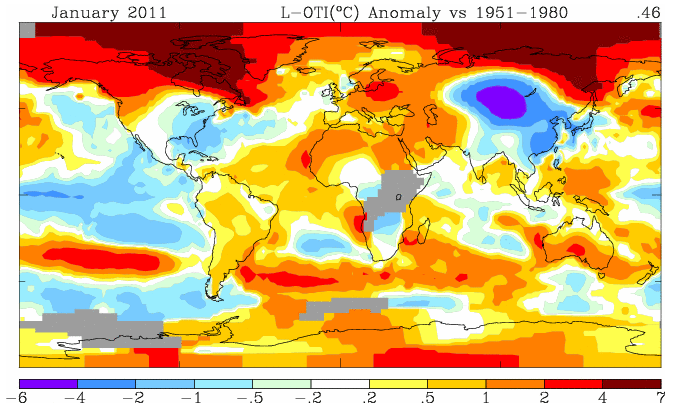
Fig 1 - Surface Temperature Map for Jan 2011 (Source: GISS)
The first answer comes by way of looking at a surface temperature map (Fig 1). What we find is that the north and south poles are not warming equally. In fact, the term "polar amplification" is better described by saying "Arctic amplification." If we look out to the end of the century there is anticipated to be amplification in the south as well but most of the warming will take place in the north.
But that still leaves us with, why? The Arctic gets cold too, therefore is drier than the equator. Why would the equator not warm faster?
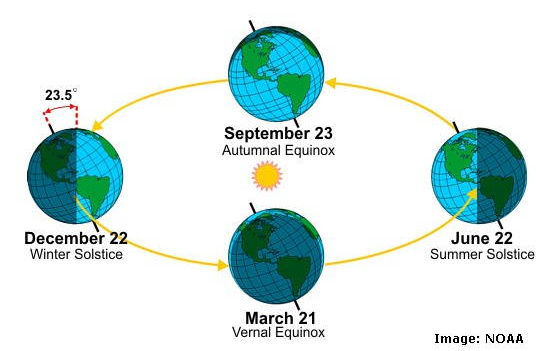
Fig 2 - Orbital tilt through the year
Pretty much everyone knows that these basic very important facts about the north pole:
- The ice at the pole is covering the Arctic ocean. It's sea ice.
- Both poles are mostly dark half the year and mostly light half the year.
These two very basic aspects of the Arctic make it special in terms of climate change form the reason why Arctic Amplification is happens and is so important.
Each year the ice of the Arctic thaws back to a minimum extent during the late summer, usually some time in September. Then it freezes back each winter. This is obviously because summer months are warmer and winter months are colder.
The Battle of Albedo
Now I'll beat you up with the concept of "albedo." Albedo is the effect where light colored surfaces reflect light and dark colored surfaces absorb light. Think of it as white pavement or black pavement. Black pavement is always going to scorch your bare feet more than white pavement in the noontime sun. Dark surfaces absorb more heat from the sun. Light surfaces reflect more light away and absorb less heat.
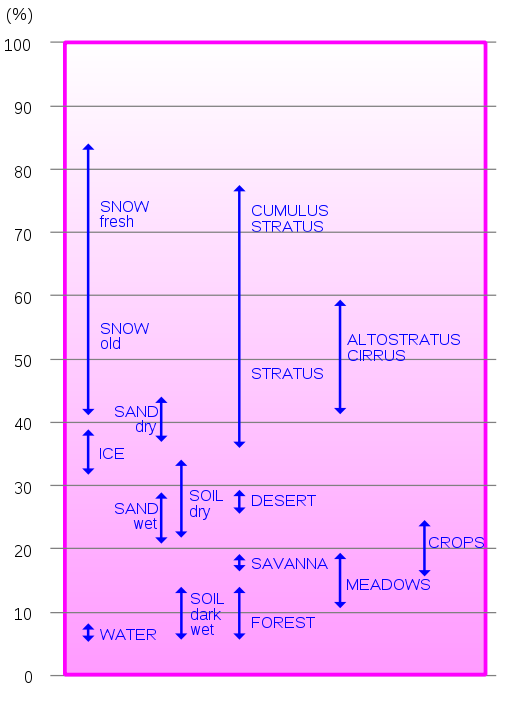
Fig 3 - Albedo effects (source: wikipedia)
As you can see from Figure 3, the albedo of fresh snow is dramatically different from water - it's much more reflective.
In the winter the Arctic sea is almost completely frozen over but this doesn't matter a lot because there is little sun shine for half the winter and even no sun shine at all for several months of the year. There is no albedo effect at all during this part of the year.
In the summer months, though, the story is the opposite. If the Arctic Sea is covered with ice in the summer - as it has been dating back perhaps thousands, to millions of years - the incoming sunlight is mostly reflected back to space without adding any heat to the Earth. But, as ice melts back, as is happening today, the summer sun is absorbed by the darker open sea exposed by the disappearing ice.
The open water absorbs more and more heat during the extended daylight of the summer months until winter comes again, when the Arctic Sea freezes. But because of warming the ice is also losing its capacity to freeze back to previous levels. This is what is meant by a feedback. Less ice makes warmer water, which makes thinner ice, which melts easier, which makes warmer water… and so on.
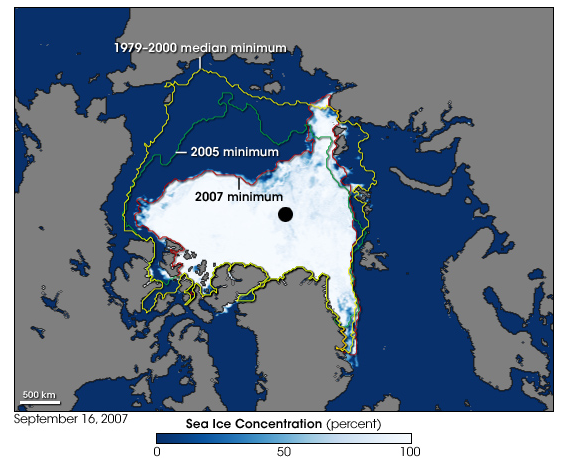
Fig 4 - 2007 Summer sea ice minimum (source: NSIDC)
This also points out why the sea ice in the Antarctic is less important and generates less warming. The Antarctic is a land mass 1.5 times the size of the United States. Each winter sea ice develops around the Antarctic continent but thaws back mostly to the coast each summer. There it can go no further. The continent is almost completely covered in snow year round so the south pole maintains its high reflectivity during the summer months.
Something to be wary of is people who point to very select years or short time periods to say the ice is not melting. You have to look at all the data to see the full picture. The full picture of the Arctic clearly shows a rapid decline of ice both in extent (area) and volume (total ice). Some people will also tell you that ice is growing in Antarctica. That's true and false. Winter sea ice extent is increasing slightly, but the land based ice, on the whole, is melting. And as we understand above, winter sea ice extent is not going to have any effect because there is little or no sun in the winter.
When you take a moment to step back from the dusty battle taking place on climate issues sometimes you gain a little perspective. I've actually learned quite a lot doing battle in the blogosphere trenches. On occasion I get a boot on the derriere that forces me to try to better understand the arguments on both sides of the issue and learn more about what scientists are trying to tell us.
It's not a pretty battle, and you have to bust ice to really get down to the truth.
- - - - - -
For the most up to date and accurate information about snow and ice issues you can visit the NSIDC, the National Snow and Ice Data Center.

Arguments


It has already been pointed out to you several times now that the geography is significantly different. The Arctic is significantly warmer than the Antarctic because of those differences. Remember "Global Average Temperature" means exactly what it says. Its that average of global temperatures. The earth does not heat or cool evenly. Why would we expect it to do so.
(*BTW, I don't doubt the reasons for the Antarctic increasing sea ice extent are numerous and complex, nor do I doubt that many of the listed mechanisms could very well be playing a role.).
Everyone has been presenting evidence to help you understand why there is a difference between the mechanisms in play at the poles. So far you have ignored all of the evidence and simply stated you don't believe. A true skeptic would recognize that evidence, weigh it, ask questions and express concerns if any. How about in the spirit of learning and understanding you give us specific empirical evidence why you don't believe.
"observed" in what way? I tend to only trust the satellite data on this.
If you only trust satellite data, then why do you cling to a 1922 anecdotal news article and throw out instrumental records in favor of proxy's in the MWP graph.
3 or 4 tenths of degree warming in 30 years is the most rapid warming ever observed?
Actually it is more than that which has already been pointed out to you. Can you show data to the contrary?
Your problem is that pointing out accurate facts is considered disengenious. At no point in #16 do I suggest what is forcing climate change today. As you suggest Holocene Climactic Optimum is an example of polar amplification forced naturally. It may give you palpitations but it's true.
Here is what I'm looking at:
"Thanks for shooting yourself in the foot again RW1.You claim 30 years isn't sufficient data, but apparently a single month is?!?!"
No, it's pretty meaningless. The point is it shows how much the temps can fluctuate from year to year. That's all.
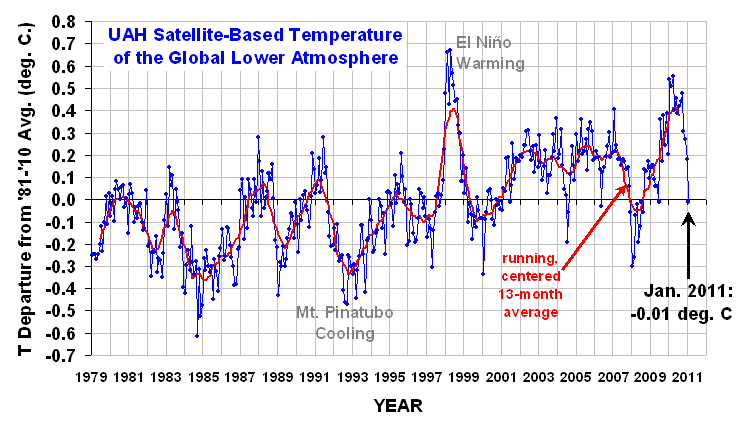
http://vortex.nsstc.uah.edu/data/msu/t2lt/uahncdc.lt.
Its the global column (3). Maybe a chartist can bung a line on it and prove me wrong :)
I don't mean this to be an indictment of his capacity to comprehend this stuff. That's obviously not the case. But I just don't understand why it's such a challenge to accept what is so blatantly obvious, while at the same time grasping so fearlessly at the smaller contradictions.
"I see a pretty clear upward trend in that graph."
No, you are absolutely correct, there is an upward trend of about 3-4 tenths of a degree over the period. Other data sets show a little more, about 4-5 tenths of a degree.
#157. RW1, Does this upward trend mean anything to you?
I will point out that your repeated "I don't trust anything but the satellite data" statements, joined with your claims that a 1922 article establishes high variability, are rather contradictory. That said, all data is worth something, whether it's Viking reports on sea ice levels from a 1000 years ago or current satellite data - you just have to consider coverage, accuracy, and consistency. The Walsh data drops in accuracy pre-1953, but that's still >50 years of accurate data and best estimates for before that.
Now: your initial queries were regarding albedos. That was covered more than extensively on the Lindzen and Choi and the Chemistry of CO2 Absorption threads, not to mention here, where multiple people demonstrated that a simple albedo and gain calculation was insufficient and incorrect for calculating climate response.
Exactly what objection to the observed Arctic icecap retreat are you trying to raise? This discussion would benefit greatly from some clarity on that question.
With 'I don't think its nearly enough' RW1 rejects 30 years of data as an insufficient sample. With 'I'm looking at UAH and RSS,' and 'I tend to only trust satellite on this', RW1 restricts his world to a 30 year dataset, thereby setting up the inevitable infinite loop: Thirty years is all we have; thirty years isn't enough to tell what's happening. We saw this earlier in this thread with ice extent data.
Sure, satellite data may be 'better' than prior data (whatever 'better' means here), but that does not mean that prior data are all wrong. I was in the oil business way back in the pencil and paper days; when computer-aided mapping came out, there was a rush to replace anything hand drawn because the computer maps were 'better'. Trouble was, we'd found a heck of a lot of oil and gas with those hand drawn maps. They weren't wrong.
In this case, standards exist: "Thirty years was chosen as a period long enough to eliminate year-to-year variations." You don't get to simply declare 'I don't think 30 years is long enough'; that may be your opinion, but if you base your scientific conclusions on opinions, you do so at the risk of all credibility.
But this is an ice thread, not a temperature thread. There are plenty of those. Detailed temperature analysis comments should go to the appropriate thread.
And... the mere fact that the satellite data very closely mirrors the other data sets should give one confidence in all the other data. That's just how it works!
It seems far too convenient to dismiss data that you don't want to accept when the data is obviously corroborated via multiple sources.
"Does this upward trend mean anything to you?"
Not much. It's ant crumbs - barely outside the margin of error.
"what is so blatantly obvious"
What exactly is so blatantly obvious? That there's clear downward trend in Artic sea ice since the start of the satellite record, or that anthropogenic global warming is the cause of the decline? The former is not in dispute.
All I'm saying is that 30 years is not nearly enough time to establish an accurate range of variability.
RW1 responded with,
"How can it be accelerating when the past 3 years have seen a larger summer minimum than the record low of 2007?"
I and others have pointed out that the loss of summer Arctic sea ice loss (and volume) is accelerating, when called on this RW1 then says:
"I'm not disputing that the documented period we have shows a downward trend, but 30 years is hardly enough data to show whether this is anything significant or just random noise of natural variability."
Wow, quite the contradiction and shift of the goal posts. Given that the trend over 32-years is statistically significant, that shows that we do have sufficient data to extract a signal from the 32 years of data. Regarding natural variability, RW1 needs to familiarize himself/herself witht he latest research. For example Polyak et al. (2010) conducted a meta analysis of Arctic paleo records and concluded that:
“The current reduction in Arctic ice cover started in the late 19th century, consistent with the rapidly warming climate, and became very pronounced over the last three decades. This ice loss appears to be unmatched over at least the last few thousand years and unexplainable by any of the known natural variabilities.”
I have lost cout of how many times RW1 has been shown to be wrong or guilty of misleading or parroting misinformation on this thread. I do not see any interest by RW1 to learn or accept the facts presented to him/her-- I think we all know what such behaviour is called.....
I hope that people following this thread see for themselves the contempt that so-called "skeptics" hold for the science and for facts, and how uninterested they are in learning.
You have to step back from the data for a minute and look at all the lines of evidence. It's not just Arctic sea ice. It's not just the satellite data. It's not just ice mass loss in Greenland. It's not just the measured Arctic amplification. It's not just the measured increase in atmospheric water vapor. It's not just... I could go on and on here.
There are thousands of lines of empirical evidence that show quite clearly that what we believe is happening is actually happening. And yet, you still cling to the few anomalies to the massive amount of evidence we do have.
Honestly, I'm just trying to understand why this is. I'm completely dumbfounded.
That's exactly where I was heading when I recalled this is an ice thread, not a temperature thread. Some months ago I posted a graph comparing UAH to GISS temperatures; they do not have the same values (no surprise there), but over the life of the satellite data, their trends are indistinguishable. To use the language of high school algebra: If satellite = good and surface duplicates satellite, then surface = good.
As far as 30 years being insufficient to determine natural variability, that's one man's opinion. To misquote, "the trend's the thing."
"You have to step back from the data for a minute and look at all the lines of evidence. It's not just Arctic sea ice. It's not just the satellite data. It's not just ice mass loss in Greenland. It's not just the measured Arctic amplification. It's not just the measured increase in atmospheric water vapor. It's not just... I could go on and on here.
There are thousands of lines of empirical evidence that show quite clearly that what we believe is happening is actually happening. And yet, you still cling to the few anomalies to the massive amount of evidence we do have."
I'm sorry, the planet is very dynamic - it doesn't do anything but change. I don't doubt the change that's occurring - just the alleged primary anthropogenic cause, which from energy budget/balance standpoint is an incredibly small perturbation. There is just way too much conflicting evidence.
"Honestly, I'm just trying to understand why this is. I'm completely dumbfounded."
I can see that.
"I'm sorry, the planet is very dynamic - it doesn't do anything but change."
Yes, climate changes, but when it does so it is not random. There are measurable forces that make it happen. If you disagree with the evidence that is presented supporting the anthropogenic cause then please provide an alternative explanation. What do you propose is causing the current change in the climate?
There are ranges of uncertainties, there are short term (<10-11 year ENSO and the like) variability, but we know what's going on, and the major driver right now is our excess CO2 raising the temperature of the climate. We have good records of the forcings for the last million years or so that have caused long term changes in climate, and aside from CO2 just about all of them are declining right now. It's us, and there's really no reasonable question about it.
Denying that we are having a major effect on our climate (which seems to be the gist of your posts) is simply wishful thinking. I'm not dumbfounded by your position - just saddened.
I don't doubt you believe that due to your past posting history completely ignoring all evidence presented to you in favor or incredible cherry picking and conflicting statements.
How about presenting the "way too much conflicting evidence" you for anthropogenic climate change. And while doing that, please present it in the proper thread here.
Nope, you shot yourself in the foot, by doing exactly what I said *all* denialists do-tell us x amount of years is insufficient, then try to prove a trend on the basis of a single year or month-as you just did. Of course month to month & year to year data is variable (though not as much as you try to claim), as heat is being exchanged between the air & the oceans, but over several decades a statistically significant, discernible can be seen-& that trend says the planet is warming. Also, if you look at *all* temperature readings-air, sea surface & deep sea-you see a definite build-up in heat that just can't be made to disappear with denialist hand waving!
"Yes, climate changes, but when it does so it is not random. There are measurable forces that make it happen. If you disagree with the evidence that is presented supporting the anthropogenic cause then please provide an alternative explanation. What do you propose is causing the current change in the climate?"
What do you propose caused all the climate change in the past? Can you give me all the details explaining each 100 year period for the last few thousand years? What do you propose changed the climate over the past few thousand years?
"I don't doubt you believe that due to your past posting history completely ignoring all evidence presented to you in favor or incredible cherry picking and conflicting statements.
How about presenting the "way too much conflicting evidence" you for anthropogenic climate change. And while doing that, please present it in the proper thread here."
It only takes one piece of conflicting evidence to disprove a hypothesis, but that aside the key is understanding the energy balance in detail and the role of evaporation, clouds and precipitation that drive the feedback mechanism.
You would have to overturn a lot of well understood physics to do that. Anthropogenic climate change is not a hypothesis, its a theory. As for the energy balance it is well documented with satellite data. Remember, you said yourself that you only believe in satellite data. There is a paper about Earth's energy imbalance (Murphy 2009) and a discussion about it on this site as well here.
Again, just saying you don't believe something doesn't make it so, especially in the face of all the empirical evidence that exists and been shown to you.
In order to put AGW in question you'd have to come up with a competing theory that explained all the empirical evidence better. You'd also have to explain why CO2 has less impact than we currently measure and physics predicts. That's a mighty tall order, literally on the level of overturning evolutionary theory.
You say, "Can you give me all the details explaining each 100 year period for the last few thousand years?" A great deal of those changes in climate are very well understood. You just don't read about them on skeptic blogs. It's all in the peer reviewed literature. And there is a lot of it.
Please read argument #2, Climate's changed before, in the top left corner and ask any questions you have on that thread.
Solar irradiance changes have been the primary climate forcing agent over the past few thousand years.
Of course, that said, I'm still waiting for you or one of your Denialist mates to actually come up with anything that actually contradicts the Theory of AGW-all I've seen to date though is a lot of strawman arguments about "insufficient data" or playing up year to year variability (which isn't as high as you claim). Go to the back of the class buddy.
Those topics were covered in great (gah, exhausting) detail on the Lindzen and Choi thread.
"You would have to overturn a lot of well understood physics to do that."
Not really. The physics of GHGs absorption are pretty well understood and quantified, as is the aggregate measured response of the system to forcing power (i.e. the gain of the system). The issue boils down to the net feedback operating on the system. The large amount of positive feedback need for AGW is the extraordinary claim that requires extraordinary proof. I don't dispute there is likely some effect - just that the amount is too high.
I have no wish to rehash it here - I think you were clearly answered on the earlier thread. The 'gain' you have discussed is inappropriate for climate calculations. Please read the Climate sensitivity is low thread for the peer reviewed work and actual data on sensitivity to forcings.
"Out of curiosity, can I ask where you get most of your information on climate science?"
I've read a lot of books and papers and thought about it from a whole bunch of different angles, but most of my conclusions and views come from mixing and meshing the behavior and evidence coming from both sides using logic and critical thinking skills.
And yes, I have gotten a lot of information from George White. I've taken the time to understand a lot of the work he has done and have spent time watching and observing others try to discredit it only to fail in my estimation. For example, it is claimed around here that the halving of the 3.7 W/m^2 is incorrect because it's already been halved, yet I've asked numerous times for a source documenting the incremental absorption from 2xCO2 is actually 7.4 W/m^2. So far no one has provided it, and I've even searched around myself and found nothing of the sort. These kinds of things reveal things to my critical thinking mind and I then mix and mesh them in with all the other stuff I know. Eventually, I believe at least, I figure out who really knows what they're talking about and who doesn't.
The difference is because of (a) increased absorption by CO2, and (b) a rise in the level of CO2 emission, where CO2 density is low enough for IR to escape to space, and due to the lapse rate is actually colder - hence less energy.
These numbers are obtained by running line-by-line models (as GW has done), much as numeric integration does for equations without symbolic solutions. For some reason GW doesn't believe his own results, and goes halving them - that's no reason for you to make the same mistake.
I would suggest that further discussion of climate sensitivity take place on the Climate sensitivity is low thread, where the data and the discussion on this topic are actually being presented. You are way off topic here.
"So, in your estimation the 10 thousand-odd climate scientists working in this field have somehow made some critical error? And all the major scientific organizations (PNAS, etc.) who have made strong open declarations about AGW have all managed come to completely erroneous conclusions?
Good question. In short, yes. I think in essence they are mostly guessing and/or only looking for and interpreting data in ways that support enhanced anthropogenic warming because that is what their financiers are more or less looking for them to 'discover'.
I'm not getting into that with you here, nor am I going to speak for George.
"Good question. In short, yes. I think in essence they are mostly guessing and/or only looking for and interpreting data in ways that support enhanced anthropogenic warming because that is what their financiers are more or less looking for them to 'discover'."
And with that we move from discussing Scientific Theory to Conspiracy Theory.
Conspiracies, 'financiers,' etc are never on topic.
That is utter unsubstantiated nonsense that as far as I can see arises from an extremely poor understanding of science, and frankly looks like violation of comments policy.
This is not "interpreting" data. Its actually doing the maths which you appear not to be. You can what political opinions you like but you cannot have your own version of reality. If you cant do the maths yourself, then unfortunately you have to accept the result from those who can. The 3.7W/m2 is result of very complex numerical integration; there is no "opinion" in it. If you want to dispute it, then refute the equations, but you cant do that with a half-baked piece of simplistic nonsense that this "gain" stuff is.
I politely suggest that you apply your critical thinking skills to your base assumptions.
Independently validated, empirical researched is not overturned by vast conspiracy notions and lack of understanding.