





A Detailed Look at Renewable Baseload Energy
Posted on 25 June 2011 by Mark Diesendorf, dana1981
The myth that renewable energy sources can't meet baseload (24-hour per day) demand has become quite widespread and widely-accepted. After all, the wind doesn't blow all the time, and there's no sunlight at night. However, detailed computer simulations, backed up by real-world experience with wind power, demonstrate that a transition to 100% energy production from renewable sources is possible within the next few decades.
Reducing Baseload Demand
Firstly, we currently do not use our energy very efficiently. For example, nighttime energy demand is much lower than during the day, and yet we waste a great deal of energy from coal and nuclear power plants, which are difficult to power up quickly, and are thus left running at high capacity even when demand is low. Baseload demand can be further reduced by increasing the energy efficiency of homes and other buildings.
Renewable Baseload Sources
Secondly, some renewable energy sources are just as reliable for baseload energy as fossil fuels. For example, bio-electricity generated from burning the residues of crops and plantation forests, concentrated solar thermal power with low-cost thermal storage (such as in molten salt), and hot-rock geothermal power. In fact, bio-electricity from residues already contributes to both baseload and peak-load power in parts of Europe and the USA, and is poised for rapid growth. Concentrated solar thermal technology is advancing rapidly, and a 19.9-megawatt solar thermal plant opened in Spain in 2011 (Gemasolar), which stores energy in molten salt for up to 15 hours, and is thus able to provide energy 24 hours per day for a minimum of 270 days per year (74% of the year).
Addressing Intermittency from Wind and Solar
Wind power is currently the cheapest source of renewable energy, but presents the challenge of dealing with the intermittency of windspeed. Nevertheless, as of 2011, wind already supplies 24% of Denmark's electricity generation, and over 14% of Spain and Portugal's.
Although the output of a single wind farm will fluctuate greatly, the fluctuations in the total output from a number of wind farms geographically distributed in different wind regimes will be much smaller and partially predictable. Modeling has also shown that it's relatively inexpensive to increase the reliability of the total wind output to a level equivalent to a coal-fired power station by adding a few low-cost peak-load gas turbines that are opearated infrequently, to fill in the gaps when the wind farm production is low (Diesendorf 2010). Additionally, in many regions, peak wind (see Figure 4 below) and solar production match up well with peak electricity demand.
Current power grid systems are already built to handle fluctuations in supply and demand with peak-load plants such as hydroelectric and gas turbines which can be switched on and off quickly, and by reserve baseload plants that are kept hot. Adding wind and solar photovoltaic capacity to the grid may require augmenting the amount of peak-load plants, which can be done relatively cheaply by adding gas turbines, which can be fueled by sustainably-produced biofuels or natural gas. Recent studies by the US National Renewable Energy Laboratory found that wind could supply 20-30% of electricity, given improved transmission links and a little low-cost flexible back-up.
As mentioned above, there have been numerous regional and global case studies demonstrating that renewable sources can meet all energy needs within a few decades. Some of these case studies are summarized below.
Global Case Studies
Energy consulting firm Ecofys produced a report detailing how we can meet nearly 100% of global energy needs with renewable sources by 2050. Approximately half of the goal is met through increased energy efficiency to first reduce energy demands, and the other half is achieved by switching to renewable energy sources for electricity production (Figure 1).
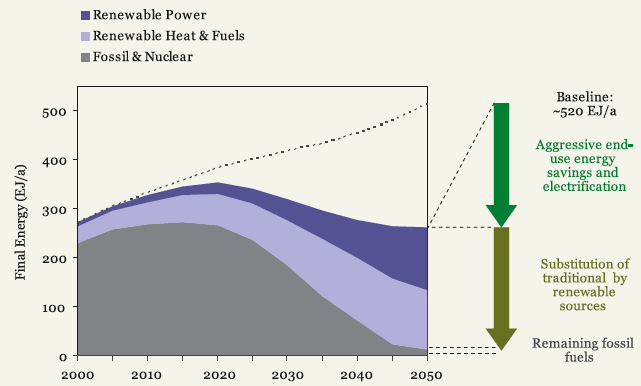
Figure 1: Ecofys projected global energy consumption between 2000 and 2050
Stanford's Mark Jacobson and UC Davis' Mark Delucchi (J&D) published a study in 2010 in the journal Energy Policy examining the possibility of meeting all global energy needs with wind, water, and solar (WWS) power. They find that it would be plausible to produce all new energy from WWS in 2030, and replace all pre-existing energy with WWS by 2050.
In Part I of their study, J&D examine the technologies, energy resources, infrastructure, and materials necessary to provide all energy from WWS sources. In Part II of the study, J&D examine the variability of WWS energy, and the costs of their proposal. J&D project that when accounting for the costs associated with air pollution and climate change, all the WWS technologies they consider will be cheaper than conventional energy sources (including coal) by 2020 or 2030, and in fact onshore wind is already cheaper.
European Union Case Study
The European Renewable Energy Council (EREC) prepared a plan for the European Union (EU) to meet 100% of its energy needs with renewable sources by 2050, entitled Re-Thinking 2050. The EREC plan begins with an average annual growth rate of renewable electricity capacity of 14% between 2007 and 2020. Total EU renewable power production increases from 185 GW in 2007 to 521.5 GW in 2020, 965.2 GW in 2030, and finally 1,956 GW in 2050. In 2050, the proposed EU energy production breakdown is: 31% from wind, 27% from solar PV, 12% from geothermal, 10% from biomass, 9% from hydroelectric, 8% from solar thermal, and 3% from the ocean (Figure 2).
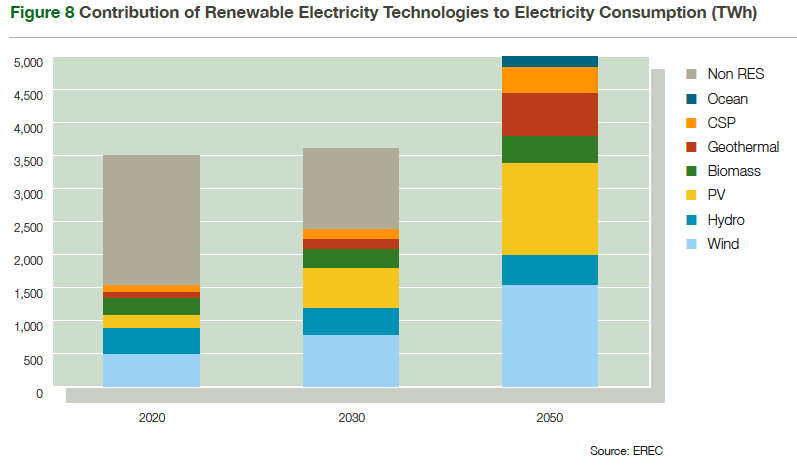
Figure 2: EREC report breakdown of EU energy production in 2020, 2030, and 2050
Northern Europe Case Study
Sørensen (2008) developed a plan through which a group of northern European countries (Denmark, Norway, Sweden, Finland, and Germany) could meet its energy needs using primarily wind, hydropower, and biofuels. Due to the high latitudes of these countries, solar is only a significant contributor to electricity and heat production in Germany. In order to address the intermittency of wind power, Sørensen proposes either utilizing hydro reservoir or hydrogen for energy storage, or importing and exporting energy between the northern European nations to meet the varying demand. However, Sørensen finds:
"The intermittency of wind energy turns out not to be so large, that any substantial trade of electric power between the Nordic countries is called for. The reasons are first the difference in wind regimes...and second the establishment of a level of wind exploitation considerably greater that that required by dedicated electricity demands. The latter choice implies that a part of the wind power generated does not have time-urgent uses but may be converted (e.g. to hydrogen) at variable rates, leaving a base-production of wind power sufficient to cover the time-urgent demands."
Britain Case Study
The Centre for Alternative Technology prepared a plan entitled Zero Carbon Britain 2030. The report details a comprehensive plan through which Britain could reduce its CO2-equivalent emissions 90% by the year 2030 (in comparison to 2007 levels). The report proposes to achieve the final 10% emissions reduction through carbon sequestration.
In terms of energy production, the report proposes to provide nearly 100% of UK energy demands by 2030 from renewable sources. In their plan, 82% of the British electricity demand is supplied through wind (73% from offshore turbines, 9% from onshore), 5% from wave and tidal stream, 4.5% from fixed tidal, 4% from biomass, 3% from biogas, 0.9% each from nuclear and hydroelectric, and 0.5% from solar photovoltaic (PV) (Figure 3). In this plan, the UK also generates enough electricity to become a significant energy exporter (174 GW and 150 terawatt-hours exported, for approximately £6.37 billion income per year).
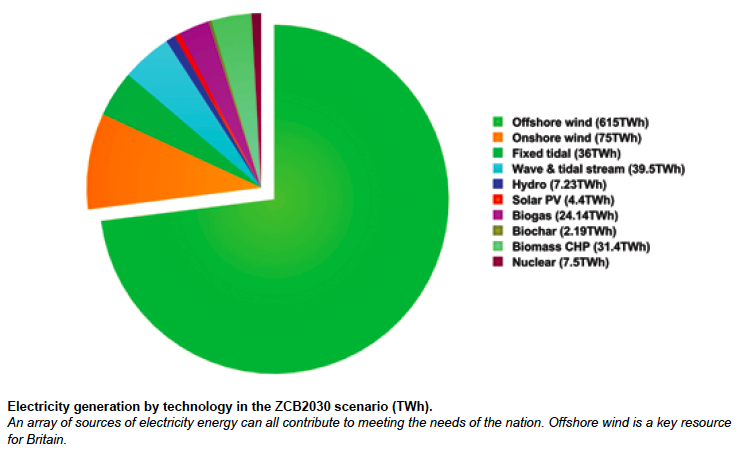
Figure 3: British electricity generation breakdown in 2030
In order to address the intermittency associated with the heavy proposed use of wind power, the report proposes to deploy offshore turbines dispersed in locations all around the country (when there is little windspeed in one location, there is likely to be high windspeed in other locations), and implement backup generation consisting of biogas, biomass, hydro, and imports to manage the remaining variability. Management of electricity demand must also become more efficient, for example through the implementation of smart grids.
The heavy reliance on wind is also plausible because peak electricity demand matches up well with peak wind availability in the UK (Figure 4, UK Committee on Climate Change 2011).
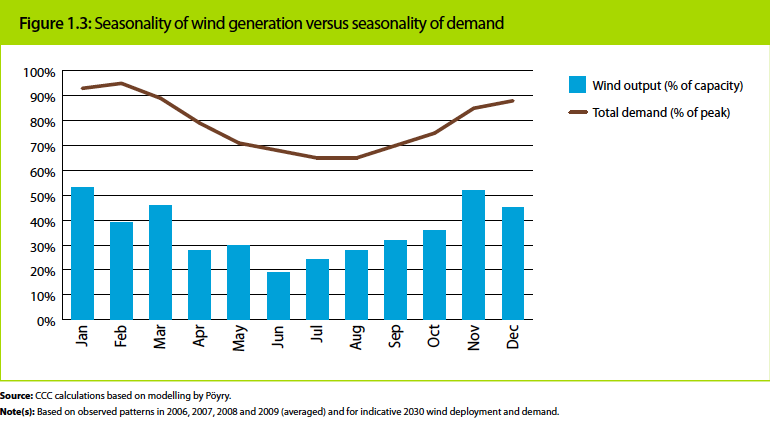
Figure 4: Monthly wind output vs. electricity demand in the UK
The plan was tested by the “Future Energy Scenario Assessment” (FESA) software. This combines weather and demand data, and tests whether there is enough dispatchable generation to manage the variable base supply of renewable electricity with the variable demand. The Zero Carbon Britain proposal passed this test.
Other Individual Nation Case Studies
Plans to meet 100% of energy needs from renewable sources have also been proposed for various other individual countries such as Denmark (Lund and Mathiessen 2009), Germany (Klaus 2010), Portugal (Krajačić et al 2010), Ireland (Connolly et al 2010), Australia (Zero Carbon Australia 2020), and New Zealand (Mason et al. 2010). In another study focusing on Denmark, Mathiesen et al 2010 found that not only could the country meet 85% of its electricity demands with renewable sources by 2030 and 100% by 2050 (63% from wind, 22% from biomass, 9% from solar PV), but the authors also concluded doing so may be economically beneficial:
"implementing energy savings, renewable energy and more efficient conversion technologies can have positive socio-economic effects, create employment and potentially lead to large earnings on exports. If externalities such as health effects are included, even more benefits can be expected. 100% Renewable energy systems will be technically possible in the future, and may even be economically beneficial compared to the business-as-usual energy system."
Summary
Arguments that renewable energy isn't up to the task because "the Sun doesn't shine at night and the wind doesn't blow all the time" are overly simplistic.
There are a number of renewable energy technologies which can supply baseload power. The intermittency of other sources such as wind and solar photovoltaic can be addressed by interconnecting power plants which are widely geographically distributed, and by coupling them with peak-load plants such as gas turbines fueled by biofuels or natural gas which can quickly be switched on to fill in gaps of low wind or solar production. Numerous regional and global case studies – some incorporating modeling to demonstrate their feasibility – have provided plausible plans to meet 100% of energy demand with renewable sources.
NOTE: This post is also the Advanced rebuttal to "Renewables can't provide baseload power".

Arguments


I stand surprised and corrected. I should have said Janus-headed. My apologies.
[DB] Your link is bad. Not that any even oblique reference to Janus at all would be needful in a comment thread on climate change.
This entire tangent of the dialogue is getting out of hand. All parties, please focus on the topic of the discussion. Thanks!
You say:
And also:
Your discussion of an outline plan for renewables generation at (4) is essentially Jacobson & Delucchi, and I linked to a comprehensive critique when I first joined this thread.
Coincidentally, new evidence is coming to light about the lacklustre results from the Colorado Integrated Solar Project which has a direct bearing on our disucssion.
life cycle emissions
is one source but many would discount it because it's the industry talking. I think it is pretty reasonable though
and here is an independent source that suggests nuclear is on a par with Wind emiisions comparisons"
Unfortunately, even your second link could be seen as "the industry talking", stating : Prof Lenzen has just completed a study, commissioned by the uranium industry...
And that source differs from the Savacool link given on the German Energy Priorities thread, i.e. :
Nuclear 66 gCO2e/kWh
Wind 9-10 gCO2e/kWh
Different from BBD's figures too - although, presumably, he/she will tell us why he/she is right ! ;-)
And it ends with these wise words :
Rather than detail the complexity and variation inherent in the greenhouse gas emissions associated with the nuclear lifecycle, most studies obscure it; especially those motivated on both sides of the nuclear debate attempting to make nuclear energy look cleaner or dirtier than it really is.
Brook makes the reasonable point "...for fast spectrum reactors like the IFR, it would be substantially lower, since we skip the mining, milling and storage steps", but does not comment on how much lower. Brook does not give a figure for how much lower, but from the report it appears missing those steps would save from 10 to 25% of emissions, giving us emissions of 60 gCO2e/kWh for old reactors, and 45 gCO2e/kWh for generation III and IIIplus reactors. These figures should be reduced for countries with primarily low emission power generation (as, of course, should the equivalent figures for renewable power).
I am now even more painfully embarrassed. Link.
For the record here:
The original head-face gaffe was both careless and unintentional. I fully accept your criticism wrt a poor choice of simile in a sensitive discussion. I apologise unreservedly to TC for the apparent slur.
Perhaps we are losing our way. There is no doubt that nuclear and renewables are all low-emissions generation technologies.
Lifecycle emissions profiles are relevant, but not decisive. We can argue all night about the details but what would be the point? I can only remind everyone that the EU is conspicuously committed to emissions reductions and to renewables, and is unlikely to use bad data that misrepresents the relative lifecycle emissions of nuclear, wind and solar plant. Which is why I provided the link to EU documentation.
The essential question (as we are reminded by the moderator) is whether or nor renewables can actually deliver reliable large-scale baseload capacity sufficient to meet the needs of an industrialised economy.
Realistic projections must reconcile with a sharp increase in overall electricity demand over coming decades as the wholesale electrification of personal, commercial and public transport really gets underway.
The shift from gas (and to a lesser extent oil) to electricity for domestic heating is a major factor in the UK. No doubt it will be elsewhere. Here and elsewhere, an energy-hungry surge in urban AC is projected to manage increasingly extreme urban temperatures. And so on.
Nothing I have seen on this thread demonstrates a plausible case for high-renewables scenarios as things stand, never mind over decades of increased demand.
I wish it were otherwise, but we have to play with the cards on the table.
In 2009, Dieter Helm wrote an article in the Times in which he said:
Helm, like MacKay is serious, and should be taken seriously. I recommend reading the rest - it's short.
I don't see this increase in overall electricity demand as inevitable. In fact, I'd see investment in negawatts expanding in parallel. A home or business building can be its own source of power using the grid as a battery. As long as the structure is progressively improved with more insulation and other retrofits, recharging electric vehicles should not draw more power than is provided - esp if the vehicles' batteries export power when required.
A city with several thousand (or tens of thousands) vehicles should have access to a fair amount of power in those batteries.
When we're talking about supplying power to established cities and communities, we must always remember that there's a huge benefit in investing in negawatts by upgrading structures for not much outlay. Combining this with import/export of power through a grid connected to other areas which don't suffer simultaneous loss of wind/solar input relieves a lot of the stress on the local system.
Tom with due respect I do not think comments about courtesy or otherwise are helpful. I did not say anything discourteous (or if I did I apologise)
My post at 142,was challenging some of your logic about mine deaths (which I think you acknowledge) and also taking issue with your characterisation of my comments about Nuclear being CO2 free in operation by which I thought was clear meant when it is in operation providing power (which is an indisputable fact)
But let me pick up on some of your further points (especially at #150) which I think are very pertinent and see if I can take them further?
@BDD this is I think relevant for your points too as I agree the post at #159 cannot be ignored (I can't get your link at #154 to work on the critique). This appears to be the problem that Britain is grappling with (and I suspect Australia is about to have to contend with) and I think is a real example of everyone pushing a particular barrow.
I don't have the answers but maybe I can add some thoughts?
We can all argue till the cows come home about the exact Nuclear CO2 life cycle emissions and safety.
I think (please correct me if you disagree) that we can all agree that what matters is the comparison?
If we compare nuclear with coal it wins hands down on both safety and emissions - no matter how you calculate them.
So in my opinion nuclear displacing coal is a "win"
If we compare nuclear with renewables the situation is somewhat more vexed.
(for the purposes of this post I'll focus only on those renewables such as Solar PV, Concentrated Solar Thermal (CST) and Wind all of which have almost no geographic limitations in application)
On Safety
I don't want to argue the toss about someone else's data showing nuclear to be more or less safe than renewables or more or less CO2 emissions - it probably comes down to whose figures you accept and, let's face it, both the nuclear industry and the renewables industry have axes to grind and this will bias their data and views accordingly.
My own personal opinion is that it would be hard to argue conclusively that renewables are inherently less safe than nuclear.
I stand by my comments on risk and hazard above for nuclear at #135 and #142. The risk is tiny but the hazard is huge
So score a win for renewables on safety but not a slam dunk?
On Emissions
So what's the situation with CO2 emissions of nuclear versus renewables? Tom makes I think the relevant points in the last paragraph of his post #145
When they are producing power it's probably a scoreless draw?
On the life cycle issue they should be about equal on plant fabrication and nuclear ought to lose a peg or two on the fuel cycle issue.
So score a (minor) victory to renewables on that one?
But with renewables the issue comes down to what today is still an incontrovertible fact.
A renewables plant by itself simply cannot meet reliable 24/7 baseload demand.
The only available solution to this involves backing up renewables with CO2 producing alternatives. A problem nuclear does NOT have
score a decisive victory for nuclear on that issue
The Problem
If you broadly accept my characterisation above then this describes pretty well for me at least what I meant in my earlier posts about the world being full of lesser evil choices. So how to pick the lesser evil?
This is where I think the real problem lies that we need to solve and until we do there will continue to be a debate between nuclear and renewables advocates that too often descends into a dialogue of the death.
The article that spawned this thread makes a case for getting round this real renewables problem by (my characterisation) a widely geographically dispersed generation "utility" linked together in a smart grid supported by rapid response gas/biofuel turbines to handle the "unreliability" issues of any given renewables plant.
In principle this sounds feasible but the reality is we don't know as it has not been tested.
The other way around this problem would be for renewables to improve their reliability.
The only serious contender for this is surely CST. But it isn't viable today.
But now here is the problem and where I think the wishful thinking on the part of renewables advocates lets them down. It is simply not feasible to move to 100% renewables today without considerable technical, commercial and social risk.
And I don't want to ignore the real problem of nuclear hazard
So how do we get from here to there? (there being the wonderful CO2 free emissions environment of future power emissions) and within our limited budgets?
A Part Answer?
There's no magic answer but I think we must do several things.
First because I think there is no certain answer we should not bet on a single approach. So nuclear by itself is NOT the answer (and in any event won't fly politically) but neither are renewables. Whilst I don't accept BDD's limitation of 30% as being forever the fact is right now renewable are a whole lot less than that and if we don't want the lights to go out won't be higher anytime soon.
I suggest the following (though not in any order of importance)
1) Invest in a realistic test of Mr Diesendorf's plan - the idea has merit - to what degree can we make it work? That implies some work on the grid which is wise
2) Replace aging goal with latest technology Gas (it's more expensive but it works, has substantially lower emissions than today and can be part of 1 )
3) Pour more investment into CST reliability.
4) Because none of the above can happen quickly, don't take nuclear off the table anywhere but require any new nuclear proposals to be subjected to rigorous overview and assessment.
5) because of all the above Coal is going to be around, whether we like it or not, for a LONG time globally (just look at china) we need to continue to develop sequestration or other clean coal alternatives
Summary
Most of all I wish we'd stop arguing about alternatives as if it's one or the other.
I can't see ANY way forward except putting a whole lot of effort into ANYTHING that looks promising. We should rule nothing out if it can contribute.
We can use Carbon pricing (tax) to price higher emissions out of the market over time and we can use incentives (direct investment, accelerated depreciation, tax discounts) to try and get alternatives off the ground. (Direct investment for early stage, accelerated depreciation for capital requirements on large scale implementations of lower CO2 plans and tax discounts for more mature low CO2 operations).
Okay - now tear me to pieces! :)
Nuh, no pieces. My view is much the same about trying absolutely everything. We've already seen how far and how fast the price of solar PV and of wind can come down. Without pushing them further, we'll never know just how cheap they can be.
And the same thing goes for other technologies. We might think they're expensive now, but we haven't tried hard enough for long enough to see which of them will (and which of them won't) follow the same cost trajectory.
As for coal being around for a long time ...? That's another reason for pushing renewable technologies as hard and fast as possible as soon as possible. If the climate goes truly and horribly pear-shaped without much warning*, there'll be an outcry demanding either clean coal or no coal - which will lead to ghastly impacts when some areas lose most or all of their power supply.
If people demand that coal be left in the ground (think asbestos, there's still plenty of that around, it's just too dangerous to use) everyone will be much better off if we already have a range of fairly cheap alternatives on the go.
*not much warning? from the pov of view of those who weren't paying attention. Think WWII.
With regard to concentrated solar, though, things are moving on :
Gemasolar solar power plant reaches 24 hours of uninterrupted production
But I think we must acknowledge there is still a long way to go. It's now got to be able to do 24hrs for 365 days a year - a goal so far not yet achieved anywhere - and 20MW is tiny compared to what we need. And it (ultimately) needs to do so without high subsidy.
I think what this demonstrates is validation of my point 3- that CST is the most promising reliable renewable alternative and we should be continuing to invest in it but we should not pretend that is yet able to provide the full solution.
It will take many years to scale up to a decent generation size and to provide a 24/7 solution.
I'd love to see an example of CST in use as part of a "test" network of wind and possible gas turbine along the lines Diesendorf's plan suggests.
I'm told on another post that Hawaii might be an ideal place to do this as it has abundant geothermal, solar and wind capacity.
I wonder are there forums where these ideas can be communicated to those in the actual industry and if they read blogs like this? After all just talking amongst "ourselves" is fun but how do we get the message to those that can actually implement these things?
Apologies - not the only bad link I posted yesterday. This is the problem with rattling out comments, late at night, when dog tired. Sometimes I consider giving up on HTML tags and going back to the old ways... It may not have been pretty, but it worked.
Anyway, here's the link to the critique(s) of the J&D paper.
This is baffling. Please see the article by Helm I quote at #159. For example:
I'm disappointed :( - but not surprised alas - at the comprehensive torching this link gives to yet another wishful thinking 100% renewables plan.
I wish advocates of renewables would try and be more realistic - ultimately they do the case for moving to lower emissions more harm than good by proposing unrealistic feelgood wishful thinking scenariois that can be so comprehensively shown to be impractical. Because then what ends up happening is that any "good" bits get ignored too.
I think I stand by my post #161 above - we need to acknowledge that the reliability and cost of renewables remain a significant challenge. Let's focus on how to address that issue rather than pretending it doesn't exist.
@adelady #163 - I have to agree with BBD somewhat - if you examine the real cost of Solar PV and Wind they are currently some of the MOST expensive ways to abate CO2 emissions available - do a bit of googling and you will see what I mean. That doesn't mean I reject them as alternatives - only that we need to be realistic about what they can do. Yes improved volume will help but the cost curve reduction is not linear - there are limits.
Mind you - there are some other options emerging
Paint on Solar
But there's a LONG LONG road to commercialisation
I'm open to the idea of using the combined electric fleet as backup for renewables intermittency. Some claim this is feasible with smart chargers; others that it is yet more evidence of the fundamental 'perpetual motion machine' fallacy at the heart of all high-renewables projections. In other words, there's never enough energy to go around in the long run and catastrophic capacity shortfalls will occur.
In the UK, current planning is for an installed capacity of ca 33GW of mainly offshore wind by ca 2020. The 'battery sceptics' point out that winter anticyclones can effectively stop national wind production for several days. The national electrified fleet might be a workable energetic reservoir for short bursts of backup but it could not cope with this. This is why policy currently leans strongly towards new gas-fired plant as spinning reserve for installed wind capacity once it exceeds 10% of the national energy mix.
This is part of the background that informs
this short but very revealing piece in the Guardian (see originally #124):
As an end note, that's a significant spinning reserve, and it will emit significant amounts of CO2.
BDD #169: The fact that one power company says it does not make it true. Again, SEGS. Largest solar plant in the world. More than 20 years old. Only 10% of the baseload power it supplies comes from natural gas backups. Ergo, E.ON's claim that renewable energy can't provide baseload power without 90% fossil fuel backup is directly contradicted by established reality.
I really don't think your rebutaal of BBD at #169 stands scrutiny.
1st because the example he is talking about is Wind as a reliable renewable and your example of SEGS is solar (CST).
Second I'd like to see evidence that SEGS can provide baseload 24/7 for 365 because I don't think it can yet, The link on this site SEGS performance suggests it can only operate reliably for 65% of the year - that doesn't really cut it? But if you can source a link that shows otherwise would love to see it - so I would like to challenge your "Only 10% of the baseload power it supplies comes from natural gas backups" figure? It doesn't seem credible to me? (happy to be proven wrong though)
finally - BBD is talking in the context of the UK - where solar is not nearly so viable an option and wind is the "viable" UK alternative.
So, really, I think you are comparing your apple with his orange and the comparison is flawed (not to mention that I think your apple is a little bruised by exaggeration)
1) Shutting down nuclear plant if there are demonstrable safety concerns is a Good Thing. In the wake of Fukushima, this may accelerate, and that would be a Good Thing too.
What is not a good thing is when arguments based on accidents at old plant (Chernobyl and Fukushima) are used to try and prevent construction of Generation III plant. That's illogical. Remove logic and what is left?
2) See #96.
You did not respond.
The footprint of low-density energy technologies is a serious constraint on solar and wind. Interconnectivity and security of same over wide areas is another (even for the US, long-distance HVDC interconnectors represent a security of supply risk). Variability is another. See also Mark Harrigan at #171. Actual insolation is another (thanks again, Mark Harrigan; you said it for me). We've been through the European DESERTEC handwaving upthread. It was not resolved satisfactorily eg #81 ff.
You say:
Well, who do we listen to? The chief exec of E.ON UK (and every other energy expert who says the same), or you? Especially since your response rests on SEGS, which as MH has helpfully pointed out, is an irrelevance for the UK. Solar is an irrelevance at mid/high latitudes generally. Huge pumped hydro resources are the best bet, but you are in trouble if they do not exist and you are forced to engineer them. Again, we've been through all this earlier in the thread.
At what point do proponents of renewables finally concede that their case is actually weak and unpersuasive?
Perhaps after reading the critiques of Jacobson & Delucchi?
But I just try and point to where I think the evidence and data lead. I try to avoid any sort of ideological advocacy.
I wish renewables were more effective and lower cost than they are.
So then the challenge for us all is not to simply pretend these problems don't exist (and I agree too many advocates of renewables fall into this trap) but also not to simply point them out and leave it at that.
We must apply our thinking to how do we solve the problems since continued increasing CO2 emissions are unacceptable and nuclear, whatever it's benefits, is simply politically unacceptable
Along the way we have to solve the problem of energy poverty
This article articulates that well
Solving Energy Poverty
When around 25-30% of the world's population have NO electricity at all it is morally repugnant for us in the west to presume we can force high cost solutions on those who do not enjoy the benefits of a high energy high wealth economy (and let's face it wealth and energy correlate).
It's an ugly truth at the moment that fossil fuels, because they do not currently have to carry the real cost of the damage they cause to the climate, are by far the cheapest way to provide energy. Which is why no matter what we in the west do we will see India and China dramatically increase their overall emissions (even though I applaud them for making great efforts to reduce their per capita and per unit of GDP emissions to be much lower than we in the West produced as we created our wealth.)
I think the demonstration city China is creating might be a very useful experiment
China Green City.
Certainly worth watching.
I wonder if Mr Diesendorf has tried to talk to them about implementing a test of his proposal?
It will also be very interesting in this country to see what happens after Sunday's announcement of what Australia's Carbon Tax system will look like - not doubt a vigorous debate will take place about the impacts and what actions might ensue.
German Emissions to increase
Unfortunately reality mugs wishful thinking again?
This is why we need a carbon price - because it's just so hard to know just exactly what is the "right" choice when trying to reduce CO2 emissions - other than NOT using energy.
So, in the west - it's just gotta be less :(
[dana1981] Please move any discussion about German energy to German Energy Priorities
The externalities of coal are not in dispute. Nuclear can displace coal from the global energy mix. That is not in dispute.
The question is whether renewables can displace coal from the global energy mix as fast or faster than nuclear.
So far, the evidence does not convince.
[dana1981] I'm allowed to respond to other people's comments too, you know!
Where did I say you weren't? Baffled ;-)
I'd be interested in your response to the comment though.
Fair enough. Thank you for hearing me out over the last few days.
One question. SkS does a commendable job educating about climate change. It is increasingly and deservedly influential.
Unfortunately SkS endorses an unrealistic view of the likely role of renewables in decarbonising the global energy mix.
Is this risk-free?
We're not saying that renewables must or even necessarily should provide most of our energy, what we're saying is that they could. This is true.
Personally, if nuclear power can do a better job producing low-carbon power, I have no problem with that. I have serious reservations about nuclear power (primarily economic), but again that's my personal opinion. We're just here to discuss science and refute myths, not to endorse specific solutions.
It is speculation. Coherent energy policy is not built on speculation. The stakes are too high.
AGW is supported by convergent observations. Renewable baseload is not. Surely someone seasoned in debating with 'sceptics' can see this?
We've been through all this. The missing element here is scalability.
Yes, this requires overbuilding, as no single site will be running at full capacity all the time. But given distributed renewable inputs (wind, solar, with gas backup) we're looking at >90% renewable supplying the baseline with no outre assumptions whatsoever.
Granted, there are areas like the UK where land is limited, sunshine poor, and only so much area for wind - I don't believe based on the studies I've read that the UK can support itself with internally based renewable energy. But add in North Africa, a lovely place to put solar power generators, NE Europe, excellent placement for wind power, etc., and it would be quite possible to import enough energy to supply European needs. Just replace oil imports with powerlines...
I suspect that for areas such as the UK nuclear will be a preferable source, although I suspect some careful economic analysis is required - but claims that renewables cannot meet baseline needs (with some fossil fuel backups) are just not supportable.
With respect, everything you say has been examined and discounted during the course of this thread. I know long threads are hard work, but hard work has gone into making this one so long. Please read the whole thing, then comment on specifics with reference to earlier discussion.
As just one example among many, your statement that North Africa is 'a lovely place to put solar power generators' has been examined critically above and found severely wanting.
I welcome serious discussion, but not endless repetition.
WRT you assertions in paragraphs 1, 2 and final, please read the critique of J&D linked repeatedly in this thread.
Like many commenters here you are apparently unconsciously confusing two very different things:
- the claim that renewables might one day possibly make a contribution of >30% to the global energy mix
- whether renewables can displace coal from the global energy mix as fast or faster than nuclear between now and 2050
(That site you referenced, incidentally, is essentially unreadable due to the lack of contrast between foreground and background. Peter Lang, who's referenced, has posted here before, had these issues pointed out, argued a lot, and then left.)
The carbon footprint backup for wind, for example, has been presented as a conflict (too much CO2), without properly considering an interconnected grid covering distances >250km. Support over larger distances averages out the weather considerably, while single-site analysis is in many respects a near sighted and unreasonable comparison. Much of the solar focus has been on material limits to PV and the backups required there, whereas concentrated thermal solar power is lower tech, requires less restricted materials, and lends itself quite naturally to 24 hour+ on-site thermal backups, with an operational availability around 80% for single sites already demonstrated (without fossil fuel backup). Again, a distributed network with overcapacity is very important.
The scale/size required, another frequent objection, is not out of range - see Surface Area Required to Power the Whole World With Solar and Wind Power, shown on Treehugger (horrible website name, 'tho).
Now, I fully agree that nuclear should be part of the mix; preferably (IMO) using breeder reactors and on-site reprocessing so that fuel utilization is ~90% rather than ~5% as in once-through reactors.
But what I see, repeatedly, in this and similar discussions is consistent knocking of renewable resources by what (in my opinion) appear to be nuclear supporters who consider it an either/or proposition - attacking renewables to defend nuclear. It's not! And these objections to renewables on baseload supply really do not hold up.
~25% of new power generating capacity over the last decade has been in the form of renewable sources (from Celsias). Nuclear only accounted for 2% over that period - personally I would like to see both of those numbers rise significantly. But right now renewables are replacing coal an order of magnitude faster than nuclear is. It seems a significant number of people think renewables are a reasonable proposition.
With due respect I completely reject your argument of "We may not pay that high cost in market energy prices, but we pay it elsewhere, and so would developing nations which chose to install artificially cheap coal power"
I find it a very western myopic view that ignores the brutal reality of energy poverty
And quite frankly at a certain level it is morally repugnant with respect to my comment about solving that problem. And I'm sure reading your other posts that you would not intend to damage the world's poor.
So I urge you to reconsider your views.
I agree the true externalities of coal are NOT priced in - and won't ever really be unless we create a market mechanism to do so (i.e. carbon tax).
The problem of course that the external costs (AGW) are not paid by the polluters/consumers. AND that we in the west (who are mostly responsible for AGW to date) built our wealth on ("articially") cheap fossil fuels.
We've imposed a share of that cost on the world's poor already by the damage done to the climate.
By what right do we now impose on the 25% of the global world's poor who current have NO electricty an increased price to pay for renewables/alternatives when we didn't pay it?
The reality is by saying this you are denying the world's poor affordable energy and hence the right to lift themselves out of poverty (which by the way is the key to reducing the population pressure created by the world's poor)
I would argue that unless and until we can offer the world's poor cheap and affordable alternatives that match what we paid (in not pricing the externalities of coal) we have NO right to impose a high price for energy on the world's poor.
To tie this back to the plan that spawned this thread I would argue that our focus must be on testing such a plan in the west with the best available renewables (as per my post at #161) and PROVING it works/lowering the cost before we have the right to tell the global poor what to do
Those who rely on coal for energy have to pay these costs, whether it be in terms of medical care, deaths, etc. even though they may not be reflected in the price of electricity. You can't get away from the true costs.
I'm not talking about imposing any costs on third world energy, so I have no idea where you're getting that from. We don't dictate the price of energy internationally. I'm saying they can't get away from paying the full true costs of coal, if that's the energy source they choose.
I would also suggest that since it's in our own best interests, developed countries should help developing countries financially and technologically to build renewable energy plants rather than fossil fuels. There are international agreements in place to do just that. Just look at what's happening in Kenya, for example.
I'm deeply unimpressed by this. As I said above, I am unable to continue the discussion in good faith until you have read at least some of the references provided.
Transparent evasions and linking to yet more hand-waving about renewables helps no-one. Especially as the LAGI graphic appears to be based on flawed calculations of area.
The first clue that something is seriously amiss is the author's claim that:
The standard figures are 5-20W/m*2 for SPV and 15W/m*2 for CSP. Not 200W/m*2.
So this is going to be very wrong indeed:
Going back to MacKay* (who is working from CSP at 15W/m*2), we find that an area equivalent to Germany would be required to power 1 billion people or 1/7 of the current global population. See here (pp178 - 185).
A more realistic picture emerges from Saul Griffith's estimate of the size of Renewistan:
This was originally posted at at #69.
Please take the time to read earlier comments. It is a courtesy.
At the risk of being repetitive, your core argument confuses this:
- the claim that renewables might one day possibly make a contribution of >30% to the global energy mix
With this:
- whether renewables can displace coal from the global energy mix as fast or faster than nuclear between now and 2050
*David MacKay is professor of physics at the University of Cambridge and chief scientific advisor to the UK Department for Energy and Climate Change (DECC).
We're not sitting around saying it's too difficult or can't be done...
Taking MacKays numbers: 360,000 km^2 of solar to fully power 1 billion people? In WWII Patton's Southwestern US military training grounds totaled ~225,000 km^2 (~87,500 miles^2), right where the best locations for solar power are located. That's enough by MacKays numbers to supply all the energy needs of ~625 million people, almost twice the population of the US. And Patton didn't use all the available land, either.
It's a big job - but not, I hope, an impossible one.
---
Side note: "Transparent evasions and linking to yet more hand-waving about renewables helps no-one."
If I'm in error, then by all means point that out, and I'll take a look. But insults are quite unnecessary in the discussion.
That's a good question. Limits on nuclear expansion include politics, how long it takes to build the plants, total fissionables available, and not insignificantly the land use required (external cost) and energy required (fossil, electric, fuel generated from nuclear energy?) for mining those fissionables.
I don't believe it would be possible to significantly expand the nuclear supply to begin replacing fossil fuel use without breeder reactors and (preferably on-site) reprocessing of fuel, or with the currently quite underdeveloped thorium reaction. There's just not enough fuel for a long-term plan otherwise.
Another limiting factor is cooling - most current designs use a great deal of water, which is a limited resource, so I would suspect it necessary to use the somewhat less efficient air-cooled methods (10% hit on efficiency?).
But - if you know of any well fleshed out plans for completely powering the world with nuclear rather than fossil fuels, preferably on the order of the various case studies presented in the topic post, please point them out.
I have no idea if your figures for the area of Patton's training grounds is accurate (link?).
Assuming that it is, then let's remember that the average per capita energy consumption in the US is 250 kWh/day, not 125 kWh/day as in Europe.
Yes, covering 360,000 km*2 of the SW USA with solar plant could meet the energy needs of 500 million Americans. But a picture is, as ever, worth a thousand words.
Obviously vast areas could be covered with horizon-to-horizon CSP. But in your #197 you correctly ask about the political impediments and build time constraints for nuclear. The same applies here. You might find the locals (well, all of Texas I imagine) resistant. The odd environmentalist might kick up a fuss too.
Just a thought: you mention water cooling in your #197. It would be interesting to know ow much water will be required to clean the mirrors on a Texas-sized CSP array.
Everywhere, constraints. You were right to say that the sum of my comments here is that nuclear and renewables are not going to displace fossil fuels rapidly enough. Hence my focus on known efficiency when it comes to baseload technology. This is mistaken by many here as 'nuclear boosterism'. It is pragmatism.
You say:
The LAGI maps you referenced are in error. They underestimate the footprint of solar plant by over an order of magnitude. And you haven't read the critique of J&D. I read your links; all I ask is the same courtesy from you. This hardly constitutes an insult.
The BBC article you link actually highlights the subsidy-driven investment bubble in SPV that has occurred in the UK. Which is why the government has been forced to reduce the irresistably genererous FIT for large-scale SPV arrays.
Anyway, let's look at what is possible:
And:
SPV in a mid-latitude maritime climate is the wrong policy choice. As I hope is now clear.
DESERTEC and HVDC interconnectors are fine as dots and lines on a map, but regional instability and insurmountable security issues, especially with the interconnectors, are likely to keep North African solar on the drawing board for the forseeable future. Which is a great shame, but we have to play with the cards on the table.
And while we're on the subject, note the misrepresentation of the size of the CSP footprint in the DESERTEC graphic.
You say:
Good questions. They cut both ways:
- Build time constraint and political/social resistance to realistic-scale renewables footprints will be comparable to nuclear and - given the footprint - possibly even greater.
- Full energy accounting for the Australia-area-equivalent global renewable plant? Including component replacement (lifecycle and failure) and upgrades?
You continue:
- This is the hard question. There's probably enough economically recoverable uranium to fuel ~30 years of Gen III expansion as fast as it can be built.
- This displaces coal rapidly and efficiently.
- Nothing so far indicates that renewables can do the same.
- There's only one bag of money.
- Much rests on Gen IV, as you say.
This is why Dr Hansen cautioned President Obama:





