



 Arguments







Explaining climate change science & rebutting global warming misinformation
Global warming is real and human-caused. It is leading to large-scale climate change. Under the guise of climate "skepticism", the public is bombarded with misinformation that casts doubt on the reality of human-caused global warming. This website gets skeptical about global warming "skepticism".
Our mission is simple: debunk climate misinformation by presenting peer-reviewed science and explaining the techniques of science denial, discourses of climate delay, and climate solutions denial.


Fact brief - Do nearby wind turbines decrease home values by an average of 75%?
Posted on 27 October 2026 by Sue Bin Park
 Skeptical Science is partnering with Gigafact to produce fact briefs — bite-sized fact checks of trending claims. You can submit claims you think need checking via the tipline.
Do nearby wind turbines decrease home values by an average of 75%?
 Research has found much smaller effects on nearby home prices, and those effects fade with time and distance from turbines.
One 2024 study analyzing data from 1997 to 2020 found that visible turbines were associated with an average sale price decrease of about 1.1%, largely affecting urban areas. The effect disappeared within 10 years of installation and was not statistically significant for installations after 2017, indicating that the 1.1% average likely overstates future wind project impacts.
Another 2023 study examining half a million transactions across 34 states found that announcing a project within one mile could initially reduce nearby home values by up to 11% compared with homes 3-5 miles away. However, values recovered to within 2% of pre-announcement levels in 5 years of operation.
These effects have declined in recent years, which researchers suggest may reflect greater familiarity with turbines; responsible siting and community involvement can further reduce impacts.
Go to full rebuttal on Skeptical Science or to the fact brief on Gigafact
This fact brief is responsive to quotes such as this one.
Sources
U.S. Department of Energy Do Wind Turbines Lower Property Values?
PNAS The visual effect of wind turbines on property values is small and diminishing in space and time
American Clean Power Land-based Wind Turbines do not Affect Property Values
Center for Rural Affairs Wind energy and property values
Columbia Law School Sabin Center for Climate Change Law Rebutting 33 False Claims About Solar, Wind, and Electric Vehicles
Please use this form to provide feedback about this fact brief. This will help us to better gauge its impact and usability. Thank you!
How not to detect warming acceleration
Posted on 26 October 2026 by Zeke Hausfather
This is a re-post from The Climate Brink
Whether global warming has accelerated (and how much it has accelerated) is one of the livelier debates in climate science at the moment. The physical case for it is fairly strong: cooling aerosol pollution has fallen substantially over the past two decades while greenhouse gas emissions remain near record highs. The observed rate of warming over the past decade is roughly double what it was over the prior four decades. But showing that this speed-up is statistically distinguishable from the normal year-to-year wiggles of the climate has proven surprisingly hard.
A new paper by Jin and Pu in the journal npj Climate and Atmospheric Science argues that the data through 2025 now show a statistically significant doubling of the warming rate. I broadly agree with them that warming has sped up. But the method they use is problematic, and would find a significant acceleration in many simulated worlds where none exists.
To start with, let’s look at the data. The figure below fits a single continuous trend line to annual global temperatures since 1970, allowing the slope to change at whichever year fits the data best (2012, in this case). The rate of warming between 1970 and 2012 was 0.18C per decade (with an uncertainty range of 0.15C to 0.20C), while warming between 2012 and 2025 was 0.35C per decade (0.26C to 0.45C).1
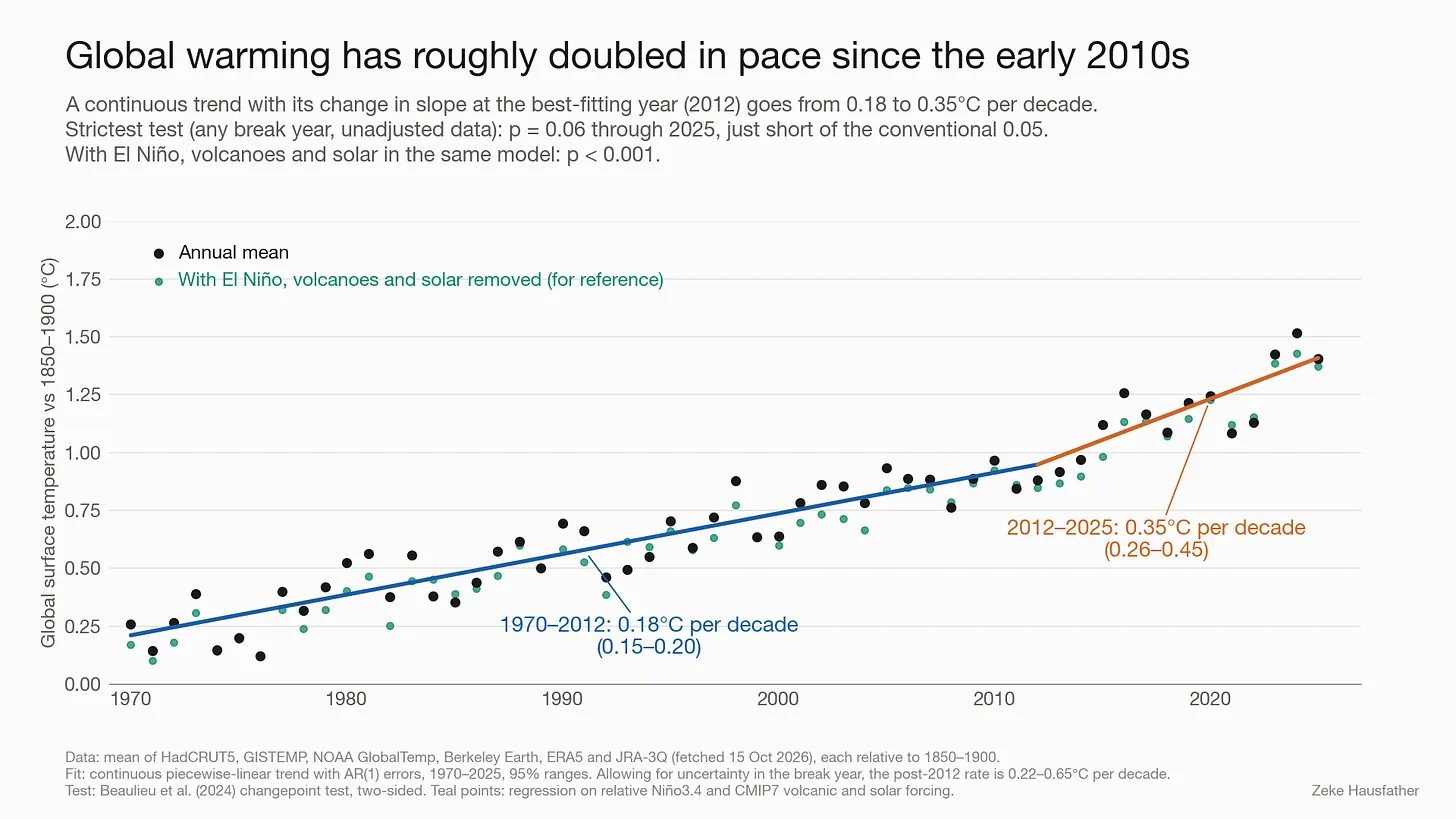
Whether that change is “statistically significant” depends on how you test it. Beaulieu et al. (2024) used a demanding test that allows the change to happen in any year, and found that a surge in warming was “not detectable yet” with data through 2023. Foster and Rahmstorf (2026) applied the same test to data through 2024 and also found no significant acceleration in the raw data, but argued that acceleration was detectable (with 98% confidence) after removing the estimated effects of El Niño, volcanic eruptions and solar variability. Running their test on the raw data through 2025, I get a p-value of 0.06 for the average of six global temperature datasets (just shy of the conventional 0.05 threshold). Across the individual datasets I’ve used in this analysis it ranges from 0.02 (NOAA) to 0.13 (JRA-3Q), with only NOAA and NASA’s GISTEMP below 0.05. If El Niño, volcanoes and solar are included in the same statistical model, it drops below 0.001.
2026 SkS Weekly Climate Change & Global Warming News Roundup #43
Posted on 25 October 2026 by BaerbelW, Doug Bostrom
Stories we promoted this week, by category:
Climate Change Impacts (6 items)
- Warming oceans hit the battlefield Marine radar signal propagation is highly sensitive to fine-scale vertical changes in water vapour. Now research shows that long-term increases in sea surface temperatures are strengthening the frequency and intensity of the features that allow radar signals to travel further than expected. Nature Climate Change, David D. Flagg, Oct 15, 2026.
- Climate change affects the quality of one of the world's most important staple foods Phys.org, Technical University Munich, Oct 18, 2026.
- Latest Climate Report Warns of Major Upheaval to California Way of Life The dire projections come from the state’s Climate Change Assessment, which analyzes the impacts of changing weather patterns on the nation’s most-populous state. NYT, Soumya Karlamangla, Oct 19, 2026.
- US extreme weather survivors are a growing group - now they want to be a political force At a gathering in Texas, near where floods killed 136 people last year, survivors are united on the need for urgent action The Guardian, Oliver Milman, Oct 21, 2026.
- Europe’s killer heat this summer claims 50,000 lives. Climate change blamed for two-thirds of deaths. AP News, Seth Borenstein, Oct 22, 2026.
- Most of the World`s Shallow Coral Reefs Could Collapse in the Next 50 Years If ocean temperatures continue to rise, experts warn these precious ecosystems may no longer be able to sustain marine life or the people who depend on them. Inside Climate News, Teresa Tomassoni, Oct 23, 2026.
Climate Education and Communication (5 items)
- Climate Trunk - Daily Life Summary post of John Lang's Climate Trunk visuals in the "Daily Life" ring Skeptical Science, Bärbel Winkler, Sept 20, 2026.
- `Weather under Fire`: The climate change film we`ve been waiting for Documentary chronicles how a broadcast meteorologist and his family encountered a life-changing onslaught of death threats for telling his audience some basic facts of physics. Yale Climate Connections, Jeff Masters, Oct 15, 2026.
- Who will pay for climate reporting? Against the backdrop of a steep drop in newsroom jobs, 38 climate and environment reporters gathered for two days of in-depth talks about to cover clmate change in an environment of increasing scarcity, with representation including big metro dailies, national print and radio outlets, and nonprofit pioneers. Circle of Blue, Brett Walton, Oct 18, 2026.
- How candidates are (quietly) talking about climate change - 3 election strategies you`ll see across the US The Conversation, Geoffrey Henderson and Nathaniel Geiger, Oct 19, 2026.
- `Voting is medicine`: These health professionals want you to vote in the midterms Physician Cynthia Mahoney says voting is a powerful prescription for health. Yale Climate Connections, Neha Pathak, Oct 23, 2026.
Skeptical Science New Research for Week #43 2026
Posted on 22 October 2026 by Doug Bostrom, Marc Kodack
Open access notables
 Rapid Increase in Geogenic CO2 Emissions from Antarctic Permafrost, Ruggiero et al., Global Biogeochemical Cycles
Antarctic permafrost and ice-free soils are generally assumed to make only a minor contribution to the global carbon cycle. This study shows that this assumption is incomplete. Using repeated field measurements and carbon isotope analyses, we document a marked multi-year increase in carbon dioxide emissions from Antarctic permafrost terrain and identify a substantial contribution from deep geologic carbon rather than modern microbial activity alone. Our results show that Antarctic permafrost can act as a pathway for the release of ancient carbon. This previously unrecognized process has implications for high-latitude carbon budgets and highlights the need to evaluate Antarctica in Earth system and climate assessments.
Experimental evidence of threshold-driven gas breakthrough in thawing permafrost, Shang et al., Frontiers in Environmental Science
Gas breakthrough is an important but poorly constrained mechanism for abrupt methane release during permafrost warming. This study presents an experimental investigation of gas breakthrough in saturated permafrost analogue soils subjected to controlled freezing and progressive thawing. A silty sand collected from Alaska’s North Slope was tested using an integrated program comprising unfrozen water content measurements, direct tensile tests, constant-volume gas breakthrough experiments, and stress-controlled breakthrough tests under confining pressures representative of shallow to deep permafrost. Unfrozen Water Content (UWC) measurements revealed a sharp, nonlinear reduction below 0 °C, with residual unfrozen water persisting at low temperatures and minor thermal hysteresis between freezing and thawing paths. Tensile strength increased nonlinearly with decreasing temperature, transitioning from ductile behavior near −2 °C to brittle failure at lower temperatures, while tensile resistance near −1 °C was negligible. Gas breakthrough occurred only when gas pressure exceeded thresholds governed by temperature-dependent unfrozen water content, tensile resistance, and confinement. Under high confinement, breakthrough pressures substantially exceeded unconfined tensile strength and occurred primarily during thawing near −1 °C. These results demonstrate that permafrost thawing significantly increases susceptibility to gas breakthrough and provide experimental constraints for assessing methane release from degrading permafrost.
Palaeoclimate constraints narrow uncertainty in future Arctic winter sea ice projections, Fu et al., Nature Geoscience
Arctic sea ice decline has been observed across all seasons and is projected to continue in the future. Relative to historical observations, climate models show their largest biases and uncertainties during winter, when ice cover strongly regulates air–sea heat exchange, ocean mixing and atmospheric circulation. Palaeoclimate records offer opportunities to evaluate model performance beyond the historical period, but applications have remained largely qualitative. Here we compile an Arctic-wide database of mid-Holocene (5–7 thousand years ago) biomarkers to assess sea ice simulations of this past warm period. Using a recently developed proxy system model, we present a Bayesian palaeoclimate model weighting scheme that refines the multi-model mean winter sea ice extent through fully quantitative proxy-model comparisons, accounting for model interdependence and non-stationary proxy seasonality. We demonstrate that, by adjusting the contribution of each model to the ensemble mean based on proxy evidence, model weights can eliminate biases and reduce uncertainties by 85%, to the level of interannual variability. Weighted projections using the same climate models indicate that future winter sea ice extent may be nearly 1 million km2 lower than prior estimates across forthcoming decades and possible emissions scenarios, with broad implications for Arctic ecosystems, mid-latitude weather, and cryosphere stability.
Resolving short-term meteorological variability amplifies projected glacier loss and sea-level rise, Tricht et al., Nature Communications
Global glacier models typically rely on temperature-index mass balance calculations forced with aggregated meteorological data, limiting their ability to resolve short-term variability. Here, we develop a daily-resolution version of the Global Glacier Evolution Model (GloGEM), which we apply globally and compare against the monthly configuration. Our results show that the daily model more closely reproduces mass balance observations and provides a more detailed representation of glacier runoff. Accounting for short-term meteorological variability leads to systematically greater projected mass loss, with up to 25% greater loss in Svalbard. These differences arise from extreme melt days, precipitation-phase transitions, and surface-type feedbacks not fully represented at monthly resolution. Globally, the daily model yields ice volume losses of 26 ± 10% under low-emission and 47 ± 17% under high-emission scenarios over 2025-2100 (ensemble mean ± 1 StD), resulting in an additional 5-10% mass loss (20-33 mm of global mean sea-level rise) relative to the monthly implementation. Resolving high-frequency forcing, or accounting for its effects through parameterisations, is therefore essential for robust glacier projections, while its omission may systematically underestimate future glacier loss.
From this week's government/NGO section:
The Myth of “Baseload” Power in Modern Power Grids, Jennifer Danis and Christoph Graf, Institute for Policy Integrity
the authors the term “baseload” power, together with other reliability-related energy concepts that are often used interchangeably, or in various combinations, to describe the resources’ role in electricity markets and regarding grid reliability. They also discuss why, despite the rhetoric indicating that electric grid reliability is at risk because of retiring “baseload,” “dispatchable,” or “firm” resources, these terms have distinct meanings for reliability in a diversely resourced grid.
Sounding the Alarm, Inside Track
The authors are deeply concerned that the level of physical climate and environmental risk they are seeing is increasing at a dangerous rate. The frequency, severity, and unpredictability of hazards are broadly increasing, as are the exposure and vulnerability of many parts of society to these hazards. They are worried that the risk levels we are seeing either are not being communicated to or are not being properly internalized by government. Without intervention these physical risks will translate into major economic risk. The undermining of the mortgage market drove the Global Financial Crisis – they are worried a major increase in uninsured, high-risk properties could manifest in a similar way as climate effects intensify.
Emissions Gap Report 2026: The point of return – Urgent emissions cuts needed to come back from overshoot of 1.5°C, Olhoff et al., United Nations Environment Programme
The authors detail the cuts to emissions needed by 2030, 2035 and 2040 to get on a return pathway — finding that the cuts needed are far above what current Nationally Determined Contributions deliver. However, the authors find that it is possible to close this emissions gap — pointing to many successful climate policies that have already delivered real-world emissions cuts and could be scaled up globally to accelerate action.
138 articles in 57 journals by 932 contributing authors
Physical science of climate change, effects
Enhanced Efficacy Contributes to Tropical Cyclone Intensification in Warmer Climates via Stronger Storm-Scale Radiative Feedbacks, Zhang et al., Journal of Climate 10.1175/jcli-d-25-0570.1
As El Niño fuels drought in Panama, trees help ranchers maintain their water supply
Posted on 21 October 2026 by Guest Author
This article by Nicolas Scibelli first appeared on Yale Climate Connections and is republished here under a Creative Commons Attribution-NonCommercial-NoDerivatives 4.0 International License.
[Haz clic aquí para leer en español]
A single stream nourishes the cattle of Ismael “Jim” Solis’ ranch on Panama’s Azuero Peninsula, which juts out into the Pacific Ocean.
Solis has raised cattle through countless droughts and dry spells over the years, weathering them with little concern.
But as El Niño builds strength ahead of Panama’s coming dry season, he worries that for the first time, his stream may run dry.
"We hope it keeps flowing, but we need more rain so it will last when the dry season comes,” he said.
Solis has spent his life raising cattle on the Azuero since his family arrived decades ago in the small town of Los Asientos on the southern part of the peninsula. His ranch is one of many that dominate the region, checkering the landscape in a matrix of rolling pasture dotted with trees, the last reminders of the expansive forest that once blanketed the surrounding hillsides.
 Extreme drought has caused the artificial reservoir on Cecibet Peralta's ranch to run dry. (Image credit: Nicolas Scibelli)
Across the Azuero Peninsula, extreme drought is stretching water resources thin. To counter it, some are switching to a more sustainable system of cattle ranching known as silvopasture, a method that incorporates trees into the landscape and helps preserve water. Those who have made the switch say the increased tree cover has proven vital in maintaining water supply and grass yield while neighboring farms feel the effects.
Still, with forecasts of a historically strong El Niño building in the coming months, a difficult dry season lies ahead for silvopasture and conventional ranchers alike.
Climate Trunk - Daily Life
Posted on 20 October 2026 by BaerbelW
In April 2026 we published a guest blog post by John Lang in which he introduced his "Climate Trunk" graphics project and website. Since then, he has been adding one graphic per week and plans to keep going for about 2 years rounding out the big picture of human-caused climate change graphic by graphic. In this blog post we'll show-case the graphics related to daily life and will keep adding more as they get published.
How our choices, voices and spheres of influence can help advance climate action.
#14 - True at the same time
Climate is not a story of either doom or denial. Emissions are still too high, impacts are worsening and clean energy is changing what’s possible. All three things are true at the same time.
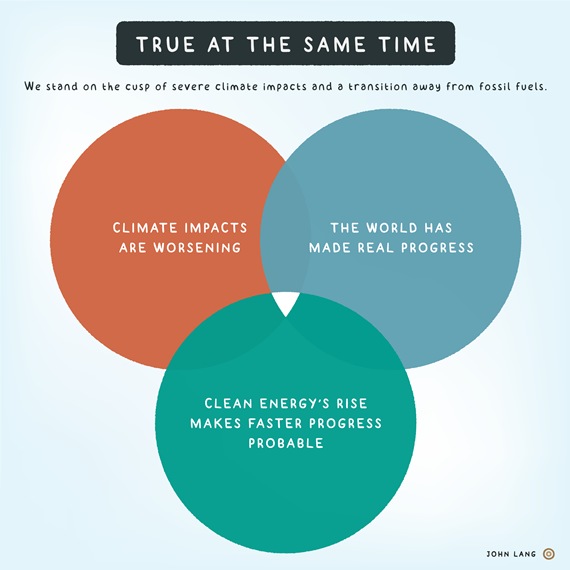
Three seemingly contradictory statements can all be true.
#20 - The persuadable majority
Nine in ten people are open to the evidence on human-caused climate change. The communication challenge is about helping the persuadable majority connect climate change to their values and everyday lives. Trust, relevance and shared values are more powerful than facts alone. Changing the minds of the one in ten – the dismissive minority – is not the task at hand.
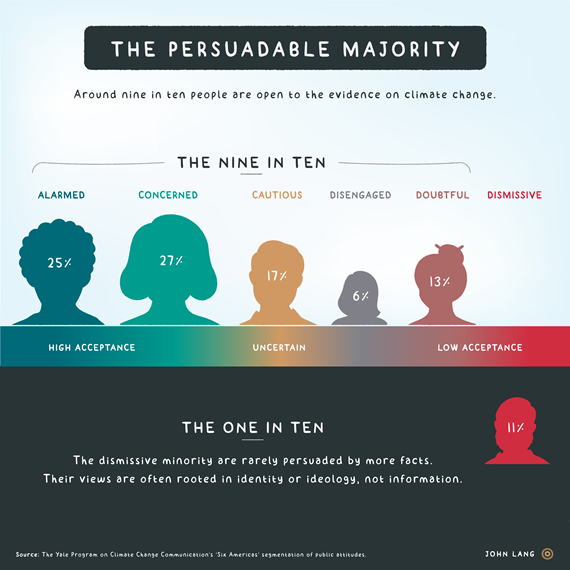
Around nine in ten people are open to evidence on climate change.
The strongest El Niño in a thousand years?
Posted on 19 October 2026 by , Zeke Hausfather
This is a re-post from The Climate Brink
Earlier this summer I told a journalist that it was not beyond the realm of possibility that this year’s El Niño would end up the strongest in 500 or even 1,000 years. That was a strong claim at the time, and I’ve had a few people ask how I could possibly know what El Niño was doing in the year 1200. It is a fair question, and the answer is that we know more than you might think.
This year’s El Niño event is already the strongest in the instrumental record based on Niño 3.4 region sea surface temperature anomalies. I’ve written in more detail about this year’s forecast here, and breaking the prior record over at Carbon Brief.
Daily Niño 3.4 anomalies passed the prior record (set in November 2015) on September 20th, and reached 3.4C as of this week. September as a whole had the highest Niño 3.4 temperature anomalies on record. And this year’s El Niño still has a few more months to grow; the latest runs in (from 14 seasonal forecast models) show this year’s El Niño peaking around 4C (with 80% of model runs ending up somewhere between 3.3C and 4.6C).
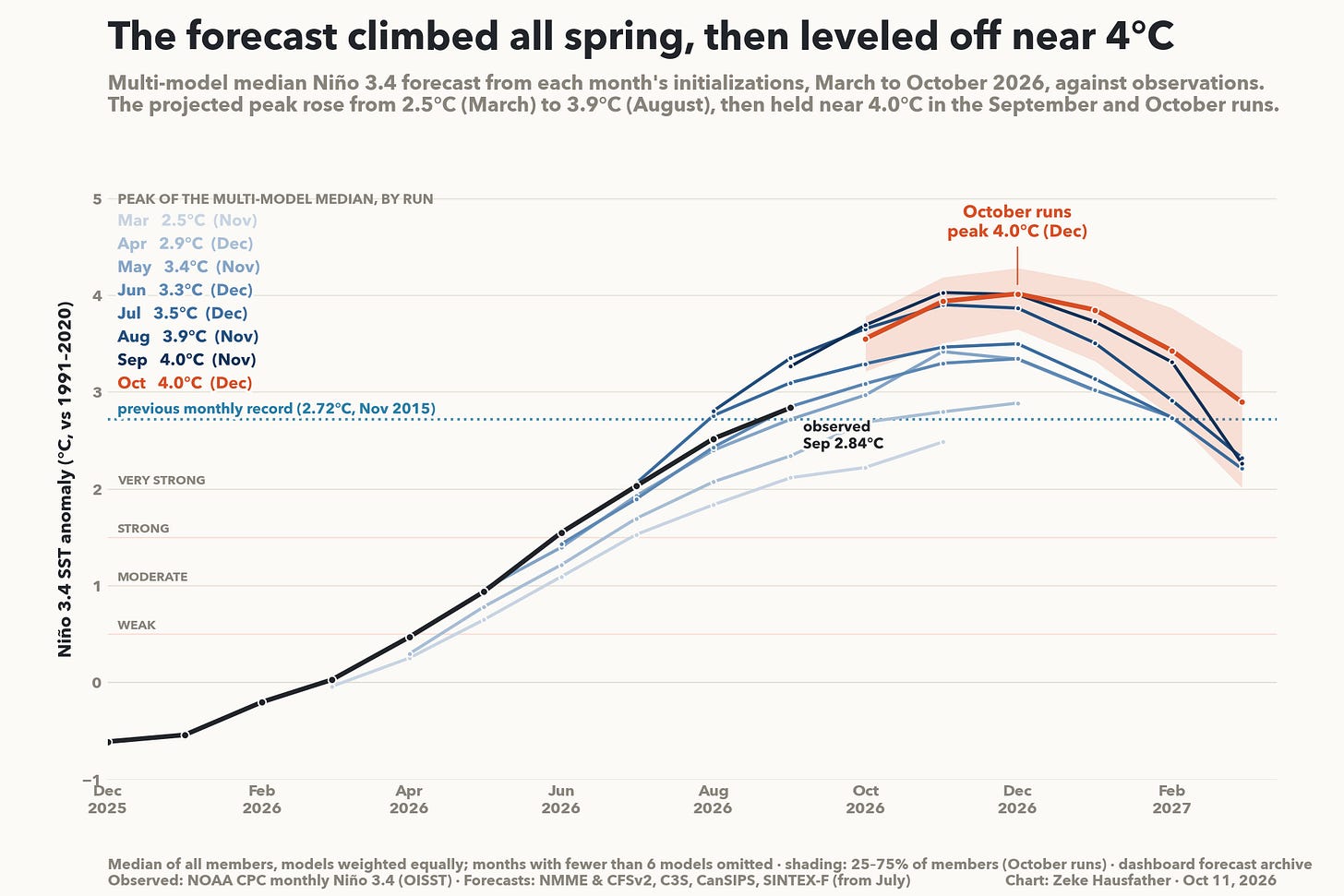
That being said, while the models underestimated the magnitude of the event earlier in the year, they have overestimated it over the past two months. However, with the first week of October already above 3C, the October forecast of 3.6C doesn’t seem outside the realm of possibility. But there remains a wide range of possible outcomes for this event across different modeling groups and ensemble members.
2026 SkS Weekly Climate Change & Global Warming News Roundup #42
Posted on 18 October 2026 by BaerbelW, Doug Bostrom
Stories we promoted this week, by category:
Climate Science and Research (6 items)
- Fingerprint Evidence for Human Effects on Climate: Advances After the 2009 Endangerment Finding Academic report finds obvious human effects on climate behavior and formally discredits a July 2025 report published by the US Department of Energy, Earth's Future, Benjamin Santer, Susan Solomon, David Thompson, Qiang Fu, Gabriele Hegerl, Sep 12, 2026.
- Fired Government Scientists Are Finding New Ways to Spread the Word on Climate Change Donald Trump’s administration fired scientists working on the next National Climate Assessment. They’re finding new ways to publish their research Rolling Stone, Thor Benson, Oct 12, 2026.
- Thousands of handwritten records reveal scale of warming in the Congo Congo Basin weather records have been poorly represented in climate assessments; to fill this gap scientists have digitized thousands of handwritten weather records, revealing significant warming in the region. Yale Environment 360, Yale Environment 360 staff, Oct 12, 2026.
- Big if True: New Paper Finds Doubling in Planet`s Rate of Warming A new paper suggests that the rate of warming of Earth's climate is higher than previously thought, but the final and best answer may depend on past El Niño effects. This is Not Cool, greenman3610, Oct 12, 2026.
- Skeptical Science New Research for Week #42 2026 Skeptical Science's latest weekly climate research survey. Skeptical Science, Doug Bostrom & Marc Kodack, Oct 15, 2026.
- Climate Overshoot Needs a New Generation of Researchers | Opinion Professor Yohe argues that dealing with the aftermath of climate overshoot will require a deep pool of scientific talent, and assembling that resource should begin now. Newsweek, Gary Yohe, Oct 15, 2026.
Climate Policy and Politics (5 items)
- SEC Issues Warning to Investment Firms That Challenged ExxonMobil The commission issued a rare “report of investigation” into the largest asset managers and state pension funds, part of a broader campaign to curb investor activism on climate risks. Inside Climate News, By Nicholas Kusnetz, Oct 09, 2026.
- Carbon Accounting May Be the Most Important Climate Fight You've Never Heard About Carbon accounting is a vital climate mitigation tool but the details are devilish. TIME, Justin Worland, Oct 09, 2026.
- IPCC is under pressure to delay publication of key global climate report AR7 report was scheduled for 2028 in time for Cop33 summit but some petro-states and major developing countries want to postpone it The Guardian, Fiona Harvey, Oct 13, 2026.
- Trump just effectively killed a popular solar energy program for rural America Solar panels can be an economic lifeline for farmers. Now they're going to be a lot harder to build. Grist, Frida Garza, Oct 16, 2026.
- Under US pressure, World Bank says it will back gas "where appropriate" The US wants the World Bank to expand its gas support while climate campaigners are pushing for it to end – its head spoke this week of limited backing for the fossil fuel Climate Home News, Joe Lo, Oct 16, 2026.
Skeptical Science New Research for Week #42 2026
Posted on 15 October 2026 by Doug Bostrom, Marc Kodack
Open access notables
Fingerprint Evidence for Human Effects on Climate: Advances After the 2009 Endangerment Finding, Santer et al., Earth s Future
Here we briefly review key advances in the field of climate fingerprinting. Fingerprint studies rely on pattern information to identify human and natural influences on Earth's climate. Our focus is on advances after 2009—the date of the finding by the U.S. Environmental Protection Agency (EPA) that emissions of six different greenhouse gases affect Earth's climate and endanger human health and welfare. In contrast to the conclusions from a 2025 review of climate science issued by the U.S. Department of Energy (DOE), we demonstrate that post-2009 scientific advances have markedly increased confidence in the identification of significant anthropogenic contributions to global climate change. These advances were enabled by longer and improved observations of climate change, by large single-model and multi-model ensembles of simulations that yield estimates of forced climate change signals and natural variability, and by the application of climate fingerprint methods to a wide array of independently monitored variables. Increasingly, scientists are now able to quantify the impact of human-caused climate change on the probability and intensity of certain types of extreme event, particularly in the case of heat waves and the heavy rainfall in some regions. In tandem with such scientific advances, global warming has also advanced: the post-2009 period included the 10 warmest years in instrumental surface temperature records, enhancing the signal of human-caused warming relative to intrinsic variability. The evidence for pervasive human fingerprints throughout Earth's climate system is incontrovertible.
Extreme Heat and Rainfall Risk Attributed to Cumulative CO2 Emissions From Fossil Fuel Producers, Callahan, Earth s Future
Legal and political approaches to climate accountability require demonstrating that a particular emitter contributed to a climate impact, but quantitative solutions to this attribution challenge remain nascent. This study leverages the proportionality of global warming to cumulative CO2 emissions to develop statistical models that directly predict extreme climate risk from cumulative emissions. Results show that cumulative emissions from individual actors have increased the probability of extreme heat and rainfall globally; for example, emissions from the United States have increased the risk of recent extreme heat by at least 50% for one-third of the globe. Focusing on specific events demonstrates that emissions from major fossil fuel firms increased the likelihood of the 2021 Pacific Northwest heat wave by 31% and 2022 extreme rainfall in Pakistan by 7%. These results demonstrate a flexible attribution framework grounded in the proportional relationships that inform climate policy, with the potential to guide efficient climate accountability assessments.
Record-setting heavy precipitation occurrence in 2024, Thackeray et al., Science Advances
Precipitation extremes have increased globally in recent decades, consistent with a warming climate. We find that 2024 experienced a record-high frequency of heavy (≥99th percentile; FP≥99) precipitation events globally based on MSWEP (Multi-Source Weighted-Ensemble Precipitation) observations from 1979 to 2025. This extends a long-term trend of ∼0.03%/decade in FP≥99, with similar but more uncertain increases for the 99.9th percentile. Unlike prior high FP≥99 years, 2024’s record was more globally distributed and emerged from a distinct seasonal evolution. El Niño and rare concurrent multi-basin tropical ocean warmth drove elevated extremes early in the year, before lagged global tropospheric responses and long-term warming sustained and amplified extremes through boreal summer. Climate models indicate that years with 2024-level FP≥99 typically require either stronger El Niño forcing or concurrent multi-basin sea surface temperature (SST) anomalies. Diagnostic projections within constrained ensemble members suggest that ∼40% of the 2024 anomaly aligns with global mean temperatures and ∼20% with El Niño variability, with some of the remainder linked to basin-scale SST structure.
A recent doubling of global warming rate signals a 1.5 °C breach by 2028, Jin & Pu, npj Climate and Atmospheric Scienc
Timely and accurate projections of when global warming will exceed the Paris Agreement’s 1.5 °C threshold are essential for effective climate policy. Existing estimates place this exceedance in the early 2030 s but carry substantial uncertainty. Here we analyze the latest observational temperature records through 2025 and identify a statistically significant doubling of the global warming rate during 2011–2025 (0.40 °C per decade) compared to 1971–2025 (0.20 °C per decade). Extrapolating this accelerated rate projects a crossing of the 1.5 °C threshold by 2028, nearly a decade earlier than previous estimates. Regional analyses attribute this acceleration primarily to intensified warming over East Asia–the North Pacific, mid-latitude Eurasia, and the South Atlantic–Antarctic regions. The ensemble mean of 26 climate models fails to capture the observed doubling of the warming rate, simulating a rate of only 0.29 °C per decade. These findings suggest a narrower window remains to limit warming to 1.5 °C, underscoring the urgency for rapid and substantial reductions in greenhouse gas emissions.
Learning from young conservatives: Increasing pro-environmental behavior change and climate policy support in the United States, Caballero et al., Energy Research & Social Science
This study uses a mixed-methods (i.e., virtual focus groups with group discussion based on live polling results) approach to explore which potential interventions show the most promise for engaging conservatives on the topics of climate policy and household action, specifically among young people in the United States (U.S.). In coordination with the non-profit organization American Conservation Coalition (ACC), we held six virtual focus groups with ACC members from geographically diverse chapters. Using our mixed methods approach, we explored political efficacy, as suggested by ACC members, as well as four messaging types informed by the social psychological literature: superordinate identities, solution aversion, pluralistic ignorance, and personal responsibility. Our results suggest that young conservative study participants identified messages intended to address solution aversion and pluralistic ignorance to be most promising. Our results also suggest that although young conservative participants in the study tend to engage in incremental, convenient pro-environmental behaviors, they are optimistic about the potential for positive spillover effects. Additionally, our focus groups revealed that a promising area of future study is that young conservatives could serve as important messengers for pro-environmental individual action and support for climate and energy policies among their conservative peers. Thus, the study suggests promising topics for research on the role that young conservatives could play in supporting climate and energy-related initiatives.
From this week's government/NGO section:
Spinning Renewable Success Into a Climate Conspiracy: Co-opting the climate science story of RCP8.5, Climate Action Against Disinformation
Fossil fuels cause climate change, and replacing them with renewables will keep our climate safe for human civilization and natural ecosystems. The progress we made towards a cleaner future means that the worst possible fossil fueled warming gets less and less likely. Thanks to the massive growth in renewables, we are finally winning the climate fight- so why are some people claiming exactly the opposite, that it was a hoax all along? Over the years, “Representative Concentration Pathways”, or RCP scenarios have been refined, as renewable energy has gained momentum around the world, pushing the planet away from the most-heavily-fossil-fueled future that represented the worst-case scenario of a climate crisis, and into slightly safer territory. But this good news, tempered as it is by the incredible amount of work remaining to fully decarbonize, is highly technical, scientific, and detailed. That is not, however, how it was portrayed in the fossil fueled disinformation ecosystem, that instead interpreted it as evidence confirming a climate conspiracy theory.
Manufacturing Petropopulism: Exposing the secretive network of front groups shilling for Big Oil in Canada, Abde Amr and Keith Stewart, Greenpeace
The authors' investigation has identified a shadowy and coordinated network of pro–fossil fuel front groups, companies, think tanks, and charities that claim to have reached over one hundred million people. Based on materials and data from the entities involved, this investigation reveals influence efforts by the oil-linked Energy in Action (EIA) network, whose members are receiving funding and support from the Canadian Energy Prosperity (CEP) group, aiming to shape the energy conversation in Canada. Over 30 entities, targeting six different sectors, have been identified as part of a coordinated network, operating under the EIA umbrella and supported by CEP to manufacture support for the oil and gas industry and advance its' narratives. EIA appears to be linked to the Canadian Association of Petroleum Producers (CAPP), with many network entities receiving direct funding from the oil and gas sector. The network spreads its' influence across diverse sectors, including technology, grassroots advocacy, and industry trade associations, targeting specific groups including women, youth, students, and Indigenous communities among others.
The AI Gas Rush: Risks and Implications of “Bring Your Own Power”, Bangsund et al., Earthjustice
The race to scale artificial intelligence is driving an unprecedented rush to build power plants solely to power data centers that are predominantly gas-powered. These power plants are evading regulations, harming communities and the climate, and are not a solution to rising energy bills. The authors explore and analyzes this trend. Policymakers across the nation are incentivizing or requiring Bring-Your-Own-Power (BYOP) in an attempt to address energy bill impacts from new AI data centers. But AI data center developers are turning to BYOP to gain access to power as quickly as possible (“speed-to-power”) — not to solve the energy bill impacts of AI. The authors find potential ratepayer benefits are not guaranteed, while harms of the massive gas BYOP buildout have been inadequately addressed.
143 articles in 58 journals by 1015 contributing authors
Physical science of climate change, effects
A recent doubling of global warming rate signals a 1.5 °C breach by 2028, Jin & Pu, npj Climate and Atmospheric Science Open Access pdf 10.1038/s41612-026-01561-y
Climate Trunk - Governance
Posted on 14 October 2026 by BaerbelW
In April 2026 we published a guest blog post by John Lang in which he introduced his "Climate Trunk" graphics project and website. Since then, he has been adding one graphic per week and plans to keep going for about 2 years rounding out the big picture of human-caused climate change graphic by graphic. In this blog post we'll show-case the graphics related to governance and will keep adding more as they get published.
The rules, institutions, diplomacy and accountability mechanisms that seek to coordinate action.
#10 - The World spoke
The UN General Assembly backed the ICJ’s landmark climate ruling by 141 votes to 8. The eight voting against, including the US and Russia, account for one-third of cumulative historical CO2 emissions since 1750.
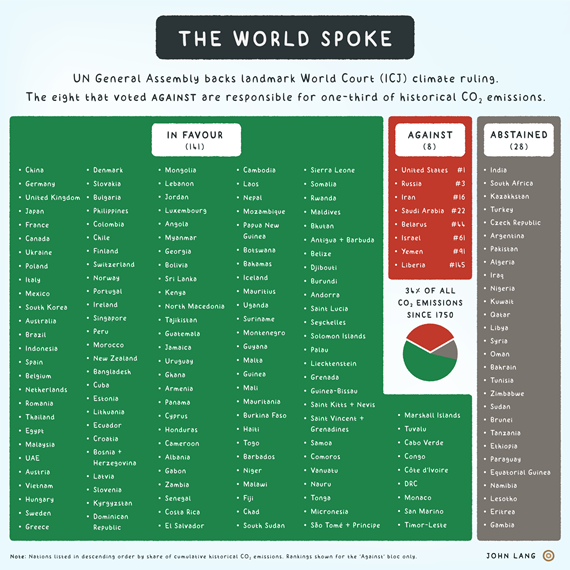
The UN overwhelmingly backed the World Court’s climate ruling.
Fact brief - Does onshore wind power need subsidies to compete with fossil fuels?
Posted on 13 October 2026 by Sue Bin Park
Skeptical Science is partnering with Gigafact to produce fact briefs — bite-sized fact checks of trending claims. You can submit claims you think need checking via the tipline.
Does onshore wind power need subsidies to compete with fossil fuels?
Unsubsidized onshore wind is now generally cheaper than building fossil fuel plants.
Cost of energy sources are compared using “levelized cost of energy,” or the average lifetime cost to build and run a power plant divided by electricity produced. A 2026 report estimated the mean LCOE of unsubsidized onshore wind at $68 per megawatt-hour, compared to $90 for new natural gas plants and $124.50 for coal.
Developments like supply chain maturation, improved monitoring, and larger, more productive turbines have allowed the LCOE of onshore wind to decrease by 70% since 2010.
While recent inflation, rising interest rates, and trade barriers have increased costs across all energy generation technologies, onshore wind is still cheaper than fossil fuel plants and projected to decrease further in the long-term.
Go to full rebuttal on Skeptical Science or to the fact brief on Gigafact
This fact brief is responsive to quotes such as this one.
Sources
Lazard Lazard Releases 2026 Levelized Cost of Energy+ Report
IRENA Renewable power generation costs in 2025
U.S. Department of Energy The Future of Offshore Wind Is Big—Literally
IRENA Wind energy
U.S. Department of Energy Experts Predict 50% Lower Wind Costs Than They Did in 2015
Columbia Law School Sabin Center for Climate Change Law Rebutting 33 False Claims About Solar, Wind, and Electric Vehicles
Please use this form to provide feedback about this fact brief. This will help us to better gauge its impact and usability. Thank you!
How Hurricane Isaias broke through to become the first Atlantic hurricane in an extremely quiet 2026 season
Posted on 12 October 2026 by Guest Author
This article by Christopher Davis, UMass Amherst is republished from The Conversation under a Creative Commons license. Read the original article.
Hurricane Isaias shattered the peace of one of the quietest Atlantic hurricane seasons on record as it grew into 2026’s first Atlantic hurricane and made landfall on the northern Gulf Coast near Destin, Fla., late on Oct. 9.
The Category 2 hurricane’s storm surge reached 5.6 feet at nearby Panama City Beach as it crossed the coast. Forecasters warned of damaging wind gusts over a large portion of the southeastern U.S. and flooding rain as the storm moved inland toward the Appalachian Mountains.
Isaias tied a 1905 storm for the latest-forming first hurricane of a season on record. To understand why it was able to strengthen into a hurricane when no other storms in the first two-thirds of the 2026 season did, let’s take a look at what was going on in the atmosphere.
As an atmospheric scientist who has studied hurricanes for years, I can tell you that wind shear and the climate phenomenon known as El Niño both play important roles.
 Hurricane Isaias faced strong winds as it moved across warm Gulf waters. The wind influence is evident in the storm’s lopsided rain bands, primarily pushed to its northeast, on Oct. 8, 2026. NOAA
2026 SkS Weekly Climate Change & Global Warming News Roundup #41
Posted on 11 October 2026 by BaerbelW, Doug Bostrom
Stories we promoted this week, by category:
Public Misunderstandings about Climate Science (5 items)
- Climate Fraud 101: Big Oil's Climate Deception Explained in 101 Documents, 1957-2026 The Center for Climate Integrity's 'Climate Fraud 101' documents seven decades of costly fossil fuel industry deception about human-caused climate change and climate change impacts. Center for Climate Integrity, Eva Carpenter, Davis Allen, Megan Matthews, Kert Davies, Sep 30, 2026.
- Trump Mocked Over 'Biggest Ice Cube' Claim During Texas Climate Rant The president did not specify which ice measurement he meant, while National Snow and Ice Data Center figures do not show a record-high Arctic extent. IBT, James RJ Florentino, Oct 02, 2026.
- Opinion: I used to believe climate change was a hoax 'My experience shows why local politicians need to push back against climate denialism.'' The Tyee, Erin Blondeau, Oct 05, 2026.
- New Documents Add to Evidence in Climate Deception Case Against ExxonMobil Court filings by the Massachusetts attorney general’s office include previously undisclosed documents, revealing new details about internal deliberations at the oil giant. Inside Climate News, By Nicholas Kusnetz, Oct 07, 2026.
- Inside the web of pro-oil and gas groups shaping Canada`s climate change narrative New research by Greenpeace Canada lays out a web of pro-oil-and-gas groups working together to influence public opinion on climate change The Narwhal , Carl Meyer, Oct 09, 2026.
Public Misunderstandings about Climate Solutions (4 items)
- Chevron Gave $150K to Bay Area Group Accused of Using AI to Fight Heat Pump Rule The group claimed victory after regulators recommended delaying landmark rules that would eventually phase out gas water heaters in 2.8 million homes. DeSmog, Miranda Green, Oct 5, 2026.
- The American Livestock Industry`s Main Lobbying Group Treated Climate Change as a PR Problem New research has revealed more examples of the National Cattlemen’s Association’s efforts to downplay and deny the industry’s greenhouse gas emissions. Inside Climate News, Georgina Gustin, Oct 07, 2026.
- Who`s telling you climate change is no big deal? A new report traces the financial connections behind conservative media’s latest attack on climate science. HEATED, Emily Atkin, Oct 08, 2026.
- To Block Solar Energy Projects, One Community Lumped Them in With Junkyards and Adult Bookstores Heated opposition to energy modernization via photovoltaic and wind generation systems is fanned by ample misinformation. Inside Climate News, By Dan Gearino, Oct 08, 2026.
Miscellaneous (4 items)
- 2026 SkS Weekly Climate Change & Global Warming News Roundup #40 A listing of 28 news and opinion articles we found interesting and shared on social media during the past week: Sun, September 27, 2026 thru Sat, October 3, 2026. Skeptical Science, Bärbel Winkler & Doug Bostrom, Oct 04, 2026.
- Revealed: the methane mega-leaks from UN climate summit host Turkey Exclusive: Cop31 leader calling for global curbs on climate-heating gas has landfills producing some of world’s worst plumes The Guardian, Damian Carrington and Ruth Michaelson and Ayça Aldatmaz, Oct 05, 2026.
- Did the hot summer make more people worry about climate change? The Conversation, Lorraine Whitmarsh & Bella Zanin, Oct 06, 2026.
- An Influential Voice in the Climate Debate Has Died at 66 Joe Romm was a prolific writer who never hesitated to take on climate change deniers and the fossil-fuel industry — or even ostensible allies. New York Times, Clay Risen, Oct 06, 2026.
Skeptical Science New Research for Week #41 2026
Posted on 8 October 2026 by Doug Bostrom, Marc Kodack
Open access notables
Committed Antarctic Ice Sheet mass loss by the end of the twenty-first century, Lin et al., Nature Geoscience
The Antarctic Ice Sheet is the largest source of uncertainty in sea-level rise projections, with uncertainties propagating through emissions scenarios, atmosphere–ocean general circulation models, ice-sheet dynamics and sea-level physics. In ice-sheet model intercomparison exercises, these uncertainties—typically attributed to intermodel differences—stem from modelling choices that may bias ensembles towards commonly adopted approaches regardless of observational consistency. Here we quantify how each individual physical assumption cascades into projection uncertainty using a machine-learning emulation framework, which also enables Bayesian calibration against satellite observations to reduce projection bias. Our results suggest it is very likely (≥0.92 probability) that the Antarctic Ice Sheet is committed to twenty-first-century mass loss, even under aggressive emissions-reduction scenarios. Higher emissions drive greater Antarctic mass loss by 2100 (≥0.89 probability), directly elevating near-term coastal risks. Under very high-emissions scenarios, we identify cascading mechanisms that could produce up to 25.4 cm of sea-level rise by 2100 (95th percentile; median = 15.7 cm) while remaining consistent with satellite observations. Effective management of these risks to densely populated coastal communities requires rapid emissions reductions and improved constraints on climate model selection, sliding laws and ice-shelf melt parameterizations.
Hysteresis and irreversibility in permafrost physical response to increase and decrease of CO2 emissions, Watanabe et al., Earth System Dynamic
Boreal permafrost over the Northern Hemisphere high latitudes, defined as areas where the ground temperature is below 0 °C for two or more years, stores more than twice as much carbon as the atmosphere. Therefore, thawing of the permafrost, a tipping element, due to global warming may lead to additional carbon emissions and accelerate the warming. To investigate the permafrost response to increase and decrease of CO2 emissions, we conducted a series of numerical experiments using an emission-driven Earth System Model, MIROC-ES2L, and adopting idealized overshooting scenarios in which a prescribed CO2 emission of 10 PgC yr−1 is given until the global warming level reaches different values between 2 and 8 °C followed by the negative emission until the cumulative emission becomes zero.
We found that the response of permafrost area to surface warming and cooling is reversible but has hysteresis for all the emission scenarios. Furthermore, the permafrost property such as the ratio of frozen to liquid water was shown to have irreversibility in the deep soil layer; part of the frozen area in the initial condition was replaced by a mixed water-ice area in the final state despite ground temperature returning almost to the initial condition. Sensitivity experiments reveal that the hysteresis and irreversibility are attributed to the delay of the soil freezing and melting associated with the soil heat conductivity and specific heat of water phase change. This result indicates that once permafrost thaws with warming it will continue for decades after warming diminishes and the delay in the permafrost recovery is larger at global warming levels greater than 2 °C. An offline calculation shows that the additional CO2 emission during the permafrost hysteresis cycle accounts for about 0.6 %–41 % of the cumulative carbon emission released from thawed permafrost in flat10 and NEC experiments.
Trends and Extremes of Near-Surface Dry-Bulb, Wet-Bulb, and Dewpoint Temperature across Southeast Asia and Northern Australia (1980–2021), May et al., Journal of Applied Meteorology and Climatolog
Trends in seasonal average dry-bulb temperature T, wet-bulb temperature TWB, and dewpoint temperature TD over the last 42 years (1980–2021) were analyzed over the Southeast (SE) Asian and tropical northern Australian region. All three variables show broad positive trends in most areas, except for relatively weak, nonsignificant trends over northern Australia. Trends in TD and TWB are as high as 0.5°C decade−1 in parts of SE Asia, with generally slightly smaller observed trends in TWB than in T. Trends over the ocean tend to be less variable and slightly weaker on average. We observe an increased occurrence of extreme events in recent years (the 2010s) compared to earlier decades. The T, TWB, and TD extremes occur substantially more frequently during El Niño years, in addition to an underlying increasing trend.
Advancing a Coordinated Strategy for Decision-Relevant Climate Data Products for the United States, Ullrich et al., Bulletin of the American Meteorological Society
Climate adaptation practitioners, planners, and policymakers rely on historical reconstructions and future projections of regional to local climate for adaptation, resilience, and risk management. To serve the many needs of these users, climate data must be relevant for informing the decision-making process (“salient”), consistent with our physical understanding of the global Earth system (“credible”), backed by expert judgment (“authoritative”), and publicly available and ready for use (“accessible”). As more decision-relevant climate data products are being developed to address outstanding needs, important challenges have emerged around the selection, evaluation, use, and standardization of these data products. This article examines opportunities and challenges associated with regional climate data for the United States and describes nascent efforts to build a coordinated strategy among communities of producers and users to maximize the utility of decision-relevant datasets. A community of practice (CoP) is now emerging to benefit both end users and data producers. The CoP will enable enhanced evaluation protocols, improved uncertainty quantification, and eased data distribution and usage, informed by ongoing input on data needs and feedback on quality and usability of data from a wide range of user communities. Broad coordination among interested parties and periodic reviews of the state of the field are vital to the success of this community of practice.
They reduce, we reduce: Perception of other countries’ climate effort predicts support for climate policies, Tam et al., PLOS Climate
As public support influences policy choices, it is crucial to understand how people view climate policies. Based on the premise that individuals tend to be conditional cooperators, we derived the “They Reduce, We Reduce” hypothesis, according to which citizens’ support for climate policies in their own country is higher if they perceive a stronger climate effort by other countries. We tested this hypothesis with a survey study (N = 4,000) in China, India, Japan, and the United States. Findings show that participants who perceived that other countries were likely and willing to take action to reduce climate change, or that the major emitters in the world were currently making substantial efforts, were more supportive of implementing climate policies in their own country. We also observed interindividual variations in this effect, though the patterns differed between countries: The policy attitudes of individuals who felt personally obligated to combat climate change and those who supported their country’s unconditional efforts were less tied to such perceptions. These findings suggest that people respond to other countries’ actions, and policy attitudes should be understood in the context of global climate governance, with reciprocity playing an important role in mobilizing public support.
From this week's government/NGO section:
Economic, Consumer Cost, Pollution Impacts of Federal Energy Policy Changes In 48 U.S. States, Energy Innovation
Federal policy changes since January 2025 will harm the 48 contiguous U.S. states with higher energy prices, lost economic growth and jobs, worse air pollution and healthcare costs, and less grid reliability. Households will pay an additional $920 billion for energy between 2026-2040 – about $6,500 cumulatively per household across that period and $640 per household in 2035. Cutting policies that drive transportation sector innovation and efficiency will inflate gasoline prices 54 cents per gallon in 2035 and 93 cents per gallon in 2040, atop upward pressure from the Iran war. OBBBA and federal cuts to domestic manufacturing and innovation will cost 390,000 jobs per year on average, totaling 6.2 million job-years lost to state economies. Slowing down electrification and domestic energy manufacturing will lower GDP, spilling into other economic sectors, costing state economies $1.3 trillion in cumulative GDP losses. Worsening local air pollution will cause 37,000 additional premature deaths and raise healthcare costs by $72 billion, contributing to rising household costs alongside rising energy prices and goods inflation. All federal energy policy decisions and climate repeals will generate 9.3 billion tons of CO2e emissions, roughly 580 million tons per year.
Offshore Wind Lease Buyouts. Picking Winners and Losers Costs Taxpayers Billions, Taxpayers for Common Sense
As of September 2026, the Department of the Interior (DOI) has agreed to pay energy companies up to $3.9 billion to cancel 12 leases they previously obtained at competitive auctions, on the condition that they make equivalent investments in conventional energy projects instead. These buyouts carry significant implications for American taxpayers and consumers, and there could be more to come. Concerns with offshore wind lease buyouts include the following; Costs Taxpayers $3.9 Billion to Cancel Projects Already Underway: The agreements would return billions in taxpayer revenue already deposited into the federal Treasury to wind developers in exchange for terminating their offshore wind leases; Picks Winners and Losers: The Administration is using billions in refunds to steer investment toward specific energy sectors, manipulating the free market. These cancellations run counter to market trends and private investment decisions. Companies won these leases through competitive auctions; now the Administration is determining which projects and energy sectors qualify for taxpayer-funded refunds; Decreases Planned Domestic Energy Supply: The 12 canceled leases were expected to support projects with a combined nameplate capacity of 19.2 gigawatts (GW), enough to power 6.6 million households. Their cancellation deprives consumers of a future source of domestic energy production; Undermines Energy Security: Robust and diverse energy sources strengthen the domestic energy market. Energy companies paid billions of dollars to secure federal offshore wind leases to diversify their energy portfolios, and now the Administration is undermining their diversification efforts. Although the Administration claims the refunds support new investments, some agreements count investments companies had already made, meaning these taxpayer-funded refunds will not lead to new investment or increase future energy supply.
Climate Fraud 101. Big Oil’s Climate Deception Explained in 101 Documents (1957–2026), Megan Matthews and Kert Davies, The Center for Climate Integrity
For decades, fossil fuel industry leaders were warned that, unless action was taken, communities across the globe would suffer catastrophic harms caused by their products. What they did with that knowledge is the story of the most consequential corporate deception campaign in world history. The authors highlight decades of Big Oil’s climate lies through 101 documents showing that the industry knew and lied about its' central role in the climate crisis.
159 articles in 86 journals by 872 contributing authors
Physical science of climate change, effects
Asymmetry in carbon cycle feedbacks and transient climate response under positive and negative CO2 emissions, Chimuka & Zickfeld, Biogeosciences Open Access pdf 10.5194/bg-23-6211-2026
Scientists link fossil fuel producers to the West’s worsening water shortages
Posted on 7 October 2026 by Guest Author
This is a re-post from Yale Climate Connections by Barbara Grady
As the Western United States grapples with severe drought, leading cities to scramble for water and farmers to abandon some crops, a new scientific study has found that 122 major oil, gas, coal, and cement companies and state-owned operations are partially responsible.
The study found that climate change from all climate-warming greenhouse gas emissions over the last 70 years has resulted in a 36% decline in annual average mountain snowpacks, the major source of surface water in Western states – and that about 40% of that decline is linked to the climate pollution caused by just 122 companies.
The annual loss attributable to those 122 companies is equivalent to the amount of water held by Lake Mead, the nation’s largest reservoir, at full capacity.
The authors of the peer-reviewed paper, “Carbon emissions exacerbating the Western US water crisis,” also found that global warming from greenhouse gas emissions has led to a 13% decline in average annual streamflows from mountains to the lower-lying areas that depend on them, and to a 4.3% increase in the need for agricultural irrigation. The study attributed about half the streamflow declines and roughly half the increased need for irrigation to the warming caused by the 122 companies. In other words, those companies’ products resulted in a 6% fall in streamflows in the region, according to the study.
Nine scientists from the University of California at Merced and the Union of Concerned Scientists contributed to the study, published August 25 in the Nature magazine affiliate Communications Earth & Environment.
The world without solar and wind?
Posted on 6 October 2026 by Zeke Hausfather
This is a re-post from The Climate Brink
Twenty years ago, wind, solar and other non-hydro renewables were close to a rounding error. In 2005 they supplied a mere 2.0% of the world’s electricity generation. By 2015 that had risen to 6.8%, and by 2025 it was up to 19.8%. According to the IEA Electricity 2026 outlook, non-hydro renewables will supply around 21.8% of global electricity in 2026, edging past natural gas (21.6%) to become the second-largest source of power after coal.1
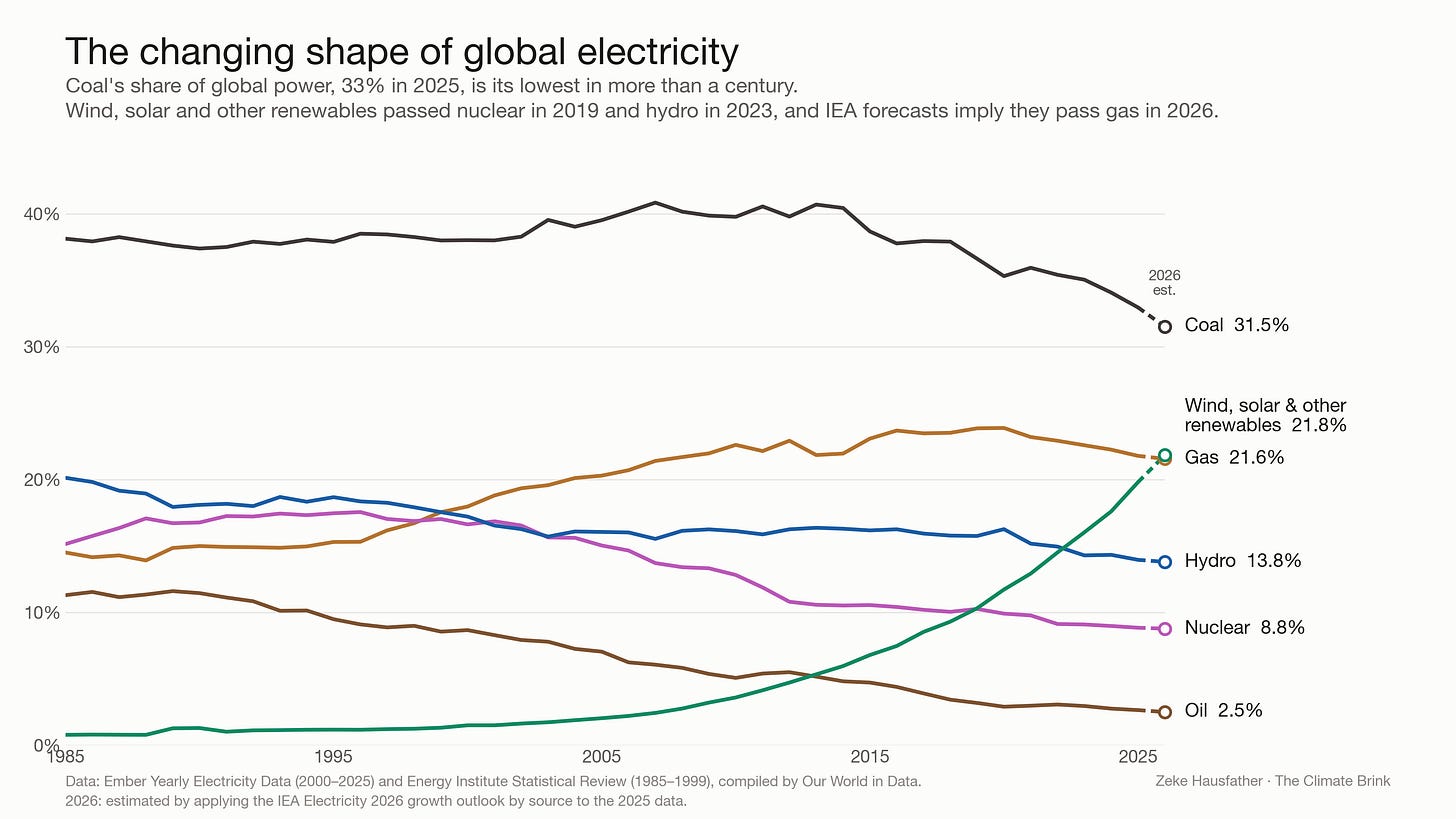
That is a remarkable pace of growth from an industry that barely existed two decades ago. But not everyone is impressed; many commenters on social media have responded to these figures by pointing out that despite the growth of renewables, fossil fuel generation continues to grow as well. They aren’t wrong; global coal generation set a record in 2024. Gas generation reached a new high in 2025.
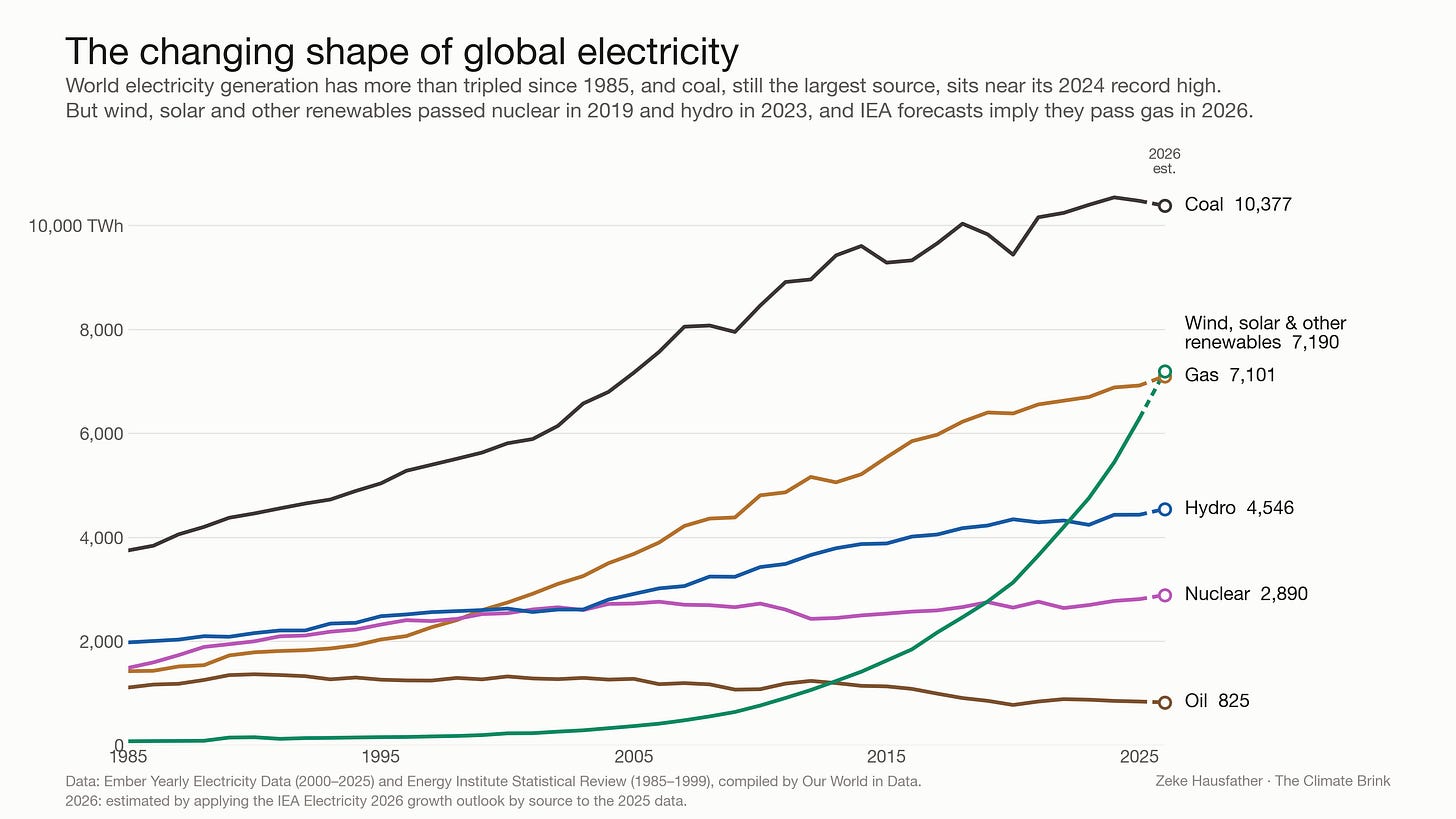
Their point is that clean energy isn’t replacing fossil fuels at all. It’s simply being piled on top of them to feed an ever-growing appetite for electricity, making this an “energy addition” rather than an energy transition. Global fossil electricity generation around 50% higher today than it was in 2005. Coal generation rose by 3,300 TWh and gas by 3,200 TWh. The world burns more coal for power now than it did when wind and solar started taking off.
This argument has been made in the past both by skeptics of growth and by energy systems modelers. The historian Jean-Baptiste Fressoz argues in More and More and More (2024) that “far from the industrial era passing through a series of transformations, each new phase has in practice remained almost wholly entangled with the previous one.” Coal mining created a huge new demand for timber for pit props, while the oil age ran on steel made with coal. Vaclav Smil has made the same point about today’s clean energy boom more bluntly: ”We use more fossil fuels today than at any time in history… Renewables are not replacing fossil fuels; are joining them.”
America is hurtling toward a power grid crisis
Posted on 5 October 2026 by dana1981
This is a re-post from Yale Climate Connections
A crisis is brewing for the U.S. electricity grid – one that could make your electric bill skyrocket and thwart efforts to address climate change.
To understand the problem, think of transmission lines – the poles and wires that transport electricity from power plants to homes and businesses – as an interstate highway system for electrons. Like too many cars on the road, too many electrons traveling across power lines can cause traffic jams.
These sorts of jams haven’t been a problem until just recently, as power-hungry data centers proliferate and demand from electric vehicles, heat pumps, and air conditioning grows.
As a result, Americans’ electricity rates, which already spiked by more than one-third over the past five years, are poised to keep rising.
Read: Home electricity bills are skyrocketing. For data centers, not so much.
What’s more, when rising demand meets inadequate grid capacity, that slows efforts to address climate pollution. When new clean power sources are stymied by too much traffic on power lines, existing fossil fuel power plants are forced to remain in service and burn gas and coal more often. And when data centers are unable to connect to the grid, they often build dirty on-site natural gas power generation instead.
Adding more transmission lines to the grid would ease congestion, but on average, permitting and building a new transmission line in the U.S. takes a decade. Some big multistate transmission lines have taken over three decades to complete. And the Trump administration recently axed Congress’ attempts to accelerate the process.
A bipartisan group of senators just released a bill that would reform permitting for transmission lines and other large projects, speeding up the process for constructing new lines. But time is running short in this session of Congress, and the stakes of inaction are high.
"Failing to pass permitting reforms would have real consequences for all of us,” said Zach Zimmerman, director of research and policy for Grid Strategies, a power sector consulting firm, in an email. “Every year that major transmission projects are delayed means higher system costs and less ability to move power where it is needed during extreme weather. Without reform, we will continue to pay more for the grid.”
The U.S. has struggled to modernize its grid
The demand for electrons on the U.S. power grid remained relatively flat for decades, increasing by a mere 5% between 2005 and 2023.
Now that’s changed: Analysts at the consulting firm ICF forecast that U.S. residential electricity rates could rise another 15% to 40% over the next five years and double by 2050, with power grid traffic jams being a root problem.
 U.S. electricity demand from 2000 to 2025 (blue) in terawatt-hours (TWh) and the range of forecasts (green) by various groups. (Image credit: created by Dana Nuccitelli with data from Ember, Princeton REPEAT, American Clean Power, Bank of America Institute, Enverus Intelligence Research, and McKinsey & Company)
2026 SkS Weekly Climate Change & Global Warming News Roundup #40
Posted on 4 October 2026 by BaerbelW, Doug Bostrom
Stories we promoted this week, by category:
Climate Policy and Politics (7 items)
- Midterm Battleground State Poll: Political Priorities & Opinions on the Clean Energy Transition The data relating to “climate hushing” is particularly revealing, showing that — by large margins — battleground state voters (a) want politicians to spend more time talking about climate change (not less), and (b) are more likely to vote for candidates who make transitioning away from fossil fuels a top priority if elected. Environmental Voter Project, EVP staff, Sep 22, 2026.
- Gavin Newsom condemns Democrats` `climate hushing`, predicts Trump`s downfall and expects AOC to run in 2028 Energy modernization means more affordable energy and politicians should not be afraid to say it. The Guardian, Mark Hertsgaard, Sep 24, 2026.
- Fed up with Brazil’s politicians not listening, a climate scientist runs for office Luciana Gatti, who studies carbon uptake in the Amazon, aims to join Brazil’s lower house in this weekend’s elections Science, Daniel Grossman, Sep 28, 2026.
- Alito`s Recusal From Climate Case: Too Little, Too Late? The justice’s participation in the Boulder case already may have been pivotal, and his continued stock holdings—including in fossil fuels—keep an ethics cloud over the Supreme Court. Inside Climate News, Marianne Lavelle, Sep 29, 2026.
- AI Was Supposed to Cut Emissions. Instead, Fossil Fuel Companies Are Using It to Find More Oil and Gas. A new study found AI-driven fossil fuel productivity could increase emissions. Here are examples of companies already using AI to boost production. Desmog, Sarah Hofmann, Sep 30, 2026.
- A Climate Change Rebrand More politicians have stopped talking about the climate, but love of money and risky geopolitics leave the 'green transition' still moving forward. NYT, Katrin Bennhold, Oct 01, 2026.
- Texas can`t hide from climate change by stopping students from learning about it Climate change will shape the future of Texas. Students should be allowed to learn about it. The Climate Brink, Andrew Dessler, Oct 02, 2026.
Climate Science and Research (7 items)
- `Concerning` low sea ice persists as Antarctic hits third-lowest winter peak Antarctic sea ice has recorded its third-smallest winter peak extent since satellite records began 48 years ago, new data reveals. Carbon Brief, Ayesha Tandon, Sep 25, 2026.
- Who is responsible for limiting global warming to 1.5°? Climate mitigation as systems integration: researcher models and quantifies Interlocking systemic changes spanning government, industry and households necessary for adhering to a 1.5°C warming limit. Phys.org, Irene Ketting, Sep 27, 2026.
- Godzilla El Niño is about to hit the Arctic. How bad will it be? Part 1 of a 2-part collaboration between Dave Borlace ("Just have a Think") and Ella Gilbert (Dr Gilbz) about possible connections between the Super El Nino and Artic sea ice in the northern and Antarctica in the southern hemisphere. "Just have a Think" on Youtube, Dave Borlace, Sep 27, 2026.
- “Godzilla” El Niño = crashing Antarctic sea ice? Part 2 of a 2-part collaboration between Dave Borlace ("Just have a Think") and Ella Gilbert (Dr Gilbz) about possible connections between the Super El Nino and Artic sea ice in the northern and Antarctica in the southern hemisphere. Dr Gilbz on Youtube, Ella Gilbert, Sep 27, 2026.
- The impacts of this year`s record-shattering El Niño El Niño will drive severe drought from Indonesia to the Southern Africa and northern South America, with wetter winters from the US Gulf Coast to Southern South America. The Climate Brink, Zeke Hausfather, Sep 28, 2026.
- Planetary Health Check 2026 The 2026 Planetary Health Check identifies 7 of 9 planetary boundaries as exceeded and includes a special focus on carbon sinks. Planetary Health Check, Carlos Nobre et al. , Sep 29, 2026.
- Skeptical Science New Research for Week #40 2026 Skeptical Science's weekly survey of academic, government and NGO climate research. Skeptical Science, Doug Bostrom & Marc Kodack, Oct 01, 2026.
Skeptical Science New Research for Week #40 2026
Posted on 1 October 2026 by Doug Bostrom, Marc Kodack
Open access notables
Centuries of global heating from Carbon Majors: Dependence on future emissions pathways, Frierson & Henrie, PLOS Climate
We perform simulations that attribute the amount of global warming due to corporations, governments and other entities into the future. We utilize the Finite Amplitude Impulse Response (FaIR) model run until 2500, and the Carbon Majors dataset, a database with the emissions history associated with the top 178 oil, gas, coal, and cement producers. We perform counterfactual experiments to calculate the warming attributable to the emissions associated with these entities, using several different future emissions scenarios. The future atmospheric carbon dioxide (CO2) anomaly attributable to a company’s past emissions is smaller with less ensemble spread in a lower emissions future than it is in a high emissions future. This is due to smaller carbon cycle feedbacks with lower emissions. However, the temperature change from past emissions is larger in a lower emissions future, even with the smaller change in CO2. This is due primarily to the logarithmic sensitivity of CO2 radiative forcing to concentration. Methane concentration post-2080 experiences a negative anomaly, due to a decrease in methane lifetime from elevated temperature, which is a small negative feedback. For any future emissions scenario, the historical emissions from oil, gas, coal, and cement producers affect many aspects of the climate system, including CO2 in the atmosphere and other parts of the carbon cycle, methane, ozone, and stratospheric water vapor. The total radiative forcing induced by these elements stays positive throughout all simulations, which in turn causes positive temperature perturbations. Thus in addition to the damages that have already occurred, we expect the Carbon Majors to be responsible for calculable climate damages for many centuries into the future.
Global Emissions Since the Paris Agreement Have Intensified Europe's Recent Heatwaves, Trok et al., Geophysical Research Letters
Understanding the consequences of continued greenhouse-gas emissions requires determining whether recent emissions can be robustly linked to changes in extreme weather events. However, current approaches have a limited ability to quantify changes in extreme weather caused by small subsets of anthropogenic emissions, particularly for individual events. To address these limitations, we train a generative machine-learning model to predict spatially-explicit changes in daily surface temperature at different levels of cumulative emissions, conditional on the event's observed meteorological conditions. Using this approach, we find strong evidence (>95% probability) that the combined effects of anthropogenic emissions released since the 2015 UN Paris Agreement have increased the intensity of Europe's summer temperature extremes since 2021. Additionally, our results suggest >99% probability that regional-mean temperature during Europe's high-impact June 2025 heatwave would have been lower (median estimate of 0.34°C) if the same large-scale meteorological conditions had occurred under 2015 levels of cumulative emissions.
Permafrost-Thaw Driven Acid-Rock Drainage Threatens Arctic Aquatic Ecosystems, Skierszkan, AGU Advances
A new study in this issue of AGU Advances (Evinger et al., 2026) documents abrupt onset of acid-rock drainage from thawing permafrost in Alaska's Brooks Range. Similar findings emerged from a publication in Science earlier this year (Skierszkan et al., 2026a, https://doi.org/10.1126/science.aea2898). This Viewpoint provides a broader regional context of the phenomenon, highlighting widespread acid-rock drainage within northwestern North America's permafrost zone. Acid-rock drainage is accelerating release of metals and acidity at toxic concentrations in thousands of seepages in regions undergoing permafrost thaw. As such, it may be of the most consequential recently recognized environmental hazards caused by cryosphere loss. This widespread outcome of global warming presents a major risk to water resources and aquatic ecosystems.
Abrupt Onset and Persistent Downstream Effects of Acid Rock Drainage on Rivers Across Northwest Arctic Alaska, Evinger et al., AGU Advances
Warming in the Arctic is accelerating permafrost thaw, leading to changes in the water quality of streams and rivers that provide important ecosystem services to rural communities. In Arctic Alaska, a growing concern is the increasing number of rivers affected by natural acid rock drainage, a process that occurs when certain minerals are exposed to air and water, releasing acid, sulfate, and a mixture of major and trace metals. Here, we examined the effects of acid rock drainage on river chemistry across six watersheds in Alaska's Brooks Range. Acid rock drainage inputs were extremely acidic, with concentrations of nickel, zinc, and cadmium similar to those observed in mine-impacted rivers outside the region. Acidic, metal-rich inputs to rivers raised metal levels downstream by up to 70 times, with the potential for long range transport (>100 km). We used long-term water quality records to constrain the timing of onset to 2019–2020, which coincided with warm, snowy conditions of the preceding winters. Collectively, our findings document the recent and abrupt onset of acid rock drainage that releases toxic metals to Arctic rivers, with implications for wildlife and humans.
Understanding the Gateway: Unpacking the Mechanisms, Boundaries, and Outcomes of Climate Consensus Messaging, Göbel et al., Journal of Environmental Psycholog
Communicating the scientific consensus on climate change acts as a gateway to increasing climate beliefs, a process described by the Gateway Belief Model (GBM). Although the effectiveness of this approach is well-documented, critical gaps in the literature persist. Few studies have scrutinized the risks of low-consensus messages and their correctability, the potential for consensus messaging to have an impact beyond self-reported measures, or the cognitive mechanisms driving belief updates. This study addresses these three critical areas in a German sample (N = 941). First, we demonstrate the powerful adverse effect of a low-consensus message on the perceived scientific consensus (PSC) and show that this effect can be corrected through subsequent accurate messaging. Second, we introduce learning as a novel cognitive outcome, finding that high-consensus messaging can act as a gateway to knowledge acquisition. Third, we explore initial confidence as a key psychological moderator, revealing that it influences belief updating under certain conditions.
From this week's government/NGO section:
Planetary Health Check 2026, Caesar et al., Potsdam Institute for Climate Impact Research
The Planetary Health Check (PHC) provides an annual assessment of the state of the Planet. It is structured around the Planetary Boundaries: the nine critical processes that regulate stability, resilience, and the conditions that support life on Earth. For each boundary, one or two indicators, known as control variables, are used to assess its status. These show whether conditions remain within the Safe Operating Space – the range in which the risk of destabilizing the Planet remains low. Beyond a boundary lies the Zone of Increasing Risk, followed by the High-Risk Zone, where the risk of large-scale and potentially irreversible changes becomes high. The 2026 Planetary Health Check finds that seven of the nine Planetary Boundaries are transgressed, and trends for all seven continue to point in the wrong direction, indicating further deterioration in the conditions that support long-term planetary stability.
The Billion Dollar Deal: How the Fossil Fuel Industry Bought the Trump Administration, Cashed In, and Left Americans to Pay the Price, Senate Democrats Anti-Corruption Initiative, Senate Environment & Public Works Committee
The authors trace the massive fossil fuel and polluting industry donations to President Trump and Republican campaigns during the 2024 election cycle and demonstrates how the industries unlocked power over executive branch agencies in the form of personnel and policy decisions. Senate Democratic investigators found over the course of 19 investigations into Environmental Protection Agency (EPA) regulatory rollbacks, 13 investigations into nine other agencies, and another 13 investigations into 88 separate polluters, backed by original analyses of campaign finance filings, corporate earnings, and investor communications. The near-total refusal of the Trump Administration—and the fossil fuel administration that runs it—to cooperate with legitimate Congressional oversight complicated the investigations, but truth has a way of finding the light, and some corruption casts a shadow too unmistakable to conceal.
134 articles in 64 journals by 882 contributing authors
Physical science of climate change, effects
AMOC Discrepancies across Reanalyses and Models Limit Dynamical Understanding, Raganato et al., Journal of Climate 10.1175/jcli-d-25-0618.1
The impacts of this year’s record-shattering El Niño
Posted on 30 September 2026 by Zeke Hausfather
This is a re-post from The Climate Brink
The 2026-27 El Niño is on track to be the strongest event in the instrumental record. The latest (September 2026) runs of the 14 seasonal forecast models that I track over at the Climate Dashboard put the event’s peak at around 4.1C in the Niño 3.4 region (with the middle 80% of ensemble members between 3.4C and 4.6C), well above the prior record of 2.75C during the 2015-16 El Niño.1
I’ve previously written about how unprecedenteted this event will be. The question I get asked most often now is a more practical one: what does it actually mean for the weather where I live?
I recently published a piece in Nature on the impacts of El Niño and what countries should do to prepare. But I can only fit so much in a short journal article, and there is vast scientific literature on regional El Niño impacts that has accumulated over the past few decades.
This post walks presents a map of higher-confidence El Niño impacts, with an in-depth discussion of each different region. Some of the canonical El Niño impacts show up in nearly every strong event on record, while others turn out to be closer to a coin flip when looking at the record of past events.
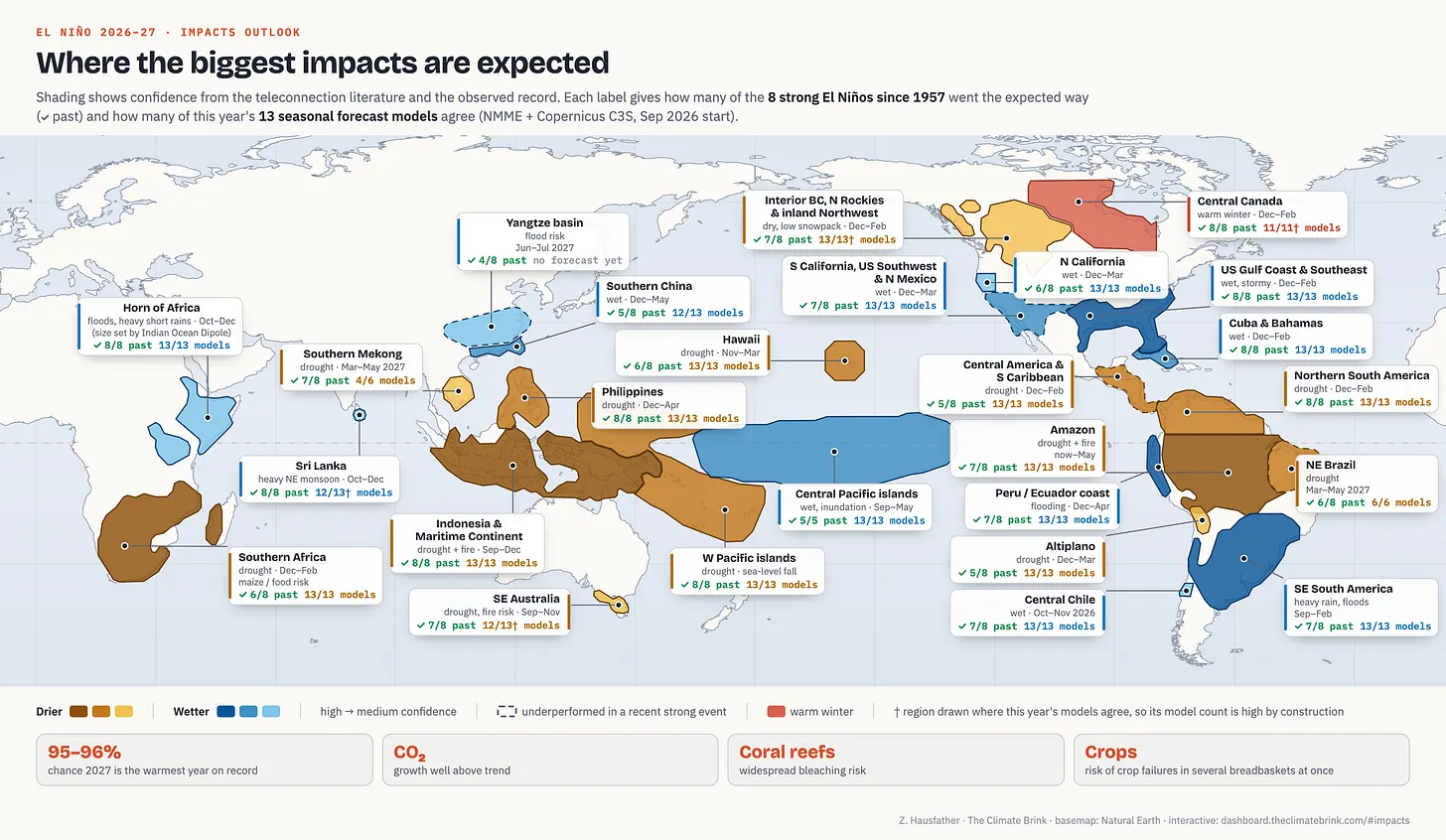
If you want to dig into a particular region, I’ve put togehter an interactive version of this map over at the Climate Dashboard. Clicking on a region brings up how it fared in each of the eight past strong El Niños, what each of this year’s forecast models shows, and a short summary of the relevant research. You can also replay any past strong event across the whole map, step through the forecast season by season, or click anywhere to see the raw model forecast for that spot.






