



 Arguments







Christy Once Again Misinforms Congress
Posted on 8 August 2012 by dana1981
On August 1st 2012, John Christy once again testified before the US Congress in a Senate hearing on climate issues. His written testimony is here and his verbal testimony is here. We previously examined Christy's congressional testimony to the House of Representatives from March 2011 and found it full of incorrect and misleading statements. This time, Christy repeated many of the same myths and misleading arguments from last year's testimony, and threw in a reference to an incomplete, flawed, unpublished paper for good measure.
Christy's testimony is broken into five distinct climate myths:
1) Disputing the accuracy of the surface temperature record;
2) Exaggerating the discrepancy between modeled and observed global warming;
3) Denying the consensus on human-caused global warming;
4) Cheerleading fossil fuels as the best thing since sliced bread; and
5) Denying that climate change is linked to extreme weather.
We will address the first four myths in this post, while a separate post is devoted to the extreme weather denial of Christy and Co.
Misinforming Congress with Watts' Flawed Unpublished Paper
In his testimony, Christy disputed the accuracy of the surface temperature record (as he also did in last year's testimony). The accuracy of this record has been confirmed time and time again, and yet Christy refuses to accept the scientific research demonstrating its accuracy. Worst of all, as Anthony Watts notes, Christy cited the incomplete, unpublished, fundamentally flawed preliminary paper on which Watts and Christy are both co-authors:
"Watts et al. demonstrate that when humans alter the immediate landscape around the thermometer stations, there is a clear warming signal due simply to those alterations, especially at night. An even more worrisome result is that the adjustment procedure for one of the popular surface temperature datasets actually increases the temperature of the rural (i.e. best) stations to match and even exceed the more urbanized (i.e. poor) stations. This is a case where it appears the adjustment process took the spurious warming of the poorer stations and spread it throughout the entire set of stations and even magnified it"
None of the above statements are true. Christy did finally note that his paper with Watts is "ongoing" and incomplete, mentioning one of the many fundamental flaws in their preliminary paper - its failure to account for changes in time of day temperature station readings:
"This is ongoing research and bears watching as other factors as still under investigation, such as changes in the time-of-day readings were taken, but at this point it helps explain why the surface measurements appear to be warming more than the deep atmosphere (where the greenhouse effect should appear.)"
Yet if the research is incomplete, preliminary, and not reviewed, how can Christy possibly justify referencing it in testimony to Congress? There is simply no excuse, particularly since major flaws were immediately identified in the Watts pre-publication as soon as it was made public (i.e. see this post by Victor Venema published the very next day). Christy has misinformed Congress by implying that it has overturned the large body of scientific evidence confirming the accuracy of the surface temperature record.
It's problematic enough that Christy did not recognize the many obvious errors in his preliminary paper with Watts. While Watts is an amateur, Christy does not have that excuse - he is a climate scientist. Not only did Christy fail to identify clear fundamental errors in the paper's analysis which completely undermine its conclusion, but he then presented that incorrect conclusion to Congress.
This is an important point, because Christy is constantly claiming that his UAH satellite temperature record is the gold standard, contrary to other research, for example Mears et al. 2011 and Thorne et al. 2011, which note that the satellite data possibly have outstanding issues, and contrary to the Watts and Christy preliminary paper in which the amount of warming the authors claim is happening in the United States is inconsistent with the amount of warming in the UAH record. Christy also constantly argues that the surface temperature data sets have a warm bias, including in his testimony to Congress.
Yet in the paper he co-authored on the subject with Watts, Christy apparently did not know to take the first and most critical step of homogenizing the data and removing the climate-unrelated biases introduced by factors like stations moving and time of observation changing. These are factors which many different scientific groups have investigated using different methodologies, all arriving at essentially the same answer.
If Christy does not understand this most fundamental aspect about the instrumental temperature record, then he is in no position to dispute its accuracy, especially to the US Congress.
Christy Exaggerates the Model-Data Discrepancy
Christy summarized his criticisms of climate models thusly:
"The average warming rate of 34 CMIP5 IPCC models is greater than observations, suggesting models are too sensitive to CO2."
We have previously debunked this myth here, but Christy conveniently provides the data in Figure 2.1 of his own written testimony which completely undermine his point.
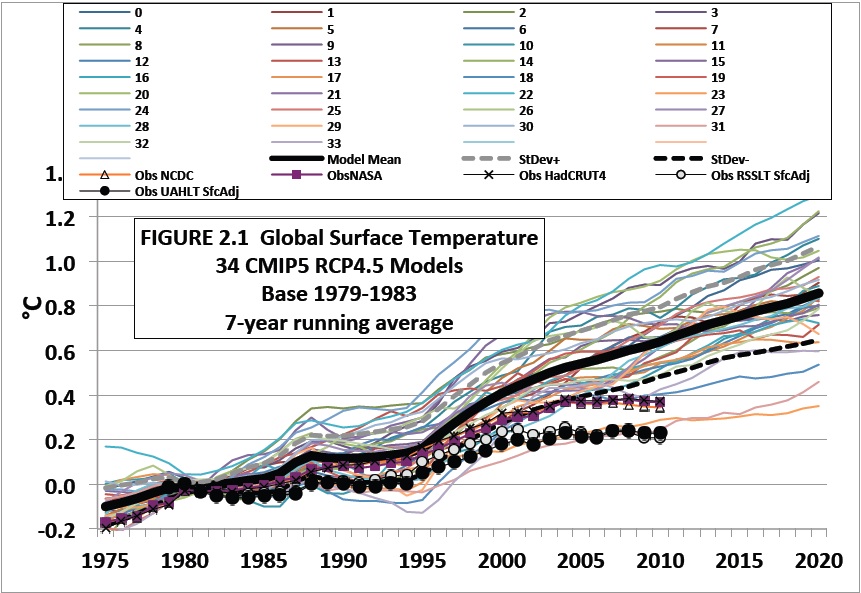
As Christy's figure here shows, the surface temperature data (NCDC, NASA, and HadCRUT4 shown in triangles, squares, and x's, respectively) fall within the envelope of Coupled Model Intercomparison Project Phase 5 (CMIP5) model runs. Note that Santer et al. 2011 and Thorne et al. 2011 both showed that the satellite temperature trends (also plotted in Christy's Figure 2.1, but which are not directly comparable to surface temperatures) also fall within the model uncertainty range, which Christy neglects to mention.
Christy is correct to note that the model average warming trend (0.23°C/decade for 1978-2011) is a bit higher than observations (0.17°C/decade over the same timeframe), but that is because over the past decade virtually every natural influence on global temperatures has acted in the cooling direction (i.e. an extended solar minimum, rising aerosols emissions, and increased heat storage in the deep oceans). We're in the midst of a 'hiatus decade', but as Christy's own figure shows, the observed warming is nevertheless consistent with the envelope of model runs, because climate models expect hiatus decades to sometimes occur.
Instead of making this point, Christy misinformed our policymakers by telling them that these results indicate that climate sensitivity is low, and that we should follow the example of North Carolina politicians by suggesting that based on these results we should simply ignore climate model projections and stumble blindly into the future.
Denying the Consensus
Christy also devoted much of his written testimony denying the scientific consensus on human-caused global warming. In the question and answer session, he disputed the validity of Doran 2009 because relatively few climate science experts had participated (77 of 79 answered that human activity is a significant contributing factor to global warming). However, this ignores the many other studies with larger sample sizes on the subject, such as Oreskes 2004, Peiser 2006, Anderegg 2010, the statements of dozens of scientific organizations including every National Academy of Science with an official position.
Christy espoused various conspiracy theories in his testimony, calling the IPCC 'gatekeepers' and suggesting that a climate contrarian opposition to the IPCC should be funded with taxpayer dollars. Christy suggested the factually devoid NIPCC report and the fundamentally backwards Michaels Cato report (aptly described by Chris Colose here) as shining examples of the sorts of BS (bad science) that taxpayers should be funding.
However, these groups seem to be obtaining sufficient funding from the fossil fuel industry to pump out their BS reports without additional taxpayer assistance.
Fossil Fuel Energy and Economics Myths
Strangely, Christy concluded both his written and verbal testimony talking about fossil fuel energy and economics rather than climate science - subjects well outside of his area of expertise. Christy began with the misleading argument that CO2 is plant food, which is a gross oversimplification of a complex issue, and which is frankly an insult to the intelligence of his audience.
He then smoothly transitioned from this oversimplified argument to the myth that CO2 limits will hurt the poor because, he argued, fossil fuel energy is cheap. In reality, when all costs are taken into consideration, many renewable energy sources are significantly cheaper than fossil fuels. Ironically, Christy cites concerns about the wellbeing of people in Africa, who are the most vulnerable to the impacts of the climate change his testimony seeks to accelerate.
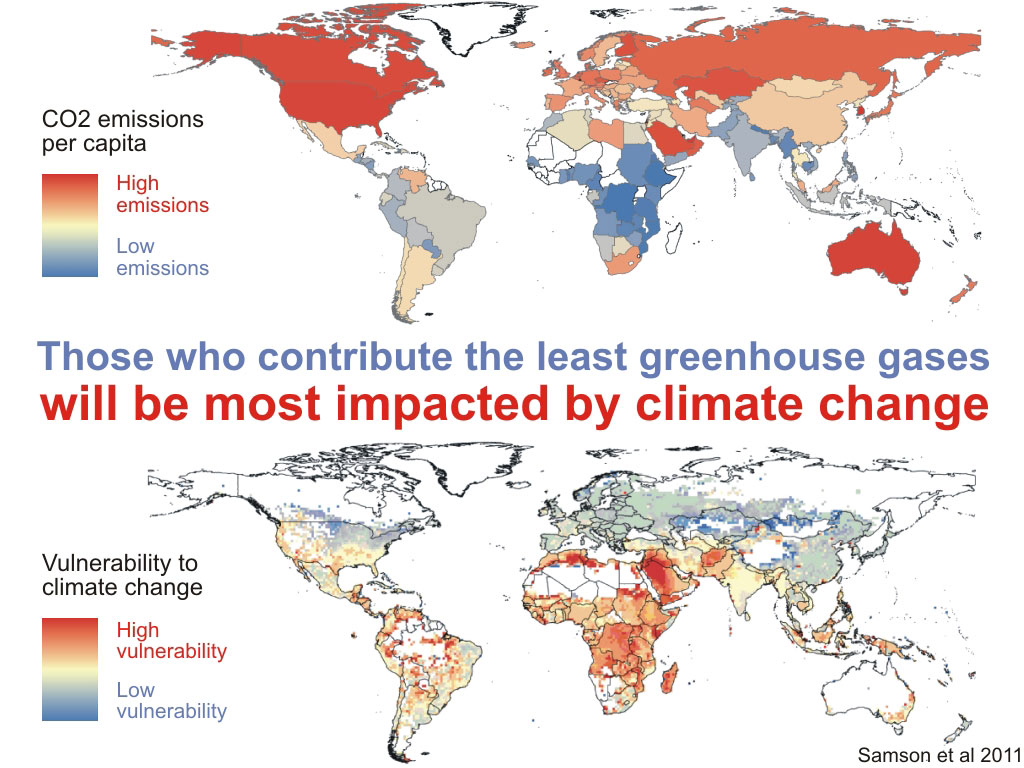
Per capita emissions vs. vulnerability to climate change, from Samson et al. (2011)
In fact as Peter Sinclair discusses, many Africans have also been taking advantage of solar panels which can pay for themselves in just a few months, are far safer than burning fossil fuels, in addition to being cleaner and better for the climate, and can be implemented far more quickly than waiting for new coal power plants to be built. Africans are apparently more forward-thinking than John Christy when it comes to energy.
Summary
As always seems to be the case when climate contrarians are invited to speak to policymakers (or the public), Christy has done nothing more than repeat a bunch of common and long-debunked climate myths. Even worse, in doing so Christy referenced the unpublished and incomplete paper he has co-authored with Anthony Watts, which contains numerous fundamental errors that completely undermine its conclusions. Despite these errors, and despite the fact that the paper has not been reviewed or even submitted to a journal, and despite it contradicting his own satellite measurements which he has held to be the gold standard, Christy presented those wrong conclusions to US Congress.
Unfortunately, one of the two main political parties in the USA only seems interested in propagating climate myths rather than educating themselves about what the body of climate science research tells us. And just as unfortunately, John Christy seems more than happy to provide them with the desired misinformation. In fact, during the question and answer session, Christy refused to admit the simple reality that global warming is not a hoax, which makes it very difficult to take anything he says seriously.









SixteenThree: http://lackofenvironment.wordpress.com/2012/08/16/and-then-there-were-three/