





Is Greenland close to a climate tipping point?
Posted on 2 August 2012 by James Wight
Recent findings suggest climate change in Greenland may be approaching a tipping point, beyond which amplifying feedbacks could lead (probably over centuries) to complete melting of the ice sheet, raising sea level by about 7 meters.
In June, a team of glaciologists led by Jason Box predicted that we would see melting across 100% of the ice sheet’s surface area in summer within a decade (Box et al., in press). They drew that conclusion from data on the Greenland ice sheet’s surface reflectivity, or “albedo”, showing the surface has gotten darker over the last 12 years. A darker surface absorbs more heat, leading to more melting, causing albedo to decrease further, and so on in a vicious circle.
The ice naturally gets less reflective in summer because the shape of the snowflakes changes and meltwater reveals impurities beneath the surface, but in 2012 Greenland has become much darker than in previous summers. This is occurring particularly at high elevations, which were previously too cold to melt and indeed had gained ice from increasing snowfall. This month, at the height of the melt season, Greenland’s albedo has fallen far off the charts:

Figure 1: Surface albedo of the Greenland ice sheet (average of all elevations) between March and October in each year from 2000 to 2012. (Source: Ohio State University, 2012)
Then NASA satellites recorded a startling abrupt acceleration of melting over just four days. On 8 July, about 40% of the ice sheet’s area had surface melt. By 12 July, surface melt had spread to no less than 97% of the area, penetrating all the way to the centre of Greenland, three kilometers above sea level:

Figure 2: Map of Greenland showing the area experiencing surface melt on 8 July (left) and on 12 July (right). (Source: NASA, 2012)
“This was so extraordinary that at first I questioned the result: was this real or was it due to a data error?” said Son Nghiem of NASA’s Jet Propulsion Laboratory. The melting has been confirmed by independent measurements, and attributed to a warm air mass sitting over Greenland during that week. Ice cores show this to be a 1-in-150-year event.
It is not yet clear whether this single occurence is indicative of a trend; a year with greater snowfall could return the albedo to a more normal state. Nevertheless, the extraordinary events of recent weeks are cause for concern when considered in the context of Greenland’s ice melting at an accelerating rate for the last decade, losing more than 2 trillion tonnes in total:
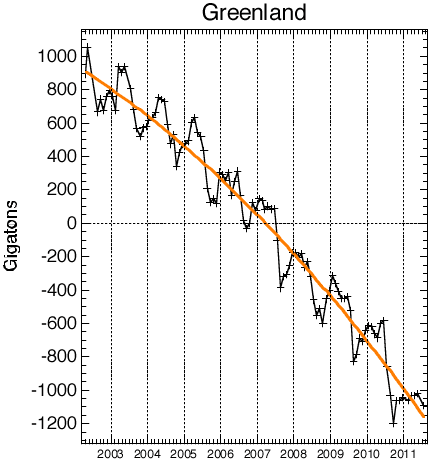
Figure 3: Greenland ice sheet mass relative to the 2002-2011 average.
According to recent modeling (Robinson et al, 2012), the tipping point for eventual total melting of the Greenland ice sheet could be a global temperature of around 1.6°C above preindustrial. Worse, the lower end of the range of possibilities is only 0.8°C, equal to today’s global temperature.
There is broader evidence that no significant cushion remains between today’s climate and a dangerous level of warming. In the last interglacial age 125,000 years ago, called the Eemian, global temperature was only ~1°C warmer than preindustrial, ie. only a couple of tenths of a degree warmer than today (Hansen et al., in press). Yet the poles were several degrees warmer, there was no summer sea ice in the Arctic, and multiple studies using different methodologies (Kopp et al., 2009; Dutton & Lambeck, 2012) say sea level was 6-9 meters higher (meaning at least partial melting of the Greenland and/or West Antarctic ice sheets).
All this points to the conclusion we may already be getting close to a dangerous level of global warming. If humanity rapidly cuts global CO2 emissions to zero or near-zero, it might be possible to return the Earth to energy balance and prevent much further warming (Hansen et al., in press). If business-as-usual emissions continue for much longer, there is a risk that eventual melting of the Greenland ice sheet could become irreversible.
This is a cross-post from Precarious Climate.
Arguments


At least, any rational civilisation would do so. If we see another whole-continent melting in Greenland in the next five to ten years, with no concommitent emergency response around the world, then it really will be all over Red Rover for any semblance of a 'pleasant' biosphere and a functioning global human society a century or two from now.
But they are pretty meagre crumbs. The SLR I convert from their average over a millennium and with polar amplification of temperature, a ~3 to 5 deg C rise in polar temperatures is less in terms of global ones.
If melting events in Greenland become common then we can expect the denialsphere to attribute it to black carbon from Chinese Industry. Now lets get back to those EMails.
More generally, when quoting the 153 year average period between melting events in the ice cores from Summit camp, it is important to put this into the context given in the actual 1995 paper that established this calculation.
The study is available here and the very first sentence of the abstract ought to be required to be quoted anytime anyone wants to repeat the "150 year" idea. Here is the opening sentence: "The rare melt features in the GISP2, central Greenland deep ice
core have decreased in frequency over the most recent 7000 years." These melt events are not some quasi-clockwork natural cycle thing. The most recent one was in 1889 and before that, the next most recent one was not for another 700-800 years earlier. Why NASA chose to include that misleading quote about this being "right on time" in their press release, I'll never know.
http://lance-modis.eosdis.nasa.gov/imagery/subsets/?subset=Arctic_r04c06.2012214.terra.500m
From arctic mosaic http://lance-modis.eosdis.nasa.gov/imagery/subsets/?mosaic=Arctic
You're absolutely correct, of course. I was coming at it from the perspective of wondering what it will take to shift the current collective international inertia... if there actually is anything at all that will poke humanity off its butt and respond before the whole question becomes purely moot.
I guess that my point is that ice-melt across the (good as) whole of Greenland is one of those profound signals that, if repeated, is basically saying "it's time to leave... Humanity". The first essentially ice-free Arctic summer is another example.
If, by the time one of these major events occurs, we're not at the level of urgency that was seen during the second world war, when rationing and other such readjustments were enacted, then we might as well toss any pretense of responsibility out the window and declare an open-ended Armageddon party for future global civilisation.
The rationalist in me says: 'how about we stop emitting greenhouse gases just to be on the safe side. I'm not that great a swimmer."
So, if there is no repetition in the near future, this melting seems to be irrelevant to the global warming debate.
If correct, imo this needs to be pointed out in the article, because right now, the article does not adress the Scepticist's line of argumentation.
First, the events are not the same. What happened last month was that 97% of the Greenland ice surface, including the highest point, melted. What happened about a 150 years ago was that just the highest point melted.
Second, the melting at the highest point about 150 years ago was the only other time in the past thousand years that has happened. If you go back a few thousand years and then divide the total number of times the highest point melted by the total time period you'll get an average of about 150 years... but it is not a 'regular cycle' at all.
So no, the 97% melt does not have to be repeated some time in the next 150 years in order to be significant. If it happens again that would be incredibly alarming. However, it happening even once was extraordinary.
[Source]
Given the decline in insolation forcing over time, it becomes correspondingly more rare for a confluence of factors to conjoin to create a melt event. Furthermore, give the unparalleled forcing from the previously-sequestered CO2 bolus mankind has injected into the carbon cycle, overall warming will continue for decades-to-centuries, with summit melt to become a regular occurrence in the near future (Box et al 2012).
Deniers posing as skeptics set up a charade tableau of false equivalence to poison the well of public acceptance of that science. A parsimonious harping at the font of stolen, out-of-context and context-less emails proven not germane to the science is continuing on in the prosecution of the agenda of denial.
Where do I can find the data used to make the graph "GISP2 Holocene Melt Years", and/or a high resolution version of that figure?
(the link given above only shows a graph in low resolution)
[DB] Try here:
http://www.ncdc.noaa.gov/paleo/icecore/greenland/greenland.html
Extreme melt seasons of the GIS mean that instead of the lower reaches being the ablation zone (where mass is lost) and the upper reaches being the accumulation zone (where the sheet packs on weight), much of the entire sheet is an ablation zone. So no growth in those years, just losses.
Expected increases in mass loss of the GIS will be primarily due to calving at the marine-terminating outlet glaciers, such as Jakobshavn, Petermann and Zachariae.
http://www.theregister.co.uk/2012/08/03/greenland_ice_sheet_not_about_to_disappear/
From my lay reading it suffers from the fact that it only looks back 30 years -difficult to reach any reliable conclusion in such short a time frame. Also there is no mention of the effects of fast rising atmospheric CO2 concentration on ice melt.
Regards.
There's some comment on the same paper at CarbonBrief that is perhaps a little more balanced than TheRegister post you link to.
The paper in question Kjær et al 2012 examined aerial photos to obtain local melt data back to 1985 giving 27 years rather than the 10 years of satellite data. Their findings is suggesting to them that rising Grennland temperatures, rather than resulting in a new regime of ice-loss, may result in a melt event lasting a few years followed by a new regime with less extreme ice loss, or 'stabalisation'. They suggest recent data from the likes of GRACE is too short a record and may only be seeing the melt events, not the longer term stabalisation.
The language used by the lead author appears designed to attract attention. "It is too early to proclaim the 'ice sheet's future doom'..." is one of the quotes CarbonBrief got from him.
It covers a specific sub-region of a region of the world, the NW portion of the GIS. There is no mention of ground-truth comparisons of the dted's, a must-have to ensure accuracy (from personal experience working with such models). Also, differing topographies and differing season with differing deposition rates produce dynamically different responses in flow rates of the ice.
Given that, I fail to see how anyone can derive anything scientifically useful out of the abstract alone, as there simply is not enough context for meaningful interpretations of the results vs the area of coverage itself, let alone the rest of the GIS.
Therefore, the newspaper article is nothing but disinformationist overhype.
Wait for the assessments of real glaciologists for proper understandings.
Basically, we know that the summit melted every 150 years on average. We don't know how often the entire ice sheet has melted.
JohnB, the 'melting could stop' paper seems to me to sail right past the fact that the previous 'melting stop' they base their conclusions on happened during a cooling period before the main effects of global warming had kicked in. The ice sheet didn't just magically stop declining... it was due to climate factors which are no longer possible.
I consider it wishful thinking that "melting could stop"; especially in view of climate warming events over recent years.
The adventurous statement by Kurt H. Kjær "the current thinning of the ice sheet is likely to ease within an 8-year period." will unfortunately be fodder for vested deniers.
You're exactly right. In fact, massive ice loss due to darkening as the mixture between ice and dust (lag) becomes more dusty as ice melts has already been observed elsewhere in the solar system. This process is part of what is thought to have caused Saturn's icy moon Iapetus to have one side which is 10x darker than the other.
ref: Spencer and Denk 2010





