





How do we know CO2 is causing warming?
Posted on 8 October 2009 by John Cook
We've just perused the empirical evidence that humans are raising atmospheric CO2 levels. In earlier posts, we noted that tallying up the planet's heat content shows that our climate is accumulating heat, proof of global warming. But is there any evidence that links the two? Is there empirical data proving that increased CO2 contributes to the energy imbalance that causes global warming?
The greenhouse gas qualities of CO2 have been known for over a century. In 1861, John Tyndal published laboratory results identifying CO2 as a greenhouse gas that absorbed heat rays (longwave radiation). Since then, the absorptive qualities of CO2 have been more precisely measured and quantified by laboratory results and radiative physics theory (Herzberg 1953, Burch 1962, Burch 1970, etc).
Satellite measurements of the change in outgoing longwave radiation
So according to lab results and radiative physics, we expect that increasing atmospheric CO2 should absorb more longwave radiation as it escapes back out to space. Has this effect been observed? The paper Increases in greenhouse forcing inferred from the outgoing longwave radiation spectra of the Earth in 1970 and 1997 (Harries 2001) attempts to find out. In 1970, NASA launched the IRIS satellite that measured infrared spectra between 400 cm-1 to 1600 cm-1. In 1996, the Japanese Space Agency launched the IMG satellite which recorded similar observations. Harries 2001 compared both sets of data to discern any changes in outgoing radiation over the 26 year period. The resultant change in outgoing radiation was as follows:
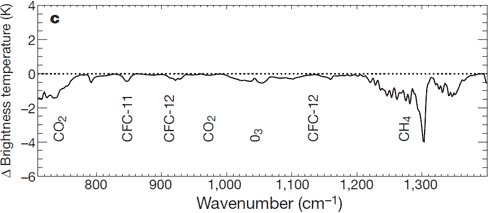
Figure 1: Change in spectrum from 1970 to 1996 due to trace gases. 'Brightness temperature' indicates equivalent blackbody temperature (Harries 2001).
What they found was a drop in outgoing radiation at the wavelength bands that greenhouse gases such as CO2 and methane (CH4) absorb energy. The change in outgoing radiation over CO2 bands was consistent with theoretical expectations. Thus the paper found "direct experimental evidence for a significant increase in the Earth's greenhouse effect".
This result has been confirmed by subsequent papers using the latest satellite data. Griggs 2004 compares the 1970 and 1997 spectra with additional satellite data from the NASA AIRS satellite launched in 2003. Chen 2007 extends this analysis to 2006 using data from the AURA satellite launched in 2004. Both papers found the observed differences in CO2 bands matched the expected changes based on rising CO2 levels. Thus we have empirical evidence that increased CO2 is preventing longwave radiation from escaping out to space.
Measurements of downward longwave radiation
What happens to longwave radiation that gets absorbed by greenhouse gases? The energy heats the atmosphere which in turn re-radiates longwave radiation. This re-radiated energy goes in all directions. Some of it makes its way back to the surface of the earth. Hence we expect to find increasing downward longwave radiation as CO2 levels increase.
Philipona 2004 finds that this is indeed the case - that downward longwave radiation is increasing due to an enhanced greenhouse effect. Evans 2006 takes this analysis further. By analysing high resolution spectral data, the increase in downward radiation can be quantitatively attributed to each of several anthropogenic gases. The results lead the authors to conclude that "this experimental data should effectively end the argument by skeptics that no experimental evidence exists for the connection between greenhouse gas increases in the atmosphere and global warming."
So we have multiple lines of empirical evidence for CO2 warming. Lab tests show CO2 absorbing longwave radiation. Satellite measurements confirm that less longwave radiation is escaping to space. Surface measurements detect increased longwave radiation returning back to Earth at wavelengths matching increased CO2 warming. And of course the result of this energy imbalance is the accumulation of heat over the last 40 years.
Acknowledgements: A big thanks must go to AGW Observer. Their lists of papers on changes in outgoing longwave radiation, changes in downward longwave radiation and laboratory measurements of CO2 absorption properties made this post possible.

Arguments


With the evidence here and John's last post, you can bring it all together to make a pretty airtight logical proof for global warming. We know these things to be factually true:
1. Global temperatures have risen.
2. CO2 is a greenhouse gas.
3. CO2's concentration in the atmosphere has risen significantly.
4. That extra CO2 comes from burning of fossil fuels.
To logically prove that humans are NOT causing the observed increase in temperatures, you therefore need to prove BOTH of two things:
First, you need to show how it could be possible to pump more of a known greenhouse gas into the atmosphere WITHOUT temperatures increasing.
Second, if CO2 is not causing the observed warming, you need to show what IS.
The link to the full post is below. I challenge any skeptic to prove both these points above.
http://akwag.blogspot.com/2009/09/obama-speaks-on-global-warming-what-you_22.html
http://www.sciencedaily.com/releases/2009/01/090109115047.htm
Very well done. It's posts like these that start generating the "these government-funded scientists are fabricating evidence" arguments from a fervent crowd that is high on repetition of talking points and short on science.
- The amplifying effect of water vapor feedback has been empirically observed and a major part of why the climate is so sensitive to CO2 greenhouse warming.
- The troposphere hot spot has been observed in short term satellite measurements. It has been difficult to observe in long term measurements due to spurious cooling trends imposed by satellite drift issues.
- Citing atmospheric cooling over recent years fails to take into account that the atmosphere is one small part of the climate system. The ocean has a much greater heat capacity, absorbing about 95% of global warming, and heat exchanges between the atmosphere and ocean means atmospheric temperatures show much internal variability. The bottom line is empirical observations find that the oceans are still warming - the planet is still accumulating heat - global warming is still happening.
- I'm surprised to hear you say global temperature has risen as fast numerous times over the last few thousand years. Multiple paleo-reconstructions of global temperature over the last few thousand years using a variety of data sources (including corals, stalagmites, tree rings, boreholes and ice cores) have found the 20th century is the warmest of the entire record, and that warming was most dramatic after 1920.
Apologies to any subsequent commenters if my links or answers duplicate their responses.There are several assertions crammed into one paragraph, but I'll deal with the prominent assertions you're presenting. Water vapor is a positive feedback, as many direct observations have indicated.
http://www.agu.org/pubs/crossref/2008/2008GL035333.shtml
The "no tropical hotspot" argument is both a questionable assertion and a red herring. First, the balance of evidence suggests that there is a tropical hotspot.
http://www.skepticalscience.com/tropospheric-hot-spot.htm
http://www.realclimate.org/index.php/archives/2008/05/tropical-tropopshere-ii/
http://www.realclimate.org/index.php/archives/2007/12/tropical-troposphere-trends/
Second, a tropical tropospheric hotspot is not unique to GHG warming. It should appear with solar warming as well.
Lastly, if there truly was no tropical hotspot in observations, it would actually imply, if anything, a higher climate sensitivity.
http://chriscolose.wordpress.com/2008/12/20/skepticsdenialists-part-2-hotspots-and-repetition/
Not really Leonard. Saying stuff doesn’t make it true!
The absolute humidity certainly has increased. There really isn’t any question of that [*]
A recent analysis indicates that the upper tropospheric temperature in the tropics is not inconsistent with predictions from modelling [**]
[*] Dessler, A. E., Z. Zhang, and P. Yang (2008), Water-vapor climate feedback inferred from climate fluctuations, 2003–2008, Geophys. Res. Lett., 35, L20704
http://www.agu.org/pubs/crossref/2008/2008GL035333.shtml
Gettelman A and Fu, Q. (2008) Observed and simulated upper-tropospheric water vapor feedback . J. Climate 21, 3282-3289
Buehler SA (2008) An upper tropospheric humidity data set from operational satellite microwave data. J. Geophys. Res. 113, art #D14110
Brogniez H and Pierrehumbert RT (2007) Intercomparison of tropical tropospheric humidity in GCMs with AMSU-B water vapor data. Geophys. Res. Lett. 34, art #L17912
Royer DL et al. (2007) Climate sensitivity constrained by CO2 concentrations over the past 420 million years Nature 446, 530-532
Santer BD et al. (2007) Identification of human-induced changes in atmospheric moisture content. Proc. Natl. Acad. Sci. USA 104, 15248-15253
Soden BJ, et al (2005) The radiative signature of upper tropospheric moistening Science 310, 841-844.
[**]B. D. Santer et al. (2008) Consistency of modelled and observed temperature trends in the tropical troposphere. International Journal of Climatology 28, 1703 – 1722.
https://publicaffairs.llnl.gov/news/news_releases/2008/NR-08-10-05-article.pdf
The relation between temperature and CO2 relates to the equilibrium temperature resulting from a raised CO2 level, Leonard. It’s obvious that natural variation will modulate the transition towards that new temperature. Analysis of total heat content indicates that the earth continues to absorb heat under influence of radiative imbalance and this is going to contribute to enhanced surface warming.
http://www.skepticalscience.com/How-we-know-global-warming-is-happening-Part-2.html
I don’t think there’s any evidence that supports that assertion. Can you provide some?
Whatever “self-regulates” means here (can you explain?), the evidence indicates that water vapour is a positive feedback (see papers cited in my post #6 above). Nothing is really “self-regulating” the system. The earth responds to enhanced radiative forcing by absorbing heat and warming.
That’s not relevant without considering the steady increase in solar constant since the start of the solar system. 500 million years ago the sun was radiating around 4% less brightly than now. Any particular CO2 concentration will give a much warmer earth now than the same CO2 concentration in the deep past. The relationship between paleo CO2 measures and paleo temperatures in the deep past is quite strong as has been described in a review by Royer:
Dana L. Royer (2006) CO2-forced climate thresholds during the Phanerozoic. Geochimica et Cosmochimica Acta 70 (2006) 5665–5675
Abstract: The correspondence between atmospheric CO2 concentrations and globally averaged surface temperatures in the recent past suggests that thiscoupling may be of great antiquity. Here, I compare 490 published proxy records of CO2 spanning the Ordovician to Neogene with records of global cool events to evaluate the strength of CO2-temperature coupling over the Phanerozoic (last 542 my). For periods
with sufficient CO2 coverage, all cool events are associated with CO2 levels below 1000 ppm. A CO2 threshold of below 500 ppm is suggested for the initiation of widespread, continental glaciations, although this threshold was likely higher during the Paleozoic due to a lower solar luminosity at that time. Also, based on data from the Jurassic and Cretaceous, a CO2 threshold of below 1000 ppm is proposed for the initiation of cool non-glacial conditions. A pervasive, tight correlation between CO2 and temperature is found both at coarse (10 my timescales) and fine resolutions up to the temporal limits of the data set (million-year timescales), indicating that CO2, operating in combination with many other factors such as solar luminosity and paleogeography, has imparted strong control over global temperatures for much of the Phanerozoic.
droyer.web.wesleyan.edu/PhanCO2(GCA).pdf
Leonard makes logical errors in each of these areas. His argument about water vapor being a much more potent GHG is a stock and flow error. The notion that decreasing temperatures during a period of CO2 increase disproves AGW fails to grasp nonlinearities and time delays. He talks about "water vapor feedback," but based on the incoherence of the sentence, I'd guess he doesn't know what a feedback is.
But even highly-educated people with technical backgrounds can fail to grasp these concepts intuitively. A study called "All Models are Wrong" (John Sterman, System Dynamics Review, Winter 2002) found that even most MIT grad students couldn't grasp basic systems thinking concepts like stocks and flows.
I'd argue that, aside from political bias, the inability to do systems thinking is the second biggest driver of climate denial. People like McIntyre and Plimer may be highly educated and skilled at performing calculations, but their brains' intuitive grasp of systems concepts may be under-developed.
This is why you don't have to be a technical expert on all the details of climate science to still respond to denier talking points. Most of them aren't errors of fact so much as errors of logic.
(John - Sorry to steal your thunder on the previous post. There must have been some water vapor feedbacks or something :)
It's too bad we don't have much papers like Evans & Puckrin (2006) who measure the change in DLR by each gas. A new paper by Wang & Liang (2009) mentions the possible reason why we don't have much of them:
"While surface shortwave radiation has long been measured globally [Gilgen and Ohmura, 1999], Ld is not conventionally observed due to the higher cost of pyrgeometers used for Ld measurement, and more difficult challenges of instrument calibration and quality control [Enz et al., 1975; Udo, 2000; Sridhar and Elliott, 2002; Duarte et al., 2006]."
(Ld being the surface downward longwave radiation.)
http://www.agu.org/pubs/crossref/2009/2009JD011800.shtml
The non skeptics arent concerned with this however, even if it were true. All they want to do is ramrod the idea that CO2 is doing everything. This paper for instance "proves" that CO2 is responsible for global warming, since more IR energy around a band of CO2 IR emission is now greater as compared to 25 years ago. If the data is good, about all it proves is that there is more CO2, which we already know.
The data is insufficient because even if more heat is being trapped during the day due to CO2, it is the stored energetic carry-over from one day to the next that matters. (Night and winter has an important role in global cooling, yet never mentioned in these discussions.) Energy stored in land and sea.
If the total conditions during the 24 hr cycle are enough to "discharge" the energy, even if you have an instantaneous increase in heat retention from CO2, (as is typically illustrated in greenhouse energy budget diagrams), about all you can say is that CO2 makes it hotter during the day (and under specific conditions). That is a lot different from saying that CO2 is the main cause of global warming.
Never mind the possibility that you allude to about nuclear testing. Never mind the possibility that air pollution causes more clouds, and clouds as any farmer knows keeps things generally warmer.
The concept that CO2 is doing everything however has been institutionalized, and opening up people's minds on the subject appears about as difficult as getting rid of excess CO2 itself.
The studies above also confirm the amplified greenhouse effect from methane but as there is much less methane in the air than CO2, it's radiative forcing is much smaller. Any comments repeating this strawman argument will be deleted.
Very simply in response to post #13, the greenhouse effect slows the loss of out going thermal radiation both day and night. A stronger greenhouse effect results in warmer nights, the energy of which is carried over the the next day. The atmosphere radiates energy all night long, thus preventing a drastic drop in surface temperature, especially over land, in the absence of sunshine.
The energy input of the previous day is not totally "discharged" at night as you assert, it only slowly trickles out due the the atmospheric greenhouse effect. Adding greenhouse gases slows the loss even more.
I would start with the fact that water vapor is not a well mixed gas. What would happen if a magic wand where waved and water vapor concentration were approximately the same everywhere such as is the case with CO2?
The water vapour feedback applies to anything that enhances (or reduces, of course) the atmospheric temperature. So if the sun became a bit brighter such that the direct atmospheric warming was 1 oC, and the resulting water vapour feedback adds an additional x of additional warming then the total warming from the solar enhancement + water vapour feedback is something like 1 + x + x^2 + x^3 + x^4 ...
which is 1/(1-x).
So if the water vapour response to a 1 oC warming is 0.5 oC then the total warming when everything comes to equilibrium is 1/(1-0.5) = 2 oC.
The same argument applies for the enhancement of atmospheric CO2 concentrations. If the atmospheric CO2 concentrations rise by an amount giving a 1 oC of warming then the water vapour feedback will result in a total warming of 1/(1-x).
In some ways it's better to describe the feedback as an "amplification" to avoid the connotation with a "runaway" positive feedback.
This is a better post than most i have seen here (with a bit of history and hard physics), but i wonder what the radiation band absorption spectra would look like if the oceans were also absorbing radiation wavelengths due to eg less clouds over the oceans?, rather than c02/ch4 doing it??
Just a thought.
1.) OK, so a CO2 absorbs a photon of infrared. The only ways that molecule can de-energize to be ready for the next photon is to conduct heat away through impact with another molecule, or to re-radiate it out at the same frequency. Either it does one of these or all CO2 molecules will soon reach saturation and be unable to absorb more infrared. If it conducts it to another molecule then that molecule will either conduct it away again or re-radiate the photon, BUT AT THAT MOLECULE'S WAVELENGTHS, not CO2's. O2, N2, H2O all radiate at different wavelengths than CO2, and your chart above doesn't even cover two of the H2O bands. Unless you analyze the total energy exchange by the Earth on all wavelengths you can't begin to come to any conclusions.
2.) Dr. Heinz Hug's work suggests that CO2 is such a good absorber of infrared energy that it absorbs 100% of IR radiated from the ground at your 650/cm region within 10 meters of the ground. Doubling the CO2 level in the atmosphere will not result in any more energy being trapped in the atmosphere because ALL OF IT IS ALREADY ABSORBED. You won't get twice the heating from doubling the CO2 concentration because there is none left to absorb at that wavelength.
3.) The three primary IR absorption peaks of CO2 only cover about 8% of the infrared band, so CO2 is transparent to 92% of infrared energy.
4.) The Philipona paper mentioned above indicates a 1.8W/m2 increase in energy being radiated towards the ground. The sun sends ~1,000W/m2 at the equator. The increase described by Philipona is 0.18% of the sun's output. Can you prove that there has not been 1/5 of 1% variance in the sun's output over the last 34 years?
Note that hotter objects emit radiation at shorter wavelengths. Hence the sun emits shortwave radiation while the earth emits longwave radiation. This is the basis of the greenhouse effect - shortwave radiation from the sun passes through the atmosphere, warms the earth which then emits longwave radiation back out to space. This longwave radiation is absorbed by greenhouse gases. The enhanced greenhouse effect observed by the papers listed above are at longwave wavelengths, not shortwave. It's basic science.
That myth is ancient--as in the turn of the 19th century to the 20th century. See A Saturated Gassy Argument.
Considering how small TSI changes are and considering how much of TSI is in the IR spectrum and at which wave lengths, I'm wondering how your question #4 can make sense.
"O2, N2, H2O all radiate at different wavelengths than CO2, and your chart above doesn't even cover two of the H2O bands. Unless you analyze the total energy exchange by the Earth on all wavelengths you can't begin to come to any conclusions."
If there is a measured difference in CO2 bands (such as the one measured by Harries et al. in their few studies), possible differences in H2O bands don't change that, the CO2 difference remains the same.
"The three primary IR absorption peaks of CO2 only cover about 8% of the infrared band, so CO2 is transparent to 92% of infrared energy."
Which also doesn't take away anything from CO2 absorption. Nobody is claiming that CO2 absorbs whole of infrared band.
"The Philipona paper mentioned above indicates a 1.8W/m2 increase in energy being radiated towards the ground. The sun sends ~1,000W/m2 at the equator. The increase described by Philipona is 0.18% of the sun's output. Can you prove that there has not been 1/5 of 1% variance in the sun's output over the last 34 years?"
The 1.8 W/(m^2) number in Philipona et al. is for downward longwave radiation, but the number you give for the sun is for total sunlight, not only for longwave band. Try again.
Furthermore, the Philipona and Evans papers examine downward LW radiation, how would increased ocean absorbtion lead to increased downward radiation?
It seems like a lot of money has been spent around testing the effects of CO2 on the Earth's atmosphere, but has anything like the following lab work been performed? That is, experimentation to show how CO2 actually impedes the COOLING of an object, and demonstrate that recycled heat is not getting around CO2 at other IR wavelenghts?
In terms of a thought (or actual) experiment this might involve an elongated and sealed glass tube, (perhaps a few meters long) insulated thermically everywhere except on one end. At the base, inside the tube, a heating element would be used for heating a radiative plate wired with sensors that allow monitoring temperature over time. The opposite (non-insulated) tube ending would protrude into a cool dark chamber where the heat radiation is absorbed.
For experiments, the tube would be filled with air having controlled amounts of CO2. The heating element would be switched on to leave the temperature of the plate at some specific elevated value. It would then be switched off to allow the plate to cool.
The data of interest would be the TIME it takes for the plate to cool for the different levels of CO2.
Indications that cooling actually take longer for higher levels of CO2 would be consistent with the idea that CO2 plays a significant role in global warming.
If cooling times, however, were not found to be affected by CO2 concentrations, either CO2 is saturating energetically as mentioned by Lorenzo, or heat is returning to the plate and being emitted at other IR wavelengths.
Ocean heat content has plateaued. The OHC page at the NODC shows the latest update.
http://www.nodc.noaa.gov/OC5/3M_HEAT_CONTENT/index.html
Schuckmann et al may indeed show a slight increase in OHC to 2000m – with everyone else showing slight cooling to slight warming to 700m. Talk about cherry picking.
With a reduction in TSI since 2000 (http://www.pmodwrc.ch/pmod.php?topic=tsi/composite
/SolarConstant) and a 1% increase in Earth albedo over the same period (http://www.bbso.njit.edu/Research/EarthShine/) – it would be very surprising if there were much warming going on. Schuckmann et al may need to revise their depth integrating or areal averaging algorithms.
TSI will increase over the upward arm of the current 11 year cycle – but the longer term trend is downward.
One should anticipate significant variability in ocean heat content – it is blindingly evident in the record of the recent past and ocean heat content must continue to be variable.
Natural climate variability should be anticipated on 20 to 30 year – and longer - timescales. You continue to argue that natural variability is evident as an explanation for short term cooling – but continue to be non specific about what drives variability in the earth’s heat budget. I quote from NASA’s SORCE pages.
‘The Sun and Global Warming
Of the many trends that appear to cause fluctuations in the Sun’s energy, those that last decades to centuries are the most likely to have a measurable impact on the Earth’s climate in the foreseeable future. Many researchers believe the steady rise in sunspots and faculae since the late seventeenth century may be responsible for as much as half of the 0.6 degrees of global warming over the last 110 years (IPCC, 2001). Since pre-industrial times, it’s thought that the Sun has given rise to a global heating similar to that caused by the increase of carbon dioxide in the atmosphere. If the past is any indication of things to come, solar cycles may play a role in future global warming.’
http://earthobservatory.nasa.gov/Features/SORCE/sorce_04.php
Before you suggest that TSI peaked in 1958 – look at the TSI reconstructions in this report for AR4 from the British Met Office. Better yet - read the whole report.
This should include the section on possible amplifying mechanisms for subtle solar variations.
http://www.metoffice.gov.uk/publications/HCTN/HCTN_62.pdf
It is very odd indeed you can insist on feedbacks for greenhouse gases – but want to ignore the feedbacks for solar variations. For example an increase in TSI and temperature leads to an increase in water vapour in the atmosphere. The same feedback as carbon dioxide – but with several others thrown in as well.
While there is still considerable doubt on the exact values of TSI and TSI changes over time – the SST changes observed directly and as a result of interactions with global hydrology are reasonably conclusive. We are looking at natural variability producing a cooling influence for 20 to 30 years from 2000.
The question of whether this is ‘warming interrupted’ – e.g. realclimate, Keenlyside, Swanson and Tsonis and Mojib Latiff – or something else entirely is not answerable at this time. However, from a number of lines of evidence – anthropogenic warming is at most 50% of what is claimed by global warming activists.
Activists such as yourselves are continuing to promote alarmism. You need to develop a more nuanced understanding and a less dogmatic approach.
Regarding positive feedbacks, these apply to any sort of warming whether they be CO2 warming or solar warming. And there is always the possibility that there are other feedbacks unique to solar variations (eg - changes to ozone in the stratosphere, cosmic ray modulation of clouds). But if solar activity does have a greater effect on climate than generally thought, then what does that say about the current situation where oceans are showing a strong warming trend simultaneous to the sun cooling to it's lowest levels in a century?
http://wattsupwiththat.com/2009/03/20/dr-syun-akasofu-on-ipccs-forecast-accuracy/
- a reasonable summary
http://www.iarc.uaf.edu/people/indiv/iarc_all_staff.php?photo=sakasofu
- home page of Dr Akasofu
http://www.climate4you.com/
- home page for Prof. Humlum
The planet isn’t currently warming and the IPCC is a political stuff up rather than a credible scientific oganisation.
Look in the green box immediately above this Comments section. There our host John Cook has supplied a link to an extensive collection of literature on the laboratory measurements of CO2 absorption properties.
"RSVP, lab experiments of the type you describe (actually, much better designed than the one you described) have been done for more than 150 years. They are now done even in high school science classes."
You are basically saying that it was a little boy who said that the Emperor was wearing no clothes. I knew that too, but was wondering if SOMEONE COULD DIRECT ME TO THIS DATA.
AND something must definitely be wrong if we have been in the know for 150 years and not done anything about it. For this reason, I do not believe there is ounce of truth in your reply.
You obviously have done very little of your own research on this. Now you're accusing Tom to be lying, less he does it for you.
Indeed, in what at least some of us will see as a nice irony, the truly “political” nature of the IPCC report has now been revealed -- far from being “alarmist” predictions, the assessments of the science researchers involved were mostly watered down for fear of rightist political repercussions, in order to insure that the main governments would allow it to be published. In a delicious turn of the screw, we now know just two years later that the “alarmist” assessments of 2007 were dangerously conservative!
Deviating from the primary scientific threads here is understandably tempting for those who cannot or will not understand the objective reality of AGW and aggravated climate changes. How much easier to accuse people of lying, to simply repeat already demolished untruths, to ignore well-demonstrated facts and trends that are inconvenient or discomforting, to deny that the data is plainly out there for all to understand and, if they have the data and rational goods, challenge.
Hey, it’s a scary world we are busily creating, and there are quite legitimate reasons to fear it. An easy and all-too-human way to cope with such a looming catastrophe is to look for reasons to deny it. We should call these kinds of deniers doubters, IMO. Far from getting angry with them, we need to find better ways to inform them, as John himself observed a few posts back. http://www.skepticalscience.com/Some-Skeptical-Science-housekeeping.html
Being an experienced publisher, I was struck by his thoughtfulness in stepping back to see how this blog interacts with its readers. It is an obvious publishing task that an amazing number of writers and bloggers never think to do. Kudos, John, as you kindly say to your commenters. But really, getting a much wider audience for these tough to handle topics is not your fundamental responsibility; you and most of the commenting posters here are doing a great job of exploring the science and its implications in terms many educated people can understand.
Just please keep up this good and informative work; it is the foundation for the missing, but inevitable, much broader constituency
If it is real - heating should show up in the 700m profile as well as in the 2000m profile. It is highly unlikely that the 700m profile is not warming at the same time as the 2000m profile is warming.
I wish Schuckmann et al had used total heat content rather than an undefined areal average - to make it comparable with other studies.
A link to Susan Wijffell's presentation at last months Ocean Obs conference - see page 4 - none of the ocean heat content researchers agree with each other within the error bounds - but none are showing strong warming. Scuckmann seems to be an extreme outlier.
I note that Dr Wijfells calculates ocean warming over 50 years at 0.3 W/m2 - whereas Schuckmann et al calculates recent (2003 to 2008) ocean warming at 0.77 W/m2.
http://www.oceanobs09.net/plenary/files/Wijffels_HeatContentTemperature_2Aa_vfinal.pdf
Schuckmann et al should be viewed with skepticism.
I have provided a link to the latest evidence (based on the methods of Levitus et al) at the NODC.
I think my point is not that the IPCC is political - but that it is a political stuffup.
"On this page, there are 3 links to a list of all the papers on CO2 absorption properties (4 including this one)."
Excuse me, but my experiment/query is not concerned with how much IR energy CO2 absorbs. The experiment is designed to demonstrate the impact CO2 may have on the TIME it takes for materials to cool. Your answer does not at all reflect your having understood the question nor its significance.
"RSVP this stuff is so basic, it's textbook type of material. Scientists have known for 150 years.
You obviously have done very little of your own research on this. Now you're accusing Tom to be lying, less he does it for you."
Instead of a helpful reply, one that enthusiastically points to the data, I get two replies for the Thought Police.
Not a single remark that even addresses the substance of what I have said. It is not my responsibility to proove your theories, and you should definitely not shirk when a question is asked. It is pathetic.
While there may be right wing conservatives resisting the idea that CO2 is causing global warming, that is not the real danger. The real danger is that we all decide that that is what is causing global warming, when in fact it isnt, or it turns out not to be.
I am not more confortable believing the problem is not CO2, especially because I believe Global Warming is really happening. It is unfair to generalize about what the motives are for someone that is not with the program.
And more power to us all if CO2 levels are reduced viewing excess CO2 as a pollutant. Wouldnt it be nice if it just turned out to be some natural phenomenon. I doubt this however, and find those with this flimsy theory as actually acting irresponsibly.
I really appreciate your site, and this post tying the concepts together is the first I have seen presented in a credible way. That being said, I also like many of the commentaries, for instance I think that Robbo The Yobbo has brought up many good questions that haven't been satisfactorily addressed. In addition to his, I have the following questions regarding this post:
1) RSVP asked "Kind of funny how you see a change around 600 cm-1, but no change around 1000 cm-1." And you responded "
[ Response: Different bands react in different ways - observations match theoretical expectations in this case. ]"
Please provide additional explanation, I don't know what your response really means.
2) Despite that you have made convincing arguments about AGW, the model predictions about future global temperatures based on CO2 remain horribly inaccurate. If it was truly as explainable as the presented arguments suggest, the predictive ability of the models would be good. How can science claim AGW as a fact without evidence that its impact on future climate could be predicted.
3) This is more of a statement, but I have found the UN to be a horribly corrupt organization and I find no more reason to trust their findings on this subject than in their ability to follow their own sanctions and laws.
(Oh, and s/he called me a liar.)
RSVP, are you really unwilling to believe that some high school science teacher somewhere in the world could have beaten you to the idea of simulating the Earth's surface with a hot object and the Earth's atmosphere with a closed glass container? Or is the use of a thermometer the part of your proposed experiment that you think is uniquely original to you?
And the many experiments that have not taken the form literally described by you, really are better. Apparently you do not understand the basic physics of temperature and radiation. Do you keep switched-off appliances plugged into all the electric outlets in your house to prevent the electricity from leaking out all over the floor? If not, I presume that is because you have a rudimentary understanding of electricity. You need a similarly rudimentary understanding of temperature, heat, and radiation. You could get that from reading, but you seem to have not actually read any of the material that John Cook and the folks commenting here have pointed you to.
Is it odd that all wave lengths went down?
My background is as a hydrologist. In the normal course of events I wouldn't give a professional rat’s arse about climate. What I have been wondering about for 20 years is why we get 20 to 30 years of ‘drought dominated regimes’ followed by 20 to 30 years of ‘flood dominated regimes’. The answer lies in the Pacific Ocean of course. There appear to be ocean climate cycles with a low frequency modulation remarkably similar to Hale Cycle solar periodicity.
There are thousands of papers on this in the hydrological and oceanographic literature. Yet it has been almost entirely missed by the IPCC – with only the barest mention of the Pacific Decadal Oscillation – one small aspect of the phenomenon. As a result of the low frequency ocean state modulation – I hypothesised back in 2002 that there would be a cooling influence likely to be experienced for 20 to 30 years. This was a big call in 2002 – so I thought about it for 3 days non-stop and finally rang Australia’s leading hydro-climatologist who said I was right and not insane.
I could wish for more definitive ocean heat content data – but multiple strands of evidence show little if any evidence of current ocean and atmospheric warming.
We are not likely to get a global surface temperature record anytime soon. This would depend on a conjunction of high solar activity in the 11 year Schwarbe Cycle with a strong El Niño. Solar activity is declining over the next few hundred years. A strong El Niño is very unlikely in a cool ocean mode. The best indication of a cool ocean mode is a negative PDO – although the PDO should be viewed as a climate signal rather than having any climate significance in its own right. A strong El Niño is very unlikely while there is a cool mode PDO.
Temperatures may start to rise at the 1976 to 1998 rate after the ‘interrupted warming’ in a decade or two. Flimsy theory indeed. Google 'multi decadal ocean temperature variation' and you will get 124,000 hits. Google 'decadal ocean temperature variation' and you will get 635,000 hits.
There is a proper and seemly scientific scepticism. This has been replaced by arrogance and a very misplaced confidence in our level of scientific understanding. The problem of a lack of scientific scepticism is compounded by a liberal fringe who take catastrophic global warming as a article of faith.
The history of the human race shows a much greater proclivity for people to hysterically embrace prophecies of doom than to rationally resist the temptation to apocalyptic visions. Things are always much worse than we imagine and always on the brink of disaster. Reality seems to be that we are not going to hell in a hand basket (well - more than ordinarily) anytime soon.
Not with the program? Oh my God.
Also, please refrain from ad hominems of "liberal fringes" who "hysterically embrace prophecies of doom". The topic of this post was to determine whether there's empirical evidence for an enhanced greenhouse effect in the peer reviewed scientific literature. Pretty straightforward analysis - no faith, no liberal politics, no catastrophic prophecies of doom. Future comments that stray from science in such a manner will be deleted.
Well stated! Like I said, if it was a fact they could make better predictions of temperature.
Nevertheless, there is a long term warming trend to be found within the noisy signal. This trend is due to the enhanced greenhouse effect causing a radiative imbalance meaning the planet is accumulating heat. This radiative imbalance has been confirmed by many empirical measurements - satellite measurements of outgoing longwave radiation, the accumulation of ocean heat content, surface measurements of downward longwave radiation and satellite measurements showing more energy coming in than escaping back out to space.
What I have never been able to understand is these claims of a lack of predictive skill. What predictions?
Forget about the various modeled scenarios for a moment and concentrate on the basic expectation for 1.5C-4.5C of temperature increase due to a doubling of CO2 with something close to 3C as most likely. This value of climate sensitivity is for the system at equilibrium with the radiative forcing.
CO2 has increased by less than 40% since the industrial revolution and temperature has increased by about 0.7C. If the current radiative imbalance of 0.85W/m^2 were at equilibrium, about another 0.6C would be realized getting us to ~1.3C. Correct me if I am wrong.
At 40% CO2 increase and 0.7C realized with 0.6C in the pipeline it would appear we are close to on track for ~3C of warming from a full doubling of CO2.
"RSVP, are you really unwilling to believe that some high school science teacher somewhere in the world could have beaten you to the idea of simulating the Earth's surface with a hot object and the Earth's atmosphere with a closed glass container? Or is the use of a thermometer the part of your proposed experiment that you think is uniquely original to you?"
I think you could impress a lot of people by showing that a hot coin takes longer to cool by exhaling a few times into the atmosphere that surrounds it, because I doubt if anyone believes this.
But if you know about this, please show me the data.
You scoff at the proposal because the only physics you are concerned with is how CO2s energy can be raised by a portion of the IR spectrum, (CO2 that makes up only .04% of the Earths atmosphere).
What sense should have complain about the "missing" of data on a self-invented very basic (and rather crude) experiment on heat transfer? And how about claming that because no one can _exaclty_ predict future warming the theory is invalidated or at best doubtful? Should we distrust Big Bang Theory because we don't even know if the universe will keep expanding or will collapse back? Or should we discard plate tectonics because no one can predict how high the Himalayan mountains will get? And, by the way, absorbtion by CO2, alone or in the atmosphere, is really well known both experimentally and theoretically and with great accuracy ...
Did all those people claiming that human emissions cannot be enough to increase CO2 concentration ever tried to use basic gas physics to quantify it? Or did people claiming that 0.04% of CO2 can not do much harm ever compared the so called orbital forcing that pushes the planet in and out glacial ages with anthropogenic CO2 forcing? Oh yes, the feedbacks, but apart for a few cases (yet to be demonstrated and/or quantified) they do their job whatever the forcing is.
So please, discuss the topic using the physics we all know and try to avoid emotional thinking.
P.S.
Back to physics, i'll try to answer to the first question in TruthSeeker #36.
The different absorption bands reflect different so called vibration modes. Any molecule with more than two atoms may vibrate in several different ways. The probability of interaction between a photon and the molecule depends on the vibration that is going to be excited; hence the absorption is different for the different frequencies. It's a very general behaviour. You may roughly look at the variation of the dipole moment upon vibration to get an idea of the strength of the absorption for a given mode; the details are purely quantum mechanical in nature.
That said, John may need a basic physics page where we can post links to simple experiments that readers can perform in their homes, or videos of simple experiments, that will help even his most kooky visitors to learn (despite their reluctance) without having to read. Let me start the ball rolling with this one: http://tinyurl.com/22gfv5
I also tried to find a video I've seen of looking through a tube with an infrared lens as a candle burned at the other side, and CO2 was sent into the tube. Unfortunately I couldn't find that video again. Sorry for straying from the topic, John, I'll try to do better next time.
Your assertions are simply not in accord with real world evidence
We've just had one. September 2009 was the warmest September on record:
http://data.giss.nasa.gov/gistemp/tabledata/GLB.Ts.txt
Now of course that's just one month. However Jun-Jul-August was the second warmest JJA on record. Of course that's just 4 months in a year. However it's rather telling that we're getting very warm surface temperatures during a period when the sun has dropped smack to the bottom of the solar cycle and is in a rather anomalous extended minimum.
That's a totally unfounded assertion. It's not much better than the porky pies you tried to sell on that other thread. What evidence informs your view on that subject?
That doesn't make much sense Robbo, and it's an unsupported assertion. You cite Kennlyside and Latif further up the thread as some sort of justification of this notion. However Keenlyside and Latif predict a very large warming (0.5 oC) in the period around 2010 to 2030.
N. S. Keenlyside, M. Latif, J. Jungclaus, L. Kornblueh & E. Roeckner (2008) Advancing decadal-scale climate prediction in the North Atlantic sector Nature 453, 84-88 (see Figure 4)
You obviously have strong political views. But physics doesn't conform to one's political pursuasion (see King Canute and his "advisors"). If you have to make up stuff that simply isn't true and pretend that people show or say things that they don't actually say [***](Keenlyside, Latif, Trenberth and Fasullo) then there's something wrong with your politics.....
http://www.skepticalscience.com/How-do-we-know-global-warming-is-still-happening.html (see posts #4 and #7)
There's an excellent thread on Physics Forums, having links to more at-home and in-school experiments, plus explanations of how the science long ago moved on from such crude approximations: Need Help: Can You Model CO2 as a Greenhouse Gas.
http://www.picotech.com/experiments/global/globalwarming.html
John, would it be possible to cull all the politically charged non sense and stick to science? Adjective throwing with "hysterical", "liberal", "socialist" bulls**t like the "thought police" have no place in discussions of the science.
And I dare say that I am not ready to give up the word "denier" when someone ignorant of science is denying science findings, or someone less ignorant is trying to call something green when it's red.
This statement by Truth Seeker: "I have found the UN to be a horribly corrupt organization" is totally meaningless and bad rethoric, akin to a collective ad hominem. The same statement could draw from plenty of facts and be applied to the US government, or to military contractors, or to Boeing, or just about any organization/society in this world. How relevant is it?
I'll indulge in my pedantic moment and point that it is even grammatically incorrect to use the present tense for something that will be happening in the future. Beyond pedantism, one could see a mindset revealed in the grammatical slip: that of taking one's wish as fact, even if that fact is not even in a temporal position to be verified. It's ironic that some, at the same time, complain about predictions made with a disclosed LOSU.
After the pedant moment I'll have my "skeptic" moment too: What is the LOSU on the long term Sun's activity? If there isn't one clearly stated by an association of solar physicists, or if it's too high for my liking, I will call invalid any and all predictions on future solar activity.
Just kidding, of course. That would be arguing in bad faith, as we well know.





