



 Arguments







Temporarily Frozen Planet, Permanently Frozen Objectivity
Posted on 3 December 2011 by dana1981
The BBC has produced a new series titled Frozen Planet, which is a documentary about the Arctic and Antarctic that includes an episode on climate change called On Thin Ice. Sadly, the BBC feels that sales in the climate denial-heavy United States will be more successful if it drops the climate change episode in sales of the series abroad. The Discovery Channel has not yet decided whether to carry On Thin Ice in its USA broadcast of the series.
Recently, the series' narrator, Sir David Attenborough wrote an article about his travels to the Arctic, and his concerns about the rapid global warming-enduced melting he observed there and its numerous adverse impacts. The article was published by the British magazine The Radio Times.
Nigel Lawson, a British former conservative politician and journalist, took issue with Attenborough's article and responded with his own article also published by The Radio Times. In his response, Lawson criticizes Attenborough for a supposed lack of objectivity, but it would appear that Lawson's definition of "objectivity" involves little more than regurgitating long-debunked climate myths. In fact, were Lawson a Skeptical Science reader, he would have known better than to make these false and misleading arguments, because we have debunked several of them in the very recent past.
Arctic Sea Ice Death Spiral
Lawson begins his list of criticisms of Attenborough's article by repeating the same myth we debunked when made by Roger Pielke Sr. less than a month ago - that Antarctic sea ice gain offsets Arctic sea ice loss.
"Had [Attenborough] wished to be objective, he would have pointed out that, while satellite observations do indeed confirm that the extent of arctic sea ice has been declining over the past 30 years, the same satellite observations show that, overall, Antarctic sea ice has been expanding over the same period."
Had Lawson wished to be objective, he would have pointed out that the small, statistically insignificant increase in Antarctic sea ice extent is no match for the rapid decline in Arctic sea ice extent (Figure 1).
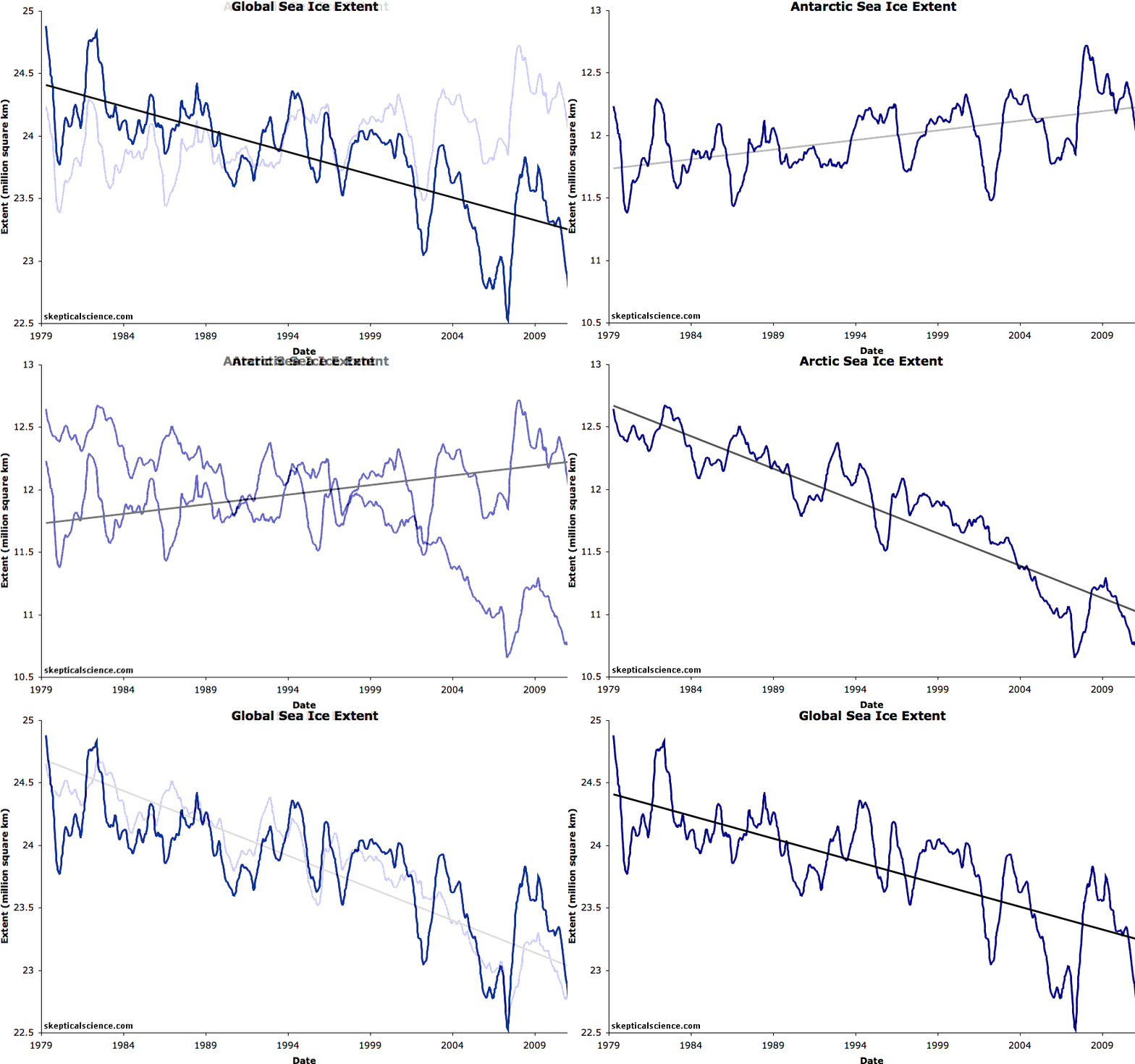
Figure 1: National Snow and Ice Data Center (NSIDC) Antarctic, Arctic, and global (sum of the two) sea ice extents with linear trends. The data is smoothed with a 12-month running average.
Had he wished to be objective, Lawson would also have noted that the decline in Arctic ice volume is even more rapid and concerning than the decline in extent (ice is three dimensional, after all). And an objective Lawson might have mentioned that he mass of the Antarctic ice sheet, especially the West Antarctic Ice Sheet (WAIS) is declining. Or that despite the slight increase in Antarctic sea ice extent, the Southern Ocean is warming - faster than the global trend, in fact.
Polar Bear Population Decline
Lawson proceeded to regurgitate the popular myth that polar bear populations are thriving:
"Had [Attenborough] wished to be objective, he would have pointed out that the polar bear population has not been falling, but rising."
Had Lawson wished to be objective, he would not have made this false assertion. According to a 2009 report by the IUCN Polar Bear Specialist Group, of the 19 recognised subpopulations of polar bears, 8 are in decline, 1 is increasing, 3 are stable and 7 don’t have enough data to draw any conclusions. Figure 2 compares the data for 2005 and 2009.
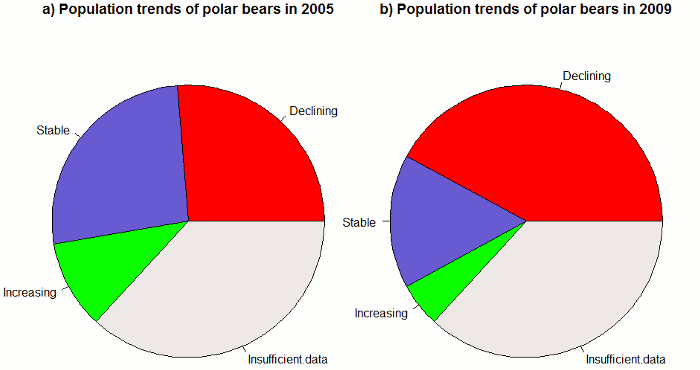
Figure 2: Subpopulation status of polar bears for 2005 and 2009 (Source: Polar Bear Specialist Group)
The overall polar bear population is indeed declining, in large part due to the aforementioned rapid decline in Arctic sea ice. The early retreat of summer sea ice means that bears have less time to hunt and therefore less time to build up fat reserves. Additionally, the fragmentation and reduction in sea ice forces the bears to swim longer distances, using up some of their fat reserves. It also forces the bears to spend more time on land, with increased interactions with humans potentially leading to higher mortality.
Clouds Will Not Save Us from Global Warming
Lawson's next false assertion involves the cloud feedback:
"Had [Attenborough] wished to be objective, he would have mentioned that recent research findings show that the increased evaporation from the Arctic ocean, as a result of warming, will cause there to be more cloud cover, thus counteracting the adverse effect he is so concerned about."
Had Lawson wished to be objective, he would not have such a false, unsubstantiated statement. It's difficult to tell whether Lawson's assertion here is based on the myth that globally, clouds will dampen global warming as a significantly negative feedback which was debunked by most recently and thoroughly by Dessler (2010):
"the short-term cloud feedback had a magnitude of 0.54 +/- 0.74 watts per square meter per kelvin, meaning that it is likely positive."
or whether Lawson is referring to research specific to the cloud feedback in the Arctic region. If the latter, he would still be incorrect. While it's true that clouds have a cooling effect via reflecting incoming solar radiation (increased albedo), had Lawson wished to be objective, he would have noted that clouds also have a competing warming effect by increasing the greenhouse effect.
Screen and Simmonds (2010) found that in the Arctic, the warming effect of the cloud feedback is greater in the spring, fall, and winter (Figure 3). After all, during most of the year the Arctic doesn't get very much sunlight, so the influence of increased cloud reflectivity is not very large, except in summer.
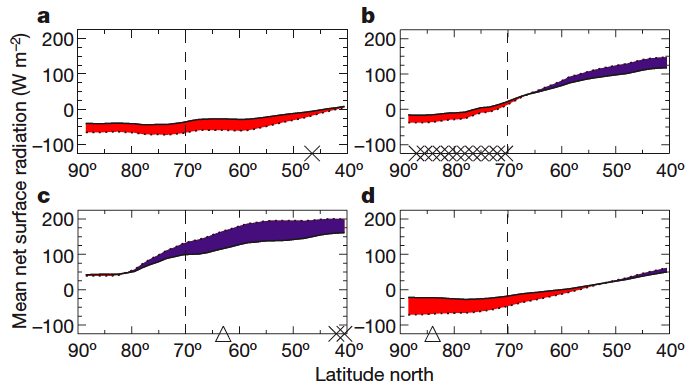
Figure 3: Impacts of cloud-cover changes on the net surface radiation. Mean net surface radiation (short-wave plus long-wave) over the 1989–2008 period under cloudy-sky (solid lines) and clear-sky (dotted lines) conditions. Means are averaged around circles of latitude for winter (a), spring (b), summer (c) and autumn (d). The fluxes are defined as positive in the downward direction. Red shading indicates that the presence of cloud has a net warming effect at the surface. Blue shading indicates that the presence of cloud has a net cooling effect at the surface. The dashed lines show the approximate edge of the Arctic basin. Symbols show latitudes where increases (triangles) and decreases (crosses) in total cloud cover significant at the 99% uncertainty level are found.
As Figure 3 shows, the net Arctic cloud feedback is very slightly negative (cooling) in the summer (Figure 3c), and positve in the winter, spring, and autumn (Figures 3a, b, d). The question is whether the overall feedback is neutral or positive. Screen and Simmonds conclude:
"In short, we find no evidence of changes in cloud cover contributing to recent near-surface Arctic warming."
However, cloud cover changes in the Arctic certainly aren't having the cooling effect that Lawson asserts.
Global Warming Continues
Lawson then repeats one of the favorite climate denialist myths - that global warming has magically stopped:
"Had [Attenborough] wished to be objective, he would have noted that, while there was indeed a modest increase in mean global temperature (of about half a degree Centigrade) during the last quarter of the 20th century, so far this century both the UK Met Office and the World Meteorological Office confirm that there has been no further global warming at all."
This myth is very easily debunked in Figure 4, and repeating it is no sign of objectivity.
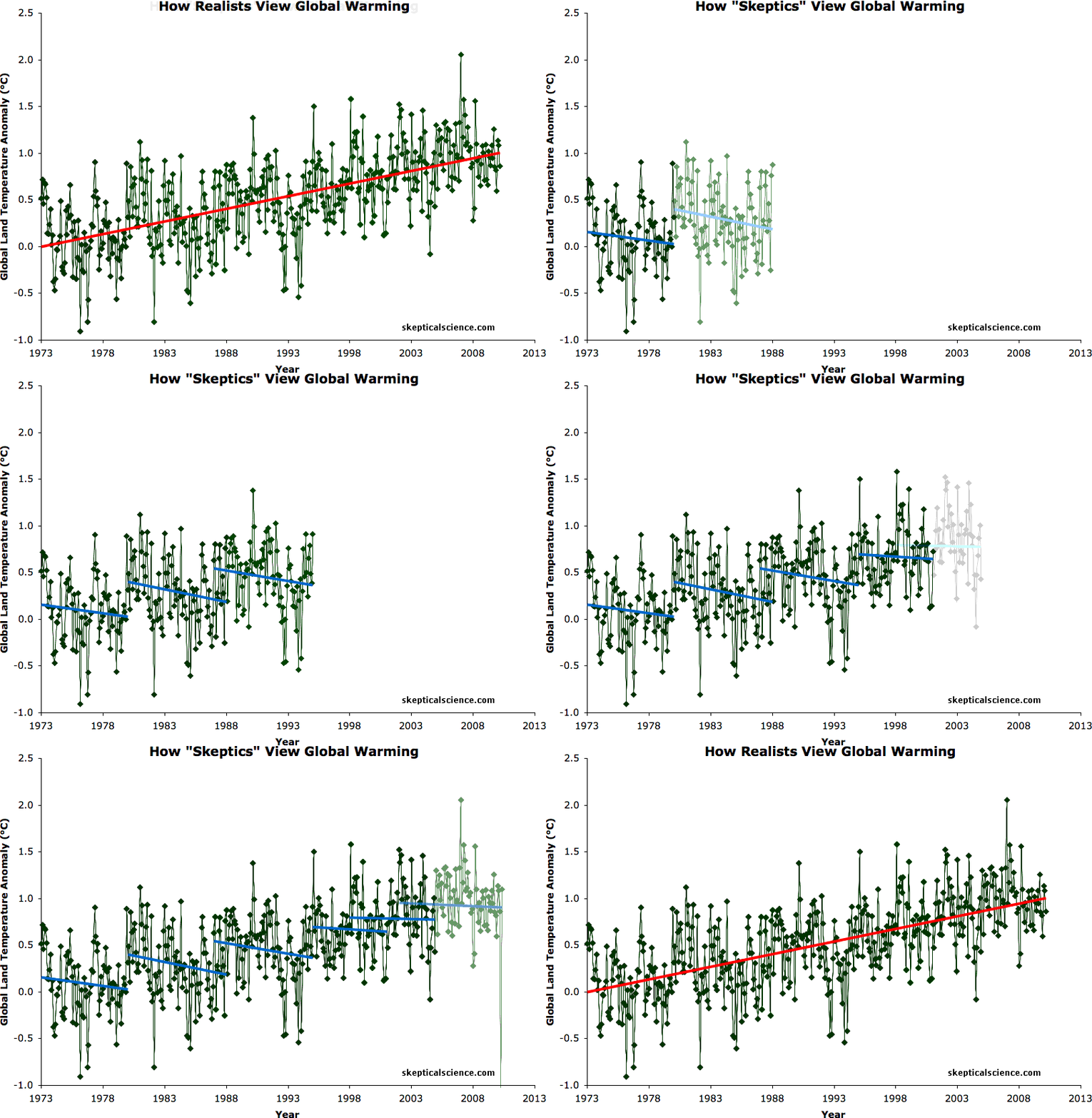
Figure 4: BEST land-only surface temperature data (green) with linear trends applied to the timeframes 1973 to 1980, 1980 to 1988, 1988 to 1995, 1995 to 2001, 1998 to 2005, 2002 to 2010 (blue), and 1973 to 2010 (red).
Even if we go along with Lawson's cherrypicked starting date, his claim of "no further global warming at all" since 2000 is simply wrong (Figure 5).
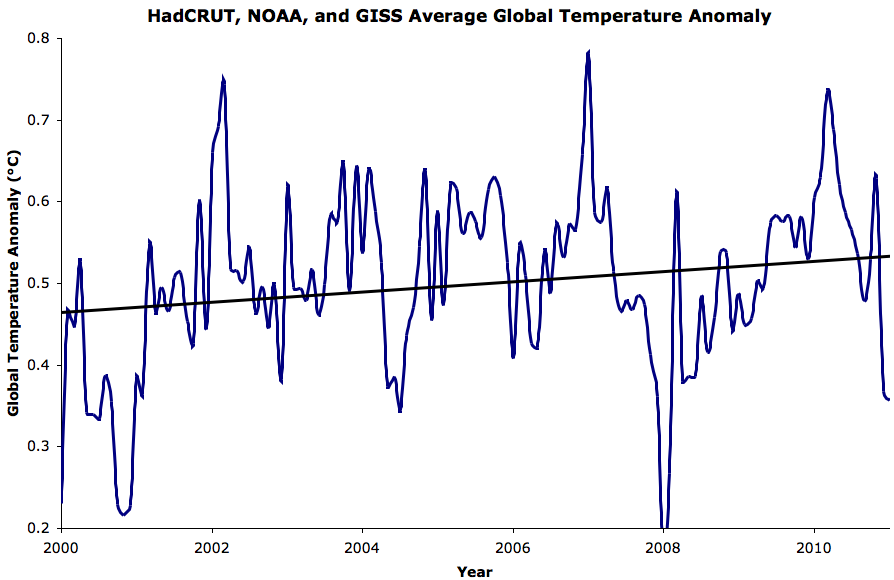
Figure 5: Average global surface temperature anomaly from HadCRUT, NOAA, and GISS since 2000 (blue), and linear trend (black)
The linear trend in this data since 2000 is 0.063°C warming per decade. Lawson has conveniently selected the HadCRUT data, which has a known cool bias. The average of the NOAA and GISS data since 2000 produces a 0.085°C warming trend per decade. Even if we cherrypick the timeframe (since 2000) and dataset (HadCRUT), there is still a warming trend (0.02°C per decade). Of course none of these trends is statistically significant, because 10 years is too short of a timeframe to establish statistical significance. Lawson is focusing on short-term noise rather than long-term signal, as Figure 4 illustrates. Nevertheless, his assertion of no warming is wrong.
Lawson Reveals His Motives
Lawson closes his article by spreading myths about climate solutions:
"if there is a resumption of warming, the only rational course is to adapt to it, rather than to try (happily a lost cause) to persuade the world to impoverish itself by moving from relatively cheap carbon-based energy to much more expensive non-carbon energy."
In fact, Lawson has crammed two myths into this closing sentence. Firstly, economic studies consistently show that climate mitigation is cheaper than adaption. Secondly, while the market price of fossil fuel energy is generally cheaper than renewable energy, when we account for all the costs, many renewable sources are cheaper in reality due to the massive external costs not reflected in the market price of coal (Figure 6).
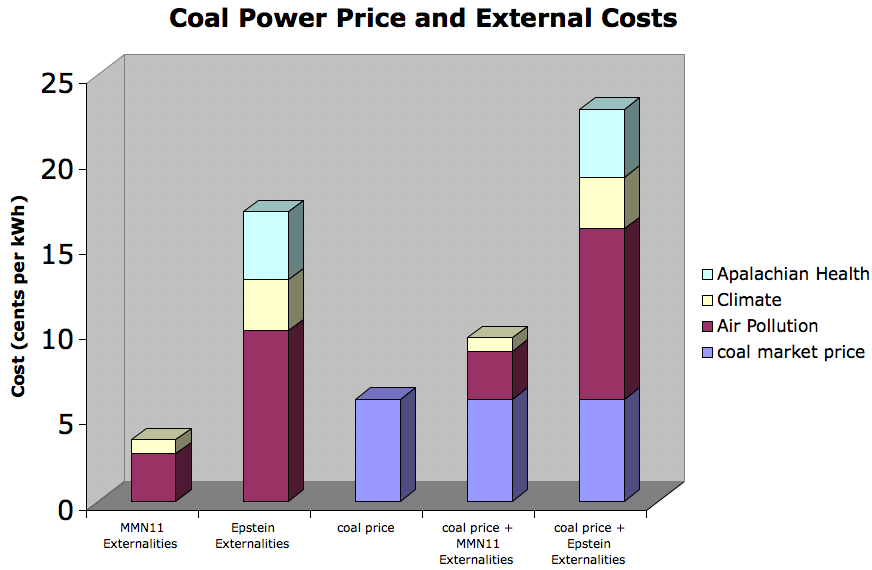
Figure 6: Average US coal electricity price vs. MMN11 and Epstein (2011) best estimate coal external costs.
If Lawson were truly objective, he would not ignore these inconvenient but very real costs.
Misinformation is not Objectivity
In every case, Lawson's "objectivity" is nothing more than repeating myths and spreading misinformation. Perhaps Lawson would feel more at home in the United States, where climate denial prohibits scientifically-sound presentations like Attenborough's from being shared with the public, and where presenting Lawson's brand of misinformation is encouraged as being "fair and balanced."


 0
0  0
0 A few numbers:
- the slope of the linear fit is -0.25 SH Km2/NH Km2 and (barely) significant;
- though, the determination coefficient R2 is relatively low (0.22);
- the Pearson correlation coefficient is -0.34, not much but it's there;
- strange enough, ice area (from the same source) shows a smaller and non-significant slope, R2 is just 0.07 and the Pearson correlation coefficient is -0.1
A correlation betweeen NH and SH sea ice apparently exists, though rather weak. If they both reflect the response to a warming world, the simple sum of the two extents makes no sense, let alone the trivial observation that SH sea ice is increasing. Rather, the sum of the absolute values of the anomalies would better represent the common cause. But we know that it's not that simple, we need the physical representation of the processes, i.e. GCMs.
A few numbers:
- the slope of the linear fit is -0.25 SH Km2/NH Km2 and (barely) significant;
- though, the determination coefficient R2 is relatively low (0.22);
- the Pearson correlation coefficient is -0.34, not much but it's there;
- strange enough, ice area (from the same source) shows a smaller and non-significant slope, R2 is just 0.07 and the Pearson correlation coefficient is -0.1
A correlation betweeen NH and SH sea ice apparently exists, though rather weak. If they both reflect the response to a warming world, the simple sum of the two extents makes no sense, let alone the trivial observation that SH sea ice is increasing. Rather, the sum of the absolute values of the anomalies would better represent the common cause. But we know that it's not that simple, we need the physical representation of the processes, i.e. GCMs.








Comments