Climate change policy: Oil's tipping point has passed
Posted on 1 February 2012 by John Hartz
This is a reprint of a news release written by Sandra Hines and posted on the website of the University of Washington on Jan 26, 2012.
Stop wrangling over global warming and instead reduce fossil-fuel use for the sake of the global economy.
That’s the message from two scientists, one from the University of Washington and one from the University of Oxford in the United Kingdom, who say in the current issue of the journal Nature (Jan. 26) that the economic pain of a flattening oil supply will trump the environment as a reason to curb the use of fossil fuels.
“Given our fossil-fuel dependent economies, this is more urgent and has a shorter time frame than global climate change,” says James W. Murray, UW professor of oceanography, who wrote the Nature commentary with David King, director of Oxford’s Smith School of Enterprise and the Environment.
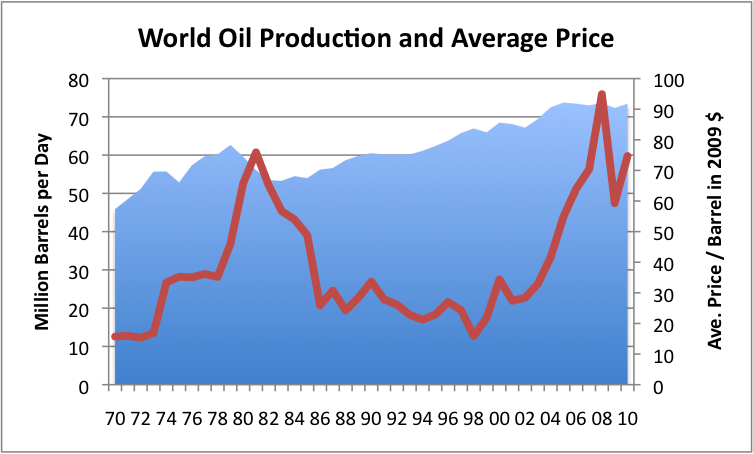
The “tipping point” for oil supply appears to have occurred around 2005, says Murray, who compared world crude oil production with world prices going back to 1998. Before 2005, supply of regular crude oil was elastic and increased in response to price increases. Since then, production appears to have hit a wall at 75 million barrels per day in spite of price increases of 15 percent each year.
“As a result, prices swing wildly in response to small changes in demand,” the co-authors wrote. “Others have remarked on this step change in the economies of oil around the year 2005, but the point needs to be lodged more firmly in the minds of policy makers.”
For those who argue that oil reserves have been increasing, that more crude oil will be available in the future, the co-authors wrote: “The true volume of global proved reserves is clouded by secrecy; forecasts by state oil companies are not audited and appear to be exaggerated. More importantly, reserves often take 6 - 10 years to drill and develop before they become part of the supply, by which time older fields have become depleted.” Production at oil fields around the world is declining between 4.5 percent and 6.7 percent per year, they wrote.
“For the economy, it’s production that matters, not how much oil might be in the ground,” Murray says. In the U.S., for example, production as a percentage of total reserves went from 9 percent to 6 percent in the last 30 years.
“We’ve already gotten the easy oil, the oil that can be produced cheaply,” he says. “It used to be we’d drill a well and the oil would flow out, now we have to go through all these complicated and expensive procedures to produce the oil.”
The same is true of alternative sources such as tar sands or “fracking” for shale gas, Murray says, where supplies may be exaggerated and production is expensive. Take the promise of shale gas and oil: A New York Times investigative piece last June reported that “the gas may not be as easy and cheap to extract from shale formations deep underground as the companies are saying, according to hundreds of industry e-mails and internal documents and an analysis of data from thousands of wells.”
Production at shale gas wells can drop 60 to 90 percent in the first year of operation, according to a world expert on shale gas who was one of the sources for the commentary piece. Murray and King built their commentary using data and information from more than 15 international and U.S. government reports, peer-reviewed journal articles, reports from groups such as the National Research Council and Brookings Institution and association findings.
Stagnant oil supplies and volatile prices take a toll on the world economy. Of the 11 recessions in the U.S. since World War II, ten were preceded by a spike in oil prices, the commentary noted.

Calculations from the International Monetary Fund, for example, say that to achieve a 4 percent growth in the global economy in the next five years, oil production must increase about 3 percent a year.
“Yet to achieve that will require either an heroic increase in oil production, ... increased efficiency of oil use, more energy-efficient growth or rapid substitution of other fuel sources,” according to the commentary.
“Economists and politicians continually debate policies that will lead to a return to economic growth. But because they have failed to recognize that the high price of energy is a central problem, they haven’t identified the necessary solutions: weaning society off fossil fuel.”
The commentary concludes: “This will be a decades-long transformation and we need to start immediately. Emphasizing the short-term economic imperative from oil prices must be enough to push governments into action now.”
Reference:
Nature Commentary: “Climate policy: Oil's tipping point has passed”, James Murray1 & David King
Nature, Volume 481, Pages: 433–435, 26 January 2012, doi:10.1038/481433a
Arguments


IMO, we need drastic, immediate changes to the current outlook for the next ten years.
P.S. love reading climate news from tomorrow, today. What an amazing planet!
What is clear is that we've passed the peak of 'conventional' oil. Without the new sources we'd now be facing massive economic consequences.
This article suggests that 'alternative fossil fuels' will not be able to continue to support the demand gap and that their costs will drop more slowly than renewable costs. However, neither of those is a sure thing. Research funding, government regulation, and 'luck' will play a part in which technologies have the biggest economic breakthroughs.
For purposes of avoiding global warming it would be nice if we could write off fossil fuels as economically unfeasible, but the reality is that we just can't know how the 'R&D race' is going to play out. I think there is some cause for hope in the fact that fossil fuel producers are just trying to keep costs from growing too much while solar power is projected to drop below current 'grid parity' over the next decade (it already has in some places). That should make a transition to renewables inevitable, but leaves alot of uncertainty about how much GHG levels will increase before we get there.
Instead, all we get is "Drill, Baby, Drill."
It feels a bit like Rome in 477 AD.
I understand that we are talking about two whole different systems here but still... it doesn't feel right.
One (the atmosphere) is a dynamic system bouncing chaotically around a mean set by the planetary energy budget, and the other (conventional oil) is a depleteable resource whose state can be inferred from other information besides the time series (reserves, price behavior, production trends). In short, there are physical reasons to believe these systems are different and consequently there will be different standards for assessing them. It would almost certainly be foolhardy to apply to the same criterion to both of them.
When your car gets the hiccups it is probably running out of fuel. The longer the hiccups continue, the more certain you can be of being stranded. It is not, however, certain that you will end up on foot in some backwoods place where creepy people with genetic defects do nasty things to strangers.
In addition, Foster and Rahmstorf (2011) - see Dec 20 2011 report is SkS - showed that by adjusting the global temperature anomaly for ENSO, volcanoes and solar cycle effects, the resultant composite global temperature upward trend appears to have statistical significance over a time span much shorter than 30 years (only 11 years).
If you take a trend or moving average of global temperature anomalies over the past 15 years it shows warming.
If you take a trend or moving average of oil production over the past 5 years it is essentially flat.
In short, they are described differently because they show different results.
Of course that doesn't preclude the possibility that production can be introduced at the $100+ price point but with a lag longer than 7 years.
You need to consider that it has been forecast for decades that oil would run out in the early years of the 21st century. So the question is: when we see oil running out as expected is it really running out? Compared to Climate Change where we expect the climate to keep getting warmer and we see data that says it is still getting warmer in spite of claims to the contrary.
Canada oil sands are not economic at less than about $100 per barrell. The people who want to build the pipeline obviously think oil will only go up in price.
So yes, there is still plenty of coal around, but the cost of coal power is going to continue going up so long as it requires gasoline to transport it.
There are also many issues with government and industry estimates of coal reserves. Much data is secret. They mine the best deposits first so only third and fourth rate deposits are left. It is difficult for a non-expert to sift through the conflicting claims to determine how much coal can really be extracted economically. When you look at the obviously fudged claims about oil (see link above), it makes you wonder how much coal there really is to be extracted. For example they measure coal in extracted tons of coal, but new coal mines have lower quality coal which has a lower heat content per ton. Because they need more coal they do more environmental damage extracting it. Eventually even West Virginia may say enough.
It has a serious topic, but manages to be an entertaining read at the same time. My favourite quote is the one about the efficiency of modern drilling sites: "The crew on site will consist of a driller and a dog. The driller is there to feed the dog. The dog is there to bite the driller if he touches anything."
Uhm ... didn't the IEA say that we are on pace to surpass the level of CO2 in the atmosphere that is considered safe by scientists by 2017? Is the argument that oil demand will become economically critical before that point?
http://www.skepticalscience.com/news.php?n=1112
"The headline conclusion of the WEO11 report is that, while the 450 target is still achievable, our chances of success are decreasing with every year of delay, and that, by 2017, the target could be out of reach."
The statement you quoted does not say we will reach 450 by 2017, only that we will be unable to avoid reaching it by that point. That is, putting on the brakes to slow emissions (if we don't start doing so until 2017) will be virtually impossible without unnecessary and painful economic upheaval.
At the current rate of emissions (assuming no slow down or acceleration) we will reach 450 by about 2042.
Pumping oil out of the ground is a function of supply and demand. The world wasn't in recession in 2005 when pumping peaked, so that was a good benchmark for our capacity. When volume declined and rocketing prices didn't cause more to be pumped, it's a good bet that they're pumping as much as they can.
The positive side is that this may just provide enough of a wake-up call to allow serious developments of non-fossil alternatives.
Unless the fossil lobby buy enough politicians so that we're forced to stick with coal, that is.
That claim is nonsense. The economy can and will grow if energy provided by oil can be replaced by energy produced from an alternative source at a competitive price.
Energy produced by oil is primarily used for transport and heating. Both can be (and are) provided from alternative sources such as gas and electricity. While the largest source of electricity in most countries is burning fossil fuels, as the price of those fuels increases, so wind, geothermal and solar alternatives become relatively cheaper and, ultimately, cheaper than fossil fuels.
Consumers, whether industrial or household do not care where their energy needs come from provided they are the cheapest available. Clean energy sources are becoming cheaper as technological advances are made in their production, storage and distribution.
Advances are being made in the efficiency with which energy is generated: solar base load electricity generation (through heat storage) is now possible, geothermal energy is being more widely used (through improved heat mining) and electricity can be stored and transported (through improving battery technology).
Dangerously polluting fossil fuels will continue to be used but there are alternatives to them. The need to use those alternatives are becoming increasingly attractive as the world grows warmer, extreme climate events increase and finite oil and gas deposits deplete with increasing rapidity. These aspects will relegate use of oil and gas to more profitable use in the petro-chemical industry, rather than inefficient transport and wasteful heating.
I find the USN to be an interesting example of an organisation driven by pragmatic rather than ideological reasoning. They also are looking at future redeploying of assets to deal commercial sealane protection with the projected projected increase of cargo shipping through the now navigable route across the arctic.
Governments may be in denial but some organisations, such as the USN, appear to realise that they must follow current developments and function in the real world.
First you need to distinguish between reserves which have been fully mapped by geological surveys, and which are commercially recoverable at current price levels and technologies, and reserves which are believed to exist based on geological reasoning, but which have not been fully mapped, or which may not be fully recoverable.
Based on which type of estimate you use, and whose estimate (there is some difference in estimates), reasonable projections of fossil fuel use in the coming centuries will lift CO2 levels to somewhere between 980 and 4600 ppmv. The later figure requires exhausting reasonable expectations of coal reserves, and is not possible within a single century (and may take as much as four centuries).
In the short term (for a century or so), that increase in CO2 levels will result in an increase in Global Mean Surface Temperature by 5 to 11 degrees C. After a century or so, CO2 levels will decline to about 25% of their peak and then take tens of thousands of years to return to natural levels. That decline will reduce temperatures to between 2 and 6 degrees C above current levels. As 2 degrees C is the limit above which AGW starts going from harmful but manageable to very dangerous, anything like the full exhaustion of gas and oil reserves and 10% of coal reserves (the assumption in calculating the figure) represents a very significant risk for the future.
These calculations assume no significant increase of natural GHG emissions as a result of higher temperature, which given developments in Siberia is not a safe assumption.
http://www.theoildrum.com/
It is really worth reading.
One figure shows much about the problem. If you are not familiar with ROI, it means Return On Investment. For one barrel oil we invest, we got 100 barrel out in 1930. Today we have passed 20 barrels, moving fast to a ROI of 10 barrels. This is a decline of 80 to 90%!
It does not matter how high oil price will climb, if you get out only one barrel oil per used this is utterly meaningless.
to give you a picture look at this graph:
http://www.theoildrum.com/files/HallandDay.png
from this post on the Oildrum:
http://www.theoildrum.com/node/8625
It really is a scary picture that comes up, but again, the solution is exactly the same for climate as for energy.
Only a little bit off topic, i recommend you all to have a look at a very exciting lecture about exponential functions by Albert Bartlett
http://www.youtube.com/watch?v=F-QA2rkpBSY&feature=list_related&playnext=1&list=SP6A1FD147A45EF50D
Yes, US coal production is now in decline, but China is just starting to ramp up. Indeed, Chinese coal is probably the single largest source of potential CO2 emissions for the next 50 years.
To stop using coal we need to stop making steel. We need to only use recycled steel. The government needs to invest in steel recycling.
Cars use lots of steel but most have too much plastic shit that stops efficient recycling. The most recyleable car is still the trusty Jeep Wrangler with stuff all plastic shit. Put the baby on LPG and you have greenest cradle to grave wheels around.
A carbon tax will not be enough we need a steel tax as well. Don't know why the government doesn't get it.
As an ecologist I have been preoccupied for years by carrying capacities and system asymptotes. Tainter's explanations of societal collapse are very good, although I think that he could possibly and usefully emphasise the laws of thermodynamics a little more, and perhaps stick his neck out more about steady-state systems, especially separated from hangings-over of the old (failed) economic paradigm.
If there is any deficiency in his analyses it would be in referencing complex, dynamic equilibrium states in ecological and thermodynamic contexts: by doing so, using a compare-and-contrast with various civilisatons' economic models, he could very effectively demonstrate what will and what will not work over the long-term in human societies.
As to achieving a maximum atmospheric CO2 (equivalent or otherwise) concentration of 450 ppm, I have for several years now been convinced that 2017 is a pie-in-the-sky landmark. Barring extreme intervention on the scale of global warfare or ('flu?) pandemic (neither unlikely, by the way), I'd say the cut-off date for Peak-Opportunity-for-keeping-mean-global-temperature-to-less-than-2C-abov-the-pre-Industrial-Revolution-value occurred at around the same time as Peak Oil... 2005.
No useful purpose would be served by a steel tax. A carbon tax would cover all the costs of carbon production both in processing iron, and in the production of energy needed. Ergo if your purpose is to reduce GHG emissions, the steel tax adds nothing to the carbon tax, and merely distorts the market.
Every physical system time series has it's own period required to separate any underlying trend from the "noise" of natural variability, and that period is determined from the data set itself. See Robert Grumbine's explanation of determining the period for the climate system here: http://moregrumbinescience.blogspot.com/2009/01/results-on-deciding-trends.html
Petroleum reserves and production are a completely different system from climate, and are not entirely a physical system as consumption is based on human behavior rather than physics, so therefore it is entirely reasonable to expect a completely different time period. That said, I don't know if 5 years is the correct period or not. Perhaps someone else can address that question.
http://www.bloomberg.com/news/2012-02-01/fracking-boom-could-finally-cap-myth-of-peak-oil-peter-orszag.html
Like it or not, without good energy storage like batteries, all the solar & wind is worth squat, in the middle of a still, -20 deg. night.
So I suspect human ingenuity will create an "overclocking" type blip, where we pull out more oil for a very short time (less than a decade from the next time the global economy is firing on all cylinders).
In a way, we should thank the Bush-era policy makers for this 5-10 year time period when we are not experiencing the economic disruption of peak oil.
I very much would prefer that the human ingenuity I spoke of where unleashed on the problem of renewable energy (ie a carbon tax).
PS - Tom Curtis - your post #28 could be the core of a fascinating main article.
You may be right. That might mean in a renewable energy based grid, power companies may offer discounts to use power during day light hours rather than offering discounts to use electricity after dark as they currently do.
How could we possibly cope. Heating our water during the day instead of at night? It's the end of civilization as we know it! /sarc
"We have to leave oil before it leaves us."
This is the opion of an agency that directly advises the members of the OECD. So this opinion should not be easily dismissed by the polluters.
While it is quite possible that alternatives can substitute for fossil fuels, it is going to take years to convert the current infrastructure. For instance it has to be remembered that there are a lot of people who might love to have a new electric car, but will have to make do with their old fossil fuel banger until it eventually collapses and even then second hand electric cars might still be too expensive.
Peak oil might be a very good thing as far as climate change is concerned as it is generally agreed that post peak oil means very limited growth at best and probably economic decline will be more the order of the day. This will obviously lead to reduced production and thus reduced emissions. It won't be a particularly nice experience and could easily lead to many countries going into depression with the attendant danger of public unrest.
I recommend Oil, Smoke and Mirrors (Full length) on YouTube (beware the credits roll while there is still half of it left to watch).
“Scrapping fossil-fuel subsidies would get us halfway there on climate change” by Brad Plumer, Ezra Klein’s Wonkblog, Washington Post, Jan 20, 2012
Click here to access this timely and thought-provoking article.
Source: “UN panel urges phase-out of fossil fuel subsidies” by Jake Schmidt, The energy Collective, Jan 31, 2012
You can use charcoal as a reducing agent but not with current furnace design. you need the coke to be strong enough to support the weight of material above and retain gas flow.
The big threat that I can see is that rising oil prices will lead to a shift to coal-powered (via electricity) cars instead with significantly higher emissions. I'm with Hansen - we need a ban on new coal-powered stations and let market force sort out a better energy system.
[source]
Last time production dropped was after the Iranian Revolution and the following Iran-Iraq War.

But there is an important point they still don't get: it has to start with the voters, since the policy makers are too beholden to monied interests to make such a decision without strong voter support.
So first, it is the voters who need to get the point " lodged more firmly in their minds"
If the externalities were truly taken into account, the oil from fracking would be considered unacceptably high priced.
Also, oil industry apologists have a bad reputation for inflating their estimates of how much oil they can get for how long out of any new reserve or technology. Why would fracking be any exception? I doubt it will be.
Finally, storage mechanisms are getting better. We are nowhere near the thermodynamic limits of storage efficiency with today's technologies, a decent new "smart grid" will open up possibilities for much more efficient technologies at much lower costs.
How do you make turkeys vote for Christmas?
Voters hold the keys in a democracy, and as the majority of them vote selfishly according to their economic conditions, the people they elect will always be mandated to pursue disaster.
If voters are informed that doing X will definitely lead to Y if action Z isn't taken might just be able to lead to some positive results, but Easter Island springs to mind.
Actively encouraging and investing in markets for alternative energies is a way forward, even if initially expensive.
Considering externalities, I'd argue that leaving coal in the ground is worth more than digging it up.
There are many people who believe that the unrest in the Middle East since the beginning of last year was/is largely a response to rising food prices. This was certainly the cause of food riots in the Far east in 2007. Imagine living in a country where the average person needs to spend 50% of their income on food, and then imagine what happens when world oil prices rise. The saying 'we're nine meals from anarchy' has an awful ring of truth to it.
And then they tell us there will be 9bn people on the planet by 2050...
I know I've not provided links but I encourage folks to do a bit of their own research on this topic. Here are a few phrases to google that will start you off uncovering the evidence...
food riots far east 2007
food prices arab spring
oil costs in farming
nine meals from anarchy