





Climate change models underestimate future temperature variability; food security at risk
Posted on 27 February 2012 by John Hartz
This is a reprint of a news release posted by the University of Washington on Feb 17, 2012.

![]()
Climate warming caused by greenhouse gases is very likely to increase the variability of summertime temperatures around the world by the end of this century, a University of Washington climate scientist said Friday. The findings have major implications for food production.
Current climate models do not adequately reflect feedbacks from the relationship between the atmosphere and soil, which causes them to underestimate the increase of variability in summertime temperatures, said David Battisti, a UW professor of atmospheric sciences.
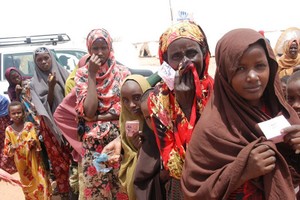
Somali refugees hold meal cards outside a feeding center at an Ethiopian transit camp in September 2011. Severe drought in the Horn of Africa created serious food security issues for many people.
P. Heinlein/Voice of America
While warmer temperatures already have implications for food production in the tropics, the new findings suggest the increase in the volatility of summertime temperatures will have serious effects in grain-growing regions of Europe and North and South America, Battisti said.
“If there’s greater variability, the odds of the temperature being so high that you can’t grow a crop are greater,” he said.
“In terms of regional and global food security, it’s not good news.”
Battisti presented his findings at the American Association for the Advancement of Science meeting in Vancouver, Canada. His discussion was part of a panel on climate and global food security that included Rosamond Naylor of Stanford University and Daniel Vimont of the University of Wisconsin, with whom he has collaborated on previous food security research.
Earlier research has shown that by the end of this century, the increase in average growing season temperature, if other factors remain the same, will likely reduce yields of rice, corn and soybean 30 to 40 percent. Already rice yields in the tropics are being affected by higher temperatures, affecting nations such as Indonesia, which frequently imports rice to stabilize prices, Battisti said.
In addition, the scientists say global warming will have greater impacts than previously thought on the El Niño Southern Oscillation, a tropical phenomenon that has global impact on climate and food production. Their conclusions are based on geological and other proxy records of climate and El Niño from the last 10,000 years, plus recent analyses of long-term climate changes because of global warming.
The Intergovernmental Panel on Climate Change, the United Nations body conducting ongoing assessments of climate change, has estimated that future month-to-month temperature variability during summer months is likely to be greater in some places and less in some places, but should stay roughly constant in many places.
But the new modeling work, Battisti said, shows most areas can expect to see greater variability in summer temperatures between now and 2085, with the biggest impacts in Europe, Africa and South America.
“The increased variability will be pretty ubiquitous. You will see it pretty much everywhere.”
Increased temperature variability compounds the loss of production because of higher average temperatures, Battisti said. Add higher fertilizer prices and other market pressures to the mix “and food insecurity is likely to be higher than it has been for some time.”

Arguments


"The South East of England recently joined a long list of regions in drought.
On Monday 20 February, the Environment Secretary announced that the South East of England has officially moved into drought status. This is due to the combination of persistent dry weather and the continuing decline in groundwater levels and river flows and increasing the risk to public water supplies, agriculture and the environment.
As a result Hampshire, West Sussex, East Sussex, Kent, Surrey, London, Berkshire, Hertfordshire, Buckinghamshire, Oxfordshire, and the east of Gloucestershire are now in drought."
UK Environment Agency
Food prices likely to increase
The Mayans - a lesson from history.
No rain expected for the foreseeable future but, then again, Scotland seems to have had the 20% that we are down.
However, we are still the lucky ones, even with all that, compared to those in places like Somalia mentioned in the article.
Doug Proctor
Did a drive-by over on real climate.
Apparently there are 3,411,327,592 acres of arable land and 12,067,879,561 acres of agricultural land which includes arable land, permanent crops and permanent pastures. http://en.wikipedia.org/wiki/Arable_land
Per the Oak Ridge National Laboratory there are 3,657,159,639 acres of cultivated and permanent crop land leaving 8,410,719,923 acres of pasture. http://daac.ornl.gov/NPP/other_files/worldnpp1.txt
At a world population of 7 billion that equates to 0.52 acres/person of crop land and 1.2 acres per person of pasture
.
But not all crop land is used to produce food. 388,888,889 acres are used to produce grain for beer. Table 8 below plus http://en.wikipedia.org/wiki/Beer
http://cruisenews.net/brewing/
85,992,673 acres of cotton
http://unctad.org/infocomm/anglais/cotton/market.htm#prod
and 47,196,385 acres of grapes for wine
http://www.wineinstitute.org/files/WorldWineProductionbyCountry.pdf
http://www.boutiquewineries.com.au/articles/HowManyGrapesinaBottleofWine.cfm
Subtracting this acreage from the total crop land reduces the acres/person for crops to 0.45.
The Median UN projection for 2050 is 9.2 billion reducing the numbers with no change in land use to 0.34 and 0.91 acres/person respectively.
Based on data from Table 8 http://books.google.com/books?id=vHprLAOlOkYC&pg=PA43&lpg=PA43&dq=what+crops+has+the+highest+caloric+yield&source=bl&ots=pv1C7ha9Kj&sig=UYSqCeS_PYvoWJX40Vthsl1siIM&hl=en&sa=X&ei=dJAmT-f-Luna0QH3gfnbCA&sqi=2&ved=0CDkQ6AEwAw#v=onepage&q=what%20crops%20has%20the%20highest%20caloric%20yield&f=false
It takes 0.45 acres of wheat to produce 2000 calories/day and 0.36 acres of rice, 0.26 acres for yams and sweet potatoes and 0.15 for Cassava.
Clearly we can feed the projected world population in 2050 if we all become vegetarians or Ovo-lacto vegetarians. Based on a 2000 calorie/day diet, with 550 calories/day (`6 ounces) of protein from equal parts chicken, eggs, pork and beef I estimate the protein for one person would take 1.4 acres, with fruits, vegetables, grain, dairy and oil taking another 0.36 acres. Substituting soybeans for meat would drop the total to 0.39 acres /person. Elimination of dairy would reduce the total further to 0.17 acres /person.
There were too many sources used to develop this information to site here. I think I have developed the concept far enough to indicate that there will be strong pressure in the future to convert more land to cropland for food production, with a possible significant increase in carbon emissions, especially if we start using crop land to produce bio-fuels or site solar cells.
This is an extreme contrast to last winter when, after 10 months of above average temperatures in 2010, we got hit hard in Dec. 2010 with cold weather and one snowfall of 48", a record snowfall for my small town. We made the national news on two major TV networks. I doubt that we've had 48" of snow this entire winter so far. And last year, the weather continued to be cold and snowy throughout the winter. Really a miserable winter and people could not remember one like it. Of course this set the climate skeptics to saying "see, the climate *is* getting colder."
It's the variability of the weather recently here in my area that seems most striking, with winters seemingly swinging to extremes one way or the other.





