





Nordhaus Sets the Record Straight - Climate Mitigation Saves Money
Posted on 2 March 2012 by dana1981
Yale's William Nordhaus is one of the foremost experts on climate economics. His research has frequently been misrepresented by climate "skeptics" to argue that CO2 limits will harm the economy. For example, Christopher Monckton cited a climate economics review by Richard Tol (which in turn heavily cited work by Nordhaus) in claiming:
"...the overwhelming majority of economic studies on the subject (which are summarized in my paper) find the cost of climate action greatly exceeds the cost of inaction..."
As we demonstrated in our response, Monckton completely misrepresented the work of Tol (and Nordhaus, by extension), and thus his claim is 100% wrong. The reality is that the overwhelming majority of economic studies on climate find the cost of climate inaction greatly exceeds the cost of action (Figure 1). That's why there is a consensus amongst economists with climate expertise that we should reduce greenhouse gas emissions (Figure 2).
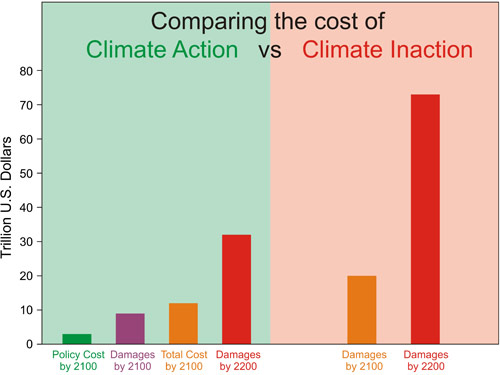
Figure 1: Approximate costs of climate action (green) and inaction (red) in 2100 and 2200. Sources: German Institute for Economic Research and Watkiss et al. 2005
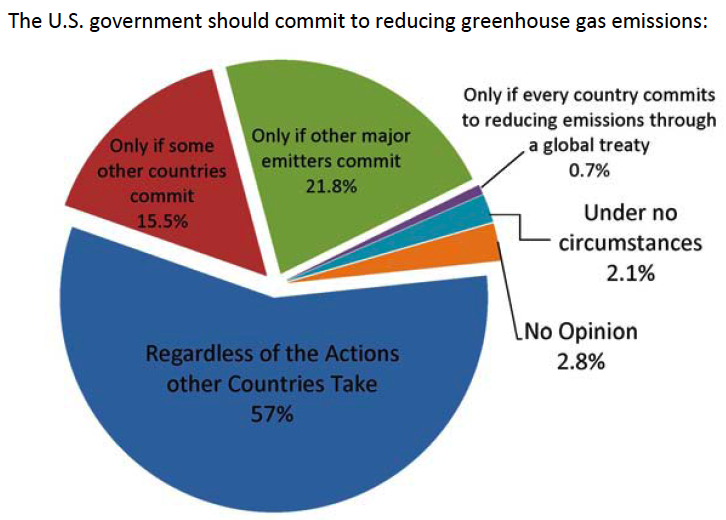
Figure 2: New York University survey results of economists with climate expertise when asked under what circumstances the USA should reduce its emissions
Similarly, a recent letter published by the Wall Street Journal, signed by 16 climate "skeptics" (few of which have any climate or economics expertise, and many of which have received fossil fuel funding) misrepresented Nordhaus' research as supporting climate inaction from an economic standpoint. When Nordhaus objected to this misrepresentation of his work, Patrick Michaels doubled-down on the misrepresentation, claiming Nordhaus didn't understand his own research.
However, as discussed by Alex C on Skeptical Science, the "skeptics" had indeed misrepresented Nordhaus' work. They focused on the cost-to-benefit ratio of various climate mitigation options, whereas it is the difference (benefit minus cost, as opposed to benefit divided by cost) which tells us how much money is saved, and thus is the most important factor in determining which option is most economically beneficial.
In a recent article, Nordhaus sought to set the record straight that the climate economics literature clearly indicates that CO2 limits will save money. Nordhaus confirmed that the SkS approach is the correct one:
"The authors cite the “benefit-to-cost ratio” to support their argument. Elementary cost-benefit and business economics teach that this is an incorrect criterion for selecting investments or policies. The appropriate criterion for decisions in this context is net benefits (that is, the difference between, and not the ratio of, benefits and costs).
This point can be seen in a simple example, which would apply in the case of investments to slow climate change. Suppose we were thinking about two policies. Policy A has a small investment in abatement of CO2 emissions. It costs relatively little (say $1 billion) but has substantial benefits (say $10 billion), for a net benefit of $9 billion. Now compare this with a very effective and larger investment, Policy B. This second investment costs more (say $10 billion) but has substantial benefits (say $50 billion), for a net benefit of $40 billion. B is preferable because it has higher net benefits ($40 billion for B as compared with $9 for A), but A has a higher benefit-cost ratio (a ratio of 10 for A as compared with 5 for B). This example shows why we should, in designing the most effective policies, look at benefits minus costs, not benefits divided by costs."
Nordhaus went on to further dispel the myth that CO2 limits will hurt the economy. In fact, the opposite is true:
"My research shows that there are indeed substantial net benefits from acting now rather than waiting fifty years. A look at Table 5-1 in my study A Question of Balance (2008) shows that the cost of waiting fifty years to begin reducing CO2 emissions is $2.3 trillion in 2005 prices. If we bring that number to today’s economy and prices, the loss from waiting is $4.1 trillion. Wars have been started over smaller sums.
My study is just one of many economic studies showing that economic efficiency would point to the need to reduce CO2 and other greenhouse gas emissions right now, and not to wait for a half-century. Waiting is not only economically costly, but will also make the transition much more costly when it eventually takes place. Current economic studies also suggest that the most efficient policy is to raise the cost of CO2 emissions substantially, either through cap-and-trade or carbon taxes, to provide appropriate incentives for businesses and households to move to low-carbon activities."
[...]
"The claim that cap-and-trade legislation or carbon taxes would be ruinous or disastrous to our societies does not stand up to serious economic analysis. We need to approach the issues with a cool head and a warm heart. And with respect for sound logic and good science."
Despite the economic reality that CO2 limits will save money, the myth that they will harm the economy is a pervasive one. However, this myth is based on nothing more than a misunderstanding of climate science and economics, and misrepresentation of the climate science and economics body of research.
Note: this information has been incorporated into the rebuttal to the myth "CO2 limits will harm the economy"

Arguments


http://www.nybooks.com/articles/archives/2012/mar/22/why-global-warming-skeptics-are-wrong/
yours
Frank Johnston
yours
Frank
So its the studies that estimate costs of GW that are skewed, always assuming the effects are negative.
Somehow, it seems, we are wired to over-emphasize ratios.
Aside from the hints given in johngray's pointer at #7, Fairoakien needs to consider that the geometrical premise of his question does not necessarily stand up.
As the poleward borders of growing regions move further poleward, the equatorially-oriented borders may (and usually will) themselves move also. Fairoakien needs to consider what happens to the surface area of a latitudinal band that spans a particular number of degrees of arc, when the arc band moves away from the equator...
As you point out, however, that benefit will come at the price of very substantial costs elsewhere in the world. Quite apart from the moral issue of gaining benefits from actions that directly harm others, should these nations pursue a high emissions policy, the fact is that the world will descend into a sustained economic crisis at best if global warming is not mitigated. While Canada's farmers may benefit, I doubt that Canada over all will benefit from doubling it's arable land in the face of economic conditions equivalent to a permanent global financial crisis, or 1930's depression.
Finally, Fairoakien is wrong in asserting that benefits are ignored when assessing the costs of global warming. The IPCC in particular considers both costs and benefits in its assessments.
Fair point. I always have my ecologist hat on and thus I tend to think across national borders, but yes, Canada's overall agricultural range may increase.
Having said that, I have a few references tucked away from years ago that note that Canada's agricultural output might not necessarily increase with a doubling of CO2, and especially so in non-irrigated regions - if I have a few spare minutes I'll dig them up. Further, optimistic forecasts are predicated on a future industrial approach to agriculture in continuation of the current style, and the small issue of Peak Oil will make such an assumption rather dubious... If humans do not come up with a viable (and sustainable) alternative to fossil fueled agriculture, the optimism of increased production is somewhat misplaced.
There's another fly in the ointment too, which I usually tend to skirt around as it's somewhat politically sensitive... During my PhD fieldwork I had the pleasure of spending some time with a Canadian senior staff member of a well-known international NGO. His expertise was in water resources, and he noted that amongst certain government circles the US was projecting future water shortages as a consequence of human-caused global warming. The expectation apparently is that such a shortfall will be in part made up by water sourced from over the border. I'm not sure that the Canadians have been/are to be consulted on the matter, but it seems that there is a south-of-the-border expectation (by some officals, at least) that such will happen.
I'm sure that Canada would be thrilled to export water to the States, but doing so might affect their own agricultural productivity...
I don't see anyone addressing the fact that if Canada benefits, while at the same time USoA suffers from a temperature rise, then there will be a meaningful 'greener grass over there'-effect also which surely will be seen as a cost for Canada to handle.
According to this study, this is partially already the case between Mexico and USoA.
Nordhaus estimates that if the countries that contribute half the emissions participate in an economically efficient scheme, the cost penalty would be 250%. Firstly, the economically efficient part is practically impossible. Secondly, even if an economically efficient scheme was possible (it is not) countries are not going to participate given they would have to pay a 250% premium to carry the free loaders.
The situation for Australia with its Clean Energy Future legislation (i.e. CO2 tax transitioning to an ETS) is estimated to be as follows:
Cost = $1,345 billion (undiscounted) or $390 billion (discounted at 4.35% pa) cumulative to 2050 based on Treasury estimates. (However, the Treasury estimates do not include the full compliance cost of the scheme that will be required, so the cost is probably an underestimate).
Benefit = $41 billion (discounted at 4.35% pa) cumulative to 2050 if Australia is part of an economically efficient international scheme where the whole world acts in unison.
In this case, the costs are about nine times more than the benefits
Benefit = ~$0 if Australia’s system is not part of a coordinated international scheme.
In this case the costs are $390 billion (probably much more) and the benefits are effectively zero.
the two comments on 4 May. Below is an expanded version.
Benefit to cost ratio of the Australian CO2 pricing scheme to 2050
In an interesting exchange between Roger W. Cohen, William Happer and Richard Lindzen, and reply by William D. Nordhaus on “The New York Review of Books” here Professor William Nordhaus (hereafter WN) said:
“The final part of the response of CHL comes back to the economics of climate change and public policy. They make two major points: that the difference between acting now and doing nothing for fifty years is “insignificant economically or climatologically,” and that the policy questions are dominated by major uncertainties.
Is the difference between acting now and waiting fifty years indeed “insignificant economically”? Given the importance attached to this question, I recalculated this figure using the latest published model. When put in 2012 prices, the loss is calculated as $3.5 trillion, and the spreadsheet is available on the Web for those who would like to check the calculations themselves. If, indeed, the climate skeptics think this is an insignificant number, they should not object to spending much smaller sums for slowing climate change starting now.”
Particularly note this bit:
I am surprised that WN says the $3.5 trillion is a significant number, given that it is cumulative to 2050 and is for the whole world. I am also surprised that WN says skeptics “should not object to spending much smaller sums for slowing climate change starting now.” I consider the Australian situation and calculate the costs to achieve the Australian share of the $3.5 trillion reduction in climate damages would be around nine times greater than Australia’s share of the estimated $3.5 trillion saving. Here is how I did my calculations.
I converted the estimated $3.5 trillion world damages avoided to the Australian proportion on the basis of Australia’s share of world GDP, i.e. 1.17%. So Australia’s share of damages avoided is 1.17% x $3.5 trillion = $41 billion. That is the cumulative damages avoided by Australia to 2050. It assumes an optimal CO2 price, the whole world implements the CO2 price in unison, and an economically efficient system is implemented across the whole world. It also assumes Australia’s share of world GDP remains constant.
The Australian Treasury estimated the loss of GDP that our legislated CO2 tax and ETS will cause. [ However, it seems they may have underestimated because they, apparently, have not estimated the compliance cost]. The cumulative loss of GDP to 2050 is $1,345 billion (undiscounted) (Chart 5:13), or $390 billion discounted at 4.34%, which I believe is the discount rate that is the default in RICE (2012) and gives the value of $3.5 trillion quoted by WN.
If my calculations are correct, the benefit, to Australia, of the optimum CO2 tax rate (if the world implements an economically efficient CO2 pricing scheme in unison) would be $41 billion and the cost (reduced GDP) would be $390 billion. Therefore, the benefit to cost ratio is 0.11. [benefit/cost should be greater than 1 for the policy to be justified] .
Therefore, I do not understand WN’s statement that “[sceptics] should not object to spending much smaller sums for slowing climate change starting now.” My calculations suggest we would spend nine times greater sums, not smaller sums, to achieve the benefits estimated by WN.
On the other hand, Dana1981’s article appears to have misrepresented Nordhaus’s work. Dana’s article does not mention the assumptions which underpin Nordhaus’s research. The assumptions are academic but they are totally impracticable to achieve in the real world. Here are some of the assumptions (in my words):
• Negligible leakage (of emissions between countries)
• All emission sources are included (all countries and all emissions in each country)
• Negligible compliance cost
• Negligible fraud
• An optimal carbon price
• The whole world implements the optimal carbon price in unison
• The whole world acts in unison to increase the optimal carbon price periodically
• The whole world continues to maintain the carbon price at the optimal level for all of this century (and thereafter).
If these assumptions are not met, the net benefits estimated by Nordhaus cannot be achieved. As Nordhaus says, p198 :
In other words, if only 50% of emissions are captured in the carbon pricing scheme, the cost penalty for the participants would be 250%. The 50% participation could be achieved by, for example, 100% of countries participating in the scheme but only 50% of the emissions in total from within the countries are caught, or 50% of countries participate and 100% of the emissions within those countries are caught in the scheme (i.e. taxed or traded).
Given the above, we can see that the assumptions are theoretical and impracticable in the real world. To recognize this point, try to envisage how we could capture 100% of emissions from 100% of emitters in Australia (every cow, sheep, goat) in the CO2 pricing scheme, let alone expecting the same to be done across the whole world; e.g. China, India, Eretria, Ethiopia, Mogadishu and Somalia.
Therefore, we should be asking: what will be the cost of complying with the requirements when they are fully implemented to the standard that will eventually be required?
By my estimates, the Australian carbon tax and ETS will cost $10 for every $1 of projected savings. But the savings will not be achieved, because they depend on all the assumptions being achieved, and clearly they will not be. Furthermore, the costs can be expected to be much higher than is being admitted so far.





