





The Dunning-Kruger effect and the climate debate
Posted on 15 February 2010 by John Cook
One of the best titles for a scientific paper has to be the Ig Nobel prize winning "Unskilled and unaware of it: How difficulties in recognizing one's own incompetence lead to inflated self-assessments". The paper compares people's skill levels to their own assessment of their abilities. In hindsight, the result seems self-evident. Unskilled people lack the skill to rate their own level of competence. This leads to the unfortunate result that unskilled people rate themselves higher than more competent people. The phenomenon is known as the Dunning-Kruger effect, named after the paper's authors, and is often seen in the climate debate. There are many with a cursory understanding who believe they're discovered fundamental flaws in climate science that have somehow been overlooked or ignored by climate scientists. Some take this a step further and believe they're being deceived.
Before anyone takes offense, let me begin with some disclaimers. I'm not saying the Dunning-Kruger effect is limited to one side of the debate. It's a universal human condition not confined to a particular ideology. When I first got into climate science discussions, I made my fair share of over-confident yet naive statements. As my understanding grew, I came to realise the complexities of climate science and how much more I have to learn (as predicted by Dunning and Kruger). I'm also not saying all skeptic arguments are a result of the Dunning-Kruger effect. However, a few examples demonstrate how the Dunning-Kruger effect can lead one astray.
In the discussion on whether CO2 is a pollutant, a graph was included to show CO2 levels over the last 10,000 years. The graph includes ice core data for CO2 levels before 1950. For values after 1950, direct measurements from Mauna Loa, Hawaii were used.
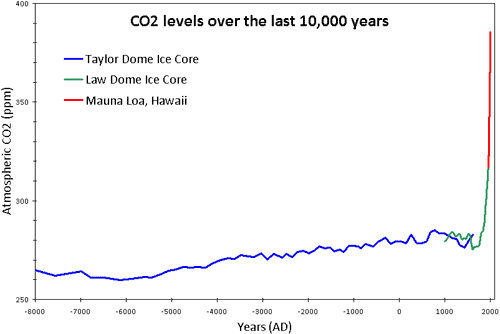
Figure 1: CO2 levels (parts per million) over the past 10,000 years. Blue line from Taylor Dome ice cores (NOAA). Green line from Law Dome ice core (CDIAC). Red line from direct measurements at Mauna Loa, Hawaii (NOAA).
A comment was posted querying the data in this graph. Here is the comment in full:
"Whoa, hold on a minute here. CO2 readings from ONE LOCATION prove we have an enormous GLOBAL spike in CO2 levels? You've got to be kidding me. This is science? That would be like me taking hydrological readings at the bottom of Lake Superior and then declaring that the entire surface of the earth must be covered with water based on my readings.
By the way, isn't Mauna Loa an active shield volcano? (http://en.wikipedia.org/wiki/Mauna_Loa) Hmmmm, you don't suppose that's where all that extra CO2 came from, do you? C'mon, people, wake up. I find it shameful that this obvious manipulation is allowed to pass as "proof". This is certainly NOT an unbiased scientific conclusion."
The commenter is asking whether it's appropriate to take CO2 readings from one location. Particularly when situated near a volcano which are known to emit CO2. Surely a better metric would be a global average of CO2 levels? These are legitimate questions. However, I deleted this comment as our Comments Policy allows no accusations of deception, whether the attack is directed towards skeptics, scientists or myself. This restriction is necessary to keep discussion constructive and restricted to science. Unfortunately, the comment began with a commendable question and ended with a not-so-commendable personal attack.
If the comment had stayed on methods and not strayed into motive, I would have posted the following response. Mauna Loa was used is because its the longest, continuous series of directly measured atmospheric CO2. The reason why it's acceptable to use Mauna Loa as a proxy for global CO2 levels is because CO2 mixes well throughout the atmosphere. Consequently, the trend in Mauna Loa CO2 (1.64 ppm per year) is statistically indistinguishable from the trend in global CO2 levels (1.66 ppm per year). If I used global CO2 in Figure 1 above, the result "hockey stick" shape would be identical.
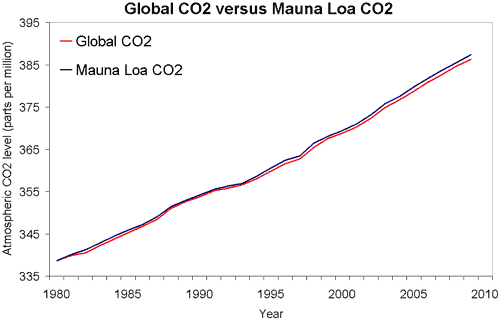
Figure 2: Global atmospheric CO2 (NOAA) versus Mauna Loa CO2 (NOAA).
Unfortunately, this type of presumptive misunderstanding is seen all too often. Someone doesn't understand a certain aspect of climate science which is understandable considering the complexities of our climate. Rather than investigate further, they assume a flaw in the climate science or worse, an act of deception. This response is often more a reflection of the gap in their own understanding than any flaw in the climate science. For further demonstration, here are the two most common examples of the Dunning-Kruger effect in the climate debate.
The most common example is the argument, "why don't climate scientists look up and see that big, fiery ball in the sky - don't they realise the sun drives climate?" In actuality, climate scientists have noticed the big, fiery ball in the sky that provides almost all our climate's energy. Consequently, there are a multitude of peer-reviewed studies examining the sun's role in global warming. These studies have independently come to the conclusion the sun has not shown enough trend to have contributed significantly to recent global warming. More recent papers using the latest data have found the sun is actually moving in the opposite direction to climate. Eg - the sun has been cooling while the climate is warming.
The second most common example of the Dunning-Kruger effect is "don't climate scientists realise climate has changed naturally in the past?" If one peruses the peer-reviewed science, they'll find that yes, climate scientists do realise that climate has changed in the past. There is a whole field of science devoted to examining and understanding past climate change: paleoclimatology. And what scientists find in the Earth's past is that the planet is highly sensitive to changes in energy imbalance. When our climate loses or gains heat, positive feedbacks amplify the temperature change. This is one (of many) lines of evidence that tell us our climate is sensitive to CO2 forcing.
How does one counter the Dunning-Kruger effect, in others or in themselves? Dunning and Kruger propose that improving a person's skills helps them recognise the limitations of their abilities. If there's a question about an aspect of climate science, the first step should be to investigate and improve understanding of the science. Odds are climate scientists have investigated the same question in the peer-reviewed scientific literature. Use Google Scholar to find out papers on the topic. Or search on Skeptical Science (in case you didn't know, there's now a freely available iPhone app :-) If there's no direct answer, find the closest topic and post a comment asking for answers. There are many well informed regulars who would be happy to point you towards any relevant peer-reviewed papers.
UPDATE 16 Feb 2010: Many thanks to Peter for sending me the following YouTube movie which is an excellent visual depiction of changing CO2 levels over the last few decades:

Arguments


It is refreshing to see some one else tell us to try to know what we don't know and remember that the more we know about this subject, the more we need to know before we can consider ourselves knowlegeable enough to argue absolutes.I don't believe that there are any absolutes.
I wish we had had the technology back in the fifties and early sixties like we do now. I think that the "climate change" subject would be less contraversial.
~~~~~~~~~~~~~~~~~~~~~
This is a classic example of circular reasoning. The only way one could scientifically come to the conclusion that "CO2 mixes well throughout the atmosphere" (in the context of what you are arguing) is to MEASURE CO2 throughout the world, introduce a significant increase in CO2 into one location, and then MEASURE the rate at which the marked increase in CO2 diffuses throughout the world.
Because the global atmosphere is complex, with wind patterns and the complex behavior, one CANNOT make the leap that diffusion in a small sample of air can be compared to the world-wide global atmosphere.
As a CO2 source not many people have correlated with this graph:
http://ldolphin.org/poprecent.gif
or this one
http://www.susps.org/images/worldpopgr.gif
The biggest problem with the presentation of this graph is the time scale. Using another well known graph that covers 500 million years of history instead of 12,000 years we get a totally different perspective.
http://www.globalwarmingart.com/images/7/76/Phanerozoic_Carbon_Dioxide.png
Here is another way of looking at CO2 levels - with the CO2 axis going down to zero.
Re CO2 levels going back 500 million years, that is an interesting question all on its own and worthy of a few posts (in fact, we touch on it here and here).
Beck found, “Since 1812, the CO2 concentration in northern hemispheric air has fluctuated exhibiting three high level maxima around 1825, 1857 and 1942 the latter showing more than 400 ppm.”
Elimination of data occurs with the Mauna Loa readings, which can vary up to 600 ppm in the course of a day.
Time to revisit the science of CO2
http://canadafreepress.com/index.php/article/18343
50 years of Continuous measurement of CO2 on Mauna Loa -Ernest-George Beck – Energy and Environment 2008
http://icecap.us/images/uploads/08_Beck-2.pdf
In thread after thread, post after post, from climate change/environment/political site around the world D-K appears with increasing frequency it seems. And no matter how often an apparent simple misunderstanding is corrected, back it comes like a rock rolling down a hill.
What is even more frightening is the Dunning-Kruger Shock-Jock effect, which is D-K on steroids. Andrew Bolt and MIranda Devine are a classic examples, as is Paul Sheahan just today - "The heat sinks in Sydney and Melbourne will be getting hotter, writes Paul Sheehan in the National Times.
"Modern culture is built around creating urban heat sinks, yet governments obsess less about this real-world, everyday problem than the more abstract problem of carbon pollution. Fixing the first problem would help ameliorate the second.""
You see - all us silly scientists concerned about an "abstract problem" when the only problem is that the cities are warming the world (not, you understand, merely possibly affecting measurements, as per Watts, but actually warming the planet more than that silly old CO2 those climatologists keep muttering about). And the terrifying thing is that this stuff, written from the bully pulpits of newspaper and radio, will be believed far more readily than the conclusions of thousands of scientists presenting the results of tens of thousands of studies.
I have nothing else to add that hasn't been said, so I'll provide the obligatory illustration.
Indeed it would be very difficult to track a single localised CO2 release across the globe. Thankfully it is not necessary to do this, as one can visually see that the localised Mauna Loa data matches well with the more contemporary global data that has been available since 1980, by simply looking at figure 2.
Using one set of older data alongside another set newer data is hardly a "trick", especially when they almost overlap.
Sorry, fella, that's a dog that won't hunt.
Here's are the actual methods employed for measurement:
How we measure background CO2 levels on Mauna Loa
Pieter Tans and Kirk Thoning, NOAA Earth System Research Laboratory
This focus on sampling at Mauna Loa seems to be quite the fad right now, but if you think about it for a few minutes it just does not pass the smell test, to imagine that all of a sudden we find out the whole thing's a botch.
How one sets the knowledge quartiles in climate science is anyones guess. Suggest that as with climate science/knowledge etc care is needed in applying results from one example to another.
But it is probably worth saying that I have had my own intimate experiences with Dunning-Kruger...
I'd certainly admit that I make a fair number of mistakes. Some of them I don't realize were mistakes until a few hours later (often fairly stupid ones it seems) and some only months later.
However, one thing I pride myself on is the ability to quickly admit when I was wrong. At moments of extreme self-doubt and even anxiety, that is the one thing that I have held onto -- even though I sometimes fail.
*
Since I don't have the time at present to participate I would like to make available two little essays from evolution/creationism days. I can actually imagine one being somewhat offensive to people on either side of that debate. Hopefully no one will find them too offensive.
I don't really think that either of them is fundamentally about evolution or creationism though, but personally more about what it means to be human. At least in my view.
Religion and Science
http://axismundi.hostzi.com/0/002.php
A Conspiracy of Silence
http://axismundi.hostzi.com/0/004.php
PS
If anyone wants to contact me about either piece (express their indignation, whatever) or about something else...
timothy chase [at] g mail [dottish] com
(remove the spaces)
But it might take a few days for me to respond.
Scientist must take responsibility to use audience appropriate communication if they want to convince anyone other than their own peer group.
Its easy to get Amens from the choir but not effective in growing your cause.
It's nicely narrative rather than pedantic, definitely accessible to laypeople, has both a readable version and a narrated-slides version. Also, most of its references are live links straight to the sources, for more detail.
Meanwhile, Mauna Loa is located hundreds of kilometers from any urban source of CO2 & is at an altitude at which it is above the Inversion Layer.
However, if you doubt the results of Mauno Loa, Westwell, then might I suggest you look at the almost identical readings from Cape Grim in Tasmania? Or are you suggesting that there is some kind of conspiracy between these two measuring stations to hide the "naturally high levels of CO2 which have have always been present in our atmosphere" (as you seem to imply)? Yet strangely these high CO2 concentrations never turn up in *any* of the correlating ice core segments.
Beck's work shows wild fluctuations in CO2 up until the point where regular measurements started. The fact that the period of highest quality measurements do not show wild fluctuations should provoke skepticism of those older measurements.
As it happens, there is plenty of reason to believe the older measurements Beck relied upon are in error. Furthermore - they're in conflict with every well-understood proxy for CO2. More info here and here
"Ha ha", they scream with delight, "how can anyone measure CO2 levels, those hockey stick style graphs are the result of cooking the books, hiding the decline, or are all just computer models. Gotcha. No One World Government for us now you evil Frankensteins."
It never occurs to them for a moment that those people whose occupation it is to measure CO2 levels might, just, be aware of those issues. Might, just, after a lifetime of studying the subject, of refining techniques, of building on the work of hundreds of other scientists, past and present, of testing results against proxy measures, might, just, have taken them into account. Might, just, be in the business of comparing like with like, of siting measuring stations to reduce variation from pollution, of averaging out diurnal and seasonal and other effects. Might, in fact, be working like scientists do in all such areas of expertise. No, they cry, "all scientists are idiots, Anthony Watts says so, hah, couldn't measure the CO2 in a brown paper bag. I'll just go on to Skeptical Science and tell that idiot John Cook all about it." And they do.
Although the argument "CO2 is so well mixed that CO2-concentration is the same in the whole atmosphere and we can rely on measurements in one location" is probably true, poster #2 is right that you do not provide the evidence for it. Presumably, if I studied diffusion and wind global wind patterns more (thus avoiding the D-K effect), I could prove well-mixedness from the physics, but that would still be theory.
If you showed some measurements from other locations which gave identical results to Hawaii, or if ice cores from both Greenland and Antartica showed identical CO2 levels, that would really clinch the case.
I am 100% convinced (D-K again?) that people have done these measurements (and that results were as expected). Can you show such data?
eg: those climate scientists that think they can understand all/most of the complexity of the climate, and therefoe make overly-confident predictions and geustimates (eg most of the error bars in the IPCC reports). A good test of these is to look at past IPCC reports, the IPCC often get their predictions wrong (references needed), but the over-confidence in their predictions seems to just continue.
Another major bone of contention, is yes, most skeptics are aware that climate science/scientists in its current understanding is aware of various skeptical arguments, and can point to various peer reviewed papers to support their positions etc etc, but the skeptics also believe and/or are very suspicious that the process of peer review within climate science in general has become corrupted (anbd also including within the IPCC process), and the peer review system now exists simply to maintain and support the status quo and those with vested interests. So, referring back to the 'peer reviewed literature' is not going to convince them unless, and until, the peer review system is reformed. (I also don't need to point out the various current events surrounding this issue).
The corrupting influence of "a little bit of knowledge" is not evident in the data from Kruger and Dunning, but I believe it becomes particularly hazardous when linked to what K&D term "motivational biases". I suspect this is a prominent reason why the professions of broadcast meteorology and geology include an unusually high proportion of AGW skeptics, as both professions entail at least some understanding of climate change, while falling well short of expertise in climate science. Accordingly, many geologists cite the paleoclimate fallacy mentioned by John (above).
Bias by itself is enough of a hazard, but coupled with the inability to recognize competence in one’s self or in others, plus the self-delusion that one has expertise that is actually lacking, leads to the situation we currently face, with a growing, even if irrational, backlash against AGW.
Several of the preceding posts also address the cultural phenomenon of bashing the know-it-all, egghead intellectuals, on the premise that seat-of-the-pants wisdom trumps ivory tower book-learnin’. This can provide an added boost to the self-confidence of those lacking the ability or the will to read actual science papers, and is a card played by some politicians who have weighed in as AGW skeptics.
In the case of the origin of the increase of CO2 levels, I have had a lot of discussions with other skeptics. The main result is a page completely devoted to that point, where all arguments are ordered and the only conclusion possible is that humans are responsible:
http://www.ferdinand-engelbeen.be/klimaat/co2_measurements.html
CO2 levels are measured at 10 "baseline" stations and some 70+ other places, which show that besides a seasonal (vegetation induced) amplitude and a N-S lag, the yearly averages at all places far away from local sources are within a few ppmv with similar trends. Thus we may say that CO2 is "well mixed" in about 95% of the atmosphere.
Besides that, in 5% of the atmosphere, that is below the inversion layer over land, CO2 levels are not well mixed, depending of local sources and sinks and wind speed. Even there, some 400+ stations measure CO2 fluxes trying to understand the local/CO2 balance of vegetation and human sources.
Unfortunately, it is in the 5% non-well mixed part of the atmosphere that many measurements in the pre-Mauna Loa era were made. Especially the "peak" around 1942 found in Beck's compilation of CO2 data, was mainly from a few series made in a polluted area. The same peak is not found in high resolution ice cores (Law Dome) neither in stomata data or (as 13C/12C ratio) in coralline sponges of the oceans. This shows that there was no such CO2 peak and that Beck's 1942 peak is biased by local/regional contamination. See further:
http://www.ferdinand-engelbeen.be/klimaat/beck_data.html
But that humans are responsible for the increase in CO2 of the past 1.5 century, doesn't say anything about the influence of the increase. The real influence of more CO2 depends mainly of the feedbacks (both positive and negative) on the about 1 degr.C for 2xCO2, which is the basic response of CO2, based on its absorption spectrum.
"The only way one could scientifically come to the conclusion that "CO2 mixes well throughout the atmosphere" (in the context of what you are arguing) is to MEASURE CO2 throughout the world, introduce a significant increase in CO2 into one location, and then MEASURE the rate at which the marked increase in CO2 diffuses throughout the world."
An experiment of that nature has been performed (sort of). Fossil fuel use is concentrated in the northern hemisphere, and there is a small difference in CO2 concentrations (about 2-3 ppm IIRC) between the north and south hemispheres as a result, which is what you would expect if atmospheric concentrations were "well mixed" (if it weren't there would be a big difference between north and south as fossil fuel emissions accumulated around areas of greatest use). The difference between north and south hemisphere concentrations is also proportional to emissions, which strongly suggests CO2 from fossil fuel emissions in the north is transported fairly quickly to the southern hemisphere. See
U. Siegenthaler & J. L. Sarmiento, Atmospheric carbon dioxide and the ocean, Nature 365, 119 - 125 (09 September 1993); doi:10.1038/365119a0
also CO2 is measured around the earth and I suspect that a spaghetti plot of the data from all measuring stations would confirm that concentrations are well mixed.
Oh, & another thing, these farmers-almost to a man-all are of the view that anthropogenic global warming is *real*, because they're seeing it directly impacting on their land.
So we have a number of serious problems:
a) No confirmatory evidence from independent sources.
b) Logic indicates that in all likelihood that such natural mechanisms of around century ago would still be operating now, but clearly aren't.
c) CO2 variations that disappear when accurate modern measurements begin.
d) An unexplained change in the carbon cycle.
e) Georg Hoffmann on Realclimate suggested that such enormous CO2 fluxes [10x annual global emissions] would leave a distinct carbon isotope in tree rings too, which has also not been found.
http://www.realclimate.org/index.php/archives/2007/05/beck-to-the-future/
Occam's razor indicates that the claims are likely wrong. [I am being overly generous]
So we not only know that not only these measurements were suspect, but we know for certain that those measurements and any conclusions drawn from them were wrong.
A question for followers of Ernst-Georg Beck and his ilk. What is his publication record in science citation index Journals? Note: this expressly excludes Energy & Environment which is a 'trade journal' and has a long record of publishing articles of highly questionable if not dubious merit.
There is value in understanding the evolution of the earth's climate over long scales. But for a discussion of the impact of modern climate change on our agricultural/industrial civilization, the appropriate question is "How will the climate of 2050 (or 2100 or whatever) compare to the climate that we have experienced over the past 12,000 years?"
There have been long periods in the distant past when the planet was much warmer, the sun was cooler, CO2 was higher, the continents and ocean basins were in different positions, and weathering of carbonate rocks occurred at different rates. The study of those times is useful for many reasons, but it would be absurd to suggest that farmers in the midwestern USA shouldn't worry about 21st century climate change because CO2 levels were really high back in the Ordovician Period and life survived. Surely that's not what TOP meant to suggest, right? That would be a ridiculous argument indeed.
I thnk thingadonta's point was not about when climate science per se originated but about human perception - I thought his point quite valid.
And I do know my level of incompetence!
Read a few papers on a subject and a degree of understanding ensues. Paywalls are a problem, I am not paying to read a paper that I will not understand entirely and may not understand at all.
Word usage is a problem. Google methane hydrate and read a bit can give a different understanding than Googling methane clathrate and reading a bit.
Knowing who to trust is a huge problem, and if you place your trust in a unreliable source the path to truth can be delayed a long time.
Even for the trained seeing what you are looking for can be problem. For the untrained it is an immense problem.
Actually, this blog pretty much is the best there is when it comes to discussing the peer reviewed literature on climate change. Go to the archives here and click on any of the more science-y topics and you'll see that John spends a LOT of time reading and discussing the literature.
Given the amount of time and effort John donates to this more-or-less thankless task, I think you should probably be able to cope with the occasional post, like this one, which tackles the "meta" question of why exactly some people fall for some of the more absurd claims.
For example, comment #4 in this thread (by Westwell) refers to the work of E.G. Beck. Now, everybody with even a passing understanding of the science involved knows that Beck's "CO2 record" is nonsense. Many people elsewhere have written at great length explaining why Beck's claims are nonsense. As I understand it, Steve McIntyre has banned discussion of Beck's work from his climate audit site because he understands that that stuff is nonsense and that hosting discussion of it would just make his blog (and the skeptic cause) look foolish.
So ... John Cook could write a carefully documented explanation of why the Keeling CO2 record is right and the Beck CO2 record is wrong. And maybe he will do that someday! But when you get to "skeptic" arguments that are as willfully blind as that, I think the more interesting point is not why they're wrong but why someone would believe them. As I understand it, that's what this thread is about.
The problem of course was that Callendar's results had long since been confirmed by proxy readings and the smooth curve (rather than Beck-like roller coaster swings) of the continuous CO2 records. The results of Beck's paper were provably false before he ever published it... he just wasn't aware of scientific progress in the half century following Callendar's effort.
Beck had a partially valid objection... Callendar's selection of data COULD have been incorrect. It was an 'educated guess' on Callendar's part that global CO2 levels did not make wild swings over the course of just a few year. Had Callendar been wrong about that then his conclusion that wild fluctuations were due to local industrial emissions might also have been flawed and his results all wrong. But rather than checking further into subsequent science, which had proved Callendar's 'guess' correct, Beck just assumed that Callendar had it all wrong and proceeded to produce a study that was decades out of date. It would have been a solid rebuttal to Callendar in the 1950s, but in the 2000s it was just a bad joke.
You mean like this:
http://photojournal.jpl.nasa.gov/catalog/PIA11194 ?
AIRS measures CO2 levels in the atmosphere with global coverage (from orbit). As you could see if you followed the link (you won't), levels at the time of measurement vary from 376 to 386 ppmv. Go ahead and compare that variation to the scale of the graph above.
So, not only is your comment woefully (willfully?) igorant of basic atmospheric physics (like turbulent mixing of non-condensing gases), it isn't even an objection that survives confrontation with data.
For D-Kers, there is no intellectual give and take, only efforts to reinforce one's own position while snubbing what might be an intrusion of reality.
I think we could all benefit by moving the debate to three areas:
Does mankind has the ability to impact climate change going forward?
To what extent should governments control its industry and citizenry in terms of greenhouse gas emissions?
If climate change is a planetary response to overpopulation and increased industrialization, should we be preparing ourselves to deal with the consequences, which may very well include the planet ridding itself of a large portion of humanity?
"When the experts are agreed, the opposite opinion cannot be held to be certain;
when [they] are not agreed, no opinion can be regarded as certain by a non-expert;
when they all hold that no sufficient grounds for a positive opinion exist, the ordinary man would do well to suspend his judgement."
Bertrand Russell.
Just a quick guide for me when I wade into unfamiliar waters. It is also a nicely parsimonious method of deciding which articles one takes the trouble to read.
Aye, convincing those with a limited understanding is the whole game, isn't it? Many have lamented this; Gavin Schmidt comes to mind. Let's divide the population into two groups: those that have a working understanding of Stephan-Boltzmann, absorption spectra, and statistics (A), and those that don't (B). So far, any model or argument that group B can understand, is also so simplistic that it can be shot down by anyone in group (A), or even just countered with something that isn't really a counter of any substance. That situation leaves the person in group B at the whim of whoever sounds better or their own predispositions. So far, that needle has proven to be a tough one to thread.
Unfortunately, I see it as a bit like trying to explain thermodynamics to a child in order to keep them from burning themselves on a hot stove. Even the simplest explanation is not enough to keep them from being skeptical until they touch it.
A co-worker of mine, when hearing an news account of the recent cold weather back East, announced "So much for Global Warming." Several minutes later he was discussing our unseasonably WARM weather here in the Willamette Valley of Oregon. "I don't remember it ever being so warm in February..." He exclaimed. To which I replied: "SO MUCH FOR GLOBAL COOLING!!" We both laughed!
Doing a little research I found enough about him to realize that he's a self-published semi-amateur climate scientist (his degree is an MA biology and he retired from teaching high school). That alone is not enough to dismiss his research, but it's also not enough to cite his work as another in a long line of "see! see! the science isn't settled!" type of debate.
If Beck wants to be a good scientist, he needs to stop self-publishing his papers and spend some time answer his critics so he can get his work published by those he considers his peers. From what I can tell (perhaps a little too much that it makes me dangerous here) he thinks he's right, everyone else is wrong, and prefers to work against the scientific community rather than with it.
What the scientific community needs to do is spend a little more time on the "case closed" aspect of dismissing Beck's work. That will make it easier for interested non-scientists like me to identify the Dunning-Kruger effect coming from people like Beck.
You indicate that “the trend [I assume you mean rate or speed of change] in Mauna Loa CO2 (1.64 ppm per year) is statistically indistinguishable from the trend in global CO2 levels (1.66 ppm per year) rate”. I have no knowledge to make a judgment on this statement so I will have to accept it, at least for the moment. However, the graph implies not only an almost identical rate of change but also an identical absolute value of the starting point of approx 338ppm. Is that correct? And if it is correct, this means that measurements are available for the global level of CO2. If so, why use the measurements at Mauna-Loa and not the global measurements?
You also state the question whether the place of sampling is appropriate “when situated near a volcano which are known to emit CO2” but you answer it in a rather incomplete way: Stating that “CO2 mixes well throughout the atmosphere” is rather vague, strictly qualitative and highly counter-intuitive. Counter-intuitive doesn’t of course necessarily mean “wrong”; but it requires further solid substantiation. Can you for example support it with quantitative data? Say by showing the measurement of a CO2 burst at Mauna-Loa (or some other volcano) at a specified point in time and then show the gradient of increase in a sufficient number of locations around the globe so as to support the statement.
I started reading your site because human consumption of fossil fuel does evidently produce CO2, and so do animals and humans by the very act of living; not to mention CH4 and other gases. Is the quantity produced negligible compared to natural causes, as those whom you dub “deniers” contend? Or is the amount substantive enough to justify the enormous economic and social upheaval that is being proposed by certain politicians? I am yet to find a conclusive source that demonstrates in a credible quantitative manner one or the other of the contentions. Such a demonstration, should help also respond to the question whether euthanasia of a portion of the global population is to be recommended in order to ensure the survival of the rest and if so, what percentage needs to be exterminated. Simply reducing fuel consumption may or may not suffice as people do breathe. Hence a very serious and reliable quantitative study is necessary before drastic economic steps are taken. Is such a study at all possible with our current means? And if not, does the risk justify the proposed economic measures?
Of course, the revelations of data manipulations, crass propaganda movies, apparent negligent sourcing by institutions that should know better, superficial sampling of tree rings etc. do not help. But disregarding all these does not answer my question either.
Your website appears to me to be biased in that there is a clear preponderance of global warming arguments. Suppressing emotional comments is reasonable and understandable but one cannot help musing whether such emotion is really preponderant among “deniers”. Could well be, but again I would need quantitative proof to accept the hypothesis. Can you provide it?
I think you're looking for a response directly from John Cole, but with regard to your observation about the preponderance of arguments it is necessarily a tautology.
When one sums up the various lines of scientific inquiry relevant to climate change, there is an overwhelming trend in the direction of support for the basic hypothesis. Researchers attacking this problem from numerous directions are ineluctably lead to the same place because of realities they encounter. Discussions and articles here will necessarily reflect this fact, lacking as we do much of anything in the way of robust arguments against the basic hypothesis of anthropogenic climate change.
The problem with using the Bertrand Russell test on the climate debate is in distinguishing the real experts from the phony ones. You have to be willing to take the time to review qualifications and, in some cases, track funding sources.
Re #41, rmbraun123 at 07:16 AM on 16 February, 2010
Your questions re CO2 measurements have already been answered in the prior comments. Human population growth is a problem, although due more to consumption of resources and need for energy, food and water than from simple exhalation, but nobody is suggesting extermination! Education, particularly of women, and access to voluntary birth control have been shown to reduce birth rates and would likely be sufficient to stabilize population at a sustainable level.
Although we feel we have
done a competent job in making a strong case for this analysis,
studying it empirically, and drawing out relevant implications, our
thesis leaves us with one haunting worry that we cannot vanquish.
That worry is that this article may contain faulty logic, methodological
errors, or poor communication. Let us assure our readers
that to the extent this article is imperfect, it is not a sin we have
committed knowingly.
At the beginning of their first season of ski racing, because they often hadn't skied with other kids their age who were as experienced as they were, they assumed and many times their parents assumed that they were the best skier their age in our club, in Colorado, or in the world.
All it took for them to be convinced otherwise was to be grouped with these other kids and go skiing, and then to finish well back in their first ski races. Because of this empirical evidence they went from sometimes insufferable arrogance to consistent humility quite quickly.
Similar processes for adults include going to a rigorous university as an undergraduate, going to graduate school at a major research university, obtaining a PhD, especially in a science, publishing in a scientific or academic journal and thus undergoing peer review, and if in an appropriate field, volunteering and being nominated as an IPCC Report Lead Author or Group Leader.
When one has experienced few or none of these things, it is easy for them to suffer the Dunning-Kruger affect in relation to climate change.
If this isn't possible, then reading 100 published, peer-reviewed papers on climate science might be ideal, but reading at least 100 posts (and the comment threads) here, at RealClimate and Climate Progress would be a good place to start - and the impressively wise and humble do that before commenting too strongly.
Given that this post seems largely to have been made to question whether 'deniers' are actually emotive, I think the answer can be found with in the post itself. Possible action to ameliorate climate change was described as 'enormous economic and social upheaval' as well as 'drastic'. Rather curiously the possibility of action quantifying the effects of co2 apparently needs to be followed by,
"Such a demonstration, should help also respond to the question whether euthanasia of a portion of the global population is to be recommended in order to ensure the survival of the rest and if so, what percentage needs to be exterminated."
This phrase is seemingly disingenuously placed solely associate any action upon climate change with genocide. This is itself is an exceedingly emotional claim, as well as not an action suggested any known politician. If it was desired to be examined in a rational manner the phrasing along the lines of 'climate change action may cause unintended loss of life (presumably in the third world)' would have been acceptable, though one would need to elucidate further. However the methodology with which this is presented is a. baseless, as no governments or individuals have proposed mass euthanasia and b. unquantified and emotive. As it was provide by an 'experienced financial professional' one has to ask why no specifics were provided.
This post was written seemingly as an attempt to be objective and unemotional and yet appears to have heavily utilized their opposites, I can only find this extraordinary. I do not mean this as a personal attack however it appears in this instance that the proof has been provided.
Westwell at 14:57 PM on 15 February, 2010
Sorry, fella, that's a dog that won't hunt.
Here's are the actual methods employed for measurement:
How we measure background CO2 levels on Mauna Loa
Pieter Tans and Kirk Thoning, NOAA Earth System Research Laboratory
I went to the proverbial horse's mouth as you recommended... and I found the following rather puzzling sentence:
"the number of carbon dioxide molecules in a given number of molecules of air"
Can you please enlighten a poor soul - who studied chemistry and physics quite some time ago - what exactly is "a molecule of air"?
wrote:
"Re #41, rmbraun123 at 07:16 AM on 16 February, 2010
Your questions re CO2 measurements have already been answered in the prior comments. Human population growth is a problem, although due more to consumption of resources and need for energy, food and water than from simple exhalation, but nobody is suggesting extermination! Education, particularly of women, and access to voluntary birth control have been shown to reduce birth rates and would likely be sufficient to stabilize population at a sustainable level."
A very worthy Malthusian response, tempered a bit by current political correctness but still Malthus redivivus. He was proven wrong by the technological advances of humanity. So will you be proven wrong in a few hundred years: let's talk about it then...
Incidentally, the Chinese tried population limitation. True it was by legislation not by enlightenment of ladies. But the results are very comparable. And the demographics of Russia as well as the worries of the Japanese and Europeans in this respect indicate that your "solution" is unlikely to work. Long live the US immigration policy... if we can get it right.
"the number of carbon dioxide molecules in a given number of molecules of air"
That's quite easy to understand I think. It's essentially the "mole fraction". Take a volume of air. Count the number of molecules therein (the O2, N2, argon, CO2, methane, ozone, CO etc. etc.). Of the total, what is the fraction of CO2? Right now it's about 386 ppm.
Replace that erroneous representation of what they said with the actual wording and the answer to your question presents itself... "in a given number of molecules of air". Molecules plural, not singular. Air is of course a mixture of different elements and compounds, but we can determine the composition and express it in various ways; percentage by volume, percentage by mass, or (in this case) percentage of molecules.
As to technology having prevented the problems of overpopulation... we have a different knowledge of history. Mine includes several famines and plagues which would seem to contradict that view. Technology has certainly helped to keep deaths from overpopulation 'down' in the mere millions, but it is also very obviously a real and growing problem.





