



 Arguments







Hotties vs Frosties?
Posted on 9 July 2010 by John Brookes
Guest post by John Brookes
There is much heat in the blogosphere debates between those who believe that we are warming the planet, and those who are highly skeptical of such claims. I will put my cards on the table right now, and say that I think we are warming the planet. There is a lot of mistrust between the warring factions. People like me are referred to as AGW alarmists, while people on the other side are regularly derided as deniers. So to start with, I'd like to take some heat out of the debate by giving nicknames to the combatants. Those on my side will be referred to as "hotties", while the other side will be referred to as "frosties".
What are hotties like? Hotties are latte sipping, bicycle riding, quasi-intellectual, communist, greeny idealogues who hate the modern world and want to drive us back to the dark ages. Most Hotties have been hidden away in their ivory towers for so long suckling off the taxpayers teat that they know almost nothing about the real world, the world they are trying to destroy. They want to impose more and more rules limiting what you can do. Hotties have been brainwashed by an elite who are using the threat of climate change for their own ends. The elite consists of politicians are intent on creating a world government, and tame but dishonest scientists who are rewarded financially for fudging data and saying what the politicians want to hear. Hotties try and drown out all dissenting opinions. Philip Adams is their hero. Hotties should wash more often.
How about the frosties? Frosties are chainsaw wielding, grumpy, overweight, middle-aged men who drive older model 4WDs. They have Galileo complexes and opinions on everything, are outraged by most things, rail against the youth of today, and are suckers for conspiracy theories. They cherry pick data, and use tired and discredited arguments as though they are brand new. They would argue that black was white, if they thought that admitting black was black would weaken their position. They intimidate and harass real climate scientists, while their own Plimer, Monckton, Nova, Archibald, etc are in the pay of industry and have less credibility than John Worsfold talking about the Eagles next premiership. They don't have heroes. Rugged individuals who are single-handedly supporting the whole of western civilisation have no need for heroes. Some do have a bit of a crush on Jo Nova though.
So I've spent some time on both hotty and frosty blogs, and this is not what I see. For example on Jo Nova's blog, I have found many well meaning frosties who are only too happy to help expand my limited understanding of the science of climate change. At one time I put up a post which said that most hotties and frosties did not understand what was going on, but were simply barracking for their side. Rather than wishing me good riddance, Eddy, a regular there, encouraged me to aim higher. Thanks to Eddy, I've decided to work a bit harder to understand what is going on. Many of the frosties are doing exactly the same thing, trying to work out what is going on. They think that attempts to reshape our world without fossil fuels spells disaster, and think it is their duty to fight against it. Sure there are some frosties who are over the top and abusive, but the same can be said of some hotties. Of course there are also frosties who uncritically lap up any new argument which supports their case, while demanding much higher standards of the hotties. There are also probably a few who are paid directly or indirectly by big coal.
A similar judgement can be made about most hotties. They genuinely believe that climate change is a serious problem which needs to be tackled, not because of their ideological beliefs, but because of its predicted effects. Most of the climate scientists are actually committed to finding the truth, even if it puts them out of a job. Scientists are like that, they are driven by a desire to understand, and their reputation in the scientific community, should they be found to have any other motive, would be mud. Just like the frosties, most hotties are trying to improve their understanding of climate change. Of course there are some hotties who will believe any old rubbish which says that humans are bad and the world is about to end because of it (and I blame the catholic church for this ;-)). There are also probably a few scientists who are so wedded to the idea of climate change that it gets in the way of their objectivity.
I don't think there is any hope for the lunatic fringe on either side. If your starting point is that the people on the other side are evil incarnate, then you won't move from that. But for the rest of us, maybe there is some common ground. Can we find the points on which we agree? Much more importantly, can we pinpoint the exact places where we disagree?
Say you are marking a short answer question in a students physics test, and their answer is wrong (no post modernism here). Unless the student has absolutely no idea what they are talking about you will usually be able to find the exact place they went wrong. For example, they assumed that a cube had 8 faces, rather than 6. After this mistake, even if they use the correct method, their answer will be wrong. If they want to get the right answer, they must return to the mistake and correct that.
Of course the real world isn't so clean cut. It’s not normally a simple problem where you know all the facts exactly and just have to join them together appropriately to get "the answer". Imagine our student having to tackle their problem, but with no knowledge (and no way of finding out) just how many faces a cube has. They may look at systems they understand reasonably well, and work backwards until they conclude that a cube has about 5.3 +/- 1 faces. So they'll use this range of values, and it will give them a range of values for the answer. If this range is not too large, it may be useful. Of course if they botch things up and conclude that a cube has 17.3 +/- 0.2 faces, any results based on this will be useless. It is often the case with problems that there is more than one way to skin a cat, and someone else may find a way of tackling the problem without needing to know the number of faces a cube has. If their results don't agree with the cubist ones, then there will be a bun fight until most people agree with one or other side. What if one or two people refuse to agree? Well, you just carry on without them. You are doomed to get nowhere if you need everyone to agree with you.
It follows that for many real world problems, you won't be able to "prove" anything. You will over time simply build up a weight of evidence to help you make decisions. This is particularly so for climate science, where you can't say, "Here is a world I prepared earlier".
Of course the fervent hotties will say, "But we've already done all the necessary work, and the weight of evidence is overwhelming." And the fervent frosties will say, "They haven't proved anything. They have failed to address this and this and this. Their results are meaningless". And there is validity to both of these points of view.
Let us take just one point, “Global temperatures over the last 15 years don’t show any signs of warming”. Most frosties are smiling now, while most hotties are like “WTF?” If both sides are looking at the same data, then how can they disagree? Surely one side must be dishonest or deluded. Well, no actually. Here is a graph of some data.
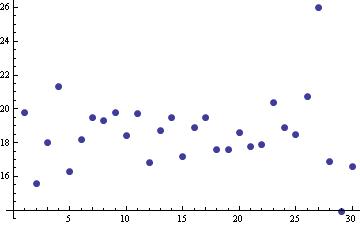
Is it increasing, decreasing or staying the same? Have a good look - take all the time you like. Don't scroll down yet. Can you draw any conclusion?
You can apply all the statistical tests you like, and draw trend lines, or trend curves or do whatever you like, and I will have no faith in any statement other than, “You can’t tell”. But that is not what I say. I say it is definitely increasing. I’m absolutely sure of it. Why? Because I know where the data came from, and I have a model in my head of what I expect that data to do, and when I look at that data, it only confirms the model.
The data is the daily maximum temperature for
This is why frosties and hotties can look at the same data and see different things. The frosties look at the data without any underlying model, and see no trend. The hotties look at the data in the light of their models, and see something different. The point of difference is not that they see different things, it is the presence or absence of an underlying model of what they see.
So lets sort out our common ground, and work out where our differences really come from. At least then we can have a debate which is better than, "You are a moron", "No, you are a moron".


 0
0  0
0 (click on image for details)

 Carrizo Plain Solar Power Plant – Southern California, USA
 and here's a coal mine:
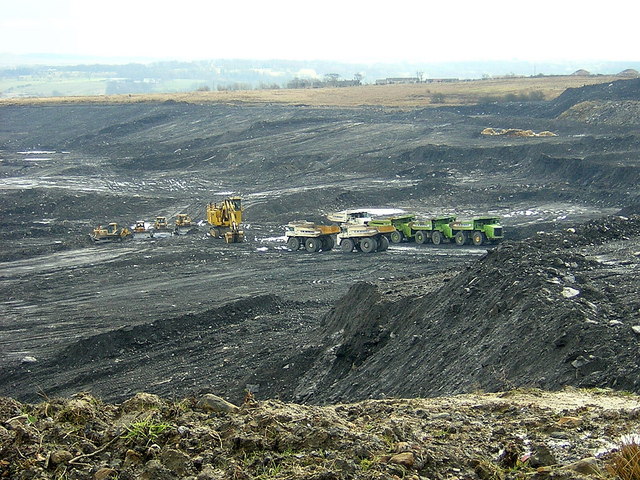 and here's an abandoned oil field:
 and here's a failed dam:
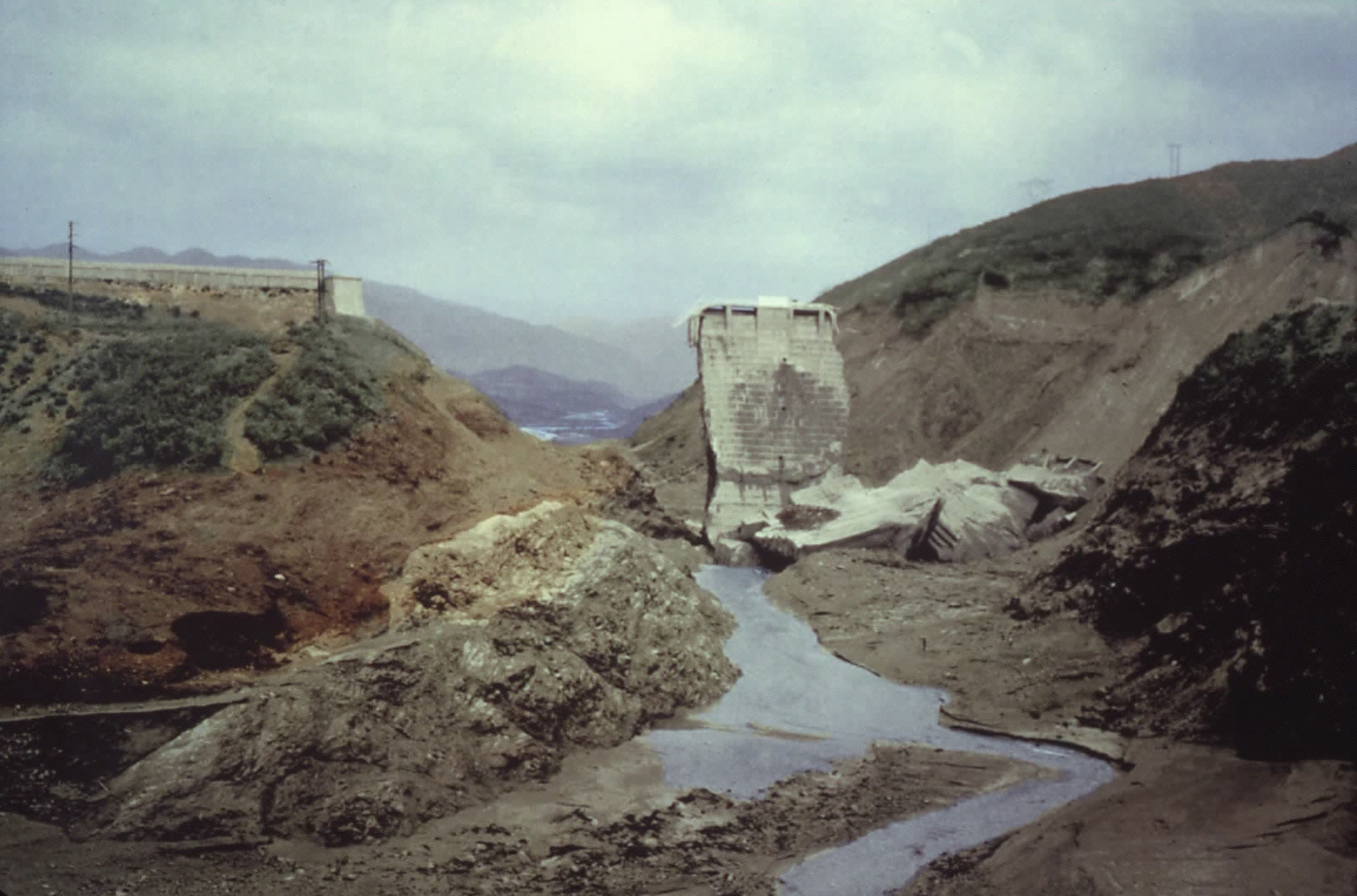 The relevance of this all escapes me, but it seems to be highly meaningful to Berényi Péter....
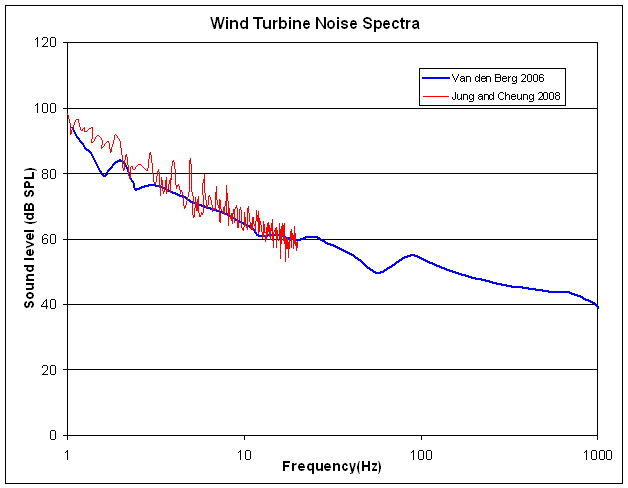 They produce a lot of inaudible low frequency noise. In cases like this you can hear nothing, but you can still feel it, mainly in your chest. With some practice you can be aware of the phenomenon, even counting beats is possible.
I have spent ten years of my life in an acoustics research lab, so I do know what I am talking about.
The slope of the curve above is really alarming. It is about 30 dB/decade below 10 Hz with no sign of flattening out. Although these particular measurements do not extend below 1 Hz, on the base of standard rotation speeds of wind turbines I expect the peak of the curve to be a little bit above 0.1 Hz. It means at 0.2 Hz noise level can be as high as 120 dB SPL (Sound Pressure Level), which is very high. If it would be in the audible range, it could cause severe pain.
The dB scale is a logarithmic one, sound energy is doubling for every 3 dB increase in SPL. Sixty decibels mean a millionfold increase.
It is also a problem you neither can measure these low frequency sounds with standard acoustic equipment nor are there proper regulations for that frequency range.
It does not mean however that it's unmeasurable. Just have to know what you are looking for and choose your equipment and measurement procedure accordingly.
A further problem may be that such low frequencies are hardly attenuated in air. What is more, due to the extremely long wavelength (a mile at 0.2 Hz) they tend to propagate in only 2D (horizontally), which means doubling the distance only lowers sound level by 3 dB.
As industrial wind turbines are getting bigger (there are already 6 MW models on the market), they get ever more efficient on radiating such low frequencies. It is so because the closer the dimensions of the source are to the wavelength, the more effective radiator it is.
Based on this I would say even the 2 km safety distance from human habitation or workplace is insufficient.
Wind Turbine Syndrome
Testimony before the New York State Legislature Energy Committee
March 7, 2006
Nina Pierpont, MD, PhD
They produce a lot of inaudible low frequency noise. In cases like this you can hear nothing, but you can still feel it, mainly in your chest. With some practice you can be aware of the phenomenon, even counting beats is possible.
I have spent ten years of my life in an acoustics research lab, so I do know what I am talking about.
The slope of the curve above is really alarming. It is about 30 dB/decade below 10 Hz with no sign of flattening out. Although these particular measurements do not extend below 1 Hz, on the base of standard rotation speeds of wind turbines I expect the peak of the curve to be a little bit above 0.1 Hz. It means at 0.2 Hz noise level can be as high as 120 dB SPL (Sound Pressure Level), which is very high. If it would be in the audible range, it could cause severe pain.
The dB scale is a logarithmic one, sound energy is doubling for every 3 dB increase in SPL. Sixty decibels mean a millionfold increase.
It is also a problem you neither can measure these low frequency sounds with standard acoustic equipment nor are there proper regulations for that frequency range.
It does not mean however that it's unmeasurable. Just have to know what you are looking for and choose your equipment and measurement procedure accordingly.
A further problem may be that such low frequencies are hardly attenuated in air. What is more, due to the extremely long wavelength (a mile at 0.2 Hz) they tend to propagate in only 2D (horizontally), which means doubling the distance only lowers sound level by 3 dB.
As industrial wind turbines are getting bigger (there are already 6 MW models on the market), they get ever more efficient on radiating such low frequencies. It is so because the closer the dimensions of the source are to the wavelength, the more effective radiator it is.
Based on this I would say even the 2 km safety distance from human habitation or workplace is insufficient.
Wind Turbine Syndrome
Testimony before the New York State Legislature Energy Committee
March 7, 2006
Nina Pierpont, MD, PhD
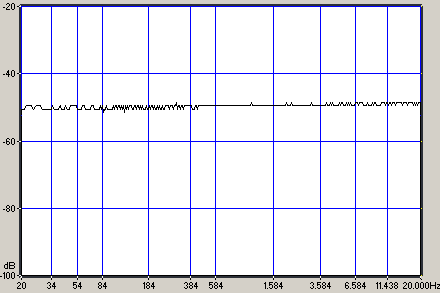 Figure 1: White noise
Pink noise has a logarithmic distribution, where each octave band (instead of each frequency) has the same amount of sound energy, i.e. the A3 to A4 frequency band (220-440 Hz; 440 Hz is the famous tuning fork note) has the same amount of energy as the C5 to C6 frequency band (523-1046 Hz; 1046 Hz is the soprano high C).
Pink noise is used when you are more interested in the energy per octave (or any other interval, like a minor third or a major fifth) than per frequency. It's also less taxing on the human ears (white noise is perceived as a loud hiss, while pink noise sound more like random noise to us), so it's also popular with sound engineers (and their audiences :P) testing large sound systems.
Figure 1: White noise
Pink noise has a logarithmic distribution, where each octave band (instead of each frequency) has the same amount of sound energy, i.e. the A3 to A4 frequency band (220-440 Hz; 440 Hz is the famous tuning fork note) has the same amount of energy as the C5 to C6 frequency band (523-1046 Hz; 1046 Hz is the soprano high C).
Pink noise is used when you are more interested in the energy per octave (or any other interval, like a minor third or a major fifth) than per frequency. It's also less taxing on the human ears (white noise is perceived as a loud hiss, while pink noise sound more like random noise to us), so it's also popular with sound engineers (and their audiences :P) testing large sound systems.
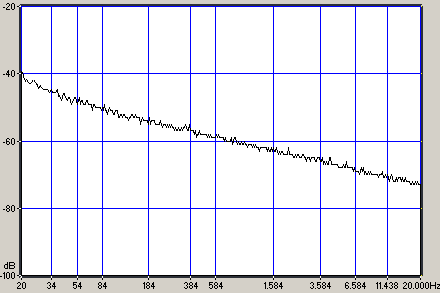 Figure 2: Pink noise
So, pink noise sounds very natural to us (if you'd make a spectrogram of all music in the world played at the same time, nearly the entire spectrogram would be remarkably pink noise-ish), probably because the human ear works logarithmically too... a 30 dB difference may be 2^10=1024 times as loud mathematically, but to us it only sounds 30 times the smallest difference the average untrained human ear can discern, like the difference between whispering (30 dB) and a not-too-loud normal conversation (60 dB). Nope, that doesn't sound 1024 times as loud, does it?
Pain begins at 125 dB, a jet engine at 100 feet produces 140 dB and the loudest sound possible would be 194 dB.
Your graph shows 95 dB at dB at 1 Hz, which isn't even close to pain level, and while it may extend to 120 dB at 0.2 Hz (still below pain level), you'll have to realize what 0.2 Hz actually is: one full cycle every 5 seconds. If you'd walk in one direction for 2.5 seconds and back for another 2.5 seconds, you would have created your own 0.2 Hz frequency. Unless you step in something sharp, it wouldn't cause "severe pain".
But even if a spectrogram of a turbine would show 95 dB at 1 Hz, which at the same distance and with a pink noise distribution would sound as loud as a soprano high C at only 85 dB (= as loud as city traffic inside a car; sopranos sing much louder than that), it's still no proof that a turbine would follow a pink noise distribution (or even any distribution) below 1 Hz.
And while I wouldn't recommend standing too close to a soprano, I wouldn't recommend a 2 km safety distance to one that can't even out-sing traffic noise inside a car either. OK, it's a ridiculous example, but so is assuming a turbine would produce 120 dB at 0.2 Hz based on measurements five octaves higher.
(@BP: I realize I left some of the audio-technical details out, because you & me already know those and anybody who's really interested can look them up on Wikipedia anyway)
Figure 2: Pink noise
So, pink noise sounds very natural to us (if you'd make a spectrogram of all music in the world played at the same time, nearly the entire spectrogram would be remarkably pink noise-ish), probably because the human ear works logarithmically too... a 30 dB difference may be 2^10=1024 times as loud mathematically, but to us it only sounds 30 times the smallest difference the average untrained human ear can discern, like the difference between whispering (30 dB) and a not-too-loud normal conversation (60 dB). Nope, that doesn't sound 1024 times as loud, does it?
Pain begins at 125 dB, a jet engine at 100 feet produces 140 dB and the loudest sound possible would be 194 dB.
Your graph shows 95 dB at dB at 1 Hz, which isn't even close to pain level, and while it may extend to 120 dB at 0.2 Hz (still below pain level), you'll have to realize what 0.2 Hz actually is: one full cycle every 5 seconds. If you'd walk in one direction for 2.5 seconds and back for another 2.5 seconds, you would have created your own 0.2 Hz frequency. Unless you step in something sharp, it wouldn't cause "severe pain".
But even if a spectrogram of a turbine would show 95 dB at 1 Hz, which at the same distance and with a pink noise distribution would sound as loud as a soprano high C at only 85 dB (= as loud as city traffic inside a car; sopranos sing much louder than that), it's still no proof that a turbine would follow a pink noise distribution (or even any distribution) below 1 Hz.
And while I wouldn't recommend standing too close to a soprano, I wouldn't recommend a 2 km safety distance to one that can't even out-sing traffic noise inside a car either. OK, it's a ridiculous example, but so is assuming a turbine would produce 120 dB at 0.2 Hz based on measurements five octaves higher.
(@BP: I realize I left some of the audio-technical details out, because you & me already know those and anybody who's really interested can look them up on Wikipedia anyway)
 The main point is you can't measure wind turbine noise with a microphone, you need a microbarometer. And A-weighted filter is out of the question (although noise regulations use it). And yes, these low frequencies, even if inaudible, influence hearing of every able person.
 The "destroying the environment" claim is laughable, and has been corrected for you on a number of occasions.
Your second point is on the possiblity of disaster around the end of the 21st century.
Well, if we take your distinctly reductionist view, and selective reporting of the evidence - generally avoiding an integrated view of the topic (another one of my points that you've avoided addressing, again presumably because you can't), and a fair amount of mis-reporting apparently because you feel the need to confirm your preconceptions, then yes you might have a point. But the balance of the evidence, when viewed holistically suggests, very strongly, that if we haven't got on top of the fossil fuel problem by some time between 2020 and 2050, then it will be very hard to avert disaster that threatenes the infrastructure on which civilisation depends by 2100.
The "destroying the environment" claim is laughable, and has been corrected for you on a number of occasions.
Your second point is on the possiblity of disaster around the end of the 21st century.
Well, if we take your distinctly reductionist view, and selective reporting of the evidence - generally avoiding an integrated view of the topic (another one of my points that you've avoided addressing, again presumably because you can't), and a fair amount of mis-reporting apparently because you feel the need to confirm your preconceptions, then yes you might have a point. But the balance of the evidence, when viewed holistically suggests, very strongly, that if we haven't got on top of the fossil fuel problem by some time between 2020 and 2050, then it will be very hard to avert disaster that threatenes the infrastructure on which civilisation depends by 2100.







Comments