





Isn't global warming just 2 °C and isn't that really small?
Posted on 27 October 2010 by MarkR
Some people insist that small sounding changes in global temperature don't matter, like here for example. On the face of it this sounds sensible: 19 °C or 21°C doesn't matter much, either way I'll wear a t-shirt.
There are 3 problems with even small sounding global warming. Firstly, 2 °C is a very optimistic assessment: we are currently on course to double CO2 twice soon after 2100. If the skeptical Dr Roy Spencer is correct here then we’re on course to get more like 3.4 °C, but if most climate science is correct then we’ll get 6 °C.
Secondly, if we cause a ~2 °C warming, some scientists think feedbacks such as melting permafrost releasing more greenhouse gases might kick in. Ice and sediment cores suggest global temperatures haven't been ~2 °C higher than today in 600,000 years so we’re not sure – but this could trigger a lot more warming.
Finally, 6 °C, the actual “best estimate” for eventual global warming from current CO2 trends still sounds small. But heating isn’t distributed evenly: as we came out of the last ice age, the temperature in northern countries rose by more than at the equator. When you average over the entire world it turns out to have only been about 6 °C global warming: for people living in Northern Europe and Canada it’s the difference between walking around in a t-shirt and a mile of ice over your head.
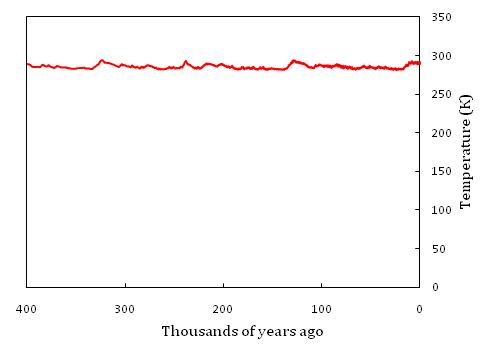
The graph below is the temperature calculated over the past 400,000 years in Antarctica from the Vostok ice core. The tiny peaks are a bit like today and the tiny troughs would force hundreds of millions from their homes. A few degrees of warming might sound small, but it can mean a lot and this is why scientists look at what the impacts of warming will be, rather than just saying “it doesn’t look like much so it can’t matter”.
Arguments


Really? all the ice core and sediment reconstructions ive seen show most o the past interglacials warmer than this one.... i think you may mean co2 levels ;-)
In the above figure looks similar to what Lindzen showed in his debate against Dessler to try and convince people that there is no reason for alarm ;)
Joe Blog,
"show most o the past interglacials warmer than this one"
Well, maybe not by 2100....we are probably going to be experiencing a super interglacial. According to Petit et al. (1999) previous inter-glacials were about +2 to +3 warmer than at the time of the most recent stratum in the core (circa 1950 if I remember correctly). We are probably in for at least another +2 C warming.
Now, what were sea levels during those previous inter-glacials?
What I meant was that 2 C global warming from today's level would put us beyond what appear to have been the warmest temperatures of the past 600,000 years. Which is one reason why we're not sure about feedbacks beyond that point!
Are you *really* going to gauge future climate from *one week* of data?
"After 14 years of nearly flat temperatures that's 1996 to now."
Hardly. Using the same UAH (not UHA) data:
"Three or four years of actual cooling should put a stake in the heart of the AGW agenda."
Considering we've had about 40 years of warming, we should have expected the spectre of climate change denialism to never again rear its ugly head, but I guess there's no rest for the wicked...
Your post is off-topic. Anyhow, lower tropospheric temperatures inferred from AMSU data are still running above average (with respect to the mean calculated over the satellite record). Regardless, short-term variability/noise is a distraction from the long-term warming trend. And yes, temperatures have been rising since 1996. See Hansen's latest paper.
Ironic that in response a post where the author is talking about temperature changes over many thousands of years and you choose to post about the change in global temperatures in the last couple of weeks. Anyhow, until a couple of weeks ago the UAH data for the mid troposphere were at record highs.
The very recent decrease in positive global temperature anomalies of late is because the atmosphere is finally responding to the strong La Nina event.
And there is no "agenda" here, just science, please take your rhetoric and spin and agenda somewhere else.
No obvious increase for a entended even if this was a real phenomenon, whould by no mean confirm than the heating is no longer ongoing. In non linear system, increase are done in step.
See
http://www.pnas.org/content/105/38/14308.full
Good point. It is rather unfortunate that so much emphasis is placed on 2100 and doubling CO2. Hopefully the IPCC will rectify that in AR5.
I'm not sure that +6 warming for doubling CO2 is the most likely scenario-- +3 C seems the most likely. That said, the IPCC might need to entertain other scenarios which allow for the fact that CO2 levels (or equivalent) will likely treble over pre-industrial levels circa 2100.
And according to UHA January 2010 was the hottest January in the 32 year satellite record, August was the second hottest month, and 2010 was the second hottest year, and we have just seen the hotest decade, yada yada yada.
But rather than cherry picking hot or cold periods within the dataset how about we consider the trend over the entire record. It is clearly positive and recent data in no way contradicts that long-term trend.
One area that often seems to get under-represented when we consider the impacts of any temperature change is the impacts on food production. Our domestic crops co-evolved with us during the Holocene and are often quite tied to temperature regimes. The argument is sometimes put that it has been warmer in the past. Yes it has but we weren't trying to feed 9-10 Billion people at the time.
A few DegC change means that every ecosystem on the planet will experience an adaptation pressure due to temperature and precipitation changes. Ecosystems can adapt, but they need time to do so. The pace of these changes, perhaps more than therir absolute magnitude is a huge ecosystem stressor. The risk is that they cannot adapt fast enough.
And the technical term for many of these ecosystems is 'farm paddock'.
The big risk from AGW, because it compounds with all the other environmental pressures, is the threat to food supply, and the flow on social chaos that may follow.
And just a few degrees can cause that in a world that is already close to not being able feed everyone.
The 6 C I gave was for 2 doublings of CO2, as our current emissions pathway is along the IPCC SRES A1.
Warming by 2100 seems almost certain to be less than this, but even the 3-4 C we may see by then is an absolutely massive change. It's not just warmer nights and evenings, but climate zones moving hundreds of miles north and hundreds of millions of people needing to protection against rising seas.
Lenton et al 2005 (published in Climate Dynamics) addresses the question of long-term Charney sensitivity. Their Figure 9.c would be the graphical summary: "A conservative estimate of known conventional fossil fuel resources is 4,000 GtC and this forms the basis for scenarios C [red curve], emitting this reserve rapidly, and D [cyan curve], emitting it slowly.". This is considering only fast feedbacks. Anyway, I think that, in the long term, the uncertainties are mainly in the emission scenario rather than the climate sensitivity
The IPCC don't go beyond 2011, but they have a graph with the temperature up to 1.000 ppm here.
Cheers.
"slow feedbacks [...] I wouldn't consider there is a scientific consensus yet (see for example James Annan's comment here (7/3/09 1:58 PM)"
Has anyone suggested that +1 should have a smaller effect than -1? There may be something in the idea. But there's no disputing that 2C, an additional 1C on top of that, is a very big deal.
As for ma previous comment, I wanted to put the emphasis on the fact that the transition is not expected to be smooth. This will create more problem for the adaptation.
Thanks for clarifying (and for the informative links).
Yes, our chosen emissions trajectory will be key to this, and I too am concerned about the possibility of slow feed backs biting us in the you-know-what. The work by Hansen et al. and Lunt et al. is sobering.
The NRC in the USA released a comprehensive report earlier this year. From their summary:
"Because carbon dioxide in the atmosphere is long lived, it can effectively lock the Earth and future generations into a range of impacts, some of which could become very severe. Emissions reductions decisions made today matter in determining impacts experienced not just over the next few decades, but in the coming centuries and millennia."
[Sourced here]
The changes induced from this huge pulse of CO2 (and other GHGs) are very likely going to be significant and long-lived. We are creating quite a mess for future generations are we not?
The Spencer reference you cite states:
"my analysis supports a best-estimate 2XCO2 climate sensitivity of 1.7 deg. C"
That is also about the thirty plus year trend for multiple measures ~ 1.6 deg C per century.
Looks like less than 2C.
There is not a great deal of evidence of net positive feedback taking place ( based on temperature anyway ).
Also, the Eemian and Holocene Climatic Optimum temperatures (~ 6000 ya, ~120,000 ya ) exceeded current temperatures.
The IPCC best estimate for the low scenario is 1.8 °C
and even that exceeds the thirty year trends.
The best estimate is not 6 °C.
I believe that's not including feedbacks.
"There is not a great deal of evidence of net positive feedback taking place"
That's your opinion, but it is not supported by evidence. The role of Water Vapor as a feedback mechanism is quite well understood, as well as the fact that warming oceans will release additional CO2 in the atmosphere.
"Also, the Eemian and Holocene Climatic Optimum temperatures (~ 6000 ya, ~120,000 ya ) exceeded current temperatures."
Indeed, but not by much - we should go above these temperatures much before 2100 (we are already at temps rivaling the HCO). Consider what sea levels were in those times to get an idea of what might be in store for us. Not fun.
"The IPCC best estimate for the low scenario is 1.8 °C"
The "low scenario" is unlikely, considering we are still pouring gigatons of CO2 in the atmosphere at a record rate.
I think you're being overly optimistic, here. The best survival strategy is still "hope for the best, prepare for the worst." Since "preparing for the worst" entails moving away from fossil fuels - soemthing we need to do for a lot of other reasons - your optimism seems unwise, from an existential point of view...
Regarding the "for how long" question, your paper is Solomon et al 2008: "climate change that takes place due to increases in carbon dioxide concentration is largely irreversible for 1,000 years after emissions stop." And that's the crux of the problem: decisions must be taken before the impacts arise because there's no way back. Wait and see = too late.
Cheers.
If the Earth experiences a 6C temperature change, then this is the equivalent of Minnesota eventually having the weather of Louisiana which is 12 degrees of latitude to the south.
Minnesota having the average weather of Louisiana is a big deal. And this is from the "best estimate" of a 6C temperature rise. If the estimate is wrong, then this could be larger.
While not Minnesota, Illinois (depending upon the emission scenario) gets a lot hotter, too:
The rest of the Midwest will follow along similarly.
Source here.
The Yooper

Unfortunately, I don't think that's a safe assumption due to Arctic amplification. Figure 2 in Graverson 2008 shows that for 1 degree of Northern hemisphere temperature increase, north of 65N there's a 2.5 degree increase.
It is also notable that during the same period observations solely from Arctic land stations reveal an amplification of the temperature trend during the dark months, November–February (Fig. 2). This amplification cannot be explained by snow-cover changes, as the albedo effect is practically absent during this dark period. Moreover, the heat flux from the ground is very small.
So 2 degrees bad... 6 degrees worse.
I just spent a half-an-hour reading your latest comment, all of your previous comments and the excellent responses that others (and a few by myself) have offered you in response (ironically, I believe I have replied to you more than any other visitor). I have to ask, did you read any of those responses? If so, did any of them make sense? Because after reading this comment, I conclude that the only part you actually are correct on is this: And it's not because you weren't offered excellent advice from others here much smarter than me (I won't name them to avoid swelling their egos, but they are legion).
So, to recap: I won't bother to provide you with any sources to substantiate anything I've said (go back and read all of the responses to your previous comments; the answers with sources are all there); you won't read them anyway, so why should I waste my time?
The Yooper
In short: Summer temperatures are pinned to just above zero C, due to the presence of ice. Average temps over the year are rising twice as fast in the Arctic as the global average. Some of the variance in the DMI data may be due to the fact that enough ice has melted to expose water at -2C, rather than ice at 0C.
You have been present on the DMI thread - and apparently you have not read it. Your questions have been clearly answered there.
The estimate is based on a doubling of CO2, which is the emissions pathway we're on, and for eventual warming, i.e. including the entire Charney sensitivity. The best estimate for low CO2 emissions is 1.8 C by 2100, but for a high emissions scenario (which we're currently on, and most 'climate skeptics' are working to maintain) it is 4 C. Of course, this is by 2100 and warming will not stop then; so I considered the full Charney sensitivity.
The result was mainly for illustrative purposes, it's pretty close to what we expect and it demonstrates that even a few C of warming can have serious impacts.
ClimateWatcher misquotes a post to make a point. ON THAT POST. That is magnificently Brazen.
CW Said "There are 3 problems with even small sounding global warming. Firstly, 2 °C is a very optimistic assessment: ..... if the skeptical Dr Roy Spencer is correct here then we’re on course to get more like 3.5 °C." My ellipses added.
Actual quote from MarkR
"There are 3 problems with even small sounding global warming. Firstly, 2 °C is a very optimistic assessment: WE ARE CURRENTLY ON COURSE TO DOUBLE CO2 TWICE SOON AFTER 2100. If the skeptical Dr Roy Spencer is correct here then we’re on course to get more like 3.4 °C, but if most climate science is correct then we’ll get 6 °C." My Emphasis.
Now thats what I call chutzpah.
I've similarly changed the phrasing of the 'warmest in 600,000 years' paragraph. The meaning of both is the same as it was originally, but hopefully it is less open to misinterpretation.
I would also consider specifying that comparing any individual ice core to today and seeing whether it has been 2 °C warmer than today or not isn't necessarily going to be that accurate. After all, we don't expect warming to be absolutely uniform and the majority of places won't warm by 2 C exactly, therefore your attempted comparison will be wrong.
My question: if the Eemian was about about (a bit less) 1 C warmer than 'today', wouldn't "2 C rise over pre-industrial times" bring our mean temp more or less EQUAL (maybe .2-.4 higher taking 0.8 C as present rise since pre-industrial) with Eemian and NOT "far exceeding Eemian"??
I am writing a book (very much accepting the consensus of climate scientists) on Climate Ch. from a layperson's perspective and I want to be as accurate as possible. Thanks!
Watch this video from the recent AGU conference: Hansen, Rohling and Caldeira on the Paleo Climate record. Very informative on the evidence showing a record that dovetails with calculated/modeled sensitivities. Very sobering stuff on rapid changes, especially in terms of sea level.




