



 Arguments









Why do glaciers lose ice?
What the science says...
Antarctica is losing ice because its glaciers are speeding up. This is due to melt water lubricating the base of the glaciers and the removal of ice shelves which act as a "speed bump" slowing the glacier flow. The ice shelves are thinning due to warming ocean waters.
Climate Myth...
Antarctica is too cold to lose ice
"The real issue is absolute temperatures. Some of the regions in which GRACE claims ice loss in East Antarctica average colder than -30°C during the summer, and never, ever get above freezing. How can you melt ice at those temperatures?" (Steve Goddard)
Glaciers are large viscous masses of ice which creep naturally through a process called internal deformation. This “creep” or movement is caused by gravity and the weight of accumulated snow and ice forcing the ice to deform like plastic.

(Figure 1: Midtsdalsbreen, Southern Norway, Personal Photograph)
Glaciers gain mass through accumulation of snowfall and through re-freezing of meltwater but lose mass (termed ablation) through surface melt, basal melt, sublimation and iceberg calving (Figure 2, right). The accumulation of ice primarily occurs in the glacier’s accumulation zone and ice loss generally originates in the glacier’s ablation zone (Figure 2, left).
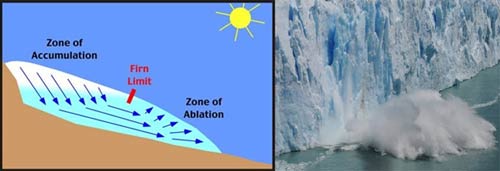
(Figure2, accumulation/ablation zones, www.physicalgeography.net, image of calving glacier on right)
For an ideal glacier, ice flow through a cross-section must exactly balance the accumulation and ablation taking place (Benn and Evans, 1998, 142). The difference between the total gains and losses measured over a specified time refers to the mass balance. Mass balance is usually measured over the course of a year which computes the sum of all the annual accumulation and ablation (Benn and Evans, 1998, 75). The velocity at which a glacier moves whereby its Mass Balance is 0 represents the point at which its inputs (through accumulation) equals its outputs (through ablation) and is termed the Balance Velocity (Figure 3).
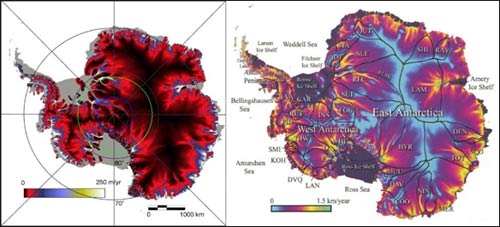
Figure 3: (Left) Balance Velocities for Antarctica as illustrated in Bamber et al (2009). (Right) Actual velocities across the ice sheet as measured by Rignot and Thomas (2002).
As every individual basin is rarely in balance, the actual velocities of glaciers/ice streams across Antarctica shows that many glaciers have velocities in excess of their balance velocity and many are less than their balance velocities (Figure 3, right).
The question of balance velocities brings us to one of the most important points of this post. When a glacier is in balance or flowing at its balance velocity, net mass will remain balanced. However, when a glacier accelerates while near or at its balance velocity, the outputs resultantly increase but the inputs do not, thereby shifting the glacier regime to one of negative mass balance or net ice loss. This situation is particularly important because accelerated ice flow is the key method through which the Antarctic ice sheets incur a net ice loss. Accelerations such as these occur through two primary mechanisms. The first of which is caused by surface melt water reaching the glacial bed causing basal lubrication therefore reducing the frictional forces at the bed and thus increasing ice flow (Bell 2008).
The second mechanism refers to when the forces at the downstream terminus of a glacier or ice stream are disturbed or altered. This can occur through removing buttressing ice shelves or by shifting the glacier’s grounding line (point where glacier ice reaches floatation). The presence of an ice shelf provides a longitudinal compressive force which slows the flow of ice streams. If removal of this compressive force occurs, velocity of ice streams increase. This has been observed directly by Scambos et al (2004) and Rignot et al (2004) through both visual observations (Scambos) and radar interferometry (Rignot).
In terms of a grounding line retreat, an inland shift of the grounding line causes less backpressure through increased calving and basal melting. This process results in increased glacier velocities and subsequent inland thinning as more ice is being pulled from the accumulation zone (Bell 2008). In a warmer climate, one would expect that surface melting would increase, making the first mechanism more likely, however because of Antarctica’s climate and the omnipresence of ice shelves and calving glaciers there, the second mechanism actually dictates the ice losses from Antarctica. Evidence has already been presented which supports the theory that it is warm ocean water in West Antarctica which is in actuality enabling this second mechanism (Shepherd, Wingham and Rignot, 2002).
We should all now at least remotely understand that mass balance changes in Antarctica aren’t reliant on surface melting but rather depend on dynamic responses such as the 2nd mechanism.
Intermediate rebuttal written by robert way
Update July 2015:
Here is a related lecture-video from Denial101x - Making Sense of Climate Science Denial
Additional videos from the MOOC
Expert interview with Eric Rignot
Expert interview with Isabella Velicogna
Last updated on 8 July 2015 by pattimer. View Archives







I agree with this article.I also had read an article from Boston globe, it’s an article about severe melting of ice sheet that is found in Antarctica. It’s said that a team of European scientists has found some ice sheet melting in East Antarctica during the summer months, in an area that is supposed to be too cold for perceptible ice loss. The ice sheets is weak throughout its structure. The glaciers is a large mass of ice, so it’s very hard to melt or it will take a long time to melt. But now it not take long time as in the past to melt. The glaciers are melting because of warming ocean water. Warming ocean water is caused by global warming. We have to solve this problem straightforward. In this article it’s said, we should all now at least remotely understand that mass balance changes in Antarctica aren’t reliant on surface melting but rather depend on dynamic responses such as the 2ndmechanism. I also have a question. Is it possible for melted ice to form its original ice form again?
It seems the melting of the land ice of the west coast has to be found in the volcanoes underneath the glaciers that have been discovered, not in human activity. A 2017 study claimed to have found 138 volcanoes, of which 91 were previously unknown. See :
https://sp.lyellcollection.org/content/early/2017/05/26/SP461.7
In addition to my previous post : Evidence for elevated and spatially variable geothermal flux beneath the West Antarctic Ice Sheet
https://www.pnas.org/content/111/25/9070
" Our results further suggest that the subglacial water system of Thwaites Glacier may be responding to heterogeneous and temporally variable basal melting driven by the evolution of rift-associated volcanism and support the hypothesis that both heterogeneous geothermal flux (6) and local magmatic processes (5) could be critical factors in determining the future behavior of the WAIS."
btw Roque , it is best to keep your comments on one thread, not spread between two threads . . . which gets messy and confusing.
I have replied on your other thread. (The issue is a nothingburger, basically. But sea-level rise might increase faster, if, as some suggest, AGW-caused melting of West Antarctic ice leaves a lighter weight of ice . . . which might allow an increase in volcanic activity undereneath. )
As Eclectic notes, do not post the same comment on more than 1 page here. Put it on the most appropriate thread and wait for feedback.
Repeated from the other thread, augmented by extra content in response to the Schroeder paper:
The paper itself makes it clear that this result only applies to the area of the Thwaites Glacier. Not the WAIS in its entirety nor the rest of the Antarctic Ice Sheet, all of which are showing significant mass losses. Per the PAPER:
So not a lot more than actual mean heat flows of continents and oceans, which are 65 and 101 mW m−2, respectively. And just in the area of Thwaites Glacier. A very tiny subset of the WAIS, itself a small portion of the overall Antarctic Ice Sheet.
Further, the authors of the paper have themselves repudiated misinterpretations of their paper:
Additionally, vulcanism has been present in Antarctica for well over 50 million years.
The ice sheet there formed 34 million years ago, and persisted since, in spite of that vulcanism. A subglacial heat mantle plume would have produced detectable subglacial drainage and melting events. None has been detected for the Pine Island Glacier and the adjacent Thwaites Glacier has proven largely insensitive to the presence of such a mantle heat source:
And
The heat coming from the geothermal activities under the ice is not a whole lot more than that coming from a dormant volcano.
People walk on dormant volcanoes. Trees grow on them.
In Antarctica, ice forms on them.
Marie Byrd Land
The volcanic heat plume mentioned under the ice of a portion of Antarctica is fossil heat; its last activity predates the formation of the Antarctic Ice Sheet (itself more than 34 million years old).
So the ice in the area formed anyway, in spite of the supposed "volcano".
Influence of a West Antarctic mantle plume on ice sheet basal conditions
Suggested supplemental reading:
Forty percent of Antarctica’s ice shelves are shrinking, worrying scientists by Kasha Patel, Environment, Washington Post, Oct 12, 2023