



 Arguments







Monckton Myth #12: Arctic Temperature Changes
Posted on 16 February 2011 by robert way
The Warming Arctic
 A common misconception that is found to exist within the blogosphere is that the Arctic (hereby defined at 64 to 90 °N) was warmer than present during the early-to-mid 20th century. In particular this claim has been supported by anecdotal evidence of reduced sea ice cover and pronounced warming at *some* Arctic stations at that time. This argument is brought forth by Lord Monckton in April of 2009 whereby he claims that "Temperatures in the Arctic and in Greenland were warmer by up to 3 Fahrenheit degrees (~1.6°C) in the late 1930s and early 1940s than they are at present". Monckton provides no evidence that he conducted an Arctic-wide analysis of air temperatures but rather seems to suggest that he selected a few stations which supported his narrative rather than examining all of the evidence. As real scientists tend to be very skeptical beasts, it is important that we assess his claim for quality to ensure that it is not based solely on a cherry-pick.
So what do the results show?
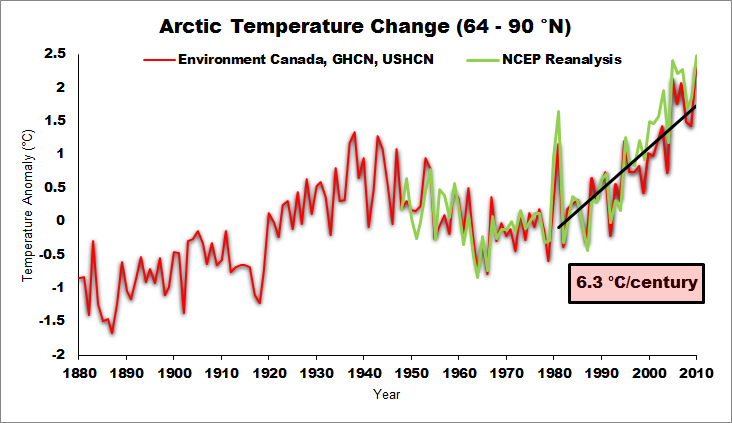
Figure 1: Temperature Anomalies (1951-1981 Baseline) for the Arctic region (64-90°N) over the past 130 years according to ccc-gistemp analysis and NCEP reanalysis.
It is evident based upon Figure 1 that the late 20th to early 21st century warming in the Arctic far exceeds the warming experienced during the 1930s and 1940s. This is supported by calculating a 10-year running means which shows that the 10-year period from 2001 to 2010 was 0.79°C warmer than the warmest 10-year period during the early-to-mid 20th century. Monckton's claim of that period being 1°C greater than the current warming is therefore proven to be incorrect. It should also be noted that the warming over the last 30 years (1981-2010) shows an extraordinarily fast rate of warming (6.3°C/century) using ccc-gistemp.
Another way of looking at the data
What about when we order the anomalies by year?
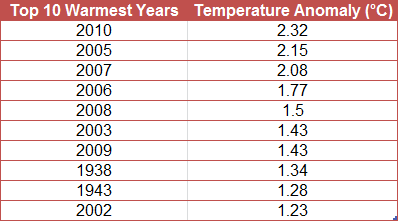
Table 1: Top 10 Warmest Years in the Arctic according to ccc-gistemp analysis.
As is readily apparent, the Arctic was NOT warmer than it is currently and in fact 2010 was the warmest year the Arctic has experienced since instrumental records began. Out of the top 10 warmest years only 2 years predate the 2000s. This post should provide a definitive answer as to whether the warming of the early century was greater in the Arctic than currently. The answer is a resounding no.
As a side note, temperature reconstructions for the Arctic are now for the most part widely accessible and I was able to run this one in 20 minutes. There is no practical reason why Monckton selects but a few stations for his analysis and ignores the overwhelming majority of evidence presented here and elsewhere. There are just no excuses.


 0
0  0
0






Comments