





Are humans too insignificant to affect global climate?
Posted on 6 October 2009 by John Cook
Are humans too insignificant to affect global climate? After all, our planet is a big place. Isn't it arrogant to claim puny little humans could make a dent in such a huge climate? However, whether human activity might affect climate is not a question of arrogance. It's merely a question of numbers. In particular, there are two numbers to consider.
Atmospheric CO2 is rising by 15 Gigatonnes per year
The first on-site continuous measurements of atmospheric CO2 were implemented by Charles Keeling in 1958 at Mauna Loa, Hawaii. This station provides the longest continuous record of atmospheric CO2. Currently, atmospheric CO2 levels are being measured at hundreds of monitoring stations across the globe. For periods before 1958, levels of atmospheric CO2 are determined from analyses of air bubbles trapped in polar ice cores.
What we observe is that in pre-industrial times over the last 10,000 years, CO2 was relatively stable at around 275 to 285 ppm. Over the last 250 years, atmospheric CO2 levels have increased by about 100ppm. Currently, the amount of CO2 in the atmosphere is increasing by 15 gigatonnes every year.
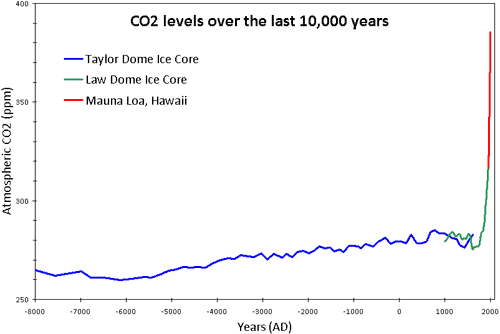
Figure 1: CO2 levels (parts per million) over the past 10,000 years. Blue line derived from ice cores obtained at Taylor Dome, Antarctica (NOAA). Green line derived from ice cores obtained at Law Dome, East Antarctica (CDIAC). Red line from direct measurements at Mauna Loa, Hawaii (NOAA).
Humans are emitting 26 Gigatonnes of CO2 per year
Global CO2 emissions are derived from international energy statistics, tabulating coal, brown coal, peat, and crude oil production by nation and year. This means we can calculate how much CO2 we're emitting not only in recent years, using United Nations data, but also estimate fossil fuel CO2 emissions back to 1751 using historical energy statistics. What we've found is fossil fuel and cement emissions have continued to increase, climbing to the current rate of 26 Gigatonnes of CO2 per year.
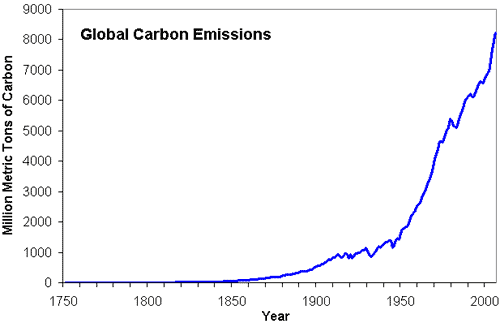
Figure 2: Total Global Carbon Emission Estimates, 1750 to 2006 (CDIAC).
In other words, humans are emitting nearly twice as much CO2 than what ends up staying there. Nature is reducing our impact on climate by absorbing a large chunk of our CO2 emissions. The amount of human CO2 left in the air, called the "airborne fraction", has hovered around 55% since 1958.
Detecting the human signature in atmospheric CO2
Further confirmation that rising CO2 levels are due to human activity come by analysing the types of CO2 found in the air. The carbon atom has several different isotopes (eg - different number of neutrons). Carbon 12 has 6 neutrons, carbon 13 has 7 neutrons. Plants have a lower C13/C12 ratio than in the atmosphere. If rising atmospheric CO2 comes fossil fuels, the C13/C12 should be falling. Indeed this is what is occuring (Ghosh 2003) and the trend correlates with the trend in global emissions.
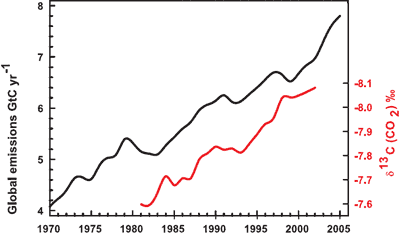
Figure 3: Annual global CO2 emissions from fossil fuel burning and cement manufacture in GtC yr–1 (black), annual averages of the 13C/12C ratio measured in atmospheric CO2 at Mauna Loa from 1981 to 2002 (red). (IPCC AR4)
So we see that humans have indeed changed the composition of our climate in dramatic ways. If anyone could be accused of arrogance, you might say it's more arrogant to think we can pollute without consequences.
UPDATE: Many thanks to Lou Grinzo from The Cost of Energy who reminds me that the 26 Gigatonnes of CO2 that we're throwing into the atmosphere is based on 2003 data (taken from the IPCC AR4). The latest data from the EIA has human CO2 emissions at 29 Gigatonnes per year.

Arguments


Bit early to tell whether there is a long term trend there.
As an interesting note, in the article Keeling estimates the increase in sea level from the H2O produced by burning hydrocarbons. As you would expect the number is very small.
Best,
John
pdt--the result of increasing CO2 concentrations is an increase in ocean acidity. There are many links to this topic. One place to look is http://www.pmel.noaa.gov/co2/OA/ . Or just start with Wikipedia.
The article poses the question as to whether humans can affect the GLOBAL CLIMATE. It then focuses on CO2 levels and annual fossil fuel consumption. Since CO2 increases = CLIMATE CHANGE (in everybody's mind), it proves that humans can indeed affect the Earth's climate, which doesnt even really exist since "climate", meteorolgically speaking, has to do with weather patterns associated with geographic regions. A more loose meaning could mean atmospheric molecular composition, but the term environment is probably more suitable.
And what is really being sold here again is the concept that CO2 is causing the Earths TEMPERATURE to go up. Why not us that word?
1) Do plants generally grow faster in warmer or cooler climates?
2) How do CO2 levels affect plant growth?
That depends on water and nutrient levels. I used to work here, and at temperatures of 50C, there was nary a plant to be seen. In contrast, despite ten months per year of winter, there's trees growing all over here.
"How do CO2 levels affect plant growth?"
That also depends on water and nutrient availability, and on which photosynthetic pathway the plant uses.
Denialists, I would say, are those that suggest we can somehow circumvent laws of thermodynamics associated with all form of energy production. Physics aside, while CO2 has something to do with global warming, the phenomenon (as this paper implies) has to do with OVERPOPULATION. Birth control and education, for instance, may be much more relevant towards this cause as compared to the narrow and miopic "scientific" discussion at hand. For purposes of analysis, it is normal and OK to isolate factors, but when you are talking about a system as complex as the Earth, it seems quite ARROGANT indeed to assume you have all the answers, and only be focussing on that one aspect of the problem.
and all live in harmony with nature while maintaing unending industrial growth. You cant just focus on one part of this problem, which has been my point since day one.
Nice try. You are talking about a desert that has looked like that since Moses. I was talking about the effect of plus 1 or 2 degrees C.
A 1C or 2C change in global mean temperature also changes patterns of precipitation and evaporation, which changes water availability. Some areas will get wetter, and some will get dryer.
Even if plants theoretically grow faster at warmer temperatures and higher ambient CO2, that does no good if they're already nutrient-limited or water-limited, as many plants are in the real world. There is lots and lots of research about this.
There are many more factors to be considered that just rate of growth.
Total yield and nutritional quality are much more important.
Rice has been shown to be negatively affected by increasing minimum temperatures:
"Grain yield declined by 10% for each 1°C increase in growing-season minimum temperature in the dry season, whereas the effect of maximum temperature on crop yield was insignificant. This report provides a direct evidence of decreased rice yields from increased nighttime temperature associated with global warming."
PNAS July 6, 2004 vol. 101 no. 27 9971-9975
http://www.pnas.org/content/101/27/9971.full
Nutritional quality of wheat declines:
"The discovery that staple crops like wheat have less protein when grown in high concentrations of CO2 has already caused concern, but the bad news doesn't stop there.
Ramping up CO2 also changes the balance of amino acids and several trace elements, says Petra Högy from the University of Hohenheim in Germany".
http://www.newscientist.com/article/dn17617-wheat-gets-worse-as-cosub2sub-rises.html
There are many other papers describing deleterious effects of higher temperatures and higher CO2 levels on the plants which are staples in our diet.
Thus messing around with our climate and atmospheric chemistry will not be good for our food supply.
The African forest is a case in point; much of it sits on a thin layer of rich soil built over time by decomposing organisms, the original soil underneath is nothing but red dust, called laterite. Laterite is quite good to build roads. With proper sun exposure throughout the day, allowing it to dry, a laterite road is likely to last longer than a paved one. Strangely enough, plants don't start growing on laterite roads nearly as fast or as easily as they do in the cracks of a paved road.
The temperate forests are also found where there is plenty of available water, as in Kamtchatka, Pacific Northwest, South Alaska. Of all factors, not a single one is more important than the availability of water, not even nutrients, with enough time given.
However, for the plants that are(currently) constrained by the speed/efficiency they can remove carbon from the air, then increasing CO2 will help them grow. This is why commercial greenhouses routinely pump massive levels of CO2 into their structures(they are designed to relax as many constraints on plant growth as possible).
Clearly, some plants, in their current environments would grow faster(and, hence bigger) if they had access to more CO2. Further, this is compounded by the fact that warming temps will also yield more WV which also makes it easier from plants to grow, on average.
IIRC, this effect has been measured from space, and there has been something approximating 6% increase in plant life on Earth over the last 20+ years.
Cheers, :)
Availability of liquid water and nutrients are the real important things. Ther rest is nit picking. I'd like to see the reference on that increase in plant life study, especially to see if there is any attribution to possible causes in the increase. I'm also wondering what exactly is meant by "increase."
I believe that land use changes are more likely than any other factor to yield that kind result. I seriously doubt that "CO2 fertilization" (an abuse of language really) can be that effective.
Availability of liquid water and nutrients are the real important things. Ther rest is nit picking. I'd like to see the reference on that increase in plant life study, especially to see if there is any attribution to possible causes in the increase. I'm also wondering what exactly is meant by "increase."
I believe that land use changes are more likely than any other factor to yield that kind result. I seriously doubt that "CO2 fertilization" (an abuse of language really) can be that effective.
On John's next post our other resident denialists are up to the same tricks "water vapour" "CO2 saturation" "ocean absorption" "Nuclear tests(!)" and calls for "laboratory experiments". Again, they have no idea what these things mean, they are just random noise injected into a thread to try to stop the clear explanations of data provided by John being accepted by readers. Next thread they will be back again either with the same non-points or with other pieces of foolishness ("submarine volcanoes" "cosmic rays").
I am dealing with a plague of mice at present. I catch one, put it outside, catch another next day, put it outside, and on, and on. Doesn't matter how many mice I catch, they just seem to keep coming. Almost makes me think they have some way of multiplying faster than I can catch them. Just like denialists, except they have caused far more serious damage than a few mice..
IAC, this point is moot, as a warming planet also has more water vapor in the air and more precipitation which have rather larger impacts on CO2.
David Horton: If CO2 isn't good for plants, why do greenhouses pump it in? That one simple question will put all your silliness in context. People whose livelihood depend on growing plants quickly disagree with you about the benefits of CO2. Put simply, plants get carbon from the air and if the air has less carbon in it, a plant has to move a greater amount of air through its system to grow *when everything else is equal*.
Calling something "denialist" doesn't address whether it is true.
Also, your common sense idea that the Earth is getting less green is not science. I will try to find the reference that demonstrates how it is in error.
Cheers, :)
Climate-Driven Increase in Global Terrestrial Net Primary Production from 1982-1999.
Nemani et al.
Also, above I made a typo above ... which have rather larger impacts on CO2 should read "...which have rather larger imapcts on plant growth".
Cheers, :)
As for the statistics in their figure 4, I can only begin to imagine what kind of treatment would "skeptics" of the GW kind would give it. Of course, it would be out of bad faith, so I won't even go there.
Furthermore, the largest increase is attributed to the Amazon rainforest being exposed to more sunlight. That seem to square with observations and models suggesting that the Amazon is and will be getting drier. This, however, is anything but good news if it continues throughout the century, as it could very negatively affect the carbon cycle, as analyzed in the Phillips et al (2009) paper.
There is no shortage of papers showing how disturbances stemming from climate change would negate temporary gains from higher temps or CO2 "fertilization." This especially true at the higher lattitudes, whose forests have already been shown to be a lot less of a carbon sink than the tropical ones.
http://www.sciencemag.org/cgi/content/abstract/323/5919/1344
http://rstb.royalsocietypublishing.org/content/363/1501/2259.abstract
http://www.pnas.org/content/105/5/1551.abstract
http://rstb.royalsocietypublishing.org/content/363/1498/1737.abstract
So rejoicing at the Amazon'e NPP increase might be a little like enjoying the warmth and light of the fire starting to burn your house.
Whether there are some negative impacts from climate change(though I note that such negatives appear to be modelled impacts of what *might* happen), doesn't change the fact that there are also some positive impacts as well.
Cheers, :)
Most people whose livelihood depends on growing plants don't grow them in greenhouses. They grow them outdoors, in environments where nutrients or water are the primary limiting factor, not CO2.
Once again, it's ironic that "skeptics" so often point to the tiny atmospheric fraction of CO2 but so generously impart it that tremendous fertilization power. I admit, however, that you are of a more sophisticated kind.
Commercial GH routinely use 1200 ppm, or at least 800 ppm concentrations, since they don't see that much result below. And of course their water and nutrients are optimized 100% of the time.
tell your friend to reverse the axis to "demonstrate" a huge drop in CO2.
Seriously, if one can not read a graph should not even try. Expanding the axis means let people see and judge. On the contrary, putting the origin of the y axis to zero means mask what people could (or should) read.
Andrew (a practicing ecologist)
P.S: Regarding comment #26. There is nothing wrong with the Y-axis scale used in Figure 1, as it fairly represents the variability in the observed data. Plotting from a zero origin would be meaningless unless one wanted to minimize the visual impact of the trend.
This paper deals with that (yes, it is increasing (both emissions and sinks are growing, but the former faster than the latter)):
"Changes in the long-term efficiency of the natural sinks in removing atmospheric CO2, as measured by the ratio of sinks to emissions, are indicated by the proportional trend in the AF [(1/AF)dAF/dt]. Over the period 1959–2006, this was +0.25 ±0.21% y-1"
"We estimate that 35±16% of the increase in atmospheric CO2 growth rate between 1970–1999 and 2000–2006 was caused by the decrease in the efficiency of the land and ocean sinks in removing anthropogenic CO2 (18 ± 15%) and by the increase in carbon intensity of the global economy (17 ± 6%). The remaining 65 ± 16% was due to the increase in the global economy."
Knorr 2009





