





Climate Change Denial book now available!
Posted on 29 April 2011 by John Cook
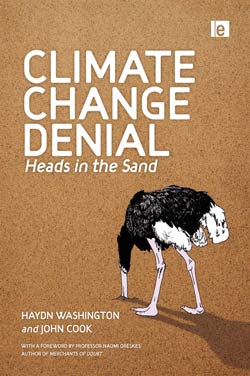
The book Climate Change Denial: Heads in the Sand, by Haydn Washington and John Cook and published by UK publisher Earthscan, is now available for sale. You can order from Earthscan, Amazon or NewSouth Books (for Australians).
The book examines the phenomenon of climate change denial. It looks at the many techniques of literal denial, where 'skeptics' deny the evidence for man-made global warming. It exposes denial within governments, who make a lot of noise about climate change but fail to back it up with action. And it examines the denial within most of us, when we let denial prosper. This book explains the climate science and the social science behind denial.
Climate change can be solved – but only when we cease to deny that it exists. This book shows how we can break through denial, accept reality, and thus solve the climate crisis. It will engage scientists, university students, climate change activists as well as the general public seeking to roll back denial and act.
To order 'Climate Change Denial' with a discount:
| Australia - AUD$34.95 | Rest of the World - £14.99, USD$24.95 |
Amazon |
| Follow this special link to obtain a 20% discount at NewSouth Books To order by phone, fax or mail, download this PDF |
Go to the Earthscan website and enter the discount code AF20 in the voucher box to obtain a 20% discount. | Order Climate Change Denial: Heads in the Sand |
Praise for Climate Change Denial
"This book is a must have for anyone trying to understand the climate change issue. Washington and Cook use impressive skill to peel back the lies and deceit associated with a well-oiled machine, used for selling tobacco and now selling manufactured doubt about climate change."
Ove Hoegh-Guldberg, Director of Global Change Institute, University of Queensland"Ignorance of science is one blockade to effective action on the human predicament. But corporate-financed disinformation campaigns, such as those claiming that climate disruption is a hoax, are equally important. This excellent book will help solve both those problems."
Paul R. Ehrlich, co-author of Humanity on a Tightrope"Climate Change Denial reveals the crossroads we face as a society: do we let denial and confusion continue to derail solutions, leaving us vulnerable to runaway climate change, or do we accept reality and forge a truly sustainable path for future generations?"
James Hoggan, author of Climate Cover-Up and president of DeSmogBlog"This is a major contribution to the growing body of well-reasoned analyses of climate change denial. It’s a must read for anyone interested in understanding the tactics used by the “denial industry” to attack scientific evidence of anthropogenic climate change."
Riley E. Dunlap, Regents Professor of Sociology, Oklahoma State University"Climate change denial is the biggest single obstacle to achieving a sustainable future. This book provides all the evidence and arguments you need to counter the campaign of misinformation. Read it, study it and spread its message widely."
Ian Lowe, Emeritus Professor, School of Science, Griffith University and President of the Australian Conservation Foundation"Washington and Cook shine a bright light on the charlatans, organizations, and funders behind the climate change denial industry. This clear and compelling book will make it easier for the general public to see through their tricks, and more likely that the world will move faster to take action on the most urgent environmental problem we have ever faced."
Peter Gleick, hydroclimatologist, Member US National Academy of Sciences, MacArthur Fellow, President, Pacific Institute"Washington and Cook offer the best available guide to recognizing and combating climate change denial. Their book is compact, lucidly written, and based on recent research in climate science, psychology and sociology. Anyone concerned with reality-based policy in any area can profit from reading this excellent work."
Spencer Weart, author of The Discovery of Global Warming"In engaging, easy-to-understand language, Climate Change Denial tells us all we need to know about global warming denial, explaining why, even though the scientific evidence is irrefutable, denial continues to prosper. We learn the arguments and techniques the deniers use and how easily they are refuted. Most important, the book shows us that if we and our elected leaders pull our heads out of the sand, there is still time to find a path to a sustainable, livable future."
James Lawrence Powell, author of 2084 and the forthcoming Inquisition of Climate Science
Book Reviews
"The book is compact and well referenced. It carries an eloquent foreword from Naomi Oreskes. It is lucid and compelling in its discussions. It adds a weighty voice to the summons to face the physical and ethical reality of climate change, to have done with denial and to set about the still achievable task of repair."
Hot Topic
"‘Climate Change Denial’ is a useful book and resource for those with an open mind – for instance journalists. It reads easy and provides a fairly concise picture of the situation many of climate scientists have to live with."
Real Climate"The book has the virtue of thoughtful accessibility, and is an excellent primer for anyone getting interested in this area and looking for a good overview."
Carbon Brief"Climate Change Denial is a wise and timely book. It is well researched and painstakingly footnoted. It deserves an audience but then, you had already decided from the title whether or not you agreed with the book, right?"
Ecologist"The book is a riveting read. Washington and Cook take no prisoners. Every trick, lie and deceitful attempt by vested interests to delay action on global warming is exposed, along with the tactics of their well-oiled propaganda machine, including the same unscrupulous scientists, handed down from Big Tobacco to Big Carbon. Drilling down to the heart of the epic scale of betrayal of our planet and its people, Cook and Washington explain the denial within governments, within ourselves and the social science behind denial. Climate change can be solved they say but only when we cease denying its existence."
Independent Australia"It is perfect for anyone who is sick of having arguments about climate change with deniers. Not only does it provide vast amounts of information about the real threat of climate change but it also, with good humour and rigorous logic, exposes the inaccuracy of those who would deny climate change."
Bruce Elder, Sydney Morning Herald"This is a crucial book to read before runaway climate change is truly beyond our control. One can only hope that this book will be read by climate deniers so we can start the challenging journey to an ecologically sustainable future."
Janine Kitson, Education (NSW Teachers Federation)"Climate Change Denial: Heads in the Sand is well worth a read. It lacks the gripping narrative of Gwynne Dyer or Gabrielle Walker, both of whom have the ability to make scientific information feel like a mystery novel rather than a textbook, but it is enjoyable nonetheless. It adds worthy social science topics, such as implicit denial and postmodernism, to the discussion, paired with a taste of what Skeptical Science does best."
Climate Sight"The book excels in peeling back the stinky layers of the onion that is climate change denial... This book, like Cook's website, is enormously good at dissecting the arguments deniers use -- which are ultimately quite flimsy. These arguments strike a chord for the reasons discussed above, but it's important to keep showing how empty and false they are, to dissipate the delusion of denial and bathe all who will listen in the sunshine of reality."
Daily Kos

Arguments


Nevertheless - does one of those links above provide a commission that would help support this site? That would significantly influence my purchasing decision...
Look forward to reading it. Will give me something to do if this rainy weather continues here in Brissie...
http://www.abc.net.au/science/articles/2006/11/02/1777947.htm
In addition to sticking it's head in the sand when frightened, it only looks at the ground six inches in front of it's feet, and tilts it's head sideways when running uphill so it doesn't seem like it's going upwards (they're terribly afraid of heights, thus the head-in-the-sand thing).
Well, most information doesn't exist. We use mediums, like paper, orientation of particles etc to store information. Which leads to the question... what is a book?
I've been thinking off and on for some time about signs or indications that a system is on the verge of a regime change, in particular with respect to climate. My gut feel assessment has been that unusual levels of variance from the mean would increase for some time before reaching the tipping point after which the status would not return to the previous conditions. So, it was with interest that I read this story about an ecological system regime change. Apparently, my thoughts are nothing new; there exist models which are used to examine state changes within a variety of system types and predict when a tipping point is about to be reached.
I can understand that predicting a tipping point using the multitude of physics processes involved in climate is extremely difficult. I was wondering if serious work has been done along an alternate line of looking at not the physical processes, but just the amount of variation from pre-existing conditions.
Snippet:
"Brock used a branch of applied mathematics known as bifurcation theory to show that the odd behavior was in fact an early warning of catastrophic change. In short, he devised a way to sense the transformation of an ecosystem by detecting subtle changes in the system's natural patterns of variability."
If there is a summary article someone knows of...
I skimmed titles and abstracts until I found this
"Slowing down as an early warning signal for abrupt
climate change
which looked promising, but I wanted to see if it was a reputable work. So, I followed the link to citations, and found:
Copenhagen Diagnosis
which I am sure is familiar, and contains:
"Is there any prospect for early warning of an
approaching tipping point?
Recent progress has been made in identifying and testing generic
potential early warning indicators of an approaching tipping
point (Lenton et al. 2008; Livina and Lenton 2007; Dakos et al.
2008; Lenton et al. 2009; Scheffer et al. 2009)..."
On the first skim read, it does not support those who say there is nothing to worry about because things are not changing as fast in the most recent decade.
Climate Emergency: Time to Slam on the Brakes
The Yooper
Really? Is that what the science says? I think this website is fantastic, and I appreciate all the work that you do to debunk the deniers. But that assessment seems fatuous. The climate change already in the pipeline is nothing short of catastrophic for humans and most other species. To say we should "accept reality" and "thus solve the climate crisis" is surely a contradiction in terms. Or maybe just marketing.
I'm trying to get some notorious local deniers along - but they're not biting.
Cheers.
I think that if you want to understand a bit more about why climate science deniers just can't seem to understand that climate change is happening, consider your remarks in the book on nuclear power and carbon capture.
A few points:
The IPCC AR4 says because nuclear is "similar" to renewables in terms of lifecycle CO2 emissions, it is "an effective GHG mitigation option". It seems you disagree. Does this mean you would say the IPCC is a suspect source for information? Should we just cherry pick what we agree with from it and dismiss the rest?
You say 6.7 cents a kWhr is "not cheap" and you say instead of building nukes that could produce power at that price we should spend where CO2 can be displaced "soonest". What does that mean? Shouldn't we be concerned about the cost? Take a look at the chart Al Gore took from McKinsey, i.e. the "global GHG abatement cost curve" he republished on page 240 of his book "Our Choice". McKinsey found that nuclear is a more cost effective mitigation option per tonne of CO2 displaced than wind or solar. Gore removed the word "nuclear" from his version of the chart so renewables supporters couldn't see what McKinsey found. Aren't you arguing the same way?
Take a look at Monbiot’s critique of German solar power subsidies - Why are feed in tariffs for solar set so high if 6.7 cents a kWhr for nuke electricity is so expensive?
You say the nuclear “fuel cycle produces weapons grade uranium and plutonium”. It doesn’t. Weapons grade material refers to highly refined material, i.e. in the case of uranium that means a sample that is 90% U235, in the case of plutonium that means Pu-239 93%. The fuel cycle for commercial nuclear power produces U235 at 3%. The plutonium would have to be reprocessed out of the waste and the bomb grade isotope separated. Why assert that a specific grade of material is created that is not? Do facts matter? If I used words the way you do, I could say crushing ordinary granite for gravel produces “weapons grade uranium”, just because it contains minute amounts of U235.
Nuclear proliferation is a serious issue, but you should make your case about it without lies or whatever you want to call what you’ve done here.
Nuclear waste can’t be dealt with, you imply. You might want to take a look at Kahan’s Cultural Cognition of Scientific Consensus. Kahan was studying, among other things, why people reject climate science. One thing he discovered is that people who accept climate science tend to reject the equally authoritative scientific consensus among the relevant scientists about nuclear waste. He cites NAS NRC studies on climate science and nuclear waste to show what the consensus on the two issues is, then writes about his data and conclusions.
The NAS concludes nuclear waste is a political problem, not a technical one. You assert otherwise. Why? Look up WIPP, which is a licensed facility in the US that is safely disposing of US military nuke waste in a salt formation. The formation has been there for 300 or so million years, There isn't water flowing through it to carry anything anywhere because otherwise the salt wouldn't be there. The formation is large enough to hold the entire world supply of nuclear waste. Opponents of nuclear power insist there is no place to put the waste. Why? Why do you, as someone who wants something done about climate, add your voice to theirs?
In order to make your point that nuclear plants are not being built, you had to tell us to ignore the places where they are being built, i.e. Asia. Why does arguing this way not seem very weird to you, given how much time you must spend going over the fine points of climate denier arguments?
We’ll have to mine uranium, unless we use breeder reactors, but we can’t use those, according to you. MIT said they didn’t expect breeders to be used in the immediate future, so you refer to them, but you don’t say why they said that. They said there is enough uranium, which you dispute, they said light water reactors are proven and available and not too dangerous or too expensive to use given the climate problem we face, which you dispute, so they expect the industry, if people decide climate change should be dealt with, will use those. Your argument cherry picks MIT for what you can distort them to say to support your conclusions, which MIT would disagree with. Does this type of argument sound familiar to you?
You assert that nuclear power stations can “melt down like Chernobyl”. None ever has. Only Chernobyl. Chernobyl didn’t have a containment building, and it had a graphite core that could burn. The reactor core caught fire and burned out of control without a containment for some days. It is a significant design difference from anything operating in other places. You might want to let the dust settle before declaring how great a catastrophe Fukushima was or is or will be in response. Dr. Robert Gale, who directed the medical effort treating victims of Chernobyl, expects no one will be able to detect the small theoretical increase in cancer that he expects will be calculated to have occurred as a result of Fukushima over the next decades.
Why state what has to be disposed of when a nuke plant is decommissioned in units of pounds? Why not micrograms, or better, picograms? Wouldn’t that make the number look even bigger? Isn’t that your point – to exaggerate? Why do it?
What is remarkable about the nuclear fuel industry is the tiny quantity of waste that has to be disposed of compared to the amount of power produced. When I toured a reactor, its entire production of waste was sitting in a back parking lot in casks, or in the spent fuel pool in the plant, for a facility that was producing about 10% of the power to the US state I live in for decades.
One thing to bear in mind about the anti nuclear movement is that it predates widespread awareness that climate change is a problem. Eg. If you look up the written policy of the Sierra Club, the largest environmental organization in the world, you'll find that all of its nuclear policy is dated prior to their first attempt to write any policy at all about what they called back then "the enhanced greenhouse effect". Policy and attitudes conceived before it dawned on the people who conceived them that there is a very great problem nuclear may be able to help address, may need to be reconsidered, given how serious climate change is. Would you disagree?
You should carefully examine Amory Lovins a bit before quoting what he says. Among people who are looking seriously at nuclear power, Lovins is regarded as a liar, something like Lord Monckton. For instance, at the height of the Fukushima crisis I tuned into Public Radio International's "Living on Earth" podcast which featured an interview with Lovins. He asserted that the entire cost of a new nuclear plant is being paid for by the US government at the moment and even at that, no one wants to build a plant that's how undesirable nuclear power is. The program he referred to is a loan guarantee program, where the US government provides insurance to a utility that is building a plant and charges the utility for that insurance. The utility still has to pay the entire cost of building the plant. Lovins says otherwise. He’s been around long enough and he’s been confronted with this often enough this is an outright lie he repeats to the ignorant which is who he thinks listen to a show like this. This is how climate deniers operate - and it is exactly how Lovins operates. Listen to this interview with Lovins and read third comment on this post
Etc, Etc.
On carbon capture, I note that the IPCC takes a different view than you do, see their Special Report on Carbon Capture and Storage. Mark Jaccard wrote a more accessible look at the technology entitled "Sustainable Fossil Fuels". I find it weird that people who want something done about climate tend to reject carbon capture but who tend to have a more open mind about removing carbon dioxide from the atmosphere after it dawns on civilization at some future time that it has to do so to survive. What will civilization do with that carbon given the arguments you make against stopping it from going into the atmosphere in the first place?
Etc. Etc.
Contrast that "coming real soon now" of 15 cents kWhr with your statement in "Climate Change Denial" that nuclear, at the price MIT said it could be produced for now, i.e. 6.7 cents kWhr, is "not cheap" and therefore we should not be putting any money into nuclear.
You make statements about solar in your book that carefully avoid putting the cost into an understandable form, i.e. cost per kWhr now or at some date, you claim the problems with solar "have been largely solved", and you lump nuclear advocates with climate deniers together as opponents of solar who don't know what they are talking about, i.e. "this is contrary to the views expressed by nuclear and denial advocates".
James Hansen is a nuclear advocate who happens not to be a climate science denier, or a solar opponent.
"This book is an extremely one sided view of the climate change controversy. It trots out conspiracy theories as if they are fact. It attacks the integrity of scientists whose research does not support the theory of AGW and explicitly says they are paid off by "Big Oil" without offering proof.
As far as examining what creates "denialism", this book could have balanced that by examing what creates alarmism.
The book is fairly well-written, but really fails to make a point."
[dana1981] Thanks for pointing that out. I added my review (having read most of the book). Definitely worth 5 stars!
So expect more negative book reviews at locations like Amazon, and would be surprised if the person offering the negative review has even read the book in its entirety.
" I added my review (having read most of the book). Definitely worth 5 stars!"
Clearly, people form opinions of books without reading them in their entirety. However, the negative reviewer makes statements which (s)he couldn't be certain of without doing so.
I think (s)he misses the point though. Why would (s)he expect a book with this title and cover to be a middle of the road, even handed review?
In this case what we in fact have is in fact an even handed book, one which distributes praise and damnation based on merit and without regard to person. Unfortunately for the opponents of climate science, that means they cop a lot of criticism in it, as they would in any genuinely even handed book on the climate debate.
Interestingly, you have appeared to have severely rattled the cages of Jo Nova, Bob Fernley-Jones and Anthony Watts, who are calling the Robyn Williams interview "The Worst “Cook”book Interview Ever?". Keep up the good work!
Since the book store doesn't want my money, I shall be ordering this book on line in due course.
Gavin Schmidt declined the invitation to join us, but he did prejudge us, like you just have. I find that kind of a priori thinking rarely goes together with even handedness, though you may disagree. I'm not sure who these 'opponents of climate science' you refer to are. Not Judith Curry for sure, since she is herself an eminent and well published climate scientist. And certainly not me. As a qualified historian and philosopher of science I stand in support of correctly carried out and properly verified scientific work. McIntyre seems keen on that too.
The simple fact is that both Curry and McIntyre has shown a willingness to stitch up climate scientists and climate science (Curry's membership of the former group not-with-standing) on limited evidence that is capable of, and in some case inconsistent with anything other than a more charitable interpretation. At the same time they show themselves to be almost entirely uncritical of astonishing flaws from their fellow travellers.
So, it is not properly carried out and verified scientific work that Curry, McIntyre, and as you include yourself in their club, you, are keen on; but only such work that be seen as challenging the IPCC consensus.
Be wary of the poster you are engaging @33-- D-K alert. The person in question was involved in sharing Gavin Schmidt's private email with Fred Pearce and McIntyre. For some entertainment go to DeepClimate (see also Part 2) and Deltoid and SheWonk.
As you have probably gathered by now, the person is an uncritical acolyte of Curry and McIntyre.
Please folks, DNFTT.
From what I can see, they both have disagreements of opinion with both IPCC consensus supporters and detractors. This is all in the rough and tumble of normal scientific discourse. Science has to be challenged, or it is dogma. Scientists who are confident of the correctness of their results welcome challenges, because it gives them the opportunity to show where the challenger is mistaken, and set their science on a more secure footing by honing their arguments and improving their supporting evidence. It is part of the essence of the scientific method and true scientific scepticism.
How else can science progress?
Now I have a lot of experience with writing computer code, and these falsehoods of McIntyre, as found by Deep Climate are not the sort of things you can do by accident.
Unfortunately for you, a balanced and honest assessment of climate science, as done by John Cook, or by the many independent inquiries of last year, does not tend to read favourably for the opponents of science.
[reciprocal challenge snipped]
I don't think he prejudged you at all : he was very explicit in his reply to the invitation :
The Invitation
At this stage we are planning to have a workshop where the main scientific issues can be discussed, so that some clarity on points of agreement and disagreement might be reached. We would try to stay off the policy issues, and will also exclude personal arguments.
The issues we have in mind are Medieval Warm Period, ice, climate sensitivity, and temperature data. We would hope to have smaller groups discussing these in some detail, hopefully with scientists who are very familiar with the technical issues to lead the discussion.
The "Thanks, but no thanks" response
Thanks for the invitation. However, I’m a little confused at what conflict you feel you are going to be addressing? The fundamental conflict is of what (if anything) we should do about greenhouse gas emissions (and other assorted pollutants), not what the weather was like 1000 years ago.
Your proposed restriction against policy discussion removes the whole point. None of the seemingly important ‘conflicts’ that are *perceived* in the science are ‘conflicts’ in any real sense within the scientific community, rather they are proxy arguments for political positions. No ‘conflict resolution’ is possible between the science community who are focussed on increasing understanding, and people who are picking through the scientific evidence for cherries they can pick to support a pre-defined policy position.
You would be much better off trying to find common ground on policy ideas via co-benefits (on air pollution, energy security, public health water resources etc), than trying to get involved in irrelevant scientific ‘controversies’.
tallbloke also wrote : "I find that kind of a priori thinking rarely goes together with even handedness, though you may disagree. I'm not sure who these 'opponents of climate science' you refer to are. Not Judith Curry for sure, since she is herself an eminent and well published climate scientist."
Even handedness ? Like this :
Tallbloke gave her a commemorative t-shirt with a Josh cartoon on it — the cartoon depicts a trash can labelled “Climate Science”. Curry quips “My reaction to climate change”. Say no more…
Climate science being shown to be in a trash can is in agrrement with her "reaction to climate change" ? Yes, very even handed...not.
“A sustainable society will require fairness (equity) and justice locally and globally.” – John Cook (“Climate Change Denial”, 2011).
“Preventing the collapse of human civilization requires nothing less than a wholesale transformation of dominant consumer culture.” – John Cook (“Climate Change Denial”, 2011).
“Just because there a professor of something denying climate change does not mean it is not true, it is just that the professor is in denial. This is why one must make use of the preponderance of evidence in science, the collective view.” – John Cook (“Climate Change Denial”, 2011).
Thank you, Nik. I never would have realized it. Shocking suggestions, I must say. I certainly won't let children or some of my more idiotic friends read it. They'd immediately be turned into commies! Gasp!
Sarcasm off. Since even the tiniest bit of cultural production has political content, your warning is akin to saying, "Be careful! The ocean is wet!"
Garrrr . . .
http://www.youtube.com/watch?v=dCjTRgHWTMs
Now, for a start, she wasn't speaking 'for herself' but recapitulating Josh the cartoonists charicature of her. Being the good sport she is, she took the gift in good humour, and brightened everyone's evening by making a laugh out of it. People from both sides of the debate are sat either side of her. It brought us together in laughter, and helped us overcome our differences. The working groups next day were noticeably more able to consult and generate statements on common ground together. This was a positive result.
To twist the true situation (and remember, I was there, 'Deepclimate' wasn't) into some kind of accusation that Judith Curry is a biased scientist, is about as far from the truth as you could stray.
You need to be a little more sceptical of people who have a personal axe to grind, and check 'facts' for yourself.
Reading the RealClimate exchange where Judith Curry claims to support Montford's book with blog-like misinformation and outright falsehoods, then wonders why Gavin hammers her for her unfounded opinions, then claims she wasn't really having an opinion on the book, is both eye-opening and sad. She displays none of the expected critical academic traits in her treatment of climate science therein, and appears to fail to comprehend why the misinformation she presents is offensive to many. Sadly, she does indeed appear, through her very own words, to be a biased scientist.
Yes, indeedy.
This is an attempt to replace the principles of the scientific method with those of jurisprudence.
"No amount of experimentation can ever prove me right; a single experiment can prove me wrong."
-Albert Einstein-
Instead we have the models, which generate 'scenarios'.
So, do you go along with John on his jurisprudence type approach? Can you see any potential pitfalls in the rule of 'the collective view'?
http://www.youtube.com/watch?v=dCjTRgHWTMs
Now, for a start, she wasn't speaking 'for herself' but recapitulating Josh the cartoonists charicature of her."
Well, I don't know how DeepClimate got into the discussion because I didn't link to him, and the link I provided for the video contains the youtube video you have given above. The exact same video that shows Curry receiving and looking at the T-shirt showing Climate Science in a dustbin, before proclaiming "My reaction to climate change".
Who was she speaking for ? How do the words that can be heard on the video differ from what DeepClimate might have said she said ? And what could a "sceptical scientist" do, let alone have an opinion on this that is not based on speech that can be heard coming out of Curry's own mouth ?





