



Climate Denial Video #4: The favourite weapon of deniers, cherry picking
Posted on 8 August 2011 by John Cook
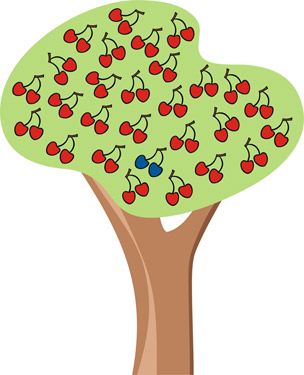
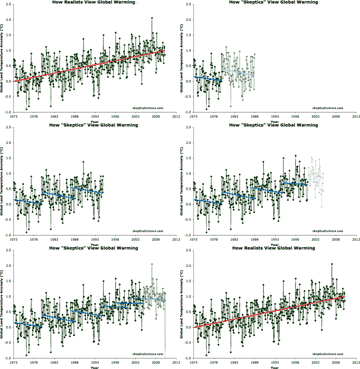
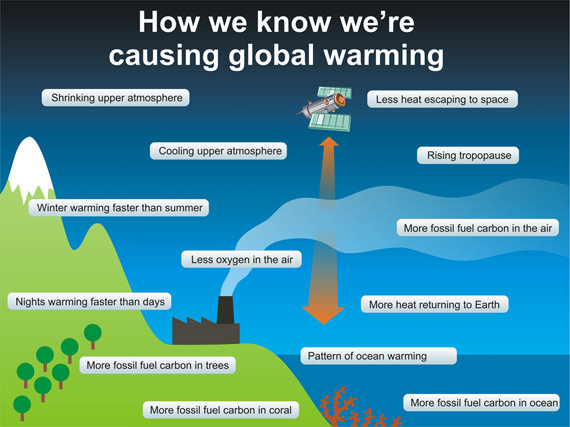
In this fourth video collaboration with Treehugger, we look at the favourite weapon of climate deniers - cherry picking. I've been quite enjoying how Treehugger have been creatively adding animation to my droning monologue and this video was no surprise as they cleverly combined our human fingerprints graphic with our cherry tree graphic. Cool stuff!
And as I never pass up the opportunity to repost my beloved infographics, here they are again:
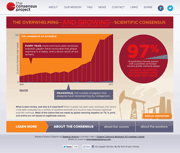
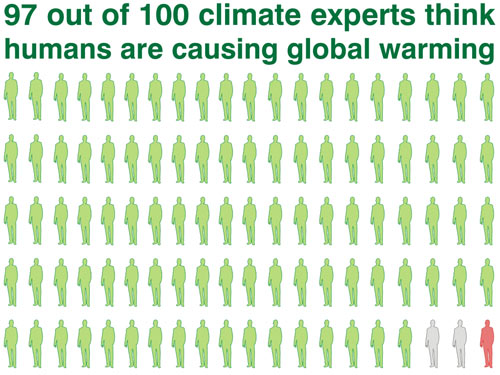
And lastly, they also used our scientific consensus infographic - but can the sharp eyed reader notice the difference between the infographic used in the video and this newly updated version? (bonus marks if you can explain the difference)
Arguments


Two percent might be pretty good compared to other measurements.
Perhaps we might be better served by saying that enough evidence has been found to leave 97 out of every 100 climate sceintists in no doubt that global warming is real and that human activities are the cause.
Perhaps someone else reading this can come up with a pithier version - thus more appealing to the general public.
The focus, at least to my way of thinking, should emphasize the vast amount of evidence from diverse sources which all leads consistantly to the same conclusion.
I'd hate to give that one remaining red guy on the graphic any kind of assistance in his misinformation campaign.
That's what scientific consensus is.
The problem is that people conflate scientific consensus with everyday consensus, which usually consists of a group having an informal chat about a topic, followed by someone (usually the boss!) proposing a course of action with nobody objecting.
Basically, the denier argument against consensus is based around a mistaken idea of what scientific consensus is, and what that consensus represents. Like many denier arguments, it's not based in reality.
I like the term "consensus of evidence" that is used here at SkS as well. It's far more convincing, as it takes the human element out of the picture.
The scientific side of the argument, rightly, adheres to constraints such as citing peer reviewed work and rules laid out in the comments policy used here. The other side does not.
One feels like one is using the Marquis de Queenbury rules while the opposition is free to go open slather.
Yes, the term "consensus of evidence" is good but the word "consensus" is too often used against us.
Another shortcoming is that it can even act as a rallying cry to the dissident minority. Consider this bogus statistic that I have made up, just for the sake of argument.
The effect that such an argument would have on me (I am convinced that carbon taxes are a realistic and even necessary public policy option) would be to say: To hell with them and their biased and smug opinions, that's what they used to say about civil rights! I'm going to call my representative right away!
In other words, appealing to scientific consensus is probably counter-productive when arguing with convinced climate contrarians.
The difference here is that politicians aren't experts in anything.
You need an analogy equivalent to the famed "4 out of 5 dentists recommend" marketing ploy.
It works, when the consensus is among experts who are trusted to know more than we do.
You can argue about people not trusting climate scientists (because of the very well sown seeds of doubt thanks to certain anti-science interests), but that's another story.
You will also find people wedded to denial, and certainly no argument works with them.
But for people on the fence, or wondering whom to believe, a statement about "climate experts" should carry weight.
I find this article interesting on trusting experts:
Experts and Global Warming
This graphic is targeting people who are still learning about climate change. In that I believe it is a very strong visual representation of the current state of climate science.
All analogies are flawed. I suppose I could argue that US politicians are experts on US politics because they got elected, but that would be beside the point. I was just trying to find an example to illustrate how people might react when they are presented with an argument from authority that they don't agree with.
I agree that such arguments can be useful to budge people who are sitting on the fence, but an argument like "most experts agree with me" can also make the fence seem higher for those on the other side. We should recognize that this is a non-technical argument to convince people to change their mind on a technical subject.
Nevertheless, it's probably good tactics, as Rob H suggested, to target the fence-sitters and write off the hard core deniers as a lost cause.
This is where the difference between the two sides lay. The denier side will deny in spite of overwhelming evidence. The AGW side believes because of the overwhelming evidence.
"Of these specialists [Climatologists who are actively publishing on climate change], 96.2% (76 of 79) answered “risen” to question 1 and 97.4% (75 of 77) answered yes to question 2 [Do you think human activity is a significant contributing factor in changing mean global temperatures?]."
You are continuing to reinforce my original point.
That is the fallacy to which I was referring.
Rob you are continuing to reinforce my point about some continuing to believe misinformation in the face of overwhelming evidence to the contrary. Cherry picking 97%, when only 82% of scientists answered yes, and changing the verbage from significant contributing factor to causing global warming are the major reasons that fence sitters move away from believing in global warming
On the other hand EtR, the graphic says "97% of climate experts", not "97% of scientists". That is an accurate statement.
Alternatively, if they are influenced away from belief in AGW by these supposed inaccuracies and cherry picking, but give the Deniers a free pass (as they must do to not be firmly in the AGW camp) then they were not fence sitter to begin with. They may not have firmly committed to accepting denier beliefs, but they have never been open to accepting the theory of AGW.
But having said that, I repudiate utterly your claim of misrepresentation and of cherry picking. If something is a significant factor and sufficient to cause warming, then it is a cause of warming. And there is no question that increased CO2 is sufficient given normal conditions (ie, the sun still shines) to increase temperatures. If would be a misrepresentation if the infographic claimed that 97% of climate experts think that humans are the only cause of global warming - but it does not.
Further, if you are sounding out expert opinion on climate change, what does it matter what petrologists or geologist in general think? What about their training and publication history makes them any more expert on climate science than, for example zoologists, or vetinary surgeons? If the question is, what do the experts think, then only the survey results pertaining to the genuine experts are relevant.
If we where to accept your claim of cherry picking here, then there is no logical basis of restricting the survey results to scientists, so that even the 82% would be cherry picking. Now you may be set against recognizing genuine expertise. You may think a theory heard by a random bloke in a pub is as good a priori as that expounded by people who have spent their lives gaining the intellectual tools, and rigourously applying them to the data. But I see no point in joining you in that delusional belief.
A cherry-pick is basically the expression of a double standard: the explicit judgement that some data points are 'better' than others. We all agree that's not right; nor is 'changing the verbage'.
But deniers cry foul over this nonsense without making a peep about '31000 scientists sign petition' (they are not all scientists) or '800 peer reviewed papers' (they are not all papers and certainly not all peer reviewed) or 'no warming since 1998' (that's just silly). Talk about a double standard!
Ya know 82% ain't so bad either. I remember a certain toothpaste company in the states claiming 4 out of 5 dentists recommending it to patients. That was a selling point!
But in this case that 82% is bound to be biased toward the negative side of the ledger. I know if someone asks me as a "scientist" about my opinion on a scientific subject I know nothing about, I'm going to err on the side of caution and say "Well...." I'm paid to be an ornery skeptic afterall! Of course, if the interviewer asked me to rate the weight of that opinion though, the skeptic in me would have to admit my opinion wouldn't mean much.
Now compare what happened in the Dolan paper with the OISM petition. People in my department actually received it in the mail, so I speak with some knowledge (I had to look up the OISM to figure out what the heck it was!). It came with a letter from an former president of the national academy of science (since repudiated for this action) and a paper formatted to look like it was published in a prestigious peer-reviewed journal (even though it wasn't) that used clearly bogus arguments to attack the idea of a human impact on climate change.
The OISM survey was deliberately misleading. John Cook is right, IMO, with his graphic. When a trap like that has been laid, the expertise of the people answering (or in this case signing) matters.
rpauli, I was responding to the last question in the article.
Two of the last three figures are a different colour from the third. My guess was that they represented undecideds.
What's the answer, J C?
The 97% represented a small fraction of the respondents who fell in a certain category. They are not necessarily "experts."
Now, 82% is very good, and should be presented as such. Why is there such a need to paint 97% as the value, when that was not the case?
Also, those 82% believe that mankind has been a significantly factor in rising temperatures. That does not translate to 82% believe all the predictions about catastrophic temperature rises. It includes people like me who see a similar rise this century as last based on "business as usual" scenarios. Remember, those 82% believe in a wide range of temperature changes and climatic effects.
If you want to convince people, use accurate and pertinent data to support your stance. Otherwise, you are viewed as a politcal activist, not a scientific source.
[DB] "That does not translate to 82% believe all the predictions about catastrophic temperature rises."
Strawman. What would lead someone to interject "catastrophic" into the discussion out of nowhere, which is what you have done? You are arguing ideology. Rhetoric fail.
If you want to convince people, use accurate and pertinent data to support your stance. Otherwise, you are viewed as a politcal activist, not a scientific source.
And you continue to evade Sphaerica's question on the other thread.
Eric, please. You are losing all remaining credibility by standing on this particular issue.
If you want to convince people in our world, tell the biggest lies you can get away with.
FauxNews proves this, as does the 'petition project,' '800 peer reviewed papers' (Not!) and so on. Search cherrypicking (or Goddard) for more examples.
That is perfectly consistent with the statement that "97 out of 100 climate experts think humans are causing global warming."
The 82% you refer to is the measure of "all respondents." It's a measure that is fairly meaningless because of the breakdowns of the various respondents.
And not only that, Anderegg 2010 came to essentially the exact same numbers using different methods. That suggests the results are robust.
Thank you all for the confirmations.
[DB] And thank you very much for the most excellent Alice in Wonderland impression on this thread. Most illuminating, the way you have ceded all semblence being an "honest broker" and have formally donned the mantle of denial.
I think we have this back to front (or maybe I do). As far as I can recall it was "skeptics" and those in denial who initially claimed that "there is no consensus". They made the argument-- something along the lines of "we do not know everything , therefore we know nothing". This essay by Oreskes in Science supports that, she notes:
"Policy-makers and the media, particularly in the United States, frequently assert that climate science is highly uncertain. Some have used this as an argument against adopting strong measures to reduce greenhouse gas emissions."
Confusion, uncertainty and delay are the tactics used by those in denial about AGW and "skeptics". And one way they do that is to make the strawman argument about "consensus", and then try pull the "science is not done by consensus" card when their strawman is addressed.
So that misguided belief (i.e., that there is no consensus, or that there is a raging debate that we are even increasing CO2, or that the "greenhouse effect" is even real) had to be addressed, and it has been, a few times now. The fact is that when you speak to experts in the field, and by "experts" I mean people who are active in climate research and disciplines related to the climate system, then, apart from a few mavericks/outliers (who are found in every scientific discipline-- some medical researchers still believe that HIV and AIDS are not related!) almost all of them agree that 1) CO2 levels in the atmosphere and oceans are increasing almost entirely b/c of human CO2 emissions and activities, 2) The "greenhouse effect" is real (a misnomer, but the experts know that) and that 3) We humans have thus very likely caused most of the warming.
Moreover, scientific societies and academies across the world agree with these statements. In fact, because of that we have not consensus but consilience.
The 'skeptics" trolling this thread are doing themselves no favours by doing the very things that John has pointed out in the series of videos.
This is not a high school debate. You need to raise the bar. You are the one being presented with volumes of evidence and facts and choosing to cherry pick which ones you believe or ignore to support your beliefs. True skeptics consider the body of evidence.
It can't be the "catastrophic" thing, because that wasn't even referenced in the question, AFAIK. To see that word there is to read into the question based on preexisting expectations.
It can't be the cherry-picking of expert opinion over uninformed opinion. That would make no sense, unless he subscribed to the "consensus as conspiracy" thesis.
This much I will say. The image is compelling - and therefore threatening to those who are committed to denying the existence of the overwhelming agreement among active climate scientists. That agreement is real.
We should be talking about what we do in light of it's existence, not whether it exists.
"We should be talking about what we do in light of it's existence, not whether it exists."
Exactly Stephen. However, "skeptics" and those in denial about AGW refuse to accept the evidence so that they do not have to take action, changing their ways frightens them. They also appear to be scared that by accepting the evidence they will be on a slippery slope, so best to dig their heels in early. That is probably one of the reasons why you rarely see "skeptics" and those in denial concede making errors or bothering to correct them.
Rob @32,
Yes, the psychology of denial and fake skepticism is fascinating and something I was naive about until two years ago.
DB @27,
"you [EtR] have ceded all semblence being an "honest broker" and have formally donned the mantle of denial"
Is it not interesting that for the longest time s/he was trying to come across as a "skeptic", not a real one mind you, but at least not someone in denial. Well, don't I feel deceived/cheated.
My complaint is that those who call "deniers" and those whom the deniers call "alarmists" refuse to budge from their established positions. I have heard some claim that they will shift positions, if evidence is presented to verify that change. Well evidence has been presented, but it is claimed to be bogus based an any number of criteria.
To top it off, there are those who call anyone who is not in their own camp (denier or alarmist), as being a member of the opposite extreme, when their views in no way mirror that faction. I did not believe this until recently.
[DB] I am more than willing to consider any evidence that can be a silver bullet that overcomes AGW. Indeed, that's one of the main reasons I continue in my involvement here.
Could you please enlighten this one as to which evidence you have presented?
Please note, said evidence should be able to be reproducible, survive peer-review and be internally & externally consistent with the physics of our world.
Look forward to it.
And you really can't see that to many of us this sentence describes YOU more than any other respondent above? You've been presented with evidence. You have ignored or dismissed it.
I guess it all comes down to what one considers 'evidence'. Your objections about 'causing' vs 'significant contributing factor' and 'climate scientists' vs 'climate experts' as the very pinnacle of ridiculous semantic shenanigans over trivia having nothing to do with the scientific realities. You seem to think they are vitally important and revealing and dismiss all objections to the contrary.
That's rich.