




So, you think that learning about climate change needs to be tedious?
Posted on 9 February 2011 by BaerbelW
Actually, that isn’t necessarily so if the information is gift-wrapped or disguised as a fun but not trivial climate-quiz! In the course of working as a voluntary zoo-docent, I have helped to put together several quizzes to pique visitors’ interest about specific topics like tigers, rhinos, the rainforests or right now apes. All of these quizzes contain general questions about the animals and areas but don’t shirk away from the hard themes like the dire straits these species and regions are in. Questions which come with striking visuals or comparisons work best to get people thinking. We’ve been using the quizzes as one element of various materials – some of it “hands-on” – on our touch-tables. If the visitors are interested to learn more, some of the questions and answers can then be explained in more detail.
As I was preparing to give a talk about climate change last year, I started to put together a climate-quiz which can simply be printed out, put into a file-folder and put on a desk for people to leaf through on their own. A "quiz-master" can also be at hand to give some assistance or to provide additional explanations to go with the answers. In addition, the quiz can also be used at the start of an otherwise perhaps dry lecture about climate change, or some of the questions and answers can be scattered throughout the presentation to engage the audience (or to keep them alert!).
Here is an example:
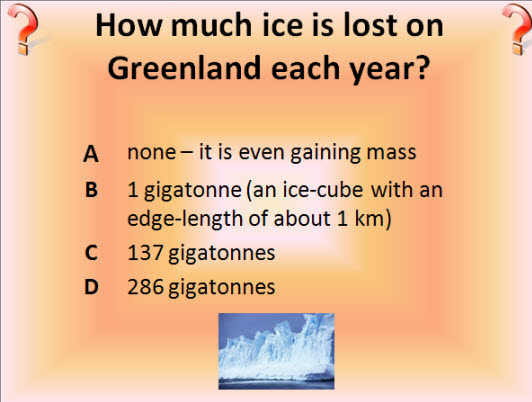
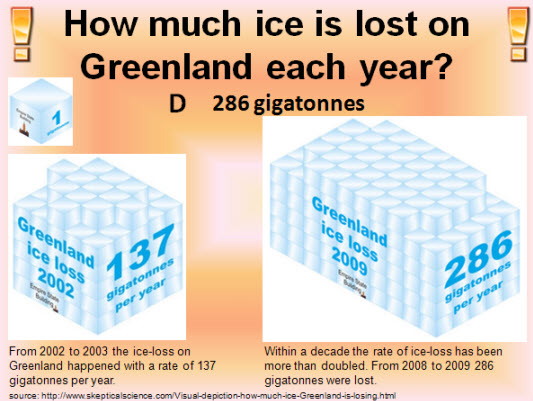
The complete quiz is currently available for download as either a PDF-file or as a Powerpoint-version. The latter allows adding suitable animations for online-presentations or creating a “run-it-yourself” interactive version where clicking on the correct answer jumps to the next slide and clicking on a wrong answer just gives a beep. There are other options as well: each slide can be created as a graphics-file (eg. jpg or gif) and these pictures can then be uploaded into an online photo-album – the only caveat for this version is, that there needs to be an option to view the pictures large enough to actually read the text (Note: Kodakgallery lets you switch to "full screen" via a link at the bottom of the screen)!
That's Baerbel's beautiful, visitor-friendly quiz. For a quiz overlapping Baerbel's but with a lower-tech presentation, Anna Haynes has posted the questions on the Warming101 blog and the quiz is also available as two sets of flash cards: one with multiple choice answers and the other with open answers. All the answers come with links to further information.
These quizzes have another purpose: they can help us learn whether Dunning&Kruger's most encouraging finding - that given feedback, even those students who didn't know that they didn't know, could improve - holds true in the realm of climate awareness.
Suggestions? How should we accumulate further quiz questions? What's a good format to store & display them?
Updated February 11: Thanks for all the feedback! The links to the downloads now lead to new versions of the files where suggestions from the comments have been included. A "bonus question" has also been added.

Arguments


I think an online form of the quiz would be fun, and not too hard to code.
Baerbel's is much more beautiful, with the images...
And Yulsman's What are you looking at? "mystery image"
Also, and this is just my feeling, but I think the 350 question is kind of subjective for a quiz to teach people the facts (that isn't to say it's not correct), and also given the following question may give people the impression that the damage is already done and there's not much point in trying to fix it now.
What percentage of its ice was lost by Greenland last year?
A) 5%
B) 1%
C) 0.1%
D) 0.01%
Answer: 286 Gigatonne or 0.01% of ice was lost by Greenland last year.
_____________________
http://en.wikipedia.org/wiki/Greenland_ice_sheet
Total Greenland ice (ice sheet plus glaciers)
~= 2.85 megagigatonnes (2.85 E15 tonnes)
2.86 E9 / 2.85 E15 ~= 0.01%
If all ice melt was considered to be land based ice, consequent sealevel rise would have been about 0.7 mm.
Not a trivial amount in absolute terms. IF melting from this source continued at this rate for 100 years it would cause about 70mm (almost 3 inches) sea level rise.
SME
Thanks for your feedback (and finding yet another typo!). I'll collect suggestions and will then re-upload the modified files. The quiz originated in connection with a 350.org activity which is why I included a question about 350 ppm. The individual questions are not numbered so any print-outs can obviously select suitable questions and/or re-arrange them as needed.
@Daniel Bailey
Thanks for the pointer about Greenland ice in 2010! A general "problem" with questions like the one about the Greenland ice is that they are moving targets. Ideally, these types of questions should be updated whenever new data (plus the corresponding graphics!) become available.
Thanks to Real Climate and Sceptic Science. :)
It would be nice to include the Skeptical Science URL in it too
One point. From the graph 2010 seems to start at -700 and end at -1150, that's more like 450 Gigatons. I think what you mean is that 600 Gigatons was lost during the melt season, some weight was put on either side of this period.
I would change the volcanoes question to: How much more CO2 is due to human activity than volcanoes? I find your wording hard to read.
I would change the sea level rise question to emphasize the cost more. $25,000 billion doesn't mean much to me. Perhaps 25-28 Trillion dollars would work. The cost is so phenominal that it is difficult to convey properly.
Slide 11 says "on save side" when I think what was meant was "on the safe side" (unless "save side" is some sort of weird Aussie colloquialism).
Slide 13 explains how CO2 drops in spring/summer, but not how it rises so precipitously again in the fall/winter. I think the gap will lead the ignorant to believe that plant CO2 uptake is a mitigating factor (contrary to the clear evidence of the graph).
Slide 24... I agree with Michael Sweet. The wording of the question is confusing, and hence the answers are ambiguous. Then unless one looks closely at the words on the answer slide, one can assume that "10 times as much" means that volcanic is 10 times human, rather than vice versa.
You might also add a slight emphasizing the actual cost of doing something about it... that economist compute it as 1% of GDP, with worst case ("alarmist") levels of 3% of GDP.
An even more interesting question is how much heat it would take to melt a proportion of the ice (say 0.01%) compared to the world-wide solar radiation over the course of a year...
@Sphaerica
"save side" on slide 11 was just me not finding another typo (thanks for spotting it)
Slide 13 - I'm going to reword the explanation for an updated version of the quiz to make this clearer
Slide 24 - I changed the question to Michael Sweet's suggestion (this was somewhat "lost in translation" as I had first created the quiz in German)
@Michael Sweet
Sea level rise question: I used the numbers as they were shown in the WWF/Allianz-report (I didn't want to get caught in the differences between German and British/US billions)
@Phil
Sorry about the double-sided printing issue - I can add one more slide as page #2 so that this works better. Thanks for your suggestion to add a link to SkepticalScience - I changed the last slide to do just that.
@SME and Peter Offenhartz
I see your points about using percentages. On the other hand, they aren't quite as visually intruiging as the graphics of the icecubes currently included. Also, as 0.01% is a very small number it would most likely just cause a reaction of "so what?" which in the case of the Greenland icesheet isn't really warranted.
I'll wait until tomorrow in case more suggestions show up in the comments and will then upload modified versions of the PDF- and PPT-files.
I think the main issue with the sea level problem is that the problem is so huge it is difficult to summarize. I cannot think of anything that really describes the problem well. Your choice is good. Millions, billions, trillions eventually it adds up to real money.