



 Arguments







The Climate Show Episode 9: Nuclear power and hot spots
Posted on 20 March 2011 by John Cook
The Climate Show have released Episode 9 which looks at mass loss from the Greenland and Antarctic ice sheets, a record ozone hole over the Arctic and reviews last winter's climate numbers. In light of the tragic events in Japan, their special guest is Professor Barry Brook from the University of Adelaide, who examines the prospects for the future of nuclear energy.
Legendary chemist/physicist and Nobel prize winner Ernst Rutherford is said to have uttered one of my favourite quotes about science communication:
"If you can't explain your physics to a barmaid it is probably not very good physics."
With that principle in mind, I was determined in this week's episode to clearly explain the misconceptions about the tropospheric hot spot. The heart of the hotspot myth lies in misunderstanding what causes temperature to warm faster in the upper troposphere compared to the surface. Basically, it's due to changes in the lapse rate (which is how quickly temperatures cool at higher altitudes). To help explain this, I whipped up a simple schematic, demonstrating how global warming changes the lapse rate:
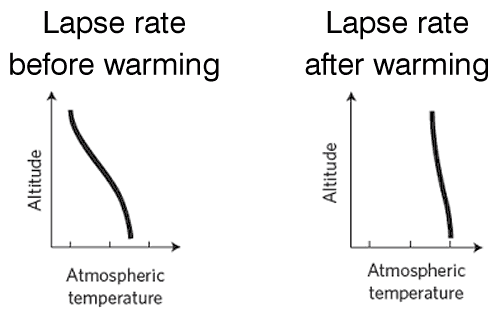
But after all that, Gareth (who must be far more effective with barmaids than I am) paraphrased my convoluted explanation in a single sentence explaining what caused the hot spot more clearly and intuitively than my attempt. Hmm. Did I mention Rutherford was from New Zealand?
Anyway, I've embedded the YouTube of the Climate Show below. And let me encourage anyone with a blog or website to embed the YouTube on your own websites, so your readers can tap into the rich source of climate news, interviews and stuttering explanations from a Brisbane blogger.









#8 Rob, Look at the graphic above. That is from the RAOB, UAH and RSS measurements. That is not the absence of evidence. It is evidence of no hot spot. The models pre-dict it. The observations contr-dict it. That is all.
[DB] Rob was kind enough to point you in the right direction:
http://www.skepticalscience.com/Dispelling-two-myths-about-the-tropospheric-hot-spot.html
Please demonstrate good faith and do so. Thanks!