





Climate cherry pickers: Falling humidity
Posted on 21 October 2010 by John Cook
Scientific skepticism requires we consider the full body of evidence before coming to conclusions. The antithesis of genuine skepticism is ignoring all the evidence that contradicts a desired conclusion. I witnessed such cherry picking on Australian television this week (the ABC's Q&A program) when Jennifer Marohasy emphatically stated that humidity was falling. To come to such a conclusion, one needs to rely on a single outlier paper where its own author cautions about the uncertainty in their result. On top of that, you need to disregard other independent lines of evidence, the theoretical understanding of positive feedback and a number of other reanalyses of humidity.
But first, a little background info is in order. Water vapor provides the most powerful feedback in the climate system. When surface temperature warms, this leads to an increase in atmospheric humidity. Because water vapor is a greenhouse gas, the increase in humidity causes additional warming. This positive feedback has the capacity to double the initial surface warming. So when temperatures rise, we expect humidity to also increase. However, one study using weather balloon measurements found decreasing humidity (Paltridge et al 2009). To get to the truth of the matter, the full body of evidence regarding humidity is perused in a new paper Trends in tropospheric humidity from reanalysis systems (Dessler & Davis 2010) (h/t to @AGWobserver who tweeted the full paper).
To give an overview of humidity trends, Dessler and David compare the results from Paltridge's 2009 paper to a number of other reanalyses of humidity. Figure 1 shows the trend in specific humidity from 1973 to 2007 over the tropics. The Paltridge reanalysis (thick black line) shows considerable divergence in the upper troposphere, with a strong negative trend while the other reanalyses all give consistent results, both with each other and theoretical expectations.
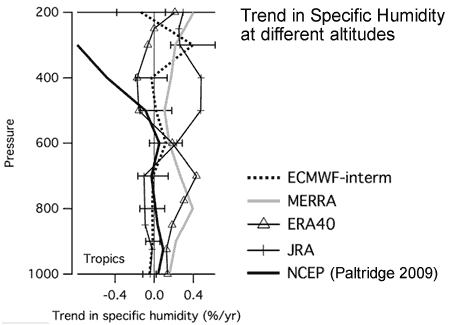
Figure 1: Various reanalyses showing the trend in specific humidity from 1973 to 2007 in the tropics (Dessler 2010 also looks at the Northern and Southern extra-tropics - only the tropic data is shown here for simplicity and as it shows the greatest contrast between Paltridge 2009 and the other reanalyses).
To gain more insight into the nature of the observed water vapor feedback, Dessler and Davis examine the relationship between humidity and surface temperature. They plot specific humidity directly against surface temperature - this gives a measure of the amount of water vapor feedback. They compare the short-term trend in water vapor feedback (under 10 years) to the long-term trend (greater than 10 years) for the 5 different reanalyses:
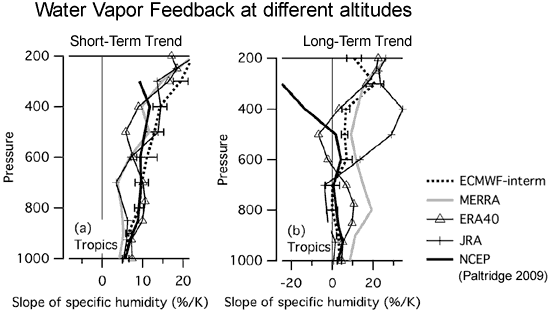
Figure 2: Short-term (a) and Long-term (b) plots of the slopes of the regression between specific humidity and surface temperature, in the tropics. Trends are divided by the average specific humidity over the entire time period, so they are expressed in percent per degree K.
For the short-term trends, all five reanalyses produce consistent results, with surface warming associated with increasing humidity (eg - positive water vapor feedback). However, there is poorer agreement in the long-term trends. The Paltridge 2009 reanalysis is a distinct outlier, with long-term and short-term trends going in opposite directions, unlike the results from the other studies.
This leads to an interesting question: could water vapor feedback be opposite over short and long-term time scales? There is no theory that can explain how short-term feedback could be positive while long-term feedback is negative. The water vapor response to a climate fluctuation with a time scale of a few years (e.g., ENSO) should be about the same as for long-term warming.
Long-term positive feedback is confirmed by several independent sources. An analysis of long-term measurements of upper tropospheric water vapor shows a positive water vapor feedback in 22 years of satellite data (Soden et al 2005). In addition, analysis of long-term paleoclimate records is also inconsistent with a negative long-term water vapor feedback (Köhler et al 2010).
So why does Paltridge 2009 show decreasing humidity? The authors of Paltridge 2009 themselves point out the well-documented problems with radiosonde humidity observations in the upper troposphere. Comparisons of Paltridge 2009 with satellite measurements (NASA’s Atmospheric Infrared Sounder - AIRS) find the Paltridge 2009 reanalysis has large biases in specific humidity in the tropical upper troposphere. Additionally, Paltridge 2009 doesn't show any large increase in specific humidity during the 1998 El Niño. Direct measurements indicate the tropical atmosphere does indeed moisten during El Niño events and such moistening is seen in the other reanalyses.
Two of the newer reanalyses shown in the figures above, MERRA and ECMWF-Interim, correct for well documented biases introduced by changes in the observing system. These newer reanalyses are in better agreement with theory, other reanalyses and independent observations.
To claim that humidity is decreasing requires you ignore a multitude of independent reanalyses, including newer ones with improved algorithms, that all show increasing humidity. It requires you accept a flawed reanalysis that even its own authors express caution about. It fails to explain how we can have short-term positive feedback and long-term negative feedback (indeed there is no known mechanism that can explain it). In short, to insist that humidity is decreasing is to neglect the full body of evidence.

Arguments


This paper details the calculations and the various inputs that are involved
BUREAU OF METEOROLOGY REFERENCE
EVAPOTRANSPIRATION CALCULATIONS
On Earth, water vapor is basically never seen acting as a forcing.
(Not that anything really defeats the paleo evidence for a sensitivity around 3, so any discovery of previously overlooked feedbacks is like showing your work when the answer is known.)
The solar radiation that is not absorbed at the skin, but progressively at further depths then goes on to manifest itself, and be measured, in different ways.
I feel that is not conveying a sense of the correct drivers that are most relevant to how water vapour enters the atmosphere in the first place. There is a need to be sure that the foundations any discussion is built upon are fully understood and solid.
The skin temperature of the ocean (where the vast majority of evaporation on earth happens) is largely a function of mixed water column temperature as a whole, which reflects the balance between inputs (solar radiation, incoming IR radiation) and outputs (outgoing IR radiation, evaporation, convection, mixing)of heat energy. As the earth's temperature increases that heat balance results in higher mixed layer temps, which leads to high skin temps and greater evaporation.
I also want to agree with Ned. This discussion of insolation and skin temperatures is a distraction. All other things being equal (insolation included), evaporation and water vapor should increase if the earth and atmosphere warm.
http://journals.ametsoc.org/doi/abs/10.1175/2010JCLI3816.1
(I haven't found full text, sorry.) Their conclusion:
"The DPD adjustment yields a different pattern of change in humidity parameters compared to the apparent trends from the raw data. The adjusted estimates show an increase in tropospheric water vapor globally."
I caught that Q and A show earlier in the week, too, and was surprised by Marohasy's statement about humidity - it appeared Tim Flannery was too, although it was almost amusing to watch him twitch at some of the more outrageous statements she was making. He displayed admirable restraint, though - keeping it polite even when giving her a dressing down for interrupting! I note she also quoted Roy Spencer, but more than a few of her talking points might have been easily rebutted by a reference to this website...
Spencer and Braswell, however, did not say that in their article. They said that they had found a short term climate sensitivity that seemed to be around 0.6 degrees C. What "short term" means in this subject I'm not sure, but I believe they were talking about days or weeks. At least it seemed like that when I looked at their data. Spencer and Braswell pointed out on several occasions in their article that they had no intention of pointing out what the long term climate sensitivity would be, but that was just what our cherry picking professors emeriti did. They drew a conclusion from one single article, ignoring all the rest, despite the fact that the writers of the article themselves pointed out that this conclusion could not be drawn from their results.
Maybe I should have written this in the "climate sensitivity is low" argument instead, but i thought the cherry picking was too similar. I just had to tell it here.
Forcings by definition are changes not derived from the climate system. Feedbacks by definition are changes derived from the climate system. CO2 increase today is not due to climate, but burning carbon, hence is a forcing. The average increase in water comes about from the changed climate.
It seems evident, that the earths temperature anomalies match quite a bit with the tropospheric humidity. This correlation also includes the flattening on the GW trend during the last decade. No net warming since 1998 and also no net humidity increase since 1998. Which is the cause and which is the effect?
Also one crucial point about water wapur feedback is the increase in the upper troposphere. Some evidence sugggest, that there is no increase. Also according to the latest McKitrick et al and Christy et al, no tropospheric hotspot is also to be found, on any of the datasets.
You also point out, that humidity increases during El Nino events. It also means, during La ninas it will decrease. And according to history, the next 30 years or so will be the times of La Nina. That could also mean decreasing in humidity for the same period.
The most critical question is... where do trade winds come from. As far as I understand, clouds drive them through condensation (models do not take in accoutn the pressure loss through condensation, this was pointed out by Jeff Id lately), and solar activity with planetary rotating parameters is driving the clouds. If you just compare the detrended global thermometer data and compare it to PDO and AMO indexes you will see that all of the 30 year variation must be driven by those events. This also suggest cooling for the next 30 years (and 30yrs of warming after that), thus a total of 1C increase temperatures for the next 90 years.
On the point of confusion, a forcing is a mechanism that can exert change. It does not cease being a forcing agent because at some point in time it has a value of zero.
What perhaps does confuse the issue is that the values that are subscribed to the various forcings are anomalies, with the base year I believe being 1750.
This is all very well in the case of CO2, but I feel, given the poor understanding of the state of the climate at that time and the relatively inadequate measurements of all the other factors driving it, anomalies may not allow the weight of each forcing mechanism to be fully appreciated when being worked into models.
Would it not be better if absolute values were to be used instead?
This is so vague (confused) as to not even be wrong. Forcing in climate is something that changes the level of radiation energy on average. That is why they are expressed in Watts per square meter. Something vague like "change" could be the difference between day and night, windy or not windy, as you specifically mention as being important. That is just weather, so your point is irrelevant without any consideration of whether these important factors change on average, which would be climate changes.
This article is only about climate observations (total amount of water in the air, which influences radiation at the surface), not an explanation of the basics of evaporation as a weather phenomenon.
Until you realize climate changes are changes in average weather, not changes in weather, you will remain confused.
In any case the existence of the water vapor feedback is not related to whether sun or GHGs are driving the temperature change. If the sun were causing the current warming, there should still be a water vapor feedback for that warming, just like there is for warming induced by icreases in GHGs. If there were no water vapor feedback, the climate system much more insensitive as a whole than it apparently is. It would be very hard to explain past climate variations, including those that have been caused by changes in solar radiation.
As for the ocean discussion, we can quibble about how deep the skin is (I think of it as much thinner than a millimeter) and what consitutes a fraction that is large (13% still seems low to me). But there are several points your graphs bring up. First, whereas on land all the visible light waverlengths would be absorbed/reflected near the surface, visible light penetrates pretty deeply into the water column. That's the point I was trying to make about the difference between the ocean and land. Second, most of the solar radiation absorbed near the ocean surface is in the infrared range. If you were to extend that x-axis out, you'd find that the contribution of downwelling thermal IR to the near surface radiation budget is actually larger than that of downwelling solar IR. That downwelling thermal IR is of course a function of air temperature not solar radiation. Finally, the point of where the radiation is absorbed is moot in the ocean because that heat gets dispersed through the water column pretty quickly, as evidenced by the fact that you don't see strong persistent gradients in temperature near the surface.
Sometimes this forum makes me feel like I'm reliving my prelims all over again!
Basically the discussion boils down to this, so to speak. You should get more water vapor as earth's temperature warms. If that didn't happen, it would be really really interesting scientifically - a potential Nature or Science paper and fame for anyone who could prove it.
However, the strength of the physics behind the expectation, the fact that most data collected to date clearly shows a response of water vapor to atmospheric temperatures, and the difficulty in accomodating for past climate change in the absence of such a relationship suggests we should look at countervailing evidence with a very critical eye, especially when we know how easy it is to misinterpretation radiosonde data.
Both Paltridge et al. and Dessler and Davis made use of "reanalysis" data sets. Simply speaking, a reanalysis is an attempt to incorporate historical meteorological observations into a weather forecast model to produce a physically consistent data set describing the actual atmosphere. There are several multi-decadal reanalyses of the atmosphere, and NCEP/NCAR is the earliest achievement among them.
Concerning humidity, NCEP/NCAR Reanalysis gave large weights on observations by radiosondes (baloons equipped with sensors and radio wave transmitters) conducted routinely by meteorological services of many countries. Later reanalyses put more weight on records retrieved from satellite observations.
Radiosonde observations are valuable sources of information about climate change, especially because we can go back with them before the start of satellite observations. We must be careful to discuss trends based on them, however.
Specific humidity (concentration of water vapor in the air) has order-of-magnitude difference between lower and upper parts in the troposphere. A radiosonde usually conducts observations while rising from the moister lower part to the drier upper part. Some sensors had long response time, or had difficulty in keeping accuracy at low humidity after having observed high humidity. Changes of sensors are likely to be improvements from longer response time to shorter one, likely to cause apparent decrease of humidity in the upper troposphere.
In addition, sensors receive solar radiation in daytime and have temperature considerably different from that of the surrounding air. This difference causes a bias in records of humidity. It is a difficult issue to account for the bias, because it is dependent on many factors, such as darkness of the equipment, mechanism of the sensor, choice of expression for initial recording of humidity information, and attempt to compensate for the bias before official reporting.
Teams that produce reanalyses, such as those of European Centre for Medium-Range Weather Forecasts (ECMWF) and of Japan Meteorological Agency (JMA), try to find and to correct biases of radiosonde observations which they incorporate. They cannot achieve perfection, but they achive gradual improvements.
Readers might want to view a video of Andrew Dessler addressing the humidity issue & climate sensitivity at Deltoid
How do you get water vapour to change without something else (eg temperature rise) first causing it? The cause of the temperature rise is the forcing not the water vapour.
I was reading in Mark Bowen's book Censoring Science about the Vostok ice core. It says,
"Methane, like carbon dioxide, rose and fell with temperature, whereas dust tended to go the other way. This made sense, as methane and carbon dioxide levels fell and the air cooled, it would have lost water vapor through feedback and become drier and more dusty."
Yet, I also recall reading in a US Army Southwest Asia (Middle East) manual that as the temperature increases in summer the soil dries. Without water to hold it down dust goes into the air. So in that case warmer air is dustier.
How can we be sure that increased levels of dust in layers of an ice core indicate lower humidity?





