





Subscribe in a reader


Username
Password
Keep me logged in
New? Register here


It's the sun
Climate's changed before
There is no consensus
Surface temp is unreliable
Models are unreliable
It's cooling
Ice age predicted in the 70's
Al Gore got it wrong
CO2 lags temperature
We're heading into an ice age
View All Arguments...


Latest Posts


Saturday, 20 October, 2007

Did global warming cause Hurricane Katrina?

One of the criticisms directed towards Al Gore's An Inconvenient Truth is that he claims Hurricane Katrina was caused by global warming. Gore never actually says this and it's useful to look at his exact words as it brings up two broader questions - does global warming cause more frequent hurricanes and does it cause more intense hurricanes?

Does global warming affect hurricane frequency?

In July 2007, Greg Holland of the National Center for Atmospheric Research and Peter Webster of Georgia Tech published a paper Heightened Tropical Cyclone Activity in the North Atlantic: Natural Variability or Climate Trend? They note an increase in the number of observed hurricanes in the North Atlantic over the past century, concluding "increasing cyclone numbers has lead to a distinct trend in the number of major hurricanes and one that is clearly associated with greenhouse warming".

However, this was refuted by Chris Landsea's Counting Atlantic Tropical Cyclones Back to 1900 stating "improved monitoring in recent years is responsible for most, if not all, of the observed trend in increasing frequency of tropical cyclones". In other words, the reason we're recording more hurricanes is due to our improved ability to observe them thanks to aircraft, radar and satellites.

In addition, a 2007 paper by Gabe Vecchi, Increased tropical Atlantic wind shear in model projections of global warming looked at the results of 18 climate models and concluded increased wind shear from rising sea surface temperatures make it more difficult for hurricanes to form and grow. So at this stage, the jury is still out on whether global warming causes more frequent hurricanes.

Does global warming affect hurricane intensity?

Kerry Emanuel wrote the definitive paper on hurricane intensity Increasing destructiveness of tropical cyclones over the past 30 years. Emanuel found a close correlation between hurricane intensity and sea surface temperature. He also suggests wind shear has much less effect on hurricane intensity than increased sea temperatures. This is confirmed by the observed data:
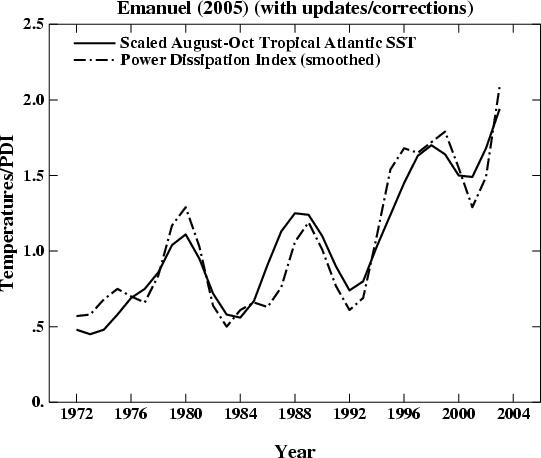
So the empirical evidence linking global warming and hurricane intensity is robust.

What Al Gore said about hurricanes

Here are Gore's words according to a transcript of An Inconvenient Truth by Greg Hoke:

Now I'm going to show you, recently released, the actual ocean temperature. Of course when the oceans get warmer, that causes stronger storms. We have seen in the last couple of years, a lot of big hurricanes. Hurricanes Jean, Francis and Ivan were among them. In the same year we had that string of big hurricanes; we also set an all time record for tornadoes in the United States. Japan again didn't get as much attention in our news media, but they set an all time record for typhoons. The previous record was seven. Here are all ten of the ones they had in 2004.

The science textbooks that have to be re-written because they say it is impossible to have a hurricane in the South Atlantic. It was the same year that the first one that ever hit Brazil. The summer of 2005 is one for the books. The first one was Emily that socked into Yucatan. Then Hurricane Dennis came along and it did a lot of damage, including to the oil industry. This is the largest oil platform in the world after Dennis went through. This one was driven into the bridge at Mobile.

And then of course came Katrina. It is worth remembering that when it hit Florida it was a Category 1, but it killed a lot of people and caused billions of dollars worth of damage. And then, what happened? Before it hit New Orleans, it went over warmer water. As the water temperature increases, the wind velocity increases and the moisture content increases. And you'll see Hurricane Katrina form over Florida. And then as it comes into the Gulf over warm water it becomes stronger and stronger and stronger. Look at that Hurricane's eye. And of course the consequences were so horrendous; there are no words to describe it.

How in god's name could that happen here? There had been warnings that hurricanes would get stronger. There were warnings that this hurricane, days before it hit, would breach the levies and cause the kind of damage that it ultimately did cause. And one question that we, as a people, need to decide is how we react when we hear warnings from the leading scientists in the world.

While not explicitly claiming a connection between hurricane frequency and global warming, Gore does allude to hurricane formation & numbers which gains him some demerit points. However, the general thrust of Al Gore's words are correct in that warmer water causes stronger hurricanes. He clearly doesn't say that Hurricane Katrina was caused by global warming but that warmer waters intensified it. All in all, he scores a pass mark with the way he handles hurricanes with a few marks off for not being clearer on hurricane frequency.

Posted by John Cook at 18:42 PM

Comments

  1. No Al Gore does not get a pass on Hurricane Katrina. He clearly implies in his book and never once qualifies it that Katrina was caused by global warming. Katrina was a Category THREE -- count it -- Three hurricane when it hit New Orleans.
    This is far less intense than many of the worst hurricanes that the Gulf has historically produced. It also hit a city that was an accident waiting to happen: the result of decades of poor infrastructure maintenance and bad urban planning. Those who suffered the most in New Orleans -- poor people of color --deserve better than to have a group of elite white men prey upon their suffering to further their own agenda.
    The scientist who argues that we are currently seeing more intense hurricanes due to global warming, Kerry Emanuel, also wrote: "it would be absurd to attribute Katrina to global warming." The storm wasn't what caused the disaster, but I imagine that FEMA, the city mayor, and La's governor are all thrilled to be exonnerated by you.
    Where on earth is the liberal conscience here. What Al Gore wrote in the book where Katrina is concerned (which I understand captures almost word for word the film) is propaganda pure and simple. This does nothing for the cause of global warming, and the people of New Orleans deserve better.
  2. Wondering Aloud at 03:00 AM on 16 November 2007
    Your post here should probably just say "No the global warming fanatics lied" There really isn't any other believable answer. At the time of Katrina (and today) the theory clearly predicts a decrease in the frequency and intensity of these types of storms.

    The fact is we have been inundated with claims that GW caused Katrina and these type events woould increase because of mans reckless disregard of SCIENCE and now they are stuck, 2006 and 2007 were far below average for hurricanes.

    How often does someone have to lie to you for political gain before you start saying "hmm... maybe I shouldn't believe them anymore"?
    [ Response: Statements such as "Katrina was caused by GW" or "GW causes more hurricanes" are on shaky ground. There is stronger empirical evidence that GW causes more intense hurricanes. But if you know of any papers that predict hurricane intensity decreases with increasing temperatures, please post any relevant links. ]
  3. Wondering Aloud at 08:56 AM on 20 November 2007
    Well you could start here... Though there are many others. What many of them say is that warming has not increased intensity or frequency.

    Free, M., Bister, M. and Emanuel, K. 2004. Potential intensity of tropical cyclones: Comparison of results from radiosonde and reanalysis data. Journal of Climate 17: 1722-1727.

    However since CO2 is supposed to produce warming primarily in cold dry air, the models I am familiar with predict that the poles should see the most significant warming. As temperature differential between the tropics and the poles is a major driving force of cyclonic storms a decrease in the differential should lead to a decrease in storm intensity. Prior to Katrina the relatively low number of major hurricanes in recent years had been seen as evidence that the models were right. I have looked at a number of papers and while 15-20 years ago I would have said warming should increase system energy and therefore intensity, I think I was wrong back then. It seems pretty clear that frequency and intensity have not increased in the last 70 years, if GW theory predicts they should this would in fact be strong evidence against it.
    [ Response: Thanks for the link - interesting that the 2004 paper is co-authored by K Emanuel who wrote the 2005 paper that is the primary evidence linking greater SST to hurricane intensity. There's more to this, I'll see what I can track down. ]
  4. Wondering Aloud at 00:38 AM on 21 November 2007
    Cool, I misssed that completely that is hilarious, could be a classic example of bandwagon jumping.
  5. Philippe Chantreau at 06:39 AM on 1 January 2008
    Bandwagon jumping? It suggests that there is dishonesty and pursuit of personal goals. Surely that happens sometimes. However, if we are to systematically assume that, it's going to be impossible for scientits to change their views of any subject in light of new evidence or better understanding, which is exactly what science is all about. Advocates on both sides hype and distort what the science says. Scientists try to figure out what really happens, and advocates are starting to make this a real hassle.

    Furthermore, there is no incompatibility between GW having no effect on the frequency of storms, yet leading to higher proportion of high intensisty storms and faster intensifying of storms. Why would Emmanuel contradict himself in any way by having both of these views?
  6. Wondering Aloud at 03:20 AM on 8 January 2008
    Ok I can live with that Phillippe, However, since there is no convincing evidence for increasing or for that matter decreasing frequency or intensity in tropical storms, the point is probably mute.
  7. Philippe Chantreau at 10:06 AM on 15 January 2008
    You can put it this way. However, there is clear evidence that storms reaching areas of very warm water (such as the Gulf of Mexico) are more likely to increase in intensity and that increase has shown to be very fast (fastest ever witnessed) in 07. That much is known. These are weather events and their significance as they relate to climate is far from clear.
  8. Wondering Aloud at 01:28 AM on 25 March 2008
    It appears that yesterday we had a cycle 23 sunspot.

    http://sohowww.nascom.nasa.gov/data/realtime/mdi_igr/512/
  9. The mere fact that he devotes a portion of his slideshow/movie to hurricanes would imply that he wants his audience to believe that GW and an increase in hurricane frequency/intensity go hand-in-hand. He gets no free pass for any aspect of that.

Post a Comment

Foul language, trolling, personal attacks or non-relevant links will be deleted.

You need to be logged in to post a comment. Login via the left margin or if you're new, register here.

© John Cook 2008





