





Subscribe in a reader


Username
Password
Keep me logged in
New? Register here


It's the sun
Climate's changed before
There is no consensus
Surface temp is unreliable
Models are unreliable
It's cooling
Ice age predicted in the 70's
Al Gore got it wrong
We're heading into an ice age
CO2 lags temperature
View All Arguments...


Latest Posts


Sunday, 27 April, 2008

Did global warming stop in 1998?

The argument that global warming stopped in 1998 is making a comeback, riding on the coat-tails of global cooling since January 2007. Last year, a paper in the Bulletin of the Australian Meteorological and Oceanographic Society examined this argument. Now the author Robert Fawcett has co-published an updated version of the paper with fellow scientist David Jones at the Australian Bureau of Meteorology. It takes a similar approach to my original treatment of the subject, although in a more rigorous, peer-reviewed fashion.

Using moving averages to discern the long term trend

As we've discussed before, temperature data shows year-to-year variations independent of long term warming or cooling trends. Volcanoes cause temporary cooling over several years while the El Niño-Southern Oscillation cycle lasts around 4 to 5 years.

The easiest way to remove short term variations, revealing any underlying trend, is to plot a moving average. Figure 1 displays the 11 year moving average - an average calculated over the year itself and five years either side. They've used three different data-sets - NCDC, NASA GISS and the British HadCRUT3. In all three data-sets, the moving average shows no sign that the warming trend has reversed.
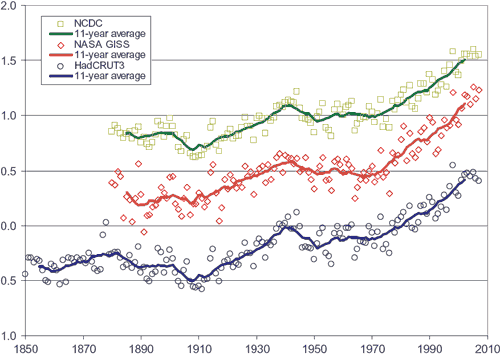

Figure 1: Globally-averaged annual mean temperature anomalies in degrees Celsius, together with 11-year unweighted moving averages (solid lines). Blue circles from the Hadley Centre (British). Red diamonds from NASA GISS. Green squares from NOAA NCDC. NASA GISS and NOAA NCDC are offset in vertical direction by increments of 0.5°C for visual clarity.

The linear trend from 1998 to 2007

Next, Fawcett and Jones look for a cooling trend in the 10 years since 1998. They find the linear trend over 1998 to 2007 is a warming trend in all three data-sets. Note that HadCRUT3 displays less warming than NASA GISS and NCDC. This is most likely due to the fact that HadCRUT data doesn't cover parts of the Arctic where there has been strong warming in recent years.
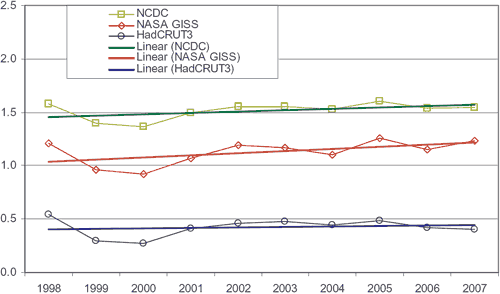

Figure 2: Linear trends (solid lines) in the three global annual mean temperature anomaly time series over the decade 1998-2007.

Removing ENSO signal from the temperature record

The reason that 1998 was such an anomalously warm year was due to a strong El Niño that year. Fawcett and Jones remove the ENSO signal by calculating a linear regression of global temperatures against the Southern Oscillation Index. A detailed description of the process is found in Fawcett 2007. The result is shown in Figure 3.
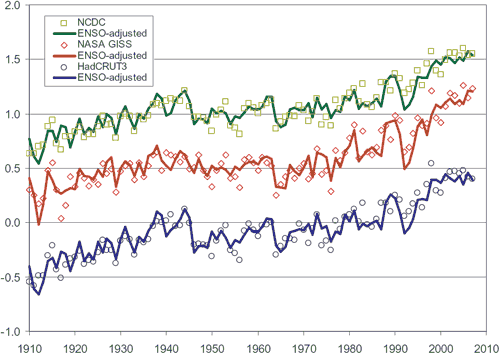

Figure 3: Three time series of globally-averaged annual mean temperature anomalies (circles) in degrees Celsius, together with ENSO-adjusted versions (lines), for the period 1910-2007.

All 3 data sets demonstrate that the anomalously hot 1998 was due to the strong El Niño of 1997/98. When ENSO-adjusted, 1998 looks much less remarkable than it does in the original data. In all 3 ENSO-adjusted data-sets, 2006 is the hottest year on record and the trend from 1998 to 2007 is that of warming.

Posted by John Cook at 20:26 PM

Comments

  1. John
    This effect is what I wwas attempting to point out in the Volcanos thread. Not only are the El Ninos more pronounced but the La Ninas as well.
  2. Is that a peer-reviewed journal? doesn't seem to me.

    Anyway, it's interesting to see that removing ENSO reveals that there was no significant warming trend from 1935 to 1985. In fact, there only seems to be a warming episode in the 1990's. What's the peer-reviewed explanation? Did CO2 suddenly become a powerful GHG in 1990?

    Also why did the authors not use the satellite data? Isn't that cherry picking?

    I'm just teasing. If you pretend to use "peer-reviewed" evidence to counter claims, you can do better than that! Maybe find papers in actual scientific journals?
    [ Response: The Bulletin of the Australian Meteorological and Oceanographic Society is a peer reviewed journal. Don't forget that 1991 featured a huge volcanic eruption that lowered global temperatures significantly - their analysis finds the global cooling would've been even worse if there weren't El Nino conditions at the time. So global temperatures were recovering from the eruption throughout the 90's. ]
  3. John
    I don't know what the relationship is yet but mentally put a vertical by at 1918, 1938, 1958, 1978 and 1998 in figure 3 to contrast the graph against the PDO.
  4. John
    Sorry,That was supposed to be 1938, 1968 and 1998 for PDO. I don't know how I did that. Sun on the brain I guess.
  5. Good post and good website. It makes sense to remove the "el Nino of the century" anomaly in discerning the trend. Then there's the 11-year solar cycle, which we are now at the minimum on. For a variety of reasons, the "global warming stopped in 1998" is one of the more ridiculous arguments from the contrarian groups, although it's one that is easy to communicate to the layperson, so I understand why it's used.
  6. NewYorkJ

    No! There is no 11-year solar signature!!! Hey, that's a contrarian argument too! Don't you know that the Sun has no influence on climate?

    As for Pinatubo, I was just saying that there was no trend up until 1990, so that's before Pinatubo. Furthermore, its effect lasted for about 2-3 years, not a whole decade.

    I don't see the point in trying to debunk something that does not need to be debunked. If temperatures have been stable since 1998, then so be it! Why twist the data this way or that way, use a running average, remove ENSO, remove Pinatubo, add this or remove that, and say, yes, there is a trend, the trend is still there, don't you see it?! It is as simplistic an argument as saying there is a downtrend since the last 7 years. A trend is a trend only up until it's no longer a trend. It could just be part of a long cycle, as far as I'm concerned.

    Anyone looking at those graphs objectively would say: there was warming up until 1940, then not much, then warming from 1990-2000, then not much again. Does that disprove AGW? No. Does the existence of a trend prove AGW? No again.
  7. John
    You might be interested in this relevant article: Stay cool about short-term climate forecasts posted Thursday, May 01, 2008.
    [ Response: This is addressed in Is Pacific Decadal Oscillation the Smoking Gun? ]
  8. Very funny how so many attribute Global Warming trends to human activity, yet when defending periods of no warming, or cooling, they claim natural causes.
    [ Response: The cooling period between 1940 to 1970 was due in some part to human activity as sulfate pollution increased atmospheric albedo, preventing as much sunlight from reaching the earth's surface. ]
  9. BTN,

    Well, there IS an asymmetry in the situation:
    - the expectation of GW fits into the framework that is CONSISTENT with the atmospheric physics that we know about.

    - the claim that GW is not happening poses problems for this framework. Specifically, what happened to the greenhouse effect? And if the answer is, There IS not greenhouse effect, then the problem becomes, Then why is the Earth's surface so warm, compared to what it "should" be?

    Since the expectation of GW is the result of the framework theory, it has to be DISPROVEN to be invalidated. The GW-denying theory is NOT consistent with the rest of atmospheric physics, so if you want to make that claim, you do have a higher standard of evidence to meet.
  10. nealjking
    That is not how science works. GW is a hypothesis, albiet a fair one. The problem is that it has been accepted as a working hypothesis but has not been proven. Climate change, on the other hand, is obvious.
    Most of the natural forcing are proven, albeit not all.
    Science works by proving your hypothesis valid, which may or may not prove an alternate hypothesis invalid (two different functions can have similar results).
    Yes I have a higher standard of evidence to meet, but I do not deny GW, rather I am very skeptical of CO2 as the cause of GW or that AGW is actually an important factor in climate change. There have been very good peer reviewed papers indicating natural causes that fit the picture much better than CO2 induced AGW. The jury is still out on this. I am not posting links here because they do not relate directly to this issue (Did global warming stop in 1998?) but if you read through the rest of this site you will find plenty of links to some very interesting papers (both from John and in the comments). But "framework theory, it has to be DISPROVEN to be invalidated." is a false premise as it too is a hypothesis, albeit a good one.
  11. Is everyone forgotting the famous quote of Kevin Ternberth from NCAR?

    http://www.npr.org/templates/story/story.php?storyId=88520025

    "...But if the aquatic robots are actually telling the right story, that raises a new question: Where is the extra heat all going?

    Kevin Trenberth at the National Center for Atmospheric Research says it's probably going back out into space. The Earth has a number of natural thermostats, including clouds, which can either trap heat and turn up the temperature, or reflect sunlight and help cool the planet.

    That can't be directly measured at the moment, however.

    "Unfortunately, we don't have adequate tracking of clouds to determine exactly what role they've been playing during this period," Trenberth says."

    Hello? Can you say, "Heat exchange system?"

Post a Comment

Foul language, trolling, personal attacks or non-relevant links will be deleted.

You need to be logged in to post a comment. Login via the left margin or if you're new, register here.

© John Cook 2008





