





How many climate scientists are climate skeptics?
Posted on 22 June 2010 by John Cook
There have been various surveys or petitions claiming that thousands of scientists are skeptical that humans are causing global warming. The thing is, when you peruse these lists, you find very few scientists who actually have expertise in climate science. So what do the experts think? A 2009 survey found that over 97% of actively publishing climate scientists are convinced humans are significantly changing global temperatures (Doran 2009). Now a new study has digged into this topic a little deeper and broader. As well as covering a larger number of climate scientists, they also researched how many papers each scientist published and how often their work was cited (Anderegg 2010). How many published climate scientists think most of recent global warming was due to human activity? Between 97 to 98%.
The results are strikingly consistent with Doran's earlier work. The overwhelming majority of climate experts think humans are causing climate change. Next, they dig a little deeper. They examine the number of publications by each scientist as a measure of expertise in climate science. What they find is the average number of publications by unconvinced scientists (eg - skeptics) is around half the number by scientists convinced by the evidence. Not only is there a vast difference in the number of convinced versus unconvinced scientists, there is also a considerable gap in expertise between the two groups.
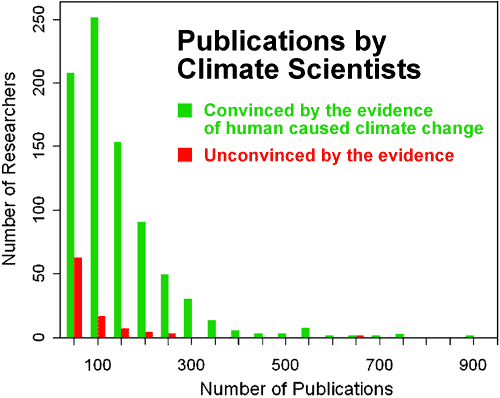
Figure 1: Distribution of the number of researchers convinced by the evidence of anthropogenic climate change and unconvinced by the evidence with a given number of total climate publications.
An alternative measure of the quality and credibility of a scientist's contribution is the number of times their work is cited by other scientists. Again, there is a considerable gap between the number of citations of papers by convinced scientists and unconvinced scientists.
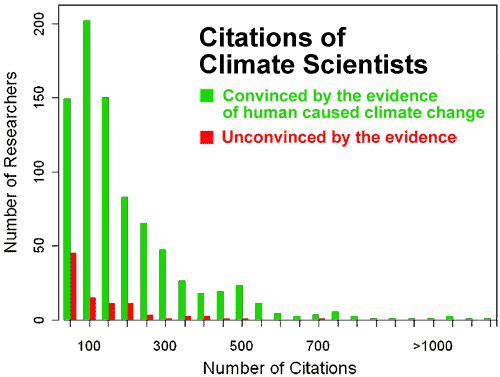
Figure 2: Distribution of the number of researchers convinced and unconvinced of human caused climate change with a given number times cited for each researcher’s average of the first through fourth most-cited papers.
Skeptics claim there is no scientific consensus, that there are many scientists who don't think humans are causing global warming. However, when it comes to climate experts, we have a numbers gap, an expertise gap and a credibility gap between the scientists convinced of human caused global warming and climate skeptics.

Arguments


You would be definitely better off by sticking to Monckton...
— Edgar Allan Poe, The Rationale of Verse
... and that I could finish my writing ..., but ...
Not so long ago (2002) 98% of scientists claimed that: LIA = bacteria = rats = the Black Death ...
And what happened (after 2002)? ...
... of course two constituents of the center of the puzzle ...
Me in place of "thousand" one Lindzen is enough, maybe I would add Pielke ...
... and from my country, I will add dozens of scientists from the Polish Committee of Geological Sciences - Polish Academy of Sciences, who officially say: that now it is nature that decides, not man-made ...
Very few times, though. In the vast number of cases, the majority have been right, and the small group way off base.
For me, it comes down to the preponderance of evidence for the pro side, and the significant lack of evidence for the nay side. And saying "but XX doesn't *prove* AGW is happening" is not proof that it's *not* happening, although that seems to be a common argument.
At this point, given the rather unevenly stacked evidence, I would say that the anti-AGW faction are making extraordinary claims, and we all know what Carl Sagan had to say about those!
@Arkadiusz - how many members of that committee of Geological Sciences work in the field of climate research?
The cited statistics are compelling, but, in all areas of peer review science, there is a publication bias favoring agreement with conventional wisdom -- likewise a similar funding bias. In a scientific environment where such an overwhelming majority of scientists favor a certain point of view, one can readily appreciate how difficult it would be to obtain funding or publication of ideas and data contrary to those of the predominate school of thought.
This is a point that should not be ignored. Scientists who challenge the consensus are often shut out of journals or even worse, forced to retract papers they have managed to get published. Just ask Dr. Andrew Wakefield. He's more than happy to tell folks all about how he's been repressed by the corrupt scientific establishment.
;)
"But the fact that some geniuses were laughed at does not imply that all who are laughed at are geniuses. They laughed at Columbus, they laughed at Fulton, they laughed at the Wright Brothers. But they also laughed at Bozo the Clown." - Carl Sagan
If you are forced to retract a paper, well, that means your paper was wrong, that clear mistakes have been pointed out. Nobody makes that kind of admission of error without proof - if there isn't clear proof of error, bad data, incorrect methods, etc., the paper will remain in the marketplace of ideas, and will be cited (or not) based on it's perceived worth.
read the comments by Pielke Jr, Curry, Christy please
Yes, do that, all of you.
A New Black List by Roger Pielke Jr.
And this one.
Comments On The PNAS Article “Expert Credibility In Climate Change” By Anderegg Et Al 2010 by Roger Pielke Sr.
"The Anderegg et al paper is another in a set of advocacy articles in the Proceedings of the National Academy of Sciences (see and see). This paper illustrates more generally how far we have gone from the appropriate scientific process."
It is always good to know how things work (as opposed to how they'd be supposed to).
Coming up with a project that is rational and counter to AGW would be quite difficult at this point with as much evidence as there is to the contrary. Again, extraordinary claims.... well, in this case, would require extraordinarily tolerant funding.
http://legendofpineridge.blogspot.com/2010/06/proceedings-of-national-academy-of.html
http://www.pnas.org/content/early/2010/06/04/1003187107.full.pdf
This link may change because it is the early edition.
The statistics are certainly interesting, but must be interpreted as "2-3% of people who have published 20 climate papers are willing to publicly attack the IPCC's conclusions." That is, to me, a surprisingly high fraction, although I think it can largely be attributed not to the scientific process but to the unfortunate extreme political polarization, which can induce blindness... on both sides.
thanks for the article. and thanks for keeping track of and offering context/rebuttals for all the skeptics' false arguments.
on this topic - the extent of the consensus - i've been bugging gavin over at realclimate to start a "list of jims" (similar to biologists' list of steves) named for james hansen. could you give him a nudge?
I just don't buy the "funding bias" argument. There are definitely real scientists who are genuinely skeptical of AGW out there who are getting funded.
Except when they are not. "It is clear that revisions have been made, and it is clear that reviewers see merit in the project. Nevertheless the proposal was turned down, principally because the Program [Director] has determined that other proposals in this competition were of higher priority."
So. Priorities are set.
"... and from my country, I will add dozens of scientists from the Polish Committee of Geological Sciences - Polish Academy of Sciences, who officially say: that now it is nature that decides, not man-made ..."
Funny how it's always the Geologists who take the opposing view, as they did over Plate Tectonics until they were forced to amend their conservative thinking by facing up to the facts that even they couldn't reject forever. Hopefully it won't be too long before the same happens with regard to global warming.
However, the Polish Academy of Sciences, as a whole, support the conclusions of the IPCC, as shown by this statement in Polish. Perhaps Arkadiusz can confirm or deny the contents ?
That statement represents the views of all the Divisions and Institutes, including the Division of Earth and Mining Sciences, of which The Institute of Geological Sciences is a part. Alongside them in that Division, but not denying, are The Institute of Geophysics, and The Institute of Oceanology.
The Division of Mathematical, Physical and Chemical Sciences don't appear to be denying either.
Why is it always the Geologists who think they know better than anyone else in any other field, even when it's not their area of expertise ?
If half to two-thirds of all proposals are rejected, you cannot argue that a rejection (even a reconsideration of a rejection, as shown here) is evidence of a bias against a particular scientist or topic. Lots of proposals get rejected.
You can only state that the reviewers (over three submissions) and the people in the program thought other proposals were more worth funding for some reason or another - not guess post-facto in the absence of evidence what that reason might be.
Many use it as a pejorative term, representing a lack of independent thought, reflecting a desire to conform to the comfortable majority, out of laziness or a desire for funding. To them, a "consensus" represents a convenient but dishonest fabrication. They view people who do not agree with the "consensus" as being therefore more diligent, more honest, more courageous, and therefore more valid.
I believe a "consensus" properly indicates a result of multiple lines of independent inquiry, pursued by people often in competition for funding in different locations, institutions, and fields of inquiry, using different methods, yet arriving independently at similar conclusions. Therefore a "consensus" actually is a powerful indicator of validity.
A 97% consensus of the independent variety is overwhelming testimony to the validity of the argument, and that is what we have in this case.
And no, not all proposals are funded. There are limited resources in science just like there are everywhere else. Many good proposals are turned down for the same reason that not all qualified job applicants are hired, and not all qualified students get accepted to every school to which they apply, and not all nice guys get to date Megan Fox. Do good work, propose interesting, relevant science, and you'll sometimes get funded. But not always.
CBW's right - not everything gets funded, not all jobs will hire you, not all wishes get granted. That's just life.
Some criticism of the paper seems justified - but that criticism doesn't seem to substantially threaten the conclusion, though, of course, "more study is needed"
~ ~ ~ ~ ~ ~ ~
caerbannog
“This is a point that should not be ignored. Scientists who challenge the consensus are often shut out of journals or even worse, forced to retract papers they have managed to get published.”
But, but, when those “skeptical” scientists are using deception and pedaling demonstrably false statements, then fall back on economic/political rational to bolster their opinions - then they do not deserve defending.
I’m still waiting for a “skeptical scientist” to produce any convincing papers that do more than slightly adjust some details of the larger AGW picture. Where are these reports?
I've never worked for NSF but I am very good friends with a two-term program officer at NSF and can testify from very close quarters that the integrity of the process is extremely good. Proposals making it all the way to being treated to detailed review at NSF are nearly uniformly of very high quality. Those finding their way to the desk of a program officer without obvious blemishes are even more tightly grouped in terms of prospects for successful research outcomes but money is scarce, too scarce to fund all proposals found meritorious by reviewers. The program officer's job is to select those proposals considered of most relevance to an individual program's overall objectives and the objectives of NSF as a whole. Given that Pielke's proposal will have been reviewed along with a sizable class of other excellent research projects, making any judgment about the justification of Pielke's annoyance over the failure of his proposal would be easier if we saw the cohort of proposals considered by the program officer. Indeed Pielke himself suggests this but leaps to a conclusion without any supporting data.
Pielke himself helps to explain the dilemma of program officers while still being unable to resist injecting political rhetoric into his words: "NSF program managers have considerable ability to slant research that they fund with insufficent transparency of the review process. This has become quite a problem in the climate science area where, as one example, in recent years they have elected to fund climate predictions decades into the future. Well, of course NSF has funded climate projections; the future behavior of global climate is an important research topic with large impact and squarely in the purview of NSF. One could certainly make a reasonable case that global climate behavior is more important than hypothetical effects of land use on climate along the Eastern seaboard of the U.S.
To me it appears Pielke is trying to use his clout as a pundit to politically influence an NSF funding decision. To the extent he succeeds he will be a degenerate influence on NSF funding decisions. He'd do better to expend his political capital in urging U.S. taxpayers to encourage more funding of NSF.
Note the ';)' at the bottom of my post. Also check out Dr. Andrew Wakefield's credentials. (Wakefield is the Monckton of medicine).
My post and your reply demonstrate the power of Poe's Law. ;) ;) ;)
"...Polish Academy of Sciences, who officially say: that now it is nature that decides, not man-made ... "
That is exactly the point!
And how do we humans determine the decisions of nature?
By science, of course, specifically, the scientific consensus. We all know the consensus may be wrong, but it has been a stable consensus now for twenty years or more ...
For months now, (to take one example) A. Watts has been trumpeting how his blog is the most popular science blog on the web, as if that endorsed his position. So what? Tell him that "Nature decides", not the number of hits, Arkadiusz.
Every survey that showed a decline in the % of the public accepting the science of global warming has declined was greeted with glee on every denialist website. Tell them that "Nature decides", Arkadiusz, not public popularity.
Deniers unashamedly used so-called "Climategate" to undermine public trust, which was the equivalent of the Jonny Cochrane undermining the state's forensic science as tainted with racism in the OJ case. Tell them that "Nature decides", Arkadiusz, this is not a jury trial.
When a poster ("marty") was told on a previous thread that "nature was not a democracy", he more or less said that scientists were trying to establish a dictatorship. Tell him that "Nature decides", Arkadiusz, there is not a show of hands at the end of a debate.
>>I believe a "consensus" properly indicates a result of multiple lines of independent inquiry, pursued by people often in competition for funding in different locations, institutions, and fields of inquiry, using different methods, yet arriving independently at similar conclusions. Therefore a "consensus" actually is a powerful indicator of validity.
>>A 97% consensus of the independent variety is overwhelming testimony to the validity of the argument, and that is what we have in this case.<<
There are a whole lot of things in the history of science which show just how poisonous it is to argue something on the basis of popularity among scientists. To cite just a single, very egregious example: The bacterial causation of peptic ulcer disease (PUD). In the mid-80s, 99.9% of the world's experts thought that PUD was primarily caused by excess stomach acid, which was, in turn, caused by things such as stress, smoking, alcohol, spicy foods, whatever. The evidence for this was overwhelming. The most lucrative operation for surgeons was the vagotomy and antrectomy (ulcer operation). The most lucrative drug was Tagamet (which reduced acid secretion). A lone pathologist in Australia, with no "credentials" came up with the idea that ulcers were caused by a bacterium (helicobacter pylori). No one believed him. He couldn't get the work published. He certainly wouldn't have qualified for any funding. It took nearly 20 years for the world to come around to his way of thinking. In 2005 he (Robin Warren) won the Nobel Prize. http://nobelprize.org/nobel_prizes/medicine/laureates/2005/press.html Today, the vagotomy and antrectomy, as well as Tagamet, exist primarily as historical reminders of the folly of scientific certitude.
You can only state that the reviewers (over three submissions) and the people in the program thought other proposals were more worth funding for some reason or another
Is it normal practice to reject a proposal supported by reviewers based on the Program Director's unspecified priorities? Not even that. An unspecified entity's unspecified priorities.
"other proposals [...] were of higher priority"
Weird language.
David Attenborough told a story in one of his documentaries about how he was impressed by the theory of Continental Drift while a geology student at Cambridge. He mentioned this to his Professor, who put him in his place with an instant riposte "Dear boy, I will accept the theory of Continental Drift when you show me what the continents can float on".
Actually, the Professor was totally correct. Without Plate Tectonics (which only came along in the late '50s), the evidence for Continental Drift (I think it was proposed in 1912) was quite slim. Instinctively, we always think the "losers" were wilfully blind or stupid in any intellectual debate, but often the "wrong" side were also the side with the better evidence at the time.
This was a point Stephen Jay Gould was fond of making, when defending Cuvier, Catastrophism and other scientific "losers". Evolution was only totally accepted in the Modern Synthesis with genetics, and Lamarckism was kicked to the kerb.
The point is that the scientific consensus HAS to be the starting point. Only when you have totally picked over its bones and understood it can you start thinking of alternatives. And the alternatives usually grow from points where the consensus is weakest, not from maverick science that rejects the whole consensus to begin with.
The priorities are not unspecified, you can read about them here and here.
1. Generally, scientists aren't funded to do work that's already been done. So "proving" the human connection is not a priority, as there's already an enormous preponderance of evidence. And for this reason, one is unlikely to get funded to pursue research which a priori disregards this preponderance of evidence. (No one will fund your gravity research if your a priori hypothesis is that things don't fall when you drop them.)
2. I'm still amazed at the "science isn't done by consensus" comments. Nonsense. The difference, however, is that the consensus is evidence-based and it's the consensus of the relevant scientific community. Further, I generally find such comments intellectually dishonest (e.g., Arkadiusz above): if the stats were reversed -- if 98% disagreed with AGW -- the mantra would be "See, this proves people have nothing to do with it." Certainly they wouldn't be fighting for the necessity of listening to the "alarmist 2%."
Might there be another explanation? Of course. Is it likely? Not very.
"Generally, scientists aren't funded to do work that's already been done."
Actually, this is the type of work which does get funded, in the real world. In 1982, Emil Frei of Harvard gave the Karnofsky address at the American Society of Clinical Oncology meetings. He spoke about two types of scientists: Investigators and Discoverers. Investigators advance timid and most often trivial hypotheses, based upon prior work. This type of work has a high probability of success, and the success reassures the scientific community. Investigators succeed and are esteemed by their mentors and peers. At best, investigative research results in single step advances, which change no paradigms. Discoverers take risks. They usually fail. Their thinking disturbs both mentors and peers. But when they succeed, the result is a multi-step advance and sometimes a true paradigm shift (e.g. the bacterial causation of peptic ulcer disease). The problem comes when investigators become imbued with so much certitude that would be discoverers can never get funded and when discoveries can't get published. The weakest of all arguments in favor of a given theory is the degree of peer acceptance. This is purely a political argument and not a scientific argument. - Larry Weisenthal/Huntington Beach, CA
"Is it normal practice to reject a proposal supported by reviewers based on the Program Director's unspecified priorities? Not even that. An unspecified entity's unspecified priorities."
I guess you've never submitted an NSF proposal.
Yes, it is quite normal. That is basically a form letter, which I and probably many others here have seen at times in response to our own lovely proposals. What's new here is the black-helicopters belief that let-them-down-gently boilerplate wording now reveals a sinister political intent.
Here's recent history of funded proposals from the program Pielke suggests is being lead by dishonest and biased program officers:
Pielke-gripe awarded cohort
Can you spot the dishonesty?
She was not accused of making a Blacklist, as I have seen on blogs like Spencer's and Watts', a spin that seems to be Pielkes Jnr.'s.
Oreskes paper
Oreskes paper
With respect to Doran 2009, his work entailed a web-based survey of 10,257 earth scientists, of which 3,146 responded. Of these 5% (157) were reported to be climate scientists. What isn’t evident is the response from those climate scientists for the two questions. Even at that, only 82 percent answered yes to the question:
“Do you think human activity is a significant contributing factor in changing mean global temperatures?”
Now, the above question does NOT ask “Do you think human activity is DRIVING the change in mean global temperatures.” Which I believe would have resulted in a different level of response. For instance I personally believe that human activity IS a significant factor in changing mean global temperatures, however not in the way being promoted by IPCC. In addition I do not feel that mean is a valid measurement to determine what man’s impact is on global temperatures.
With respect to your comment that “very few scientists who actually have expertise in climate science.” How can you use that argument when you use someone else's work (Doran 2009) who, based on your criteria, should not be considered given that the survey focused on responses from 3,146 geoscientists of which only 5% were climate scientists?
Climate science is not a topic by itself. Instead it incorporates knowledge from a number of scientific disciplines, including geoscientists, physicists, chemists, biologists, atmospheric and environmentalists to name some and which composed over 50% of those who signed the OISM petition. This is in sharp contrast to your reported 39 scientists. Furthermore you have consistently provided links in this blog to studies carried out by biologists, geoscientists etc so if they are good enough to support your position on climate change, similarly educated scientists should be accepted for their contrary view point.
As for Anderegg et al, 2010, when you delve into their respondents, close to 50% were associated with the IPCC which from a statistical perspective, should be removed from the data as having a conflict of interest. You are using the same authors to support the findings of a panel to which they contributed. In addition there is no method to verify that all of those scientists that were included in the list were in fact climate scientists (given that you seem to reject any contrarian viewpoint from a scientist that isn’t a climate scientist. You can’t have it both ways.
In the end, you conclusion is contrived and extremely biased and holds no credence.
Minds are already made up on this, and more proof of "consensus" isn't going to convince any skeptics. This is simply another artillery round in the ongoing war, which will in due course be answered by a return volley (however feeble or unconvincing it may be to those of us who don't indulge in conspiracy theories).
Down the road we're going to look on this period as akin to a situation where we were repeatedly forced to submit to digital prostate exams from self-professed doctors unable to distinguish their thumbs from their middle fingers, only later to discover to our chagrin that the gland in question was
perfectly healthy all along.
"97 to 98% of climate scientists are convinced by the evidence of human caused climate change."
OK, maybe that in a certain sample of climate scientists 97% answer 'yes' to such an umbrella statement. But of what are they really convinced? How much has the globe really warmed in the last 2 centuries? Which part of that warming is due to human activities and which is due to natural factors? Which human acivities have caused climate change? Do they really trust climate models? Do they believe the predictions of these models about sea level change, disaster damage, health risks? Etc. etc. etc. Climate skeptics claim that there is no scientific consensus on these issues. The Anderegg article does not in any way show the contrary.
In fact, the prior setting and later using of priorities is one of the mechanisms that helps to keep the process objective. The rejection letter cited above points out that reviewers felt the research had merit, it just didn't match well with priorities. Of course, if there had been fewer grant requests in the queue, perhaps the rejection letter would've been an approval.
Sometimes just reading the abstract can be helpful:
Anderegg:
Although preliminary estimates from published literature and expert surveys suggest striking agreement among climate scientists on the tenets of anthropogenic climate change (ACC), the American public expresses substantial doubt about both the anthropogenic cause and the level of scientific agreement underpinning ACC. A broad analysis of the climate scientist community itself, the distribution of credibility of dissenting researchers relative to agreeing researchers, and the level of agreement among top climate experts has not been conducted and would inform future ACC discussions. Here, we use an extensive dataset of 1,372 climate researchers and their publication and citation data to show that (i) 97–98% of the climate researchers most actively publishing in the field support the tenets of ACC outlined by the Intergovernmental Panel on Climate Change, and (ii) the relative climate expertise and scientific prominence of the researchers unconvinced of ACC are substantially below that of the convinced researchers.
The source of public confusion will hopefully be tracked down in a scientific way as opposed to simply speculating based on PR expenditures by interested parties. Anderegg and others are following that path of inquiry.
Pielke Jr. is also working the same "black list" conflation angle.
This paper -really- touched a nerve.
Here's (pdf) the Anderegg paper. Can you find a "black list?" I can't.
The response to the OIM petition was based on a simultaneous presentation of a fraudulent paper (made to look as if it had been published in PNAS) along with rather misleading questions.
As an indicator of how scientists and others feel about AGW it is useless.
since you seem hung up on the word "priorities", perhaps the NSF's discussion of Investment Priorities would be more what you are looking for
Unfortunately we'll not be able to decide the question whether rejection of Pielke's proposal was based on a fair application of these pretty vague priorities, as rejected proposals are undocumented at the NSF site.
See Pielke Sr.'s recommendations.
- present ALL proposal abstracts, reviews of both accepted and rejected proposals and program managers decision letters (or e-mails) on line for public access
- present the date of submission and final acceptance (or rejection) of the proposal.
The process is obviously not transparent at all. However, as it is American taxpayer's money, I am not concerned about it beyond the fact it can easily set direction of scientific enquiry off track.There are 76 recent funding opportunities on climate modeling while only 41 on observation and 37 on measurement (with overlaps).
None on really fundamental issues like thermodynamics of open systems or radiation entropy. Or to be more specific, on radiative entropy production of the terrestrial climate system. With a slight chance to bring in some more physics and to go beyond awfully expensive (and futile) multiparameter curve fitting.





