



 Arguments







Is Greenland losing ice? (psst, the answer is yes, at an accelerating rate)
Posted on 28 September 2010 by robert way
Confusion caused by anecdotes of structures being buried by accumulating snow on Greenland's ice sheet leads some skeptics to believe Greenland is Gaining Ice. As always, the best way to tease out the truth here by following the research of scientists investigating Greenland's ice mass balance.
In general, the best available science tells us that Greenland is losing ice extensively (Figure 1) and that these losses have drastically increased since the year 2000.
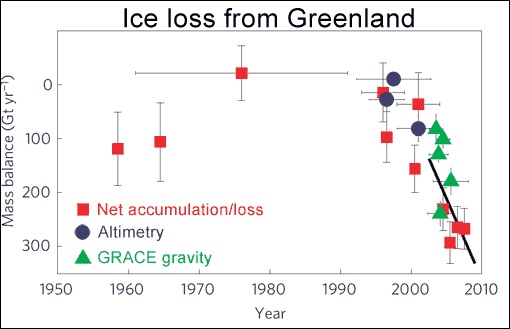
Figure 1: Estimated Greenland Ice Sheet mass balance changes since 1950 using three different methods (Jiang 2010). Mass Balance Measurement Techniques are discussed here.
The evidence suggested by a multitude of different measurement techniques suggests that not only is Greenland losing ice but that these ice losses are accelerating at a rapid pace (Velicogna 2009). Further evidence suggests that although ice losses have up to this point primarily occurred in the South and Southwest portions of Greenland, these losses are now spreading to the Northwest sector of the ice sheet (Khan et al 2010).
Although there have been some gains at high altitudes, significant ice losses are occurring at low altitudes (Wouters 2008) along the coastline where glaciers are calving ice into the oceans far quicker than ice is being accumulated at the top of the ice sheet (Rignot and Kanagaratnam 2007).
In conclusion Greenland is losing ice extensively along its margins where fast flowing ice streams are pushing more ice into the ocean than is gained in the center of the ice sheet. For more information on how ice sheets lose mass, a more comprehensive discussion is available here.
This post is the Basic version (written by Robert Way) of the skeptic argument "Greenland is gaining ice". Robert has also written a number of richly informative posts on Greenland ice loss. A good starting point is Why do glaciers lose mass. Part two in this series was How do we measure Antarctic ice loss. Part Three responded to disinformation from Steve Goddard about Antarctic ice loss.


 0
0  0
0 ( http://i51.tinypic.com/2wqvkab.png )
This got me thinking whether it's sensible to produce a whole Greenland mass loss and then try to attribute this to a single forcing?
As Kahn 2010 paper suggests NW Greenland acceleration in mass loss began in 2005. The Murray 2010 paper suggests SE Greenland accelerated early 2000's and then the rate declined late 2000's. I assume acceleration in SW Greenland began in early 2000's but I don't know how it then developed. Let's ignore what's going on in the NE.
If we have multiple different processes occuring at different times in different regions of Greenland over the past decade can we lump the results from these different processes into a single whole Greenland ice mass loss and get any real meaning from that?
(BTW Murray et al 2010 suggest the above mechanism as the main process controlling mass loss in SE Greenland.)
( http://i51.tinypic.com/2wqvkab.png )
This got me thinking whether it's sensible to produce a whole Greenland mass loss and then try to attribute this to a single forcing?
As Kahn 2010 paper suggests NW Greenland acceleration in mass loss began in 2005. The Murray 2010 paper suggests SE Greenland accelerated early 2000's and then the rate declined late 2000's. I assume acceleration in SW Greenland began in early 2000's but I don't know how it then developed. Let's ignore what's going on in the NE.
If we have multiple different processes occuring at different times in different regions of Greenland over the past decade can we lump the results from these different processes into a single whole Greenland ice mass loss and get any real meaning from that?
(BTW Murray et al 2010 suggest the above mechanism as the main process controlling mass loss in SE Greenland.)
 ( http://i52.tinypic.com/j0h091.png )
I'm not actually sure what the graph is telling me except that it looks like a huge amount of variability over that time period. And I wonder whether you have to temper any conclusions about the recent mass balance estimates in light of that?
It seems to me that buried in the idea that "Greenland is losing ice extensively and that these losses have drastically increased since the year 2000" that this is going to be part of a trend stretching into the future when in fact it could just be part of the variability seen in Hanna's data series.
( http://i52.tinypic.com/j0h091.png )
I'm not actually sure what the graph is telling me except that it looks like a huge amount of variability over that time period. And I wonder whether you have to temper any conclusions about the recent mass balance estimates in light of that?
It seems to me that buried in the idea that "Greenland is losing ice extensively and that these losses have drastically increased since the year 2000" that this is going to be part of a trend stretching into the future when in fact it could just be part of the variability seen in Hanna's data series.
 Is this image saying that pre-2006 that Greenland was gaining mass (although at a slowing rate). Around 2006 it was in balance and post-2006 it was lossing mass? I'm confused about the positive and negative numbers.
 Indeed, of the stations in Greenland with long records, Nuuk shows one of the lowest overall trends, and I'm sure he knows that too.
Even more telling, why is he using just one station to represent global temperatures in a comparison of the effects of CO2 on global warming. One station is not a global average, and it is global average temperatures that rise with increasing CO2. Individual stations can be dominated by local or regional factors and show all sorts of trends. Indeed, according to the BEST project, one third of all stations show a negative trend, in a data set for which the global land area average shows as strong a trend as GISS.
Frankly I am getting sick of the smoke and mirrors game of the fake skeptics. I am told by a wise person never to attribute to dishonesty what can be attributed to stupidity, but frankly, the fake skeptics are not that stupid.
Anyway, for more station data, go to this page and click on the map of Greenland to bring up a list of the nearest geographical sites (not all in Greenland). If you click on a particular site, in the lower left corner you have the option of text data which is where Goddard gets his station data. The CO2 data is probably Mauna Loa plus an Antarctic Ice Core.
The real question is again, not where he got that data, but why won't he show the equivalent plot for global data:
Indeed, of the stations in Greenland with long records, Nuuk shows one of the lowest overall trends, and I'm sure he knows that too.
Even more telling, why is he using just one station to represent global temperatures in a comparison of the effects of CO2 on global warming. One station is not a global average, and it is global average temperatures that rise with increasing CO2. Individual stations can be dominated by local or regional factors and show all sorts of trends. Indeed, according to the BEST project, one third of all stations show a negative trend, in a data set for which the global land area average shows as strong a trend as GISS.
Frankly I am getting sick of the smoke and mirrors game of the fake skeptics. I am told by a wise person never to attribute to dishonesty what can be attributed to stupidity, but frankly, the fake skeptics are not that stupid.
Anyway, for more station data, go to this page and click on the map of Greenland to bring up a list of the nearest geographical sites (not all in Greenland). If you click on a particular site, in the lower left corner you have the option of text data which is where Goddard gets his station data. The CO2 data is probably Mauna Loa plus an Antarctic Ice Core.
The real question is again, not where he got that data, but why won't he show the equivalent plot for global data:
 (Note, the vertical access shows CO2 increase above the preindustrial average)
Oh, that's right. Because he's not that stupid.
(Note, the vertical access shows CO2 increase above the preindustrial average)
Oh, that's right. Because he's not that stupid.







Comments