





Uncertainty Is Not the Basis for Investment
Posted on 22 February 2012 by jg
Warren Meyers, writing in Forbes magazine (Forbes 2/9/12), argues that breaking the theory of AGW into three parts undermines the potency of the often cited 97% consensus (Science, 03 December 2004):
Part 1) doubling CO2 induces global warming of 1 degree C.
Part 2) CO2-based warming will be amplified by feedback effects.
Part 3) the results will be bad for civilization.
Meyers argues that the 97% consensus is valid for part 1, but breaks down when parts 2 and 3 stand apart. Yet, his support for this censensus breakdown diverges from what a careful reading of the climate change literature would offer. He also takes on the more difficult position of proving negatives, and so additional information from the peer-reviewed literature should move his conclusions toward the conservative direction. (By "conservative," I mean, if you have a mild interglacial that has been conducive to civilization and prosperity, don't mess with it.)
Before celebrating our agreement on Part 1, it should be noted that 1C per doubling of atmospheric CO2 may be an underestimate and that 1.2 C may be more accurate (Hansen and Sato). Whether the value is 1 or 1.2, this is no small change for two reasons:
1) we are near 1C already, leaving little breathing room, and
2) Hansen makes a plausible case that ice core climate reconstructions have overestimated the ultimate warmth of the previous interglacials, thus we had less breathing room than we may have counted on if we are to preserve our mild interglacial climate.
Since Meyers' article is published in Forbes business magazine, perhaps I can compare this to financial investment: Have my advisors thoroughly apprised me of the risks before I invest in a warmer Earth? Do I want to be cautious (overestimating the risks) or daring (underestimating or disregarding the risks)? Think of risks as Earth's feedback effects, Meyers' Part 2.
On Part 2, that CO2-induced warming is accompanied by feedbacks, Meyers and I diverge on our reading of the scientific literature and on where to apply caution or engage in risk.
Meyers: "IPCC assumed that strong positive feedbacks dominated" and "catastrophic global warming advocates are wrong to over-estimate our understanding of these feedbacks"
The IPCC did not assume. It summarized the body of scientific literature which, using many different lines of evidence over many different time frames, concluded that the empirical evidence overwhelmingly suggests that warming induces positive feedbacks (see also Skeptical Science, Climate Sensitivity). A look at the palaeoclimate record reinforces this:

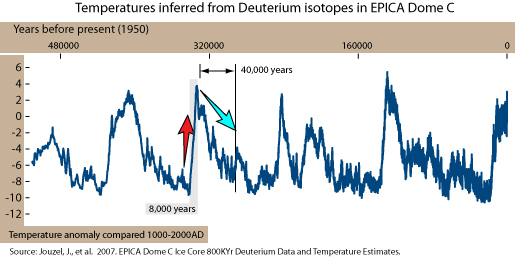
These data show a repeating pattern: Global cooling walks a gradual pace (blue arrow), often taking four times as long to reverse the onset of warming (red arrow). Thus, warming related feedbacks are more abrupt, and should be more disturbing to anyone looking for a safe, long-term investment.
A good investor would try to understand why risk-associated changes occurred. E.g., why did global climate snap out of a glacial era and create warm interglacials? Orbital changes in tilt and precession (Huybers, Nature, 08 Dec 2011) offer likely destabilizing triggers. The onsets (gray highlights) of the past four interglacials coincide with orbital changes that brought an increase of sunlight (red) to the northern hemisphere while the global sunlight (black) changed little.

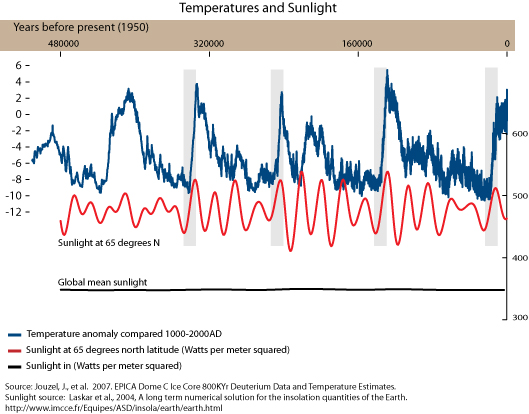
The black line represents total mean insolation and is important in understanding Earth's portfolio of warming-related feedbacks. These data show that Earth is extremely sensitive to changes that merely redistribute energy, in this case, by warming the northern hemisphere. There was fractional net gain in total energy (less that 1 W/m2), yet interglacials occurred with rapid onset. To get Biblical: Warming begets warming. If a long slow wobble (precession) was sufficient for Earth's feedbacks to raise the global temperature 8-12 degrees, we should be cautious, wary, risk-adverse of a global disturbance of 1 degree C, as this one degree disturbance occurs on top of an interglacial.
Meyers also underestimates another significant risk in Earth's feedback portfolio, how clouds will respond to warming.
Meyers: "On the other hand, water evaporated by rising temperatures may form more clouds that shade the Earth and help to reduce temperatures. Whether future man-made global warming is catastrophic depends a lot on the balance of these effects."
Meyers has missed an opportunity to point out that scientists are studying the cloud and water vapor angles (e.g., Dessler, 2010; Dessler and Sherwood, 2009). According to Schmidt et al. (Journal of Geophysical Research, 2010), clouds account for approximately 25% of the greenhouse effect. So, while Meyer cites the cooling effect of clouds, he fails to mention 25% of the greenhouse warming effect.
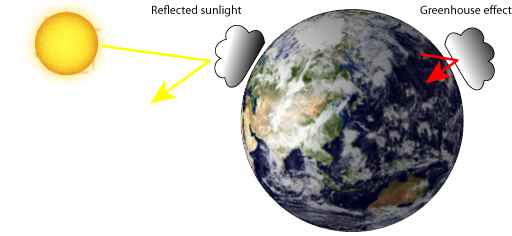
And what is the current understanding of clouds? Dessler (Science, 10 Dec. 2010) demonstrates that the cloud feedback effect over 2000 – 2010 has been slightly positive, 0.54 +/- 0.74 W/m2, and thus "a small negative feedback effect is possible but one large enough to cancel the climate's positive feedbacks is not supported" -- Dessler. This, however, is not a resolved issue, so a conservative interpretation is that as far as we know, clouds do not appear to be a negative feedback needed to counter warming, and it's too early to used clouds as a variable to dismiss the impact of global warming.
The other key feeback that Meyers omits is the water vapor feedback. Per Dessler and Sherwood (Science, 20 February 2009), "the water vapor feedback is is virtually certain to be strongly positive, with most evidence supporting a magnitude of 1.5 - 2.0 W/m2 per degree of warming."
So, considering clouds are neutral, and water vapor feedback well-established, I think the risk is most succinctly put by Meyers's own words:
Meyers: "Whether future man-made global warming is catastrophic depends a lot on the balance of these effects"
Hence, Meyers has framed the question to answer itself, but not yet put in all the data.
Risk could be swept aside if we had reason to believe that rising CO2 levels were not affecting Earth's energy budget. To this effect, Meyers makes his most flawed claim: that the missing heat from Earth's energy budget has not been found in the oceans. In fairness, it's difficult to say something isn't happening. It means he has to survey all the literature for lack of proof, and then monitor for new developments. In this case, current research is finding the missing heat in the oceans (NOAA) where it has the potential to create and sustain a new climate regime, one that may not mesh with our immense investments in water storage, agricultural, transportation and coastline infrastructure.
It's probably not necessary to critique Meyers's part 3, that warming must be bad, for our difference over part 2 is sufficient. However, in looking at the future, we should ask whether we want to be risk prone or risk averse. Skeptical Science has covered this topic (See "It's not bad"). Warming creates feedbacks that amplify warming. And, the data show that warming increases atmospheric CO2, likely through thawing of high latitude permafrost, changes in how the ocean absorbs or stores CO2, and changes in soil chemistry. Reconstructions of temperatures and CO2 levels from ice cores support this.

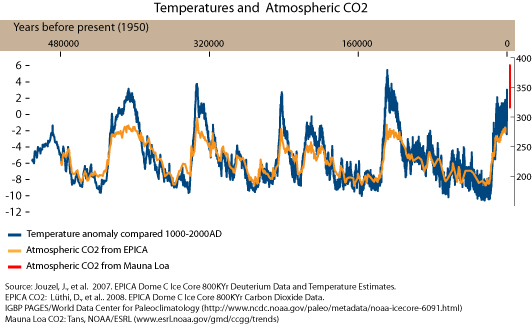
We are near one degree over Holocene and should expect feedbacks. If nothing else, the risk-adverse among us must admit that we are charting new territory. Earth's CO2 portfolio has been spiked by humanity's ingenuity. The level we've reached, 390 ppm, departs from any level pulled from 800,000 year ice, and yet current trends project concentrations to rise to 600 ppm in 70 years (Four degrees and beyond). Would you invest in this planet without a better understanding of what is happening?
----------------
UPDATE: In response to comments, I've removed an illustration comparing CO2 and temperature over the past 160,000 years (See Eric's comment 25 and my comment 34). In it's place I've added this chart from the IPCC Fourth Assessment Report showing plausible surface temperatures from various emissions scenarios.
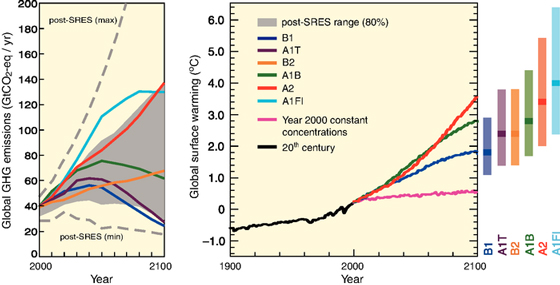
Figure SPM.5 from IPCC AR4. Scenarios for GHG emissions from 2000 to 2100 (in the absence of additional climate policies) and projections of surface temperatures relative to 1980–1999. (See link for full description of the chart.)

Arguments


For myself, when I hear somebody saying the figure is 'somewhere near 1 degC,' I find it almost always is followed by a bunch of obvious denialist statements.
I assume that the graph labelled "Temperatures and Sunlight" is in ºF rather than ºC, which makes the above sentence somewhat confusing. I've read in many other places that the end of the last glacial was associated with a rise in global surface temperatures of about 5-6ºC (which is roughly 8-12ºC).
You are incorrect in your assumption that above temps are scaled in F.
Temp anomalies in ice cores do span indeed 6-8K (or degC), as we've shown here:
http://www.skepticalscience.com/co2-lags-temperature.htm
whereas the anomalies in a similar graph scaled in F, do span ~20F, (interestingly the denialist sites are more likely to scale it in F), e.g. here:
http://stevengoddard.wordpress.com/2011/06/19/vostok-cores-show-zero-climate-sensitivity-2/
1) Is the planet warming?
2) Is the planet warming as much as climatologists say?
3) Is CO2 a 'greenhouse' gas?
4) Is the concentration of atmospheric CO2 increasing?
5) Are humans causing the increase in the concentration of atmospheric CO2?
6) What is the contribution of CO2 to the observed contemporary global warming?
7) What is the sensitivity of global temperature to a doubling of atmospheric CO2?
8) What will be the abiotic consequences of warming resulting from a doubling of atmospheric CO2?
9) What will be the biological/ecological/agricultural consequences of warming resulting from a doubling of atmospheric CO2?
10) What will be the political/social consequences of warming resulting from a doubling of atmospheric CO2?
11) What ethical/moral responsibility do polluting nations have to non-polluting countries, to future generations, and to the non-human species on the planet?
It seems that Myers and his ilk find such questions uncomfortable because such scrutiny results in a dissection of their ideology. Myers seems to be reversing the investigative train that attempts to locate a denier's divergence from science, and pretending that the whole issue of the danger of global warming will disintegrate if enough doubt is sown about the components.
Myers says:
Note how Myers, without substantiation of his claim, repeats the denialist lie that climatology is a "young" science": with a century and a half of work behind it, climatology is NOT a "young" science. Note also how Myers slips in the concept of irresponsibility, and how he introduced both of the preceding concepts before casually throwing in the concession that CO2 will warm the planet by "some amount", in a manner that itself appears intended to cast the increase as being insignificant.
Myers subsequently repeats the notion of "debate" a number of times, without explaining how much debate or otherwise there actually is in the scientific arena. It seems that he is using the term as a rhetorical device to subliminally implant doubt in the minds of his readers.
As jg notes in the OP Myers basically ignores the influence of feedings-back. But not only does he do this, and not only does he round down sensitivity to 1 C as jg observed, but he completely mangles his arithmetic:
Wrong. Completely wrong.
Even at a 1 degree celcius sensitivity, an increase of atmospheric CO2 concentration to 800 ppm would result in almost 3 degrees celcius of warming. This is because the reference concentration for sensitivity is the pre-Industrial atmospheric CO2 concentration (~280 ppm), and not the present atmospheric CO2 concentration.
Myers is demonstrating that he doesn't know what he's talking about. And if he does understand the mathematics underpinning sensitivity - well, forum protocol prevents me from making explicit accusations, but in my own personal opinion he would, in such an instance, be lying.
Now, even with a rounded-down sensitivity and with no feedback, going to 800 ppm atmospheric CO2 concentration and a concommitant 3 degrees celcius warming would be "catastrophic" for much of the biodiversity and agriculture/horticulture of the planet. That Myers does not understand or acknowledge this shows his complete ignorance of human-, crop-, and eco-physiology, as well as of the long-term abiotic responses to that amount of warming.
Myers uses many FUD words such as "second chained theory" (?), "assumed", "exaggerated", "Al Gore", "flat [sic] surface temperatures","missing heat", "Lions and Tigers and Bears, Oh My [indeed...]", "purportedly", and so on. I differ with jg on the non-necessity of debunking Myers' wide suite of scientific garbage, but I certainly acknowledge that it would take a whole chapter's-worth of writing to address it all. The guy is a veritable fountain of garbage.
Oo, and not that I am one to speak, and not that it's of any direct consequence, but Myers' grammar and vocabulary are both dismal. The piece doesn't even seem to have been run past an editor, but if it had it would be invisible under all the red lines...
Which, of course, is still regarded as a significant increase, as (failing) efforts to restrict current increases to below this target demonstrate.
An increase of CO2 levels over pre-industrial levels to 800 ppmv would result in a forcing of:
5.35 * ln(800/280) =~= 5.6 W/m^2
The forcing for doubling CO2 concentrations is 3.7 W/m^2, so if that caused just 1 degree C of warming, then the 5.6 W/m^2 would cause approx 1.5 degree C of warming, or around 0.7 degrees C additional warming relative to the warming already experienced. That would be welcome news indeed.
The problem is, an increase of only 1 degree C per doubling of CO2 is extraordinarily unlikely. Not only is it well outside the IPCC expected range, but it becomes very difficult to explain why we have seen a 0.8 degree C increase in temperatures from the 1.8 W/m^2 increase in CO2 forcings seen since the industrial era, especially given that the climate response is slow and takes decades to reach the equilibrium response.
Even if we hold out for the one in twenty chance that climate sensitivity for doubling CO2 is only 2 degrees C, that still represents 2.2 degrees additional warming for the 800 ppmv scenario, and takes us beyond the guardrail beyond which the consequences of Global Warming are not just deleterious, but potentially catastrophic. Assuming just a 2 degree C climate sensitivity represents the hail mary pass of climate policy. Assuming 1 degree C is a hail mary pass from a drunk, blindfolded quarter back.
Bernard, thanks for adding what my post left out.
jg
I should probably have been more explicit in my posts at #7, and originally at #6.
My original rounding was to 2, although I mistyped "3" in my post at #6. The actual figure I calculated for an increase in temperature resulting from an increase of atmospheric CO2 concentration from 280 ppm to 800 ppm, assuming a sensitivity of 1 degree celcius per doubling of CO2, was 1.51 degrees celcius over pre-Industrial levels. The reason I rounded to 2 was because Myers said:
By using the phrase "about one degree" Myers was trying to make the value sound insignificant,and possibly even less than one degree. I was simply pointing out that a better 'approximation' would have been "almost 2 degrees", as I used, which rounds to the same number of significant figures but which is essentialy double (in the minds of those reading) the value with which Myers tried to trick his readers.
Had I more time when I typed the earlier posts I would have tried to explain it a little more, but I was about to head out for a meeting and I probably rushed the explanation more than I should have.
Regardless, suggesting the the climate sensitivity is only 1 degree C per doubling is just absurd. As can be seen from this figure derived from Knutti and Hegerl,the probability that the climate sensitivity for a doubling of CO2 is 1 degree C is indistinguishable from zero (see the combined evdence).
Still, for the sake of saying it...
If climate sensitivity really was one degree per doubling of CO2, then we would have expected only around 0.48 of a degree increase in global temperature to 2011. Given that we've already seen 0.74 of a degree increase, without having reached equilibrium, Myers' assumption on sensitivity is out by probably at least a factor of two.
And if one assumes that Myers was talking about warming that is to follow from the present, he needs to remember that we've already experienced that 0.74 of a degree - a small fact about which he seemed to want to avoid reminding his audience...
In business one does not cavalierly forget to declare a significant proportion of one's profits or losses: why does Myers think that it's OK to do so in climatological accounting?
Unless of course one is trying to lead the shareholders...
Second, the argument given above ignores numerous non GHG forcing factors as outlined in The Last Interglacial Part Two - Why was it so warm?
Third, the paleo argument ignores the other feedbacks: ice albedo, dust, water vapor etc which worked in tandem with the CO2 feedback.
What Dikran Marsupial said.
What makes you think that calculations of contemporary forcing do not account for the various fluxes of CO2?
And what makes you think that analyses of paleo- and contemporary warming do not account for other forcings and feedings-back? If you have referenced evidence I would be most keen to see it.
Actually, paleo evidence is a very strong indicator of total feedback - to the extent that we can clearly identify the forcing (such as Milankovitch cycles of insolation) the paleo record gives the total temperature change due to that forcing, and hence the sum of the forcings and all feedbacks.
Again, paleo evidence provides one of the most straightforward indications of total feedbacks to climate forcings, within the uncertainty range of the paleo records.
KR, the albedo and dust feedbacks that are evident in the paleo chart above are not applicable to today's climate (e.g. see red squares)
We're likely to exceed the Eemian temperature change given the current path; in fact, I find it hard to believe we won't.
You are of course correct, in that given different situations (such as extensive ice cover) there may well be differences in climate sensitivity to forcings. I will note, however, that all of the evidence (short term observations, paleo evidence, basic physics and modeling) points to roughly the same 3C sensitivity per 2xCO2:
Hence I would consider claims that climate sensitivity would be (currently) low due to differences in conditions from some paleo situations to be extremely wishful thinking, and quite frankly contradicted by the available evidence.
---
Side note - I do not see how you can claim that weather patterns are excluded from paleo or other measures of climate sensitivity - since they measure the total climate system response to a forcing.
The exchange of carbon between the oceans and atmosphere is principally governed by two factors, ocean temperature and the difference in partial pressure between the surface waters and the atmosphere. Thus the warming of the oceans that we are seeing is increasing the flux from the ocean to the atmosphere now just as it did in the paleoclimate record. However, due to anthropogenic emissions there is now an increasingly large difference in partial pressures between the atmosphere and surface waters, which pushes the fluxes in the other direction. The only difference between now and then is anthropogenic emissions, the oceans are acting according to the laws of physics in the same way now as they did then.
Essentially the temperature driven outgassing is happening, it is just that it is being masked by the pressure differential driven uptake*.
Unless you have an argument that climate sensitivity is different now than it was then, the effect of CO2 on global temperatures depends only on the atmospheric concentration, the details of how that came to be is irrelevant.
* it isn't really correct to think of it as an uptake, it is more difficult for CO2 to move into the atmosphere the more CO2 it contains, and easier for CO2 to move into the surface waters the less CO2 it contains relative to the atmosphere. Thus it isn't purely uptake, but a change in the net flux.
This is classic obfuscation by you. This post is about Meyer's very misguided understanding of the science. What is your position on his claims? Could you please let us know specifically which of his claims you agree with or support and which ones that you do not agree with or support. And one can take it from there.
Open-minded and informed climate scientists know very well that model reconstructions constrained by paleo data data from periods that were both warmer and cooler than today's current climate, including independent estimates based on data from the last 130 years or so also support a value near +3 C for a doubling of CO2. This is why people like Pielke and Lindzen avoid the paleo data like the plague because it completely undermines their claims of homeostasis and strong negative feedbacks.
You continue to argue against a massive amount of very solid and robust science, multiple independent lines of evidence and last but not least basic physics.
Dikran, thanks for the reply. The paleo depiction above shows how a temperature rise is amplified by CO2, outgassing on short timescales and other sources on longer timescales. The red dashed line ("what will this give us?") is what we would nominally get by heating the oceans by 16K according to ref 5 here http://en.wikipedia.org/wiki/Henry%27s_law
Except we are only going to heat the oceans by 3C over the next few centuries so during that time the oceans will always be absorbing our extra CO2.
Albatross, IMO the labels on the last figure above are not meaningful ("if this gave us this, what will this give us?"). My answer is it won't give us nearly what is implied by that figure because the oceans will absorb lots of our CO2. I either am wrong or right about that, but I am not trying to obfuscate.
Sadly it is highly likely that the oceans will saturate at some point (possibly quite soon), which will make the required cuts in emissions needed to reduce atmospheric CO2 even sharper. This is one of the very good reasons for doing something meaningful now; it will mean we have more room for manoever later.
Thanks for highlighting that, as that also jumped out at me when reading the piece. On the contrary, Meyer assumed that whoever told him that was correct, or falsely assumed that positive feedbacks are assumed.
Reading the comments section of that article and then the follow-up article that references his previous one, it appears Meyer does not care to engage with critics or learn from mistakes.
We are seeing a disturbing trend were someone without any background in any of the disciplines of climate science is given a wide public forum to express opinions about a topic that affects everyone on our planet.
The authors objective isn't to argue the data or the science but to dull the general public's response to the results and conclusions of the scientific community at large.
To quote "Climate of Fear" (Nature doi:10.1038/464141a) -
"Scientists must not be so naive as to assume that the data speak for themselves."
You have (IMO) failed to support either aspect of your statements, or to present evidence that climate sensitivity is in fact lower than the ~3C/doubling estimated.
I'm in agreement with Albatross. Could you please state clearly what portion of the OP critiquing Meyers assertions you feel is incorrect, and why? Because otherwise I fail to see your point.
Well, we can simply say that there is a consensus on that among the 23 independent models running for IPCC, as it can be seen on this page of AR4 2007 , with a 2,1-4,4 K range for equilibrium at 2xCO2. Scientists are free to formulate hypothesis about no-feedback ou negative-feedback response to GHG forcing, as Lindzen did with the Iris Effect. But they have to corroborate their hypothesis with observations and models. For the moment, there's nothing like that. I'm more skeptic about the robustness of "central estimate" for CS (3 K), it depends on the realism of models (for example, few in the AR4 had been coupled with carbon cycle models) and the details of these estimates will certainly change with time, for example with the new generation of Earth System Models.
Well watch this space, but one of the issues is simply getting good data. It is much easier to determine maximum extent of ice, say, from geomorphology than it is to determine what the minimum extent was. Building global data sets is a long, slow effort and uncertainties will always be greater than for LGM.
jg
The feedbacks in the paleo record can be separated into applicable and nonapplicable. The applicable one is primarily the CO2 to warming amplification. However we have short circuited the amplifier and are applying CO2 directly so there is no feedback calculation to apply. Regarding nonapplicable, there is not much albedo or dust change compared to the glacial to interglacial transition, so those will not raise our target temperature. Other potential feedbacks are based on modern climate not the glacial to interglacial transition.
The evidence for high sensitivity must therefore come from models. The last diagram in the op can be quantified without a climate model which will not have 97% consensus. I agree with the final question of the OP, which is that a better understanding is needed.
Regarding feedbacks - I dont get the "applicable/not applicable bit". Feedback is response to temperature change not "co2 change" or "solar change" surely?
And you are still ignoring modern measurements of climate sensitivity - your statement that "The evidence for high sensitivity must therefore come from models" is incorrect.
As best I can read your point, you are claiming that "due to differences in conditions paleo evidence is not applicable"? Can you point to any references that support that claim regarding paleo conditions?
Note that dust and albedo are considered when calculating paleo estimates of climate sensitivity to CO2 (see Kohler et al 2010, which has considerable discussion on the topic) - you simply cannot claim that they are ignored or overlooked.
Could you please answer my question posed to you at #24 about your position on Meyer's claims (the subject of this thread) before moving on. Thanks.
And I concur with KR's comments at #30 and #40.
Review:
http://scienceblogs.com/denialism/deck.php
Denialism is how businesses and their supporters put off, or delay, making changes for the benefit of the community. Delay is the bottom line. Often some environmental harm is being done, and basic denial takes the form:
A It isn't happening
B It isn't our fault
C It's harmless or may even be good for people anyway.
D The proposed remedy is either impossible or much too costly
Meyer starts off with this gambit:
As the denialism blog shows, denialism is mostly about business avoiding doing something.
In a more recent article, Meyer says
In other words, we must wait for some breakthrough that finally convinces him to stop betting the planet on his hope that science is wrong. That's major delay, which is the bottom line of denial. Since there is only one planet we can use, the rest of humanity is held hostage until the blind rich relent.
Don't bet the planet
Albatross, I believe I answered that in #35 and raised my specific concerns with the critique of Meyer.
"I believe I answered that in #35 and raised my specific concerns with the critique of Meyer."
No you most certainly did not. I was very specific, I asked "Could you please let us know specifically which of his claims you agree with or support and which ones that you do not agree with or support and Meyer makes several statements in his opinion piece". Let me help.
1) Meyer says:
"We are discussing the hypothesis of “catastrophic man-made global warming theory.” "
Nice strawman and misrepresentation of the body of evidence. Or do you disagree?
2) Meyer also claims:
"On the opposite end of the scale, many plants grow faster with warmer air and more airborne CO2, and such growth could in turn reduce atmospheric carbon and slow expected warming."
Good luck defending that one.
3) Meyer claims:
"Rising temperatures may increase evaporation and therefore the amount of water vapor in the air, thus adding powerful greenhouse gasses to the atmosphere and accelerating warming."
May increase evaporation and the amount of WV?! He is behind on the observational data and the Clausius-Claperyon equation.
4) Meyer also says:
"The IPCC assumed that strong positive feedbacks dominated, and thus arrived at numbers that implied that feedbacks added an additional 2-4 degrees to the 1 degree from CO2 directly."
They assumed nothing or do you disagree? If yes, please provide supporting evidence.
5) Meyer claims:
"Not only may the feedback number not be high, but it might be negative, as implied by some recent research, which would actually reduce the warming we would see from a doubling of CO2 to less than one degree Celsius. After all, most long-term stable natural systems (and that would certainly describe climate) are dominated by negative rather than positive feedbacks."
Are you a advocate of the notion of homeostasis Eric and do you believe that there is evidence of a net negative feedback in the system as he suggests? If yes, please provide supporting evidence.
6) Meyer claims:
"Even more important for scientists (since the oceans are a much larger heat reservoir than the atmosphere) is the fact that the new ARGO floating temperature stations have measured little or no increase in ocean heat content since they were put in service in 2003."
That is demonstrably false, or do you disagree? If you do, please provide supporting evidence.
7) Meyer claims:
" There is no reason why warming should take a break, and we are starting to hear more frequently, even among catastrophic global warming supporters, discussion of “the missing heat.”
Again, demonstrably false or do you, unlike the climate scientists, believe that the warming should be monotonic? If you think so, please provide supporting evidence.
8) Meyer claims:
"They took computer models, which by their own admission left out a lot of the complexity in the climate, and ran them with and without manmade CO2 in the 20th century. Their conclusion: only man’s CO2 could have caused the measured warming."
Another demonstrably false statement and misrepresentation of the body of scientific understanding, or do you disagree? If you disagree, please provide supporting evidence.
9) Meyer claims:
"If the IPCC is correct that based on their high-feedback models we should expect to see 3C of warming per doubling of CO2, looking backwards this means we should already have seen about 1.5C of CO2-driven warming based on past CO2 increases."
More misinformation and oversimplification, see here. Or do you agree? If yes, please provide supporting evidence.
10) Meyer claims:
"Past warming has in fact been more consistent with low or even negative feedback assumptions."
Really? Do you agree with that assertion? If yes, please provide supporting evidence.
11) Meyer claims:
"Skeptics point out that no one really has any idea of the magnitude of the cooling from these aerosols, and that, ironically, every global warming model just happens to assume exactly the amount of cooling from these aerosols that is needed to make their models match history"
This is a gross exaggeration and misrepresentation of facts. Or do you agree with his claims? If yes, please provide supporting evidence.
12) Meyer claims:
"What they deny is the catastrophe — they argue that the theory of strong climate positive feedback is flawed, and is greatly exaggerating the amount of warming we will see from man-made CO2. "
It seems from your comments above that you agree with this misguided and uninformed statement. No?
IMHO, the premise of Meyer's argument is not based in reality and is certainly not a compelling case to delay or prevent taking action on reducing our GHG emissions. In short, he is a merchant of doubt. He (or anyone who supports his claims) is also betting against physics...and to do so is pure folly.
1) You link to a 2004 study showing 97% (link is broken btw).
2) Doran and Zimmerman 2009 is quoted as showing 97% (this is the study famous for have a sample of only 79 climate scientists)
3)William R. L. Anderegg, James W. Prall, Jacob Harold, and Stephen H. Schneider (April 9, 2010). "Expert credibility in climate change". Proceedings of the National Academy of Sciences of the United States of America.
This found that 97–98% of the climate researchers most actively publishing in the field support the tenets of ACC (Anthropogenic Climate Change) outlined by the Intergovernmental Panel on Climate Change, and (ii) the relative climate expertise and scientific prominence of the researchers unconvinced of ACC are substantially below that of the convinced researchers.
4) Stephen J. Farnsworth, S. Robert Lichter (October 27, 2011). "The Structure of Scientific Opinion on Climate Change". International Journal of Public Opinion Research. Retrieved December 2, 2011. This study of members of the American Geophysical Union or the American Meteorological Society found that 97% agreed that that global temperatures have risen over the past century. Moreover, 84% agreed that "human-induced greenhouse warming" is now occurring. Only 5% disagreed with the idea that human activity is a significant cause of global warming.
The 97% figure is widely quoted and somewhat confusing because it is so closely linked with the Doran and Zimmerman study with the small sample. I'm curious that the number seems to have been reproduced so consistently.
It's unusual in social research that a percentage across four studies using different methods and different samples would be exactly the same.
97-98% in one study
95% among the meteorologists (taking the 5% who disagree that human activity is a significan cause)
But still... this is an unusual level of uniformity.
http://mtkass.blogspot.com/2011/08/end-of-ice-ages.html
Incidentally, New Scientist Feb4, 2012 p17 reports on some new work on the effect on wheat crops of climate warming. Not a pretty picture.
william @ 48: Probably more from decaying organic matter in melting permafrost than clathrates, although outgassing from warming oceans would make a contribution too.
You might also want to look for more recent work by Petrenko but I dont have a reference to hand.





