



 Arguments







New textbook on climate science and climate denial
Posted on 22 January 2013 by John Cook
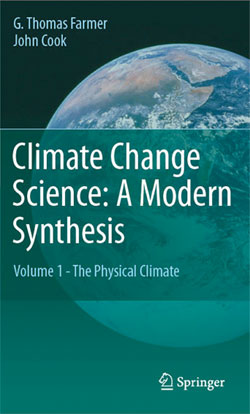 Around 2 years ago, I was honoured to be invited by geologist and long-time educator Tom Farmer to collaborate on a textbook that expounded on the principles of climate science as well as put climate change denial in perspective. That collaboration has now been published by Springer; the textbook is Climate Change Science: A Modern Synthesis (volume one of a two volume set).
The textbook is written for the introductory science student at the undergraduate college level. We describe the discipline of climate change science, and individual climate scientists whose expertise spans Earth history, geology, geography, biology, oceanography, astronomy, mathematics, physics, chemistry, engineering and more. We've attempted to cover a variety of the empirical evidence for and the effects of Earth's changing climate.
Significantly (and unique in climate textbooks to my knowledge), there is a detailed analysis of the phenomenon of climate change denial. Students learning climate science will need to put into proper context the myths and attacks on science conducted by those who deny the scientific consensus. One chapter is "Understanding Climate Change Denial", examining the social, psychological and rhetorical aspects of climate change denial. Another is "Rebuttals to Climate Myths" that debunks many of the most common climate myths (and yes, I made sure we adhered to the principles of the Debunking Handbook).
The book is available in hardcover and in e-book form (PDF format). You can also pre-order the hardcover from Amazon. You can find out more details including the full Table of Contents at the Springer website.
About the authors:
Tom Farmer has over 20 years of experience teaching environmental sciences at the undergraduate level, at the University of Virginia, University of Cincinnati, Northern Kentucky University and Howard University. He wrote the initial curriculum and taught Geology at James Madison University and served as Associate Editor for The Professional Geologist. He has published 3 books: Earth Materials and Earth Processes, The Groundwater Monitoring System and Hydrogeology at Love Canal and Peat Bogs and Hydrology in the Lake Superior Region.
John Cook is the creator of Skeptical Science, winner of the Australian Museum 2011 Eureka Prize for the Advancement of Climate Change Knowledge. He is currently a research fellow in climate communication at the Global Change Institute, University of Queensland. He co-authored the book Climate Change Denial: Heads in the Sand with Haydn Washington and the online booklet The Debunking Handbook with Stephan Lewandowsky.









I am half way through the text, including the last two chapters on climate denial. Though I have found distracting little errors and duplications, I want to know if this text is yet being used in an accredited university. If not, I am willing to provide financial help to the students of the professor that first uses it.
To #19 Bappleby13
I have tried to get information from our publisher on specific adoptions but have not yet succeeded. Springer says they can provide me with statistics from each region (state?) but not individual institutions. I find this difficult to believe. I will forward a copy of your kind offer and approach them in a different way in hopes of receiving the pertinent information. If you have a list of the "distracting little errors and duplications" I would appreciate receiving it at rockytom09@gmail.com. We are in the process of preparing for a 2nd edition for sometime in the near future, as soon as John and I complete Volume 2, "Earth's Climate History" and John finishes his MOOC and Ph.D.
Thank you for your submittal and offer. Tom
It is my sad duty to inform you that RockyTom AKA Tom Farmer has passed away after a long illness. It is my understanding that Volume 2 was about complete and I hope that Springer will allow the book to be published.
RIP rockytom