New temperature record for the Arctic in 2011
Posted on 27 January 2012 by Neven
NOTE: Reposted from Neven's blog post of the same name, via ClimateProgress from the WWF Climate Blog, this piece by Nick Sundt:
Last week NASA released data showing that last year temperatures in the Arctic rose beyond the record established in 2010 -- setting a new record for 2011. News of the record Arctic temperatures follows a series of alarming developments related to the Arctic in recent months.
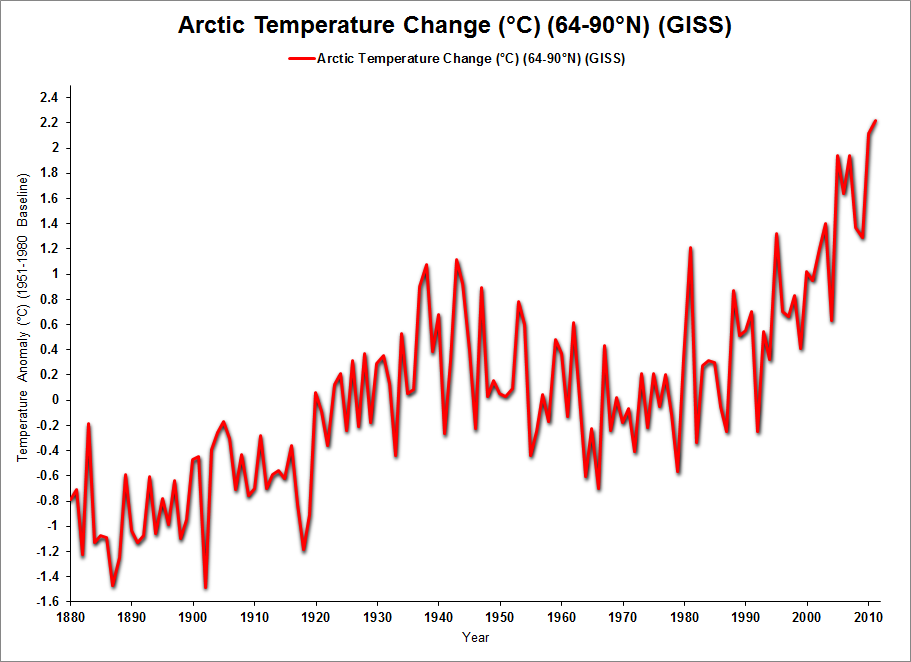
The surface temperature anomaly for the region extending from 64°N to 90°N, from 1880 through 2011, in degrees Celsius above or below the temperature during the 1951-1980 base period. The figures shows that temperatures have risen substantially since 1880 and that the rate of increase has been especially rapid since the late 1970s. Source: data from NASA Goddard Institute for Space Studies, Combined Land-Surface Air and Sea-Surface Water Temperature Anomalies, Zonal annual means (Click for larger graphic).
According to NASA's Goddard Institute for Space Studies (GISS), the annual mean surface temperature (land and air) for the region north of 64°N (the Arctic Circle is at 66° 33'N) in 2011 was 2.28°C above that which characterized the 1951-1980 period. Temperatures in the region have been rising rapidly since the late 1970s and have not dropped below the long term mean since 1992 -- nearly 20 years. This year's annual mean temperature broke the record that was just set in 2010, when the temperature was 2.11°C above 1951-1980 levels.
Continue reading here...
---
And as a bonus a cool video from NASA showing how that fresh water from Russian rivers got to the Beaufort Sea (a news item that popped up at several places last week):
NOTE: Researchers at Skeptical Science have audited the GISS data used to make the WWF graphic originally appearing in the source article for this blog post. The WWF graphic was found to be faithful to the source data and easily reproducible.

Arguments


The accumulated evidence from what’s happening to the planet’s ice and the ever-worsening news coming out of the Arctic show things have reached the point of being excruciatingly obvious but the politicians just continue to stare the other way. The “political” penny should have dropped so heavily about the vanishing ice and global temperatures that it registered above eight on the Richter seismic scale and caused a tsunami of appropriate action.
Instead, the denialists are reaching new heights of intentional misinformation, like this “analysis” of what’s happening in the Arctic I came across a couple of weeks ago.
“-------The Arctic ice extent is almost back to average, the Arctic has been doing nothing unusual, but they continue to pretend that the Arctic ice is dwindling. I wish they would try addressing the real world rather than their politically-biased fantasies”.
This beggars belief because not one single word is true, and manifestly so, starting with the absurd claim about the ice extent.
As for “the real world and politically-biased fantasies”, I’ll leave you to work out who’s really off with the fairies – that shouldn’t take very long.
http://nsidc.org/data/seaice_index/
Hopefully it'll get mainstream airtime soon.
Do not expect any political action. Brace yourself for the worst-case forecast being the mid-line of possible outcomes. You might as well tell the Conquistadors to stop looking for gold.
Yep, lovely. It appears the 'hiatus decade' started at +0.6C and ended above +1.5C. Anyone still saying warming has 'slowed down', 'paused' or whatever needs to explain this graph.
At Longyearbyen, Svalbard (close to 80 degs latitude), it is raining as we speak. On January 27th.
Average temp for the last 30 days is 17F above the normal:
http://www.yr.no/place/Norway/Svalbard/Longyearbyen/statistics.html
Temps have been way above normal for years, pretty much without getting any media coverage whatsoever. In mainland Norway, after a very warm autumn and early winter, a few days of normal January temps was obviously sensational enough to warrant pretty much the entire frontpage of the national newspapers: http://www.yr.no/artikkel/1.7967259
Pretty much no coverage of 4 months with way above normal temps, but slightly below freezing temps at the latitude of Labrador in January is first page news. The press here is mostly run by hardcore disinformers, so not too surprising, I guess.
I hope this isn't off topic but I would appreciate being pointed at an explanation of exactly how latent heat of melting (fusion?) fits into the whole warming pattern and which models it appears in and which it doesn't.
I assume that as ice melts for good and all that energy isn't 'used up' it isn't just albedo that decreases but there is a (major?) increase in the amount of heat being added to the system. Nobody seems to talk about this though.
Perhaps I am at such a low level of knowledge that everyone includes it as a constant or something but I'd appreciate the pointer.
The amount of heat that goes into melting ice is very small compared to the amount of heat that the ocean absorbs. This graphic has a small area at the bottom that includes the latent heat. It is not discussed very often because it is not a player in the major changes. If something like ocean currents starts to transport large amounts of heat to the Antarctic it could melt ice very quickly.
"At Longyearbyen, Svalbard (close to 80 degs latitude), it is raining as we speak. On January 27th.
Average temp for the last 30 days is 17F above the normal"
This has been my fear for some years, that ocean heat will rise up and rain down upon the ice sheets. Are there timely (radar?) images available showing arctic rain ?
Prof. Maurice Pelto wrote at 4:18 AM on the 28th of January, 2012:
"The increased open water and warmer air have sure impacted the glaciers on Arctic islands such as Svalbard and Novaya Zemyla"
Thank you. I would love pointers to more reports from the northernmost land areas such Franz Josef Land, Severnaya Zemlya, Ellesmere, and Peary Land.
sidd
The reduced albiedo of the water is another issue that contributes to Arctic amplification. Scientists are aware of the albeido change and it is considered in climate models. (I think the models have some trouble with this effect since they underestimate ice and snow loss). Keep reading and after a while it starts to fit together. Of course once all the Arctic ice is gone all that energy goes into the permafrost and Greenland.
“Climate Change in Arctic could Trigger Domino Effect Around the World,” International Business Times, Jan 30, 2011
Click here to access.
This in-depth article is based on a recently published paper by Professor Carlos Duarte, a leading scientist from The University of Western Australia.