



 Arguments







Carbon Cycle Feedbacks
Posted on 24 February 2011 by Andy Skuce
 The document entitled 'Carbon Dioxide and Earth's Future: Pursuing the Prudent Path', referenced in the "skeptic" scientist letter to US Congress, makes the claim that rising CO2 concentrations have "actually been good for the planet" because of the fertilization effect of CO2. Although it is true that there has been a measurable CO2 fertilization effect, particularly in the tropics (see this video seminar), this is only one factor that will influence the response of the global carbon cycle to climate change. It's instructive to look at some important factors that are not mentioned in The Prudent Path.
Sources of uncertainty
“Slow” feedbacks
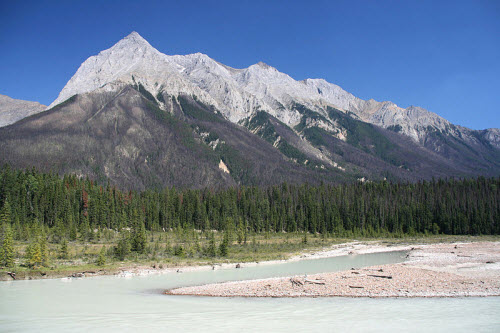
The net uptake of CO2 by the world’s forests may not last forever. Bark beetles, probably thriving due to warmer winters, have ravaged forests in Western Canada, as shown on the mountainside in the photograph above. Recent fires in Alaska and Canada (hat-tip) are increasing CO2 emissions and reducing the carbon content of the soils, which produces a weaker carbon sink because the trees grow back more slowly. In the Amazon Basin, severe droughts in 2005 and 2010 have severely damaged large parts of the rain forest, releasing huge quantities of CO2. All these effects are to some degree caused by climate change and, as the climate changes further, we can reasonably expect them to get worse and more widespread.
Another slow feedback is related to thawing of the permafrost and the release of the carbon contained within it. A recent paper by NOAA and NSIDC predicts that by the late 2020's the tundra will turn from a carbon sink to a carbon source and that, by mid-century, the permafrost will be releasing 1.5 billion tonnes of carbon per year; equivalent to today's net sink due the entire terrestrial biosphere. Much of the carbon will be released in the form of methane, which will amplify the greenhouse effect for decades compared to a release of a similar volume of CO2.
Last year, Natalia Shakhova and her co-workers reported extensive methane venting from sediments of the East Siberian Artic shelf. The rapidly warming Arctic climate is melting the permafrost layer below the shallow sea, making the layer permeable and releasing gas trapped below it.
How not to deal with uncertainty
Revealingly, the 130 pages of the Pursuing the Prudent Path document do not contain the words “beetle”, “fire”, or “permafrost”, even once. Tropical forests are discussed at length, but only in the context of the CO2 fertilization effect; no mention is made of the recent devastating droughts in the Amazon Basin. The Prudent Path document assumes that the CO2 uptake of the terrestrial biomass will continue indefinitely and even increase, whereas it avoids any consideration of the possible saturation of the fertilization effect or its limitations in promoting growth in temperate or boreal forests due to nitrogen fixation.
David Archer in his recently published primer The Global Carbon Cycle remarks that the reservoirs of carbon in plants and soils are as charged up today as they can possibly be. He also comments that, in the worst case scenario, elements of the carbon cycle may release as much carbon to the atmosphere as humans have. Uncertain though this is, it would obviously make climate change much worse. Some of the carbon cycle-climate feedbacks may have started already Surely, the worst way of dealing with uncertainties like these is to ignore them and hope they go away while we continue business as usual. The truly prudent path to follow is the one that takes account of all of the data.
Further information
This excellent video seminar given by Stephen Pacala at Stanford University is well worth watching to learn more about climate change, CO2 fertilization and the world's forest inventory. (hat-tip rustneversleeps)


 0
0  0
0 According to the BC Ministry of Forests, 16.3 million hectares of forest have been affected by pine beetle infestations. That's roughly the area of Austria and the Czech Republic combined. Map here.







Comments