



 Arguments







Stauning and Friis-Christensen on Solar Cycle Length and Global Warming
Posted on 22 March 2012 by Klaus Flemløse
In the scientific debate on global warming and the sun/cosmic rays relations, Friis-Christensen et al. have produced several fascinating and inspiring ideas. New and alternative ideas are always welcome and they deserve recognition for their contribution. Not all ideas have passed the test by the scientific community. However, it is clear that they have started a scientific debate and as well as a blog debate on solar influence and cosmic rays.
Friis-Christensen et al. investigated the relation between solar cycle length and global temperature in their 1991 paper. They found a close relation between solar cycle length and global temperature for the years 1850-1985. As I understand it, they have been doing a data mining exercise and found this relation. However, their result could not be supported by scientific evidence. Data mining is OK in some cases, but there is a risk to detect flawed relations. The result was consequently challenged by Peter Laut in 2003. Peter Laut has publicly criticized Friis-Christensen for adjusting data in an improper way. As a consequence there was a heated debate.
Recently P. Stauning has produced a paper where he has updated data and expanded same graphics, now from 1850 to 2005, and corrected the calculation errors of Friis-Christensen et al. The result of this update is that the close relation from 1850 through 1985 has stopped and from 1985 the solar cycle length curve and the temperature curve are diverging.
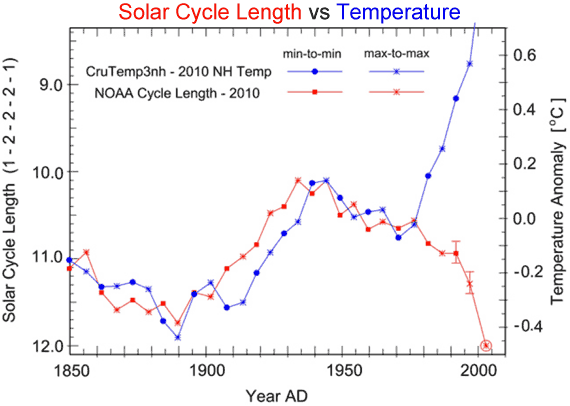
Figure 1: Solar cycle length (red) vs Northern Hemisphere temperature (blue) (Stauning 2011).The number of sunspots has a minimum and a maximum. The solar cycle length can be found in two ways. Either as the difference between two successive dates on which the number of sunspots show a minimum or as the difference between two successive dates on which the number of sunspots shows a maximum. The first number is indicated in the legend as “min-to-min” and the second as “max-to-max” in red color.The temperatures on the minimum dates and the maximum dates are indicated in the legend as “min-to-min” and “max-to-max” in blue color.
This shows that the hypothesis based on data mining - put forward by Friis-Christensen et al – had been falsified. There could be other explanations for a relation between global temperature and the sun, so the debate on sun/climate relations will continue, but one of the branches of sun/climate debate has now been cut off.
The Friis-Christensen (1991) paper has been used again and again by the climate deniers without any protest from Friis-Christensen et al. The paper by P. Stauning will hopefully prevent the deniers from using the Friis-Christensen graphs in the future.
The paper by P. Stauning is an investigation in general of the sun/climate relations and the Friis-Christensen case is only a minor part of his interesting paper. P. Stauning’s paper deserves attention from readers of Skeptical Science.
However, I would like to express my thank you to Friis-Christensen and his team for their contribution to climate science in the past. Hopefully he and his team will publish both verifications and falsifications in the future.
References:
Stauning,P (2011): Solar activity-climate relations: A different approach. J.Atm.Solar-Terr.Phys. 73, 1999-2012.
Laut,Peter (2003):Solar activity and terrestrial climate: an analysis of some purported correlations. J.Atmos.Solar-Terr.Phys 65, 801– 812
Friis-Christensen, E. Lassen (1991): Length of the Solar Cycle: An indicator of solar activity closely associated with climate, Science, New Series, Vol.254, 698-700









- SSL: I only know of this as Secure Sockets Layer
- EUV: Google suggests "Extreme ultraviolet lithography" or "European University Viadrina"
- SWAG: Google suggests "Scientific Wild Ass Guess" or "Stuff We All Get"
Will someone please throw me a lifebelt?[DB] Glossary functionality nears completion.
The misleading Friis-Christensen correlation is again presented by a german anthroposophic wannabe guru. No that the Fridays For Future movement gets attention, many deniers shoot counter attacks, blaming the activists to be manipulated.