





Stratospheric Cooling and Tropospheric Warming - Revised
Posted on 18 December 2010 by Bob Guercio
This is a revised version of Stratospheric Cooling and Tropospheric Warming posted on December 1, 2010.
Increased levels of carbon dioxide (CO2) in the atmosphere have resulted in the warming of the troposphere and cooling of the stratosphere which is caused by two mechanisms. One mechanism involves the conversion of translational energy of motion or translational kinetic energy (KE) into Infrared radiation (IR) and the other method involves the absorption of IR energy by CO2 in the troposphere such that it is no longer available to the stratosphere. The former dominates and will be discussed first. For simplicity, both methods will be explained by considering a model of a fictitious planet with an atmosphere consisting of CO2 and an inert gas such as nitrogen (N2) at pressures equivalent to those on earth. This atmosphere will have a troposphere and a stratosphere with the tropopause at 10 km. The initial concentration of CO2 will be 100 parts per million (ppm) and will be increased to 1000 ppm. These parameters were chosen in order to generate graphs which enable the reader to easily understand the mechanisms discussed herein. Furthermore, in keeping with the concept of simplicity, the heating of the earth and atmosphere due to solar insolation will not be discussed. A short digression into the nature of radiation and its interaction with CO2 in the gaseous state follows.
Temperature is a measure of the energy content of matter and is indicated by the translational KE of the particles. A gas of fast particles is at a higher temperature than one of slow particles. Energy also causes CO2 molecules to vibrate but although this vibration is related to the energy content of CO2, it is not related to the temperature of the gaseous mixture. Molecules undergoing this vibration are in an excited state.
IR radiation contains energy and in the absence of matter, this radiation will continue to travel indefinitely. In this situation, there is no temperature because there is no matter.
The energy content of IR radiation can be indicated by its IR spectrum which is a graph of power density as a function of frequency. Climatologists use wavenumbers instead of frequencies for convenience and a wavenumber is defined as the number of cycles per centimeter. Figure 1 is such a graph where the x axis indicates the wavenumber and the y axis indicates the power per square meter per wavenumber. The area under the curve represents the total power per square meter in the radiation.
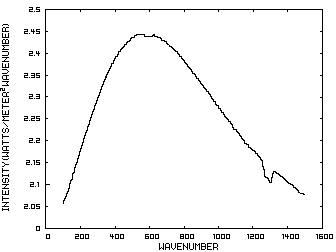
Figure 1. IR Spectrum - No Atmosphere
The interaction of IR radiation with CO2 is a two way street in that IR radiation can interact with unexcited CO2 molecules and cause them to vibrate and become excited and excited CO2 molecules can become unexcited by releasing IR radiation.
Consider now the atmosphere of our fictitious model. As depicted in Step 1 of Figure 2, N2 and CO2 molecules are in motion and the average speed of these molecules is related to the temperature of the stratosphere. Now imagine that CO2 molecules are injected into the atmosphere causing the concentration of CO2 to increase. These molecules will then collide with other molecules of either N2 or CO2 (Step 2) and some of the KE of these particles will be transferred to the CO2 resulting in excited CO2 molecules (Step 3) and a lowered stratospheric temperature. All entities, including atoms and molecules, prefer the unexcited state to the excited state. Therefore, these excited CO2 molecules will deexcite and emit IR radiation (Step 4) which, in the rarefied stratosphere, will simply be radiated out of the stratosphere. The net result is a lower stratospheric temperature. This does not happen in the troposphere because, due to higher pressures and shorter distances between particles, any emitted radiation gets absorbed by another nearby CO2 molecule.
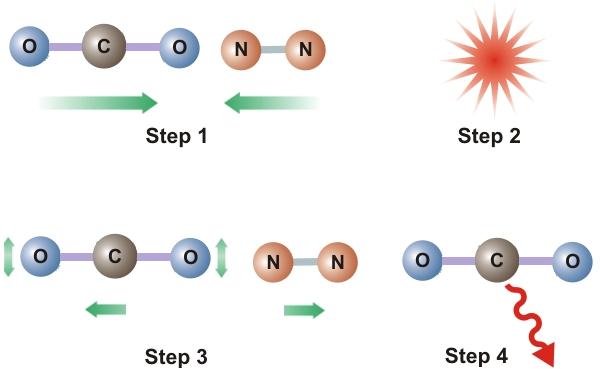
Figure 2. Kinetic To IR Energy Transfer
In order to discuss the second and less dominant mechanism, consider Figure 1 which shows the IR spectrum from a planet with no atmosphere and Figures 3 which shows the IR spectrums from the same planet with CO2 levels of 100 ppm and 1000 ppm respectively. These graphs were generated from a model simulator at the website of Dr. David Archer, a professor in the Department of the Geophysical Sciences at the University of Chicago and edited to contain only the curves of interest to this discussion. As previously stated, these parameters were chosen in order to generate graphs which enable the reader to easily understand the mechanism discussed herein.
The curves of Figures 3 approximately follow the intensity curve of Figure 1 except for the missing band of energy centered at 667 cm-1. This band is called the absorption band and is so named because it represents the IR energy that is absorbed by CO2. IR radiation of all other wavenumbers do not react with CO2 and thus the IR intensity at these wavenumbers is the same as that of Figure 1. These wavenumbers represent the atmospheric window which is so named because the IR energy radiates through the atmosphere unaffected by the CO2.
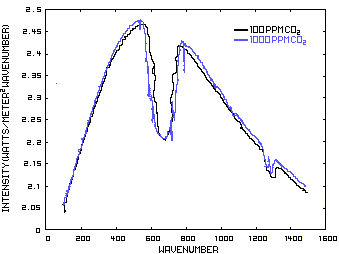
Figure 3. CO2 IR Spectrum - 100/1000 ppm
A comparison of the curves in Figure 3 shows that the absorption band at 1000 ppm is wider than that at 100 ppm because more energy has been absorbed from the IR radiation by the troposphere at a CO2 concentration of 1000 ppm than at a concentration of 100 ppm. The energy that remains in the absorption band after the IR radiation has traveled through the troposphere is the only energy that is available to interact with the CO2 of the stratosphere. At a CO2 level of 100 ppm there is more energy available for this than at a level of 1000 ppm. Therefore, the stratosphere is cooler because of the higher level of CO2 in the troposphere. Additionally, the troposphere has warmed because it has absorbed the energy that is no longer available to the stratosphere.
In concluding, this paper has explained the mechanisms which cause the troposphere to warm and the stratosphere to cool when the atmospheric level of CO2 increases. The dominant mechanism involves the conversion of the energy of motion of the particles in the atmosphere to IR radiation which escapes to space and the second method involves the absorption of IR energy by CO2 in the troposphere such that it is no longer available to the stratosphere. Both methods act to reduce the temperature of the stratosphere.
*It is recognized that a fictitious planet as described herein is a physical impossibility. The simplicity of this model serves to explain a concept that would otherwise be more difficult using a more complex and realistic model.
Robert J. Guercio - December 18, 2010

Arguments


1)What happens to the thermal IR radiation from the Earth's surface that is absorbed by CO2 in the troposhpere. Is it lost to N2 and O2 via collisional deactivation, increasing the kinetic energies of these molecules?
2)What is the CO2 concentration in the troposphere relative to the stratosphere?
2) The concentration relative to N2 and O2 is the same, ie, about 380 parts per million by volume. However, the atmosphere is much thinner in the stratosphere, so that there is much less CO2 overall.
"Now imagine that CO2 molecules are injected into the atmosphere causing the concentration of CO2 to increase. These molecules will then collide with other molecules....."
"...in the rarefied stratosphere will simply be radiated out of the stratosphere"
With this new higher conc. of CO2 then the stratosphere has actually become less rarified (is that right?), there's more CO2 around to absorpted IR. There must be more absorption of IR at this higher CO2 conc with a subsequent warming associated with that. In simple terms why are there more molecules to collide with each other but not more molecules to absorb IR?
One other question early on you write "The former dominates..." What do you mean by that? It's effect is the main cause of the cooling trend in the stratosphere?
If CO2 raises from 100 to 1000 ppMILLIONv ceteris paribus -even where the stratosphere 'is'- then it becomes "less rarified" by a factor of about 1.0009. Surely you understand that someone having total assets of 1000$ is poor and won't become rich when he has 90 cents more.
If that little bit more of IR gets absorbed at a lower altitude due to the extra CO2, this should raise its kinetic energy or that of the gases around it,... in which case the work is done and accounted for... end of story. How can it then do "double-time", going off and warming other things?
Thank you for taking the time to write this description. It is useful, but there are some minor errors that should be corrected.
I think CO2 is a linear molecule; Fig. 2 shows it bent like H2O.
Temperature is a measure of random energy. To be more precise requires a discussion of entropy, which is too much depth for this post. The random energy can be translational, rotational, vibrational or radiative. In a polyatomic gas (like CO2, O2 or N2) at low temperature, most of the random energy is translational and rotational kinetic energy. At higher temperature, a larger fraction of the energy is vibrational. That fraction depends on the characteristic energies of vibrations of the molecules that the gas contains. As figure 2 shows, collisions change translational energy into vibrational and vice versa.
A vibrating molecule is in an excited state. It can change to its unexcited state through a collision or by radiating the energy away as light. The characteristic vibrational energies of O2 and N2 are relatively high; they are not excited by collisions in earth's atmosphere. CO2's characteristic energy is lower. Its vibrations are excited by collisions in the atmosphere.
You may be mixing up radiative energy that is absorbed by an specific layer with all the radiative energy that crosses that layer. Similarly a sunbeam in the room warms the hand you interpose but not the air.
"How does a packet of energy that raises the troposphere's temperature, also raise the temperature of the Earth's surface or ocean waters?"
Are you trying quantum mechanics now? Is it the "same packet"?
You can see 3D visualizations of the different modes of the CO2 molecule, including bending mode, in my comment here.
The Yooper
Yes CO2 is linear, although, thanks to zero-point energy, it will be vibrating in all 4 modes, including the bends, even when "unexcited"; so maybe Roberts picture isn't too bad...
Great effort on a complex subject. I enjoyed the original thread, did a lot of thinking and learned a lot as a result. Putting the effects of UV heating of the stratosphere in a made it much easier for me to get my head around this - how about an intermediate version including temperature profiles & UV heating (greedy, I know).
Thanks for the comment about linearity. It's fixed. I reread the post and I think the verbiage pretty much agrees with what you said.
Bob
Thanks for the complement and I will start thinking about more blogs related to this.
Let's not forgot that I got a tremendous amount of help and input from you guys.
It's really a credit to the Skeptical Science website and forum members.
Thanks,
Bob
"How does a packet of energy that raises the troposphere's temperature, also raise the temperature of the Earth's surface or ocean waters?"
You're serious, aren't you ?
Can't you see the connection between air getting hotter ergo surface (land or ocean) getting hotter ?
Because the stratosphere isnt really warmed by terrestrial LW absorption. But through UV O2/O3 absorption, terrestrial LW does off set loses somewhat, but CO2 is emitting just under twice what it absorbs in the stratosphere.
Its a Q of path length, how opaque the atmosphere is to what wavelength. At the tropopause the path length in 15micron is already short enough that it basically just acts to transmit energy. This is a result of the reducing pressure, so for a given area(volume) there are less molecules than at a higher pressure.
Can't you see the connection between air getting hotter ergo surface (land or ocean) getting hotter ?"
In RSVP's world, if you lie on the ground at Death Valley you'll be just as cold as if you'd laid on the ground in the high desert ...
Not sure the 'step 2' diagram works??
My interpretation of that is some sort of fission explosion!
I guess without animation it's difficult to show a collision.
To an individual molecule acting electromagnetically, there is no 'up' or 'down', all direction are equal. Therefore it will radiate in all directions.
CO2 absorbs IR light and transfers much of this to surrounding molecules in kinetic energy (and at the same time collisions will pump energy back into the CO2, such that the output looks more like a greybody). All of these molecules will couple to the vacuum field and decay to lower energy states, emitting light.
Warmer temperatures mean more light, and more light going down heats the surface.
This is the basic pure radiative effect. There are other complicating factors, but this is the most important. It explains why there is so much longwave radiation coming down to Earth.
Work is done in an ideal gas by expansion. The tropopause has risen, so the troposphere has expanded, but unless it expands forever then it is not constantly doing work and therefore the flow of energy must be heat.
It does 'double time' because it's constantly receiving heat so it has to 'dump it'. Some light heats the molecules, they bump around warming other things which allows the heat to be dumped so that more IR can be absorbed. If it didn't do this, it would just increase in temperature forever and quantum physics/thermodynamics would be broken!
What are the rules for using online images? If I see an image that I like, how do I know whether or not I'm allowed to use it?
Thank you,
Bob
"By increasing the temperature of the atmosphere, you increase the amount of heat that it radiates "
The increase came from the thing you now say it is heating.
"It does 'double time' because it's constantly receiving heat "
By double time, I am referring to a single packet of energy. If it gets into the air via CO2,(coming from a hot stone on the ground), the hot stone has just lost that heat. That is not double time. That is heat transfer.
Copyright is a complicated issue.
Generally it is best to assume you can't use something unless it is stated you can. On the other hand, if someone wants to 'prosecute' to protect their copyright, it usually is a civil action, not a criminal one. Which means that the person/organisation who is protecting their copyright has to have the money to take legal action (they won't have state aid, criminal prosecutions are usually by the state).
But then again, there are fare use exceptions in the US.
In many places, if something is used in schools or colleges or in not for profit situations, then the owner may allow the use of the materials, but they usually state that the materials can be used in those situations.
You put a copyright notification on your own article, that implies you don't want anyone to copy it without you giving permission. BTW by default every piece of work is copyrighted, I don't believe the notice is required other a reminder to the reader.
Creative Commons licensing is a great new way of dealing with this sort of issue. The licenses allow as much or as little flexibility as you want.
CO2 is no different to a hot stone.
The stone is continually receiving packets of energy (during the day), as would the CO2. They both emit at the same time as absorbing, largely because they consist of billions of molecules at different states of excitation at any point in time.
They are both 'double timing'.
By this time you should know that answering RSVP by constructing an example based in his/her 'logic' to show any inconsistency would have you -as if by magic- as the proposer of such inconsistent arguments.
You should regard that comment #5 starts with an apparent connexion to the subject of the post. The not-possibly-multi-task packet is not in the post nor the idea it describes. It's something created as a particular person reads an article.
@ RSVP
What makes you think that the post is saying something like what you are describing in #5?
"The characteristic vibrational energies of O2 and N2 are relatively high; they are not excited by collisions in earth's atmosphere. CO2's characteristic energy is lower. Its vibrations are excited by collisions in the atmosphere."
Thus the more CO2, the more energy is lost via radiation.
"reducing the amount of surface-originated IR that stratospheric CO2 absorbs? Does this help explain the cooler stratosphere?"
The radiation depends only from the temperature. The absorption and convection replaced only the emitted energy.
Otherwise, the temperature profile can not be explained solely by the radiation, the convection is essential for the temperature gradient.
In the troposphere, the temperature gradient follows nearly alone from moist adiabatic vertical circulation.
Thanks for your response.
Actually I do want people copying and using it for any purpose as long as my name remains on it and my words are not plagiarized. I suppose what I need is a creative commons license.
How is this done?
Thanks again,
Bob
The Creative Commons site:
http://creativecommons.org/
I haven't used creative commons licenses, I would contact John Cook who has. Also consider discussing this on the forum??
http://spaceweather.com/
all clear in the stratosphere.
Because it seems to be along the lines of: To put confidence into a presentation at a conference funded by a petroleum-shill instead of work vetted in peer-reviewed publications by actual working climate scientists speaks volumes...
An analysis of Keen's other body of work can be found here.
The Yooper
"CO2 is no different to a hot stone"
The stone absorbs energy in the visible portion of the electromagnetic spectrum, CO2 does not (which accounts for it not being visible, unless cold enough to become dry ice).
The Ville #30
"The stone is continually receiving packets of energy (during the day), as would the CO2."
Most of this incoming energy is in the visible band, so the exchange you are talking about is favor of the stone getting a much larger share of it. And as far as the stone's cooling by radiating IR upward, the more CO2 above it, the bigger the sink for that IR.
Alec Cowen #31
"What makes you think that the post is saying something like what you are describing... "
The article states
"The interaction of IR radiation with CO2 is a two way street in that IR radiation can interact with unexcited CO2 molecules and cause them to vibrate and become excited and excited CO2 molecules can become unexcited by releasing IR radiation."
I mentioned dry ice and the article talks about an "unexcited CO2 molecule". The only unexcited CO2 molecule I can imagine is one at zero Kelvin. Dry ice forms way above that, and CO2 in its gaseous state is at a still higer temperature and generally speaking, excited. So the only thing that can happen if one CO2 dumps some energy to another is for both to get less excited (i.e. cooler).
"The result of increasing CO2 is an imbalance: solar energy is still arriving, but it's not leaving as fast."
If you douse a campfire with water, in order to quench it faster, do you pour more, or less water?
Normally the concern in such occasions is not how hot the water gets, but in any event, the more water you dump, the less it will warm on the whole. This is because the more water you dump, the more thermal mass you are providing for transfering heat from the embers and stones to the water.
Why doesnt this happen to CO2 as the concentrations increases? Afterall, isnt the amount of energy coming from the Sun the same?
"So the only thing that can happen if one CO2 dumps some energy to another is for both to get less excited (i.e. cooler). "
correction of my own post... One will get a little more excited, and the other a little less excited. However, the net temperature should remain unchanged.
"The only unexcited CO2 molecule I can imagine is one at zero Kelvin."
The most CO2 molecule be unexcited. The ratio unexcited CO2 molecule to excited CO2 molecule is given from Boltzmann-Distribution exp(-hv/(kT)).
"The stone absorbs energy in the visible portion of the electromagnetic spectrum, CO2 does not (which accounts for it not being visible, unless cold enough to become dry ice)."
You referred to a packet of energy, you did not refer to any particular flavour.
I suggest in future that you make it clear what on earth you are talking about and what you mean. For a start, what exactly do you mean by a packet of energy.
eg. if you want to be precise, then be precise, if you are talking about general principles then do so. But don't hide your intentions and play dumb games that you know are intended to disrupt without a view of making progress or helping others to understand.
If you are not interested in the subject then leave the classroom and sign up for another course.
Why not do the calculation yourself - what's the difference in heat capacity for an atmosphere with 560 vs 280 ppm CO2?
"By double time, I am referring to a single packet of energy. If it gets into the air via CO2,(coming from a hot stone on the ground), the hot stone has just lost that heat. That is not double time. That is heat transfer."
Firstly most people have a hard time decoding what on earth you are trying to convey and you return the favour to everyone hear by posting a number of replies by revealing more in a critical and patronising fashion.
In future, if you get a number of responses and don't get an answer consistent with what you were expecting. I suggest you actually clarify your original query.
RSVP said:
"Most of this incoming energy is in the visible band, so the exchange you are talking about is favor of the stone getting a much larger share of it. And as far as the stone's cooling by radiating IR upward, the more CO2 above it, the bigger the sink for that IR."
Indeed, does your ego feel better now?
"what exactly do you mean by a packet of energy."
As the context is electromagnetic radiation, and the exchange of heat from solids on the ground to CO2 molecules that make up the atmosphere, it is hard to understand where the obscurity lies.
My point has been fairly straightforward, but if I lost someone (and by the way, it seems odd you are so sure what others may or may not understand), I suppose it can be worded anew.
Let's see. If an IR "photon", energy packet, (however you want to call it) is emitted from a roof's slate shingle, and is captured by a CO2 molecule two feet away, has not the roof lost the energy, and the air gained the energy? And in losing this energy, has not the roof effectively "cooled"?
Now with this question, I am not attempting offend, bait, or work up my ego as you say. My intention is to simply point out what to me looks inconsistent with what is understood to be "global warming", a term which in itself is hiding something. Global "surface" warming?, global "atmospheric" warming?, global ocean warming???. Which is it?
Yes. The replies I have received so far are saying global "everything" warming, (even though of late, the idea that the stratosphere is cooling has come forward.) And these replies include nonsense about how CO2 in acting like an isotropic antenna is synergetically increasing the "Earth's" temperature. I would be nice if in these explanations it was clearly stated what exactly is warming, and how this actually happens. About the only accurate thing I read above was the words, "fictitious model".
stratosppheric ozone influences stratospheric temperature. This simple fact has been known for almost a century. But your figure is just for the arctic while the stratospheric cooling is seen on a global scale.
"stratosppheric ozone influences stratospheric temperature."
- But only very little





