





Wakening the Kraken
Posted on 23 April 2011 by Agnostic, Daniel Bailey
Methane (CH4) is an extremely potent greenhouse gas, 20-30 times more powerful than carbon dioxide (CO2) on a century timescale. Fortunately it normally occurs in very low concentration in the atmosphere – about 0.3 to 0.4ppm during glacial periods and 0.6 to 0.7ppm during warmer periods.
In 1750 the concentration was ~0.7ppm. By 2010 it had reached >1.8ppm, and is now at its highest level in 500,000 years. This is largely due to human activity, particularly the keeping of large herds of cattle and flocks of chickens and the production of fossil fuels. Methane has a relatively short life in the atmosphere where it oxidizes into CO2 over a period of 9-15 years.
Large amounts of methane are produced in anaerobic conditions by bacterial activity in the sediments below the seabed as well as by chemical transformation of organic matter at greater burial depths. Methane hydrates are formed by bonding with water to make an ice-like substance in certain temperature/pressure conditions that can be found at shallow water depths in polar regions. It yields 164 m3 of CH4 per m3 of solid clathrate.
Like Savoir Faire, Clathrates are seemingly everywhere
Clathrate occurs in the Antarctic and particularly in the Arctic where it is abundant in the relatively shallow though very cold seabed of the vast continental shelves which almost encircle the Arctic Ocean. It also occurs in the sea bed of warmer waters where they are of sufficient depth to enable it to remain stable.
Methane clathrate has accumulated below the seabed over millions of years. Billions of tons of it lie dormant beneath permafrost, in the pores of sandstones or shrouded in silt. As long as it remains under pressure or in cold conditions (below 0°C) it is stable and does not release methane.
We know that in the past there have been sudden changes in global warming associated with releases of greenhouse gases. These rapid, massive releases were characterised by unusual deficiency in carbon isotope 13 (∂13C ) and large extinction (30-50%) of water breathing animals, particularly Benthic species, most recently at the time of the Paleocene-Eocene Thermal Maximum (PETM) about 55.8 million years ago.
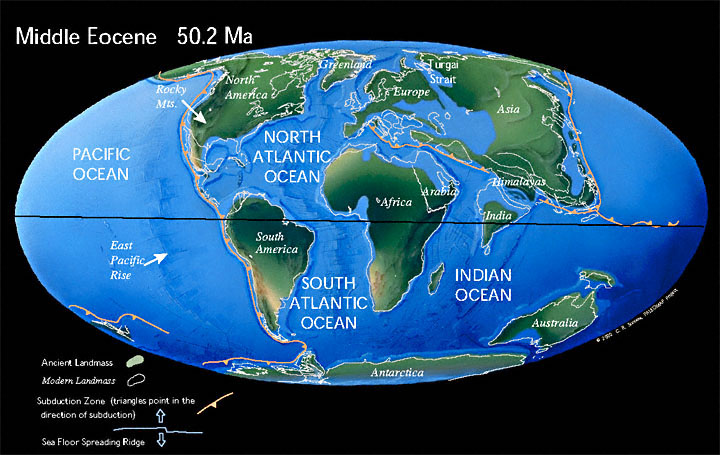
The world at the approximate time of the PETM (courtesy Christopher Scotese)
It is believed that the PETM was likely initiated by changes of the orbital parameters of the Earth (eccentricity, obliquity and precession of axis) causing an increase in the intensity and distribution of solar radiation reaching the earth (Sexton et al, 2011). This in turn, over many thousands of years, triggered natural climate change, amplified by CH4 releases characterised by a ∂13C deficiency.
A major difference between the PETM (Natural) and present (Anthropogenic) global warming is that the former was likely initiated by increased exposure to solar radiation causing carbon feedbacks and rapid global warming. The latter, geologically sudden increase is primarily caused by the on-going burning of fossil fuels, which yearly inject a massive bolus of CO2 in the atmosphere, initiating further carbon feedbacks.
Natural global warming is self-rectifying either by slow chemical weathering processes responsible for mineral sequestration of carbon or by gradual return of Earth’s orbital parameters to what they were before the onset of global warming, thereby significantly reducing the amount of solar radiation reaching the Earth’s surface. The result is cooling oceans able to gradually absorb and lower atmospheric CO2, enabling restoration of albedo at higher latitude/altitude, producing further slow global cooling. This explains why post-maximum temperatures are slow to fall. The mechanism for reducing anthropogenic global warming, initiated through radiative forcing of greenhouse gases, is to stop emissions and reduce their concentration in the atmosphere to levels which do not stimulate carbon feedbacks.
I know what you're thinking: Was it one shot or two?
Carozza et al (2011) find that natural global warming occurred in 2 stages: First, global warming of 3° to 9° C accompanied by a large bolus of organic carbon released to the atmosphere through the burning of terrestrial biomass (Kurtz et al, 2003) over approximately a 50-year period; second, a catastrophic release of methane hydrate from sediment, followed by the oxidation of a part of this methane gas in the water column and the escape of the remaining CH4 to the atmosphere over a 50-year period.
The description of Stage 2: Very rapid and massive release of carbon deficient in ∂13C, does put one in mind of the Methane Gun hypothesis. It postulates that methane clathrate at shallow depth begins melting and through the feed-back process accelerate atmospheric and oceanic warming, melting even larger and deeper clathrate deposits. The result: A relatively sudden massive venting ofmethane - the firing of the Methane Gun. Recent discovery by Davy et al (2010) of kilometer-wide (ten 8-11 kilometer and about 1,000 1-kilometer-wide features) eruption craters on the Chatham Rise seafloor off New Zealand adds further ammunition to the Methane Gun hypothesis.
It has been known for many years that methane is being emitted from Siberian swamplands hitherto covered by permafrost, trapping an estimated 1,000 billion tons of methane. Permafrost on land is now seasonally melting and with each season melting it at greater depth, ensuring that each year methane venting from this source increases.
Methane clathrate has accumulated over the East Siberian continental shelf where it is covered by sediment and seawater up to 50 meters deep. An estimated 1,400 billion tons of methane is stored in these deposits. By comparison, total human greenhouse gas emissions (including CO2) since 1750 amount to some 350 billion tons.
Significant methane release can occur when on-shore permafrost is thawed by a warmer atmosphere (unlikely to occur in significance on less than a century timescale) and undersea clathrate at relatively shallow depths is melted by warming water. This is now occurring. In both cases, methane gas bubbles to the surface with little or no oxidation, entering the atmosphere as CH4 – a powerful greenhouse gas which increases local, then Arctic atmospheric and ocean temperature, resulting in progressively deeper and larger deposits of clathrate melting.
Methane released from deeper deposits such as those found off Svalbard has to pass through a much higher water column (>300 meters) before reaching the surface. As it does so, it oxidises to CO2, dissolving in seawater or reaching the atmosphere as CO2 which causes far slower warming, but can nevertheless contribute to ocean acidification.
A significant release of methane due to melting of the vast deposits trapped by permafrost and clathrate in the Arctic would result in massive loss of oxygen, particularly in the Arctic ocean but also in the atmosphere. Resulting hypoxic conditions would cause large extinctions, especially of water breathing animals, which is what we find at the PETM.
Shakhova et al (2010) reports that the continental shelf of East Central Siberia (ECS), with an area of over 2 million km2, is emitting more methane than all other ocean sources combined. She calculates that methane venting from the ECS is now in the order of 8 million tons per annum and increasing. This equates to ~200 million tons/annum of CO2, more than the combined CO2 emissions of Scandinavia and the Benelux countries in 2007. This methane is likely sourced from non-hydrate methane previously kept in place by thin and now melting permafrost at the sea bed, melting clathrates, or some combination of both.
Release of ECS methane is already contributing to Arctic amplification resulting in temperature increase exceeding twice the global average. The rate of release from the tundra alone is predicted to reach 1.5 billion tons of carbon per annum before 2030, contributing to accelerated climate change, perhaps resulting in sustained decadal doubling of ice loss causing collapse of the Greenland Ice Sheet (Hansen et al, 2011). This would result in a possible sea level rise of ~5 meters before 2100, according to Hansen et al.
Evidence supports the theory that sudden and massive releases of greenhouse gases, including methane, caused decade-scale climate changes - with consequent species extinctions - culminating in the Holocene Thermal Optimum.
'Ware the Kraken
In summary, immense quantities of methane clathrate have been identified in the Arctic. Were a fraction of these to melt, the result would be massive release of carbon, initially as CH4 causing deeper clathrate to melt and oxidise, adding CO2 to the atmosphere. Were this to occur, it would greatly worsen global warming.
While natural global warming during the ice ages was initiated by increased solar radiation caused by cyclic changes to Earth’s orbital parameters, there is no evident mechanism for correcting Anthropogenic Global Warming over the next several centuries. The latter has already begun producing methane and CO2 in the Arctic, starting a feedback process which may lead to uncontrollable, very dangerous global warming, akin to that which occurred at the PETM.
This extremis we ignore - to our peril.
Errata
The above article refered to the PETM as an event marked by “massive extinction of animals”. Although there was “large extinction (30-50%) of water breathing animals, particularly Benthic species”, this is incorrect. The article has been modified from it's original form accordingly.

Arguments


http://en.wikipedia.org/wiki/Kraken
http://en.wikipedia.org/wiki/Kraken_in_popular_culture
The Kraken by Alfred Tennyson
Below the thunders of the upper deep;
Far far beneath in the abysmal sea,
His ancient, dreamless, uninvaded sleep
The Kraken sleepeth: faintest sunlights flee
About his shadowy sides; above him swell
Huge sponges of millennial growth and height;
And far away into the sickly light,
From many a wondrous grot and secret cell
Unnumber'd and enormous polypi
Winnow with giant arms the slumbering green.
There hath he lain for ages, and will lie
Battening upon huge seaworms in his sleep,
Until the latter fire shall heat the deep;
Then once by man and angels to be seen,
In roaring he shall rise and on the surface die.
Wasn’t the Holocene Optimum caused by Milankovitch cycles?
* Since CH4 is at least 100x more potent as a GHG than C02, the effect of CH4+C02 is the same as 570 ppm CO2 concentration.
* CH4 has a different absorption spectra than C02, and captures outgoing radiation in wavelengths where C02 is transparent (the C02 Window).
* CH4 is one of the main reasons why the 'CO2 effect is saturated' mime is irrelevant to discussions of Global Warming: releasing CO2 causes warming which causes the release of CH4.
* the abundance of Methane Clathrates exceeds that of atmospheric carbon by a factor of two. Over a hundred year time frame, CH4 decomposing to CO2 could take CO2 levels to 1,200 ppm WITHOUT us burning any more fossil fuels.
Normally I'd thank you for this piece, but I'm very much in denial over this one. :-(
Your data does not match my (limited) knowledge.
AFAIK, methane is some 20-30 times stronger than CO2 at present concentrantions, not 100+ times. (like the main post and Wikipedia say).
Yes, CH4 has a different absorption band than CO2 (which gives it all this GH potential), but the CO2 saturation argument dos not depend on CH4 emissions to be dismissed. Although CO2 cannot absorb any additional IR at 14um, it continues to increase absorption at wavelengths further and further away from this central frequency. (although, yes, with ever diminishing marginal impact per ppm added)
Your last point is an interesting one. Could you please explain the math used? Or maybe point to a reference?
A couple of points:
1: We've already raised the atmospheric concentration of greenhouse gases enough to cause over 2°C of global warming from fast feedbacks alone. We can't rely on short-term anthropogenic aerosol cooling to save us from that... and given the positive feedbacks we're already seeing from just 0.8°C of warming, it seems wildly improbable to me that 2°C won't be enough to trigger carbon cycle and albedo feedbacks which take the warming completely out of our hands.
2: Where the article says "...total human greenhouse gas emissions (including CO2) since 1750 amount to some 350 billion tons", is that figure measured in tons of carbon or tons of carbon dioxide? I think probably the former, as CDIAC says that we've put about 1.2 trillion tons of CO2 into the atmosphere since 1750, of which around half remains, with the rest being absorbed by natural carbon sinks.
It depends on the time frame used, since CH4 degrades to CO2. In shorter time frames, I have heard the 100x figure quoted. I note that the main article says "on a century timescale".
According to Modtran, 1 extra ppm of CO2 traps 9.4mW/m2, whereas 1 extra ppm of CH4 would trap 471mW/m2. That's 50x more, so I'd say the 100 figure can be discarded.
But that's not 20~30 times either, so maybe someone more knowledgeble can help us understand how that number is calculated. Probably it's the CH4 degrading to CO2 you've already mentioned - over a longer timescale it averages out to a smaller number. Would that timescale be one century?
"But that's not 20~30 times either, so maybe someone more knowledgeble can help us understand how that number is calculated."
The 30 times figure is arrived at as follows:
X = the reduction in outgoing longwave radiation if the concentration of CH4 increases from its present level of 2ppm to 3ppm.
Y = the reduction in outgoing longwave radiation if the concentration of CO2 increases from its present level of 380ppm to 381ppm.
X = 30Y
The reason for this is that the curve is much steeper at low concentrations than at high concentrations because at high concentrations the absorption bands are saturated.
Here is my reference:
http://chriscolose.wordpress.com/2008/11/10/methane-and-co2/
Results from DOE Expedition Confirm Existence of Resource-Quality Gas Hydrate in Gulf of Mexico:
A series of test wells in >6000' of water found what may be significant quantities of recoverable methane in hydrate deposits. Make that two sharp sticks: Combine drilling into an unstable substance in deep water, where you are entirely dependent on those subsea BOPs should something go wrong.
Exploration of methane hydrate and assessment of resources:
A summary of Japan's exploration program for hydrates; a more technical report available here (large pdf). They've apparently made at least one commercial discovery.
Hope this helps you Alexandre.
According to AR4 over 100 years methane has a warming potential of 25 times that of CO2 and 72 times that of CO2 over 20 years.
Thanks, it does help. So the timescale for the 25 figure is indeed those 100 years.
But I still don't understand that result I got with the Modtran. CH4 was just 50 times stronger there, and I assume it calculates just the immediate forcing, not averages over time. It should have shown something larger than that methane Global Warming Potential of 72 over 20 years I saw in your Wikipedia link.
Am I still missing something?
Strong positive feedbacks (not methane in the current theory, I believe, but CO2... although I'm not that well read on it) are a major and necessary factor to the Holocene Optimum. Milankovitch cycles started it but are not of and by themselves sufficient to begin or end a glacial period. CO2 was necessary to complete the transition.
To learn more search for "last glacial termination" on Google, and look for things like this paper: Denton et al (2010).
I've looked into this before, and while I don't remember all of the particulars, you did already touch on the important factors, which are that residence time, absorption band, and other factors all come into play.
Basically, the answer is that trying to come up with a single scalar value that represents "warming" potential for a substance is a fool's errand (well, not really a "fool's"... the task has value, but you have to understand the limitations of what you're trying to get).
Certainly it matters what current levels are, and what they're changed to, in both gases you are comparing.
Time frame matters.
Current opacity at various wavelengths matter.
So adding methane may be more powerful for the next ten years, for example, but not fifty years from now. Adding it to an already souped up CO2 atmosphere is more powerful than adding more CO2. Etc.
In the end, I think a simple scalar rating like that is like trying to rate the fastest car in a race. Some cars accelerate better, some corner better, and some have a higher top speed. Some can stay in the race longer without a pit stop. You can't just say "car #23 is faster than #52" because it depends on the track, the conditions, and the length of the race.
My understanding of the issue seems right, then. It's only those Modtran figures that don't match. Maybe I'm failing to interpret its results properly.
Ron #18
No, it's not the unit. Archer's Modtran uses ppm as well...
Anyway, thanks for the responses.
Methane too, can only be thought of as a powerful greenhouse gas because it is nearly in a logarithmic limit and you are starting from a low baseline concentration. If you were to compare the effects of two nitrogen/oxygen only (IR-transparent) atmospheres, but one with 100 ppm of CO2, and one with 100 ppm of methane, the CO2 atmosphere would generate more reduction in the outgoing radiation. This is because CO2 absorbs at wavelengths more well placed near the peak of the Planck function for a body at Earth-like temperatures. Thus, if that 100 ppm methane atmosphere was all oxidized into CO2 (and it stayed in the air), you would generate warming. The implication is that methane is not intrinsically a better greenhouse gas at all, it only looks more important in the current atmosphere when you compare a molecule-for-molecule increase between CH4 and CO2. This is important to keep in mind when looking at prospective greenhouses with relatively high abundances of methane.
Below the thunders of the upper deep;
:refers to the location of clathrates, usually a bit lower than the deeps of continental shelf, in Siberia however clathrates can form in shallower locations, but Tennyson doesn't know this
Far far beneath in the abysmal sea,
:again referring to the deepness of the layers, in 1830 there weren't to many deep sea explorations, maybe Tennyson was on a ship that did that?
His ancient, dreamless, uninvaded sleep
:personifying the clathrates, there's been at least 55 million since the last global clathrate gun reaction.
The Kraken sleepeth: faintest sunlights flee
:Maybe the ship Tennyson was in tried to measure the continental drop by dropping some light emitting stuff in the ocean.
About his shadowy sides; above him swell
Huge sponges of millennial growth and height;
:probably refers to the algae present on these locations that can be quite large, though they're not millennial creatures.
And far away into the sickly light,
From many a wondrous grot and secret cell
:this sounds more like some reef
Unnumber'd and enormous polypi
:that still has corals and stuff like
Winnow with giant arms the slumbering green.
:ocean fans, 'slumbering green' - ocean, Tennyson gets poetic ;-)
There hath he lain for ages, and will lie
:Back to 'Kraken' alias a singular methane clathratre deposit on the continental drop of Western Atlantic
Battening upon huge seaworms in his sleep,
:maybe they found some hagfish on the location?
Until the latter fire shall heat the deep;
:the reaction in the local deposit when their flaring probe hit the bottom.
Then once by man and angels to be seen,
:it must be quite an experinece to see a methane blow-out nearby.
In roaring he shall rise and on the surface die.
:the local deposit wasn't a big one and was triggered by the flare, not a current.
"massive extinction of animals, most recently at the time of the Paleocene-Eocene Thermal Maximum (PETM), about 55.8 million years ago."
"Resulting hypoxic conditions would cause large extinctions, especially of water breathing animals, which is what we find at the PETM."
In this year's Annual Review of Earth and Planetary Science, the authors claim that extinctions were pretty much limited to benthic forams. The ranges of other life forms were re-arranged. By which I mean "extensively and painfully" rearranged. But they survived. Apparently it is a misperception to assign mass-extinction to the PETM.
See also http://www.sciencedaily.com/releases/2011/04/110421161725.htm
The Paleocene-Eocene Thermal Maximum: A Perturbation of Carbon Cycle, Climate, and Biosphere with Implications for the Future
Fossil Sirenians, Related to Today's Manatees, Give Scientists New Look at Ancient Climate
Mark-US's linked source is on-topic. A preliminary read is interesting. I have some issues with parts of it, but reserve full judgement until I've had a chance to review it properly.
Open copy available here (for now, anyway).
Thanks, Mark!
The Yooper
[muoncounter] That link takes me to a blank scribd doc.
[DB] Sorry, muoncounter; I've checked it several times and it works for me. Dunno what to say.
I am not saying its not a threat, just not a guarenteed threat in the medium term.
Ergo, since it will still be in the far North I suspect it will still be called the 'Arctic Ocean'.
As to the likelihood of massive methane release. Still hard to say. However, it isn't just the clathrates we have to worry about. There is plenty of methane trapped in 'permafrost'... and there's some stuff which is definitely going to need a new name. 'Not so perma frost'? 'Formerly perma frost'? 'Expermafrost'?
i was on the loo with a back copy of the new scientist just today reading another possible reason for the PETM - massive methane release triggered by a spreading ripple from a pulse of magma - hot blob - from the geologic hotspot at iceland. pay to view but here is the chap proposing the main theory;
http://www.esc.cam.ac.uk/people/research-staff/bryan-lovell
In days of Oelde, it was once called Dûr Helcaraxë, the Grinding Ice. One might now refer to it as Aear Forodgalad, the Sea of Northern Lights. In Tengwar Quenya:
" There is a paper by Shindell et al., “Improved Attribution of Climate Forcing to Emissions“,
http://www.sciencemag.org/cgi/content/abstract/326/5953/716
This paper argues that methane is more potent than previously realised due to the interaction with black carbon. The paper gives a revised Global Warming Potential for methane measured over 100 years as 33. This is an increase of over 30% compared to the value of 21 given in the IPCC Second Assessment Report used for the Kyoto Protocol. Over 20 years. Shindell et al. calculate this GWP to be 105. If this measure were used the climate impact of methane (e.g. for Plan B above), it would be 5 times the value agreed at Kyoto."
As I have little scientific credibility, and have already posted on this subject before elsewhere, I have thought long and hard before commenting on your excellent article.
I have two criticisms.
1. I think that you have not distinguished enough between two possible nightmarish processes; the first that the clathrate stability zone begins to melt, at 50 metres depth, and thus 6 bars atmospheric pressure, releasing 168 x 6 litres of methane at surface pressure; the second, that the melting of the East Siberian shelf could then "uncap" much larger deposits of already gaseous methane.
In the second of these scenarios, the venting of a whole gasfield directly into the atmosphere would be possible. This may, or may not, be an event similar to the Storegga shelf collapse of approximately 8100 BC.
2. ...which brings me on to the Kraken - a scary beastie.
To digress slightly, high on the coastal hills of Eastern Japan, covered in lichen and moss, and almost completely forgotten until the last few months, when they have achieved a certain cyber-fame, there are a series of inscribed stones, which say something like "Please, children, do not build anything below this height. It is not safe."
This, in a written solid form, is an unmistakable warning from people who had seen a tsunami, and who cared about their descendants' fate. It is now clear that ignoring this advice was bad policy.
Akin to these concrete written warnings, I would suggest, there are numerous very old folk tales, oral traditions which were passed from mouth to mouth, that were perhaps the ancients' way of passing on essential survival information to their descendants. The treasure of the tribe, as described for example by Bruce Chatwin, in "The Songlines".
Many of these old tales concern floods and terrifying sea-monsters. I would suggest that these are precious ancestral heirlooms, which we ignore at our peril; and which may very often have their basis in real pre-historical events - the Thira eruption, the flooding of the Mediterranean basin, the flooding of the Black Sea, etc.
On the other hand, some are just the deranged ravings of a pack of Stone Age loons predicting events so far in the future, or so far beyond their actual comprehension, as to be entirely meaningless.
I am slightly discomforted by this Kraken, as I'm not sure enough of the corpus of Scandinavian myth to know which it might be... a folk memory of the awful Storegga tsunami; or a load of old bollocks about the end of it all.
It is easier for me to draw a distinction using classical Greek texts. I don't think there is much to be gained by invoking the stories of the patricidal Zeus usurping Chronos and all of that Gaia stuff out of Hesiod... This pertains to the gods, or God, or whatever.
Now, while I concede that we may already be completely fracked already, I still hope that we may yet be in the condition of the first recognisable human hero to arise from the sea of Greek myth: wily Odysseus. Who survives.
Despite picking a fight with the ocean, despite provoking the anger of the sun, and despite the various monsters he meets...
At any rate, I thought your article was excellent, and thought you'd also be amused to learn that your reference to the Kraken was the second I'd seen recently.
Try searching for "Kraken" on "The Onion"; still America's finest news source.
Strong atmospheric chemistry feedback to climate warming
from Arctic methane emissions
It's a very important result, IMO, which could provide a bridge from mild CO2 based warming to runaway methane and atmospheric chemistry change based greenhouse heating.
It's a very different atmosphere that they are talking about, with sustained methane release rates of 4 to 13 times those of today. Stratospheric water vapor and stratospheric hydroxyl radical increase, tropospheric hydroxyl radical decreases, and tropospheric ozone increases, leading to indirect warming several times that of the warming from methane itself.
It's particularly worrisome because this appears to be an honest result, resulting from a fair query of a state of the art atmospheric chemistry transport model.
If this work holds up, it may help explain the strong positive feedback of past apparent methane catastrophes including the Paleocene-Eocene Thermal Maximum and the End Permian mass extinction, I think.
Fitting a curve to the model results, and projecting that curve into the future, it appears that additional forcing of 70 W/m2, roughly the threshold needed to totally destabilize the climate, would occur somewhere between 350 and 2500 ppm of methane, depending on whether a polynomial or a linear curve fit is used.
Is this scientifically valid? No, this projects the results far beyond the data points predicted by the model.
But I believe it probable that for the first time the authors of the paper have discovered a mechanism which could truly totally destabilize the climate, and lead to a true global heating runaway greenhouse effect.
There does appear to be enough methane in the hydrates to do this, although estimates of total hydrate vary by at least an order of magnitude. There are several times as much carbon in the hydrates as is in the atmosphere at the current time, and atmospheric lifetime of methane is projected to increase greatly due to decline of tropospheric hydroxyl radical. Some experts project an 85% dissociation with bottom ocean temperature increases of 5 degrees C.
At 13 times current methane concentrations, the authors project a relatively huge radiative forcing of 5.4 W/m2. The project about 1.1 W/m2 from methane with it's current atmospheric lifetime of about 9 years. They project 2.1 W/m2 due to increase of atmospheric lifetime of methane, 1.1 W/m2 due to ozone increase, 0.9 W/m2 due to stratospheric water vapor, and 0.2 W/m2 due to increased CO2. Adding the direct and indirect effects together, they get 5.4 W/m2 for methane concentrations of about 23 ppm.
Fitting a curve to their results, and projecting it into the future, the additional 70 W/m2 necessary according to some experts to totally destabilize the climate is reached at methane concentrations of a few hundred to a couple of thousand ppm of methane.
I hope that other readers of Skeptical Science, and perhaps the owners of this site will look at this new atmospheric chemistry result, do some similar math, and let us know the results. I'll keep working on it, myself, too, and posting the results.
I hope that the authors of the model will query their model about the results of methane concentrations of hundreds of ppm, even if those results are not scientifically valid, to give the rest of us some indication of the probabilities of a true runaway destabilization of the climate.
A logarithmic curve fit with the data points generated by the above paper produces forcing of up to about 18 W/m2 and so temperature increases on the order of 14 degrees C.
This paper does not count forcing due to CO2 or water vapor not generated as a result of indirect atmospheric chemistry effects of methane, though. By the time we get to 14 degrees C increase in temperature, likely a lot of the CO2 dissolved in the oceans will be forced out- and that is a huge, huge amount of CO2.
At what point will the tropical oceans start to boil, adding potentially huge amounts of water vapor to the atmosphere?
It seems possible that we might see a series of additive logarithmic increases, starting with the logarithmic increase due to CO2.
Next, and stacked on top of that curve, could be a logarithmic curve due to methane and its indirect atmospheric chemistry effects.
Stacked on top of that could be a logarithmic curve due to huge increases in water vapor from boiling lakes and oceans.
It isn't bad enough that we might accidentally release carbon long sequestered in methane clathrates into the atmosphere.
Now we're going out and doing it deliberately.
On the other hand, for mining clathrates to be as bad as the spontaneous release of clathrates, near 100% leakage would need to apply, making the venture commercially unviable.
Currently we have the 'advantage' of dwindling supplies of conventional fossil fuels. Even coal wouldn't last much beyond 2100 if we continued to use it as a primary source of energy. Yet with developments like the Canadians finding cost effective ways of extracting oil from tar sands, the Russians pulling methane out of permafrost, the Japanese going after methane hydrates, and so forth, that equation is changing. If it continues along this line our only hopes of containing greenhouse warming may be responsible political leadership (I won't hold my breath) or the cost of renewable power dropping significantly below fossil fuel costs.
Arctic methane: Russian researchers report





