





Weather vs Climate: Watch the waves, miss the turning of the tides
Posted on 22 August 2010 by Jim Meador
This post is the Basic version (written by keepingitreal) of the skeptic argument "It's freaking cold".
It's easy to confuse current weather events with long-term climate trends, and hard to understand the difference between weather and climate. It's a bit like being at the beach, trying to figure out if the tide is rising or falling just by watching individual waves roll in and out. The slow change of the tide is masked by the constant churning of the waves.
In a similar way, the normal ups and downs of weather make it hard to see slow changes in climate. To find climate trends you need to look at how weather is changing over a longer time span. Looking at high and low temperature data from recent decades shows that new record highs occur nearly twice as often as new record lows.
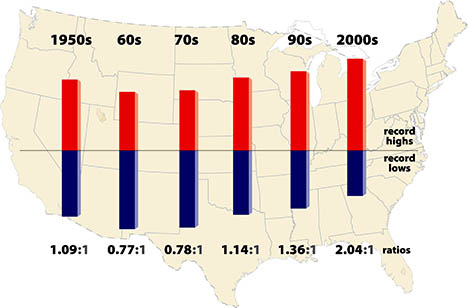
New records for cold weather will continue to be set, but global warming's gradual influence will make them increasingly rare.
Note: we're currently going through the process of writing plain English versions of all the rebuttals to skeptic arguments. It's a big task but many hands make light work. If you're interested in helping with this effort, please contact me.

Arguments


Three decades is far from long enough in determining either weather or climate trends when weather cycles have been identified where the rise and fall of the tides in a manner of speaking, takes 6 or 7 decades to complete both phases, in and out as it were, and reconstruction of El-Nino events indicate that perhaps any changes in the "tidal" frequency of them needs to be considered in terms of centuries.
However, identifying any trends will always be the easy part, understanding what any trends and cycles mean and why they occur is the hard part.
The tide analogy gives opportunity to consider whether the forces that drive the tides that affect even very small bodies of water, has what affect on the moisture suspended in the atmosphere?
OK, so look at a longer time span:
This was made from a recent GISSTemp release going back to 1880. The plateaus represent each time a new high or low (in the temperature anomaly) is set.
Hot summers (JJA average) continue getting hotter, but summertime lows don't get any lower; winter (DJF average) record lows don't get any lower than the -0.62 deg C anomaly from 1893.

This is a persistent pattern of setting records and hence not weather. Long term trend... increasing CO2?
"records in the chart above were not adjusted for UHIE"
We've heard that one numerous times. Satellite data show similar temperatures; is there also UHI in satellite data?
"too easily influenced by pacific ocean cycles"
If ocean cycles were a factor, 1998 would stand out like a sore thumb. Yet it is part of the whole. So that 'problem' won't fly either.
http://hallofrecord.blogspot.com/2007/03/us-extreme-temperatures-update.html) Since state records are often set at smaller stations, they are more immune to UHIE. Hence there are far more standing state records from the 1930's than any other decade.
New record high Winter anomalies were set in: 1882, 1889, 1901, 1914, 1926, 1944, 1980, 1981, 1983, 1988, 1995, 1998, 2002, and 2007.
The data clearly indicate that new global record highs are being set with increasing frequency while there hasn't been a new global record low in nearly a century.
As to UHI. No study showing that it has skewed temperature records has ever even been WRITTEN... let alone then stood up to scrutiny. Numerous studies of satellite, proxy, and non-urban temperature records have all shown results consistent with the established temperature series. In short, about the only thing which the UHI argument brings to the table is an easy way to identify people who are willing to take a claim with no substantiating data whatsoever as an excuse to ignore overwhelming evidence to the contrary.
This climate phase has allowed humans to thrive and flourish because it suits the temperature range we can live in comfortably and it suits the kind of plants that sustain life. Our kind of abundant life, not the kind of life that just survives in ice or fire or sitting atop an undersea volcano.
Your argument is about geology and time frames of many millions of years. We're concerned about biology and timeframes of centuries or millennia.
My post had the intention to support the previous one (posted by keepingitreal) on waves and tides.




